How to Get Rid of Rats in Your House
A practical rat-control guide for confirming activity, removing food and shelter, trapping strategically, closing entry points, cleaning safely and preventing new rat pressure.
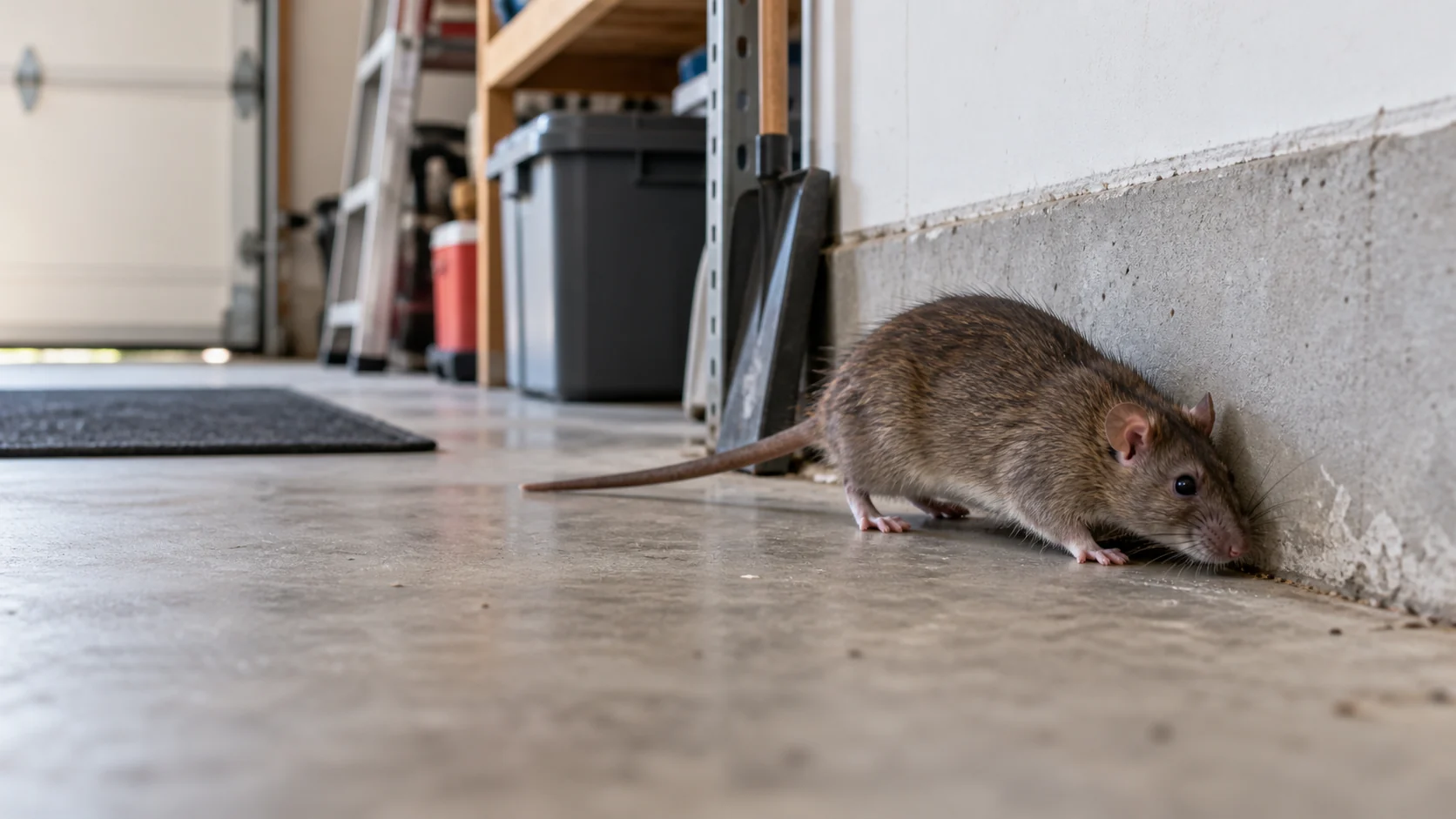
Getting rid of rats requires more than removing the first rat you see.
Rats can move between yards, foundations, crawl spaces, garages, attics, wall voids, kitchens, and other protected parts of a property. Some rats nest outdoors and enter a house for food or shelter, while others may establish themselves inside or beneath the structure.
A lasting solution usually requires several steps working together: confirm that the problem is rats, identify where they are traveling, remove food and water sources, trap rats already using the property, locate and close entry points, clean contaminated areas safely, and monitor for new activity.
This guide explains how to approach a rat problem from inspection through prevention.
First, Confirm That You Are Dealing With Rats
Rats and mice can leave similar types of evidence, but the scale is usually different.
Rats are substantially larger than house mice and typically leave larger droppings, heavier gnaw marks, larger tracks, and more obvious structural disturbance.
Signs that may point to rat activity include:
- larger rodent droppings
- heavy gnaw marks on wood, plastic, food containers, or other materials
- scratching or movement sounds in walls, ceilings, attics, or crawl spaces
- damaged food packages
- greasy marks along frequently traveled surfaces
- burrows near foundations, decks, sheds, or vegetation
- tracks in dusty areas
- strong persistent odors
- repeated sightings at night
- damaged exterior openings or vents
A direct sighting can also provide useful clues.
Norway rats tend to be heavier-bodied and are often associated with ground-level areas, burrows, basements, crawl spaces, and lower parts of structures.
Roof rats are more agile climbers and may use trees, fences, rooflines, attics, and upper portions of buildings.
Correct identification affects where you inspect and where control efforts should be concentrated.
For more help distinguishing rodents, use our identification section.
Find Where the Rats Are Active
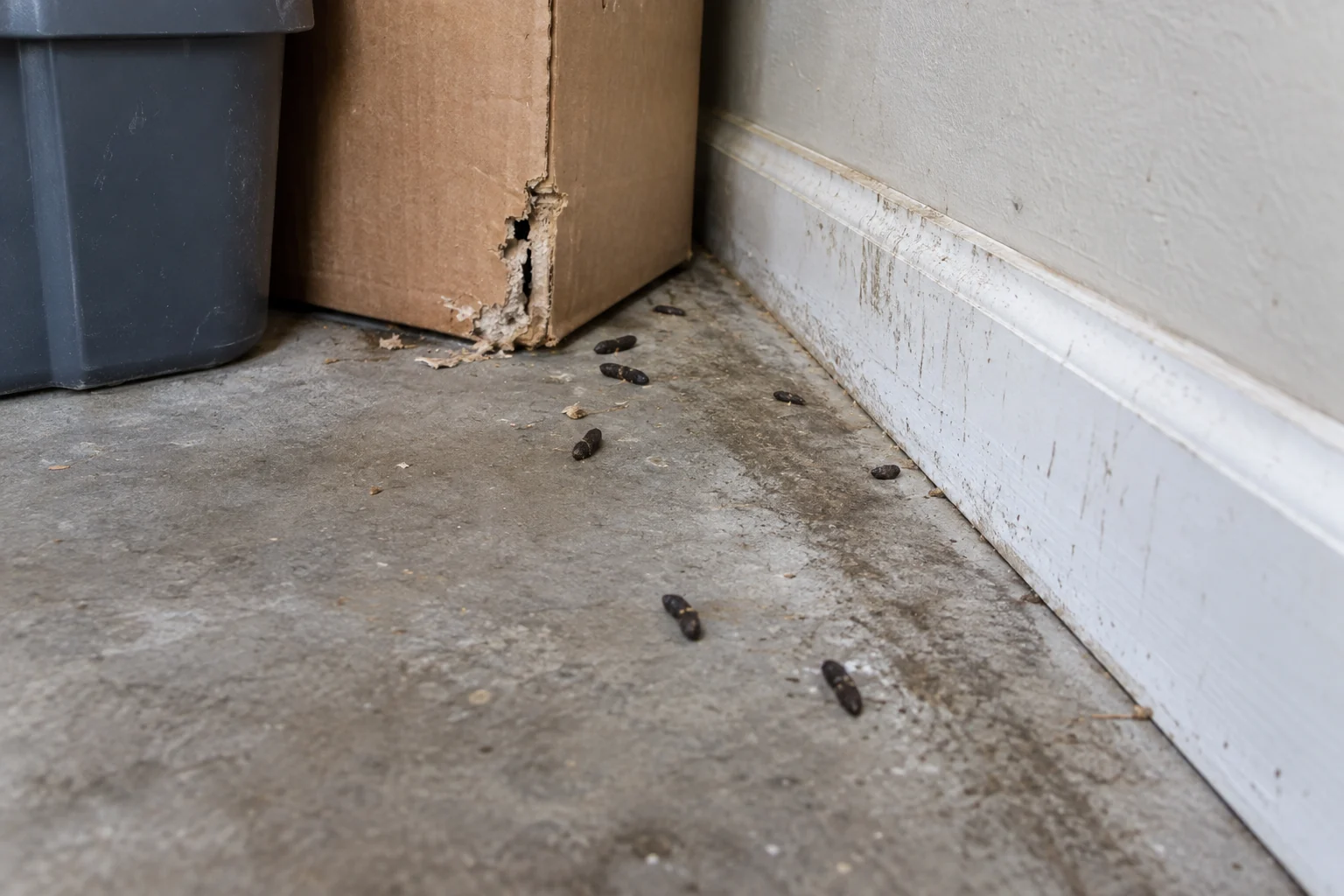
Before placing traps or repairing random openings, determine where rats are actually moving.
Inspect areas where you have found droppings, gnaw marks, damaged food, tracks, nesting material, or repeated noises.
Inside a home, important locations can include:
- kitchens
- garages
- basements
- crawl spaces
- attics
- utility rooms
- storage areas
- wall voids
- ceilings
- spaces behind appliances
- areas around plumbing and utility lines
Outside, inspect around foundations, decks, sheds, garbage storage, vegetation, fences, utility routes, roof access points, and other protected areas.
Rats often travel along edges rather than crossing exposed spaces unnecessarily.
Look along walls, fence lines, cabinets, pipes, structural edges, and other established routes.
The objective is to build a picture of the infestation.
Where are rats feeding? Where are they hiding? Where are they entering? Are they nesting inside the building or traveling in from outside?
Our rodent problem guides cover specific locations around the home in greater detail.
Look for Burrows and Exterior Rat Activity
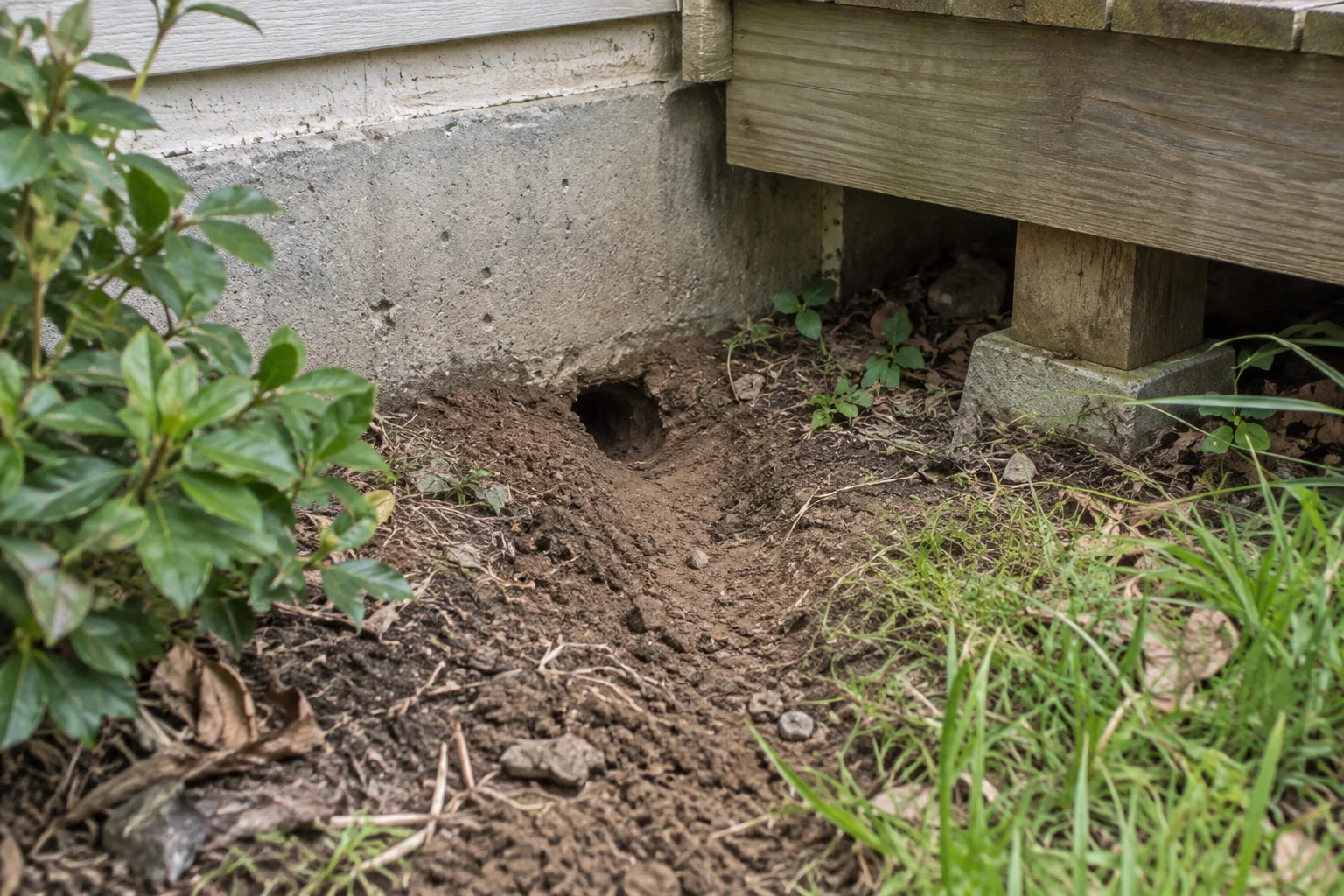
Some rat problems begin outside the building.
Ground-level rats may create burrows beneath or beside structures, particularly where there is protection from weather and disturbance.
Inspect areas around:
- foundations
- decks
- sheds
- stored materials
- dense vegetation
- garbage containers
- retaining structures
- exterior equipment
- other sheltered ground-level locations
A hole in the soil does not automatically prove that rats created it.
Look for additional evidence such as tracks, droppings, worn travel paths, gnawing, fresh soil disturbance, or repeated rat sightings.
If exterior activity is feeding an indoor infestation, dealing only with the rats inside the kitchen or garage may not solve the larger problem.
Remove Accessible Food
Rats remain around properties where reliable food is available.
Indoors, possible food sources include pantry products, pet food, food waste, crumbs, produce, and garbage.
Outdoors, rats may be attracted to garbage, animal feed, bird seed, fallen fruit, compost, pet food, or other edible material.
Store vulnerable foods in durable containers with secure lids when practical.
Keep garbage containers closed and correct damaged lids or containers that allow easy access.
Clean food residue around appliances, cabinets, storage areas, and other places that may not be disturbed often.
If pets are fed in an area with rat activity, avoid leaving unnecessary food available for long periods.
Removing food alone will not eliminate an established infestation, but it reduces the resources that allow rats to remain on the property.
Reduce Water and Shelter
Rats also need protected places to rest and nest.
Clutter, stored materials, vegetation, debris, cardboard, unused equipment, and poorly maintained storage areas can provide cover.
Water may come from plumbing leaks, condensation, outdoor containers, irrigation, pet bowls, drainage problems, or other moisture sources.
Focus on the areas showing activity.
Correct leaking plumbing where practical, remove unnecessary debris, improve access for inspection, and reduce protected hiding areas that make it difficult to see what rats are doing.
Outdoors, vegetation that touches or crowds the structure may also provide cover or climbing access.
These changes support trapping and exclusion rather than replacing them.
Use Rat-Sized Traps
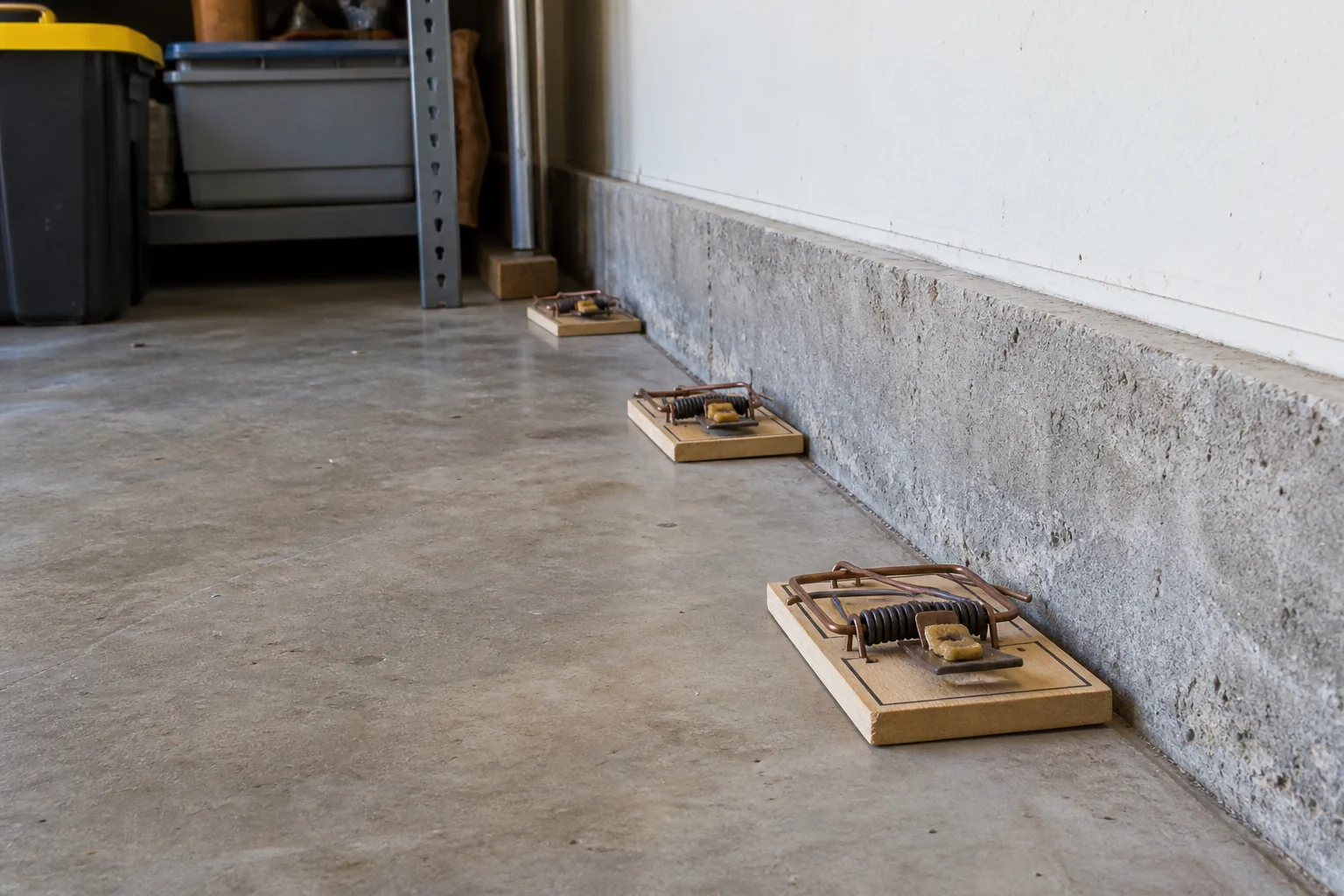
A trap designed for mice may not be appropriate for rats.
Use equipment intended for the size of the rodent you are trying to catch and follow the manufacturer's instructions.
Traditional rat snap traps can be effective when they are positioned along active travel routes.
Placement matters.
Rats commonly move next to walls and other edges, so useful trapping locations may include areas:
- along walls
- behind large appliances
- beside stored objects
- near burrows or suspected entry routes
- in garages
- in basements
- in crawl spaces
- in attics
- near areas containing fresh droppings or gnawing
Keep traps inaccessible to children and pets.
The goal is not to spread traps randomly across a property. Concentrate them where evidence shows rats are actually traveling.
For more detailed trap and treatment information, visit our rodent treatment section.
Rats May Be Cautious Around New Traps
Rats can be suspicious of unfamiliar objects placed in their environment.
This means a trap may not produce results immediately even when it has been placed on an active route.
In some situations, pre-baiting can help.
A trap can initially be baited without being activated, allowing rats to become accustomed to feeding from it. Once bait is being taken consistently, the trap can be set according to its instructions.
This is different from repeatedly moving traps around the property.
Constantly changing their location can make it more difficult to determine whether a particular travel route is active.
Watch the evidence around each trapping area and adjust placement when the activity indicates that another location is more important.
Use More Than One Trap When Activity Is Widespread
A single trap is unlikely to provide much coverage when rats are moving through several parts of a property.
If evidence exists in multiple locations, trapping should reflect those activity patterns.
Several correctly placed traps can help both remove rats and reveal which travel routes are most active.
Check traps regularly.
Continue looking for fresh droppings, tracks, new gnawing, disturbed food, or additional sightings.
Do not assume the infestation is over simply because one rat has been caught.
The important question is whether fresh rat activity continues.
Find How Rats Are Entering the House
Trapping addresses rats currently using the property.
Exclusion addresses the route that allows them to enter.
Inspect the exterior and interior for openings around:
- foundations
- exterior doors
- garage doors
- plumbing
- electrical lines
- utility penetrations
- crawl-space vents
- attic vents
- roof edges
- soffits
- damaged screens
- siding
- gaps around building materials
Also consider how rats reach those openings.
A roof-level entry point may be accessible from a nearby tree, fence, utility route, or attached structure.
A lower opening may connect directly to a crawl space, basement, wall void, or garage.
Follow the route rather than focusing only on the final visible gap.
Our prevention and exclusion guides cover rodent entry points and structural repairs in more detail.
Coordinate Exclusion With Rat Removal
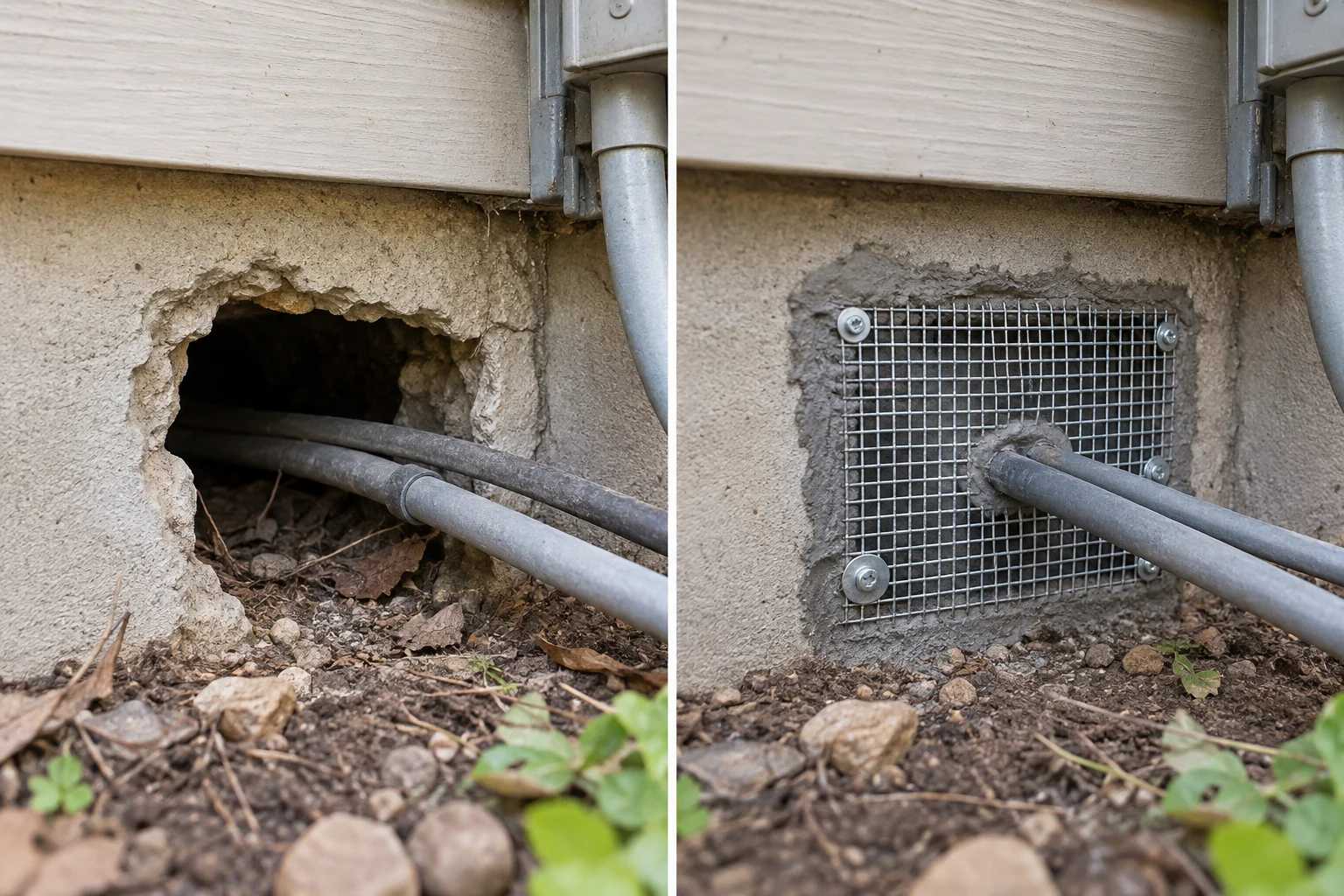
Finding an entry point does not always mean you should immediately close every opening without considering where the rats are located.
If rats are actively living inside a structure, poorly timed exclusion can leave animals trapped in inaccessible areas.
This can create additional damage, odors, or attempts to gnaw through another part of the building.
Instead, think of removal and exclusion as parts of the same process.
Trap and monitor active areas, identify the access routes, and close openings in a way that prevents new rats from entering without creating another problem inside the structure.
Complicated infestations may require professional inspection to determine the appropriate sequence.
What About Rat Poison?
Rodenticide bait may be used in some rat-control situations, but it should not be treated as a substitute for inspection and exclusion.
Pesticide products must be used exactly according to their labels.
Consumer rodenticide bait should remain secured in the bait station supplied or required for the product and must be placed where children and pets cannot access it.
Do not scatter loose poison around a home, attic, crawl space, garage, yard, or other area unless the specific product label allows that application.
There is also a practical issue with inaccessible carcasses.
A poisoned rat may die inside a wall, ceiling, attic void, crawl space, or another location that is difficult to reach, potentially leading to odor and cleanup problems.
If you are unsure whether a rodenticide is appropriate or how it can be used safely, professional pest control may be the better option.
Avoid Depending on Repellents Alone
People dealing with rats often search for products or household remedies that promise to drive rodents away.
Strong smells, ultrasonic devices, essential oils, and other repellents may sound easier than trapping and exclusion.
But moving a rat away from one corner of a room does not remove the infestation if the animal can simply move elsewhere inside the structure.
A rat problem is fundamentally about access, food, shelter, and established travel routes.
Prioritize methods that address those conditions directly:
inspection, trapping, sanitation, exclusion, monitoring, and professional intervention when needed.
Do not allow a repellent strategy to delay repairing a confirmed entry point.
Clean Rat Droppings Safely
Rodent droppings and contaminated nesting material should be handled carefully.
Do not dry sweep or vacuum fresh rat droppings, urine, or nesting material before it has been properly disinfected.
Wear appropriate protective gloves.
Wet contaminated material thoroughly with a suitable household disinfectant according to its label, allow the required contact time, and then wipe up the material.
Clean surrounding hard surfaces as appropriate and wash your hands after removing gloves.
More extensive contamination may require additional precautions.
Attics, crawl spaces, sheds, garages, HVAC-related areas, or heavily contaminated rooms can involve much more material than a few isolated droppings.
Our rodent cleanup section covers contamination, dead rodents, odor problems, and cleanup situations in more detail.
Continue Monitoring After Rats Disappear
Rat activity can become less visible before it is completely gone.
Continue checking traps and inspecting previously active locations.
Look for new:
- droppings
- gnaw marks
- tracks
- food damage
- burrow activity
- trap activity
- scratching sounds
- entry-point damage
Cleaning old evidence safely can make new evidence easier to identify.
As a practical benchmark, continue trapping and monitoring until there have been no captures and no fresh signs of rodent activity for at least a week.
If evidence returns, reconsider the areas you inspected.
There may be another entry point, nesting area, food source, or exterior population supporting the infestation.
How Long Does It Take to Get Rid of Rats?
There is no single timeline that applies to every rat infestation.
A small problem with one obvious entry route may be resolved much faster than rats established across a crawl space, attic, walls, yard, and garage.
Important factors include:
- number of rats
- location of nesting areas
- access to food and water
- number of entry points
- size of the property
- trap placement
- exterior rat activity
- structural repairs required
Rats can also be slower than mice to approach unfamiliar traps, so lack of immediate trap activity does not automatically mean that rats are gone.
Judge progress using several types of evidence rather than sightings alone.
Common Rat-Control Mistakes
One of the biggest mistakes is treating rat control as a single-product problem.
Catching one rat while ignoring an open foundation gap may lead to another rat entering later.
Sealing a single hole while leaving garbage, bird seed, or another accessible food source may shift the activity without eliminating it.
Other common problems include using undersized traps, placing traps away from travel routes, constantly moving traps, stopping too soon, overlooking exterior burrows, and ignoring upper-level entry routes when climbing rats are involved.
A better approach connects each part of the problem.
Identify the rat, locate activity, remove accessible resources, trap strategically, repair entry points, clean safely, and monitor the property.
When Should You Call a Professional Rat-Control Company?
Some rat problems can be handled by homeowners, particularly when activity is limited and entry points are easy to identify.
Professional help becomes more valuable when the infestation involves structural complexity or repeated activity.
Consider professional rodent control when:
- rat activity continues despite sustained trapping
- rats are established inside walls or ceilings
- an attic or crawl space is heavily contaminated
- there are multiple suspected entry points
- exterior burrows are widespread
- you cannot determine whether roof rats or ground-level rats are involved
- rats repeatedly return after DIY control
- repairs require access to difficult parts of the building
- rodents are associated with HVAC or other sensitive systems
- children or pets make safe device placement difficult
A useful professional inspection should look beyond the rat itself.
It should evaluate travel routes, structural openings, food and shelter conditions, contamination, and the potential for reinfestation.
Visit our professional rodent-control section for information about inspections, removal, exclusion, and professional treatment.
Prevent Rats From Coming Back
Once active rat pressure has been reduced, long-term prevention becomes the priority.
Continue maintaining the areas that initially attracted or admitted rats.
Keep garbage secure, protect stored food and animal feed, address leaks, reduce exterior debris, maintain doors and screens, and periodically inspect foundations, rooflines, vents, and utility penetrations.
Watch both the ground and the upper parts of the property.
Rats can exploit very different routes depending on species and building design.
Vegetation, fences, decks, attached structures, garages, and utility routes can all affect how rats reach a home.
Repairs should also be checked over time.
Weather, construction work, plumbing repairs, landscaping, and normal building movement can create new openings after an infestation has been eliminated.
The Best Way to Get Rid of Rats Is to Remove the Cause
A rat infestation is rarely solved permanently by catching a single animal.
The more reliable approach is to understand the entire system that allows rats to use the property.
Confirm that rats are present, locate their travel routes and nesting areas, reduce food and water, trap rats already using the home, identify and repair entry points, clean contaminated areas safely, and keep monitoring for new activity.
When those steps are combined, you are addressing both the rats you can see and the conditions that allowed them to become established.
Use our signs guides to investigate evidence, problem guides to locate rat activity around the home, prevention section for exclusion, treatment section for control methods, cleanup section for contaminated areas, safety section for rodent-related risks, and professional section when the infestation requires additional help.
For the broader national guide to rats, mice, identification, prevention, and home rodent control, return to [Rats & Mice in the Home](/).