Rat vs Mouse: How to Tell the Difference
Learn how to compare rats and mice using body size, proportions, droppings, tracks, gnaw marks, nesting areas, sounds and activity patterns around the home.

Rats and mice are both rodents, and the evidence they leave behind can look similar at first. But they differ in body size, proportions, droppings, tracks, behavior, nesting habits, and the parts of a home they are most likely to use.
Correct identification matters because the best inspection and control strategy depends on the rodent involved. A trap sized for a mouse is not the right tool for an adult rat, and a ground-level Norway rat problem may require a different inspection pattern than roof-rat activity in an attic or upper wall.
If you only caught a brief glimpse of the animal, do not rely on that sighting alone. Combine several clues: body shape, droppings, gnaw marks, footprints, travel routes, noises, and where activity is concentrated.
This guide explains the most useful differences between rats and mice in and around U.S. homes.
Rat vs Mouse at a Glance
The easiest difference is overall size.
Adult rats are much larger and heavier than adult house mice. Mice have smaller bodies, relatively large ears, pointed faces, and thin tails. Rats have heavier bodies, larger feet, thicker tails, and more powerful jaws.
A quick comparison:
- mice are much smaller overall
- rats leave larger droppings and tracks
- mouse ears look large compared with the head
- rat feet are noticeably larger
- mouse tails are thinner
- rat tails are thicker and more robust
- rats create heavier gnaw damage
- mice can use smaller structural openings
- some rat species are strongly associated with ground-level areas
- other rat species are excellent climbers and may use attics and rooflines
These differences become more useful when combined with the location of the activity.
For broader species information, visit our rodent identification section.
Size: Rats Are Much Larger Than Mice
Size is usually the fastest way to separate an adult rat from an adult mouse.
A house mouse has a compact body and looks delicate compared with a rat. Its head, feet, and body are all much smaller.
An adult rat is substantially more robust. Even a quick sighting often reveals a heavier body, larger feet, and a thicker tail.
The difficulty comes when the animal is young.
A juvenile rat can sometimes be mistaken for a mouse because it has not reached adult size. In that situation, body proportions become more useful than size alone.
A young rat tends to have relatively large feet and a heavier-looking head and body than a house mouse of similar length.
If the animal disappeared before you could judge size, look for droppings, tracks, or gnaw marks instead.
Face and Head Shape
Mice usually have a more pointed face.
The head narrows toward the nose, giving many mice a triangular profile when viewed from above or from the side.
Rats generally have a broader, heavier head.
There are differences between rat species, but a rat typically looks more substantial through the skull and muzzle than a house mouse.
The face can be useful in photographs or clear sightings, but it is not always easy to judge when an animal is moving quickly through a dark room.
Use head shape together with the ears, feet, and body size rather than depending on one feature.
Ears: Mice Often Look Larger-Eared

House mice have ears that appear relatively large compared with the size of the head.
That does not mean their ears are physically larger than a rat's ears. The important clue is proportion.
On a mouse, the ears can look prominent and oversized for such a small animal.
A rat's ears usually appear smaller in relation to its heavier head and body.
Roof rats and Norway rats also differ from one another, so ear size should be treated as one identification feature rather than a stand-alone test.
Tail Differences
Both rats and mice have long tails, but they do not look identical.
A mouse tail is usually thin and delicate compared with the body.
Rat tails are thicker and stronger-looking.
Tail length also varies by rat species. Roof rats tend to have a tail that is relatively long compared with the body, while Norway rats generally have a shorter tail relative to their heavier body.
Because tails are often hidden during a quick sighting, this clue is most useful when you have a clear photograph, trapped specimen, or extended view.
Do not identify a rodent based on tail length alone.
Feet and Tracks
Rats have much larger feet than mice.
This difference can be especially useful when you find tracks in dusty areas, garages, crawl spaces, attics, or around stored materials.
Mouse footprints are small and may be difficult to see unless the surface holds fine dust.
Rat tracks are larger and can show more obvious toe and foot impressions.
You may also see a tail mark between or beside footprints if a rodent moved across a dusty surface.
Track size, spacing, and direction can help identify active travel routes even when you never see the animal itself.
Our signs section covers tracks and other evidence left by rodents.
Mouse Droppings vs Rat Droppings
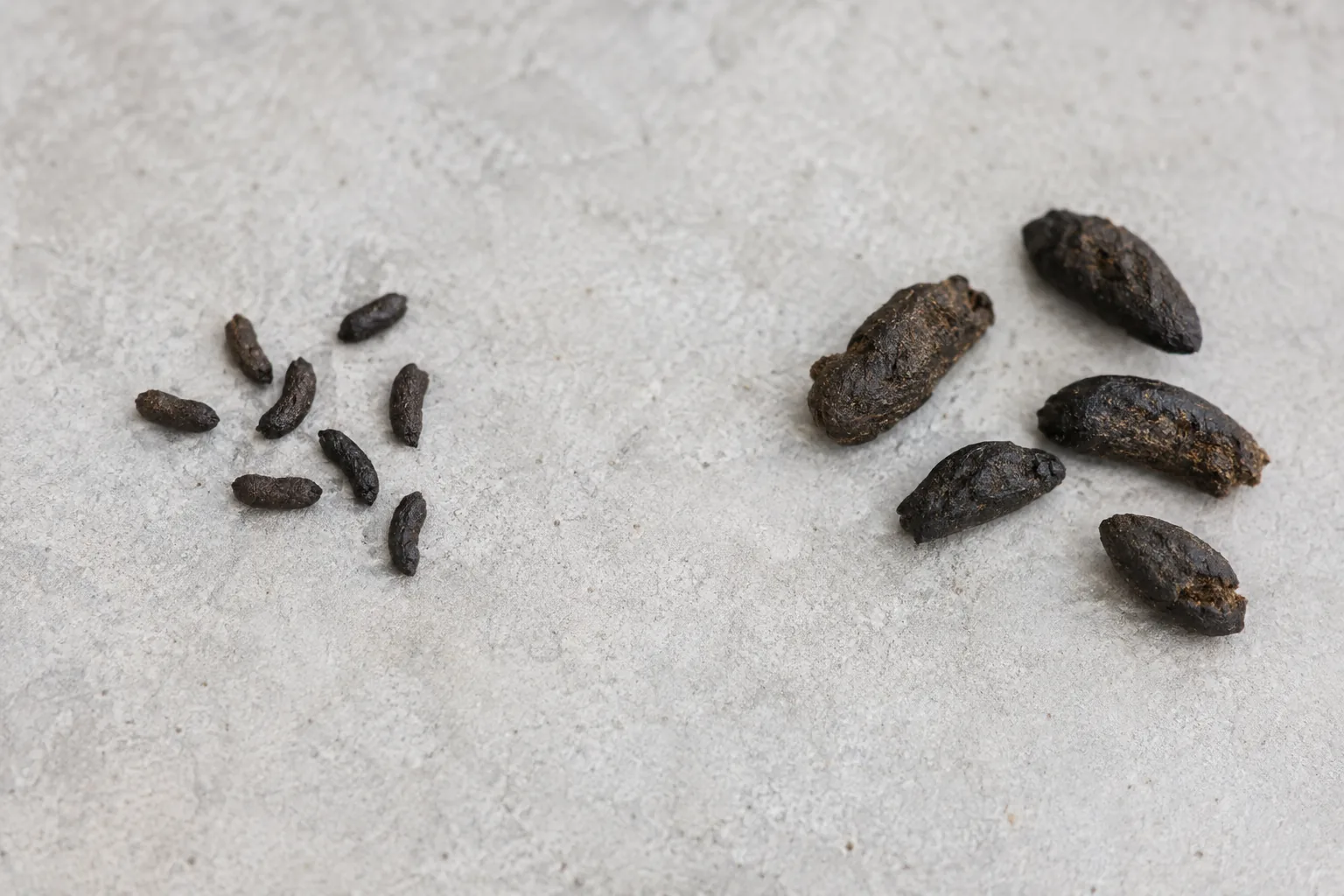
Droppings are one of the most common clues homeowners find.
Mouse droppings are small and dark, often resembling tiny grains or narrow pellets.
Rat droppings are noticeably larger.
The exact shape of rat droppings can vary depending on the rat species, age, diet, and condition, but the size difference between typical mouse and adult-rat droppings is usually significant.
Do not handle rodent droppings with bare hands.
Also avoid dry sweeping or vacuuming fresh rodent droppings before they have been properly disinfected, because that can disturb contaminated material.
When identifying droppings, consider:
- overall size
- quantity
- where they are concentrated
- whether they appear fresh
- nearby gnaw marks or tracks
- the size of openings or travel routes nearby
A pile of small droppings inside a kitchen cabinet points toward a different scale of rodent than large droppings found along a garage wall or near a crawl-space opening.
Gnaw Marks and Damage
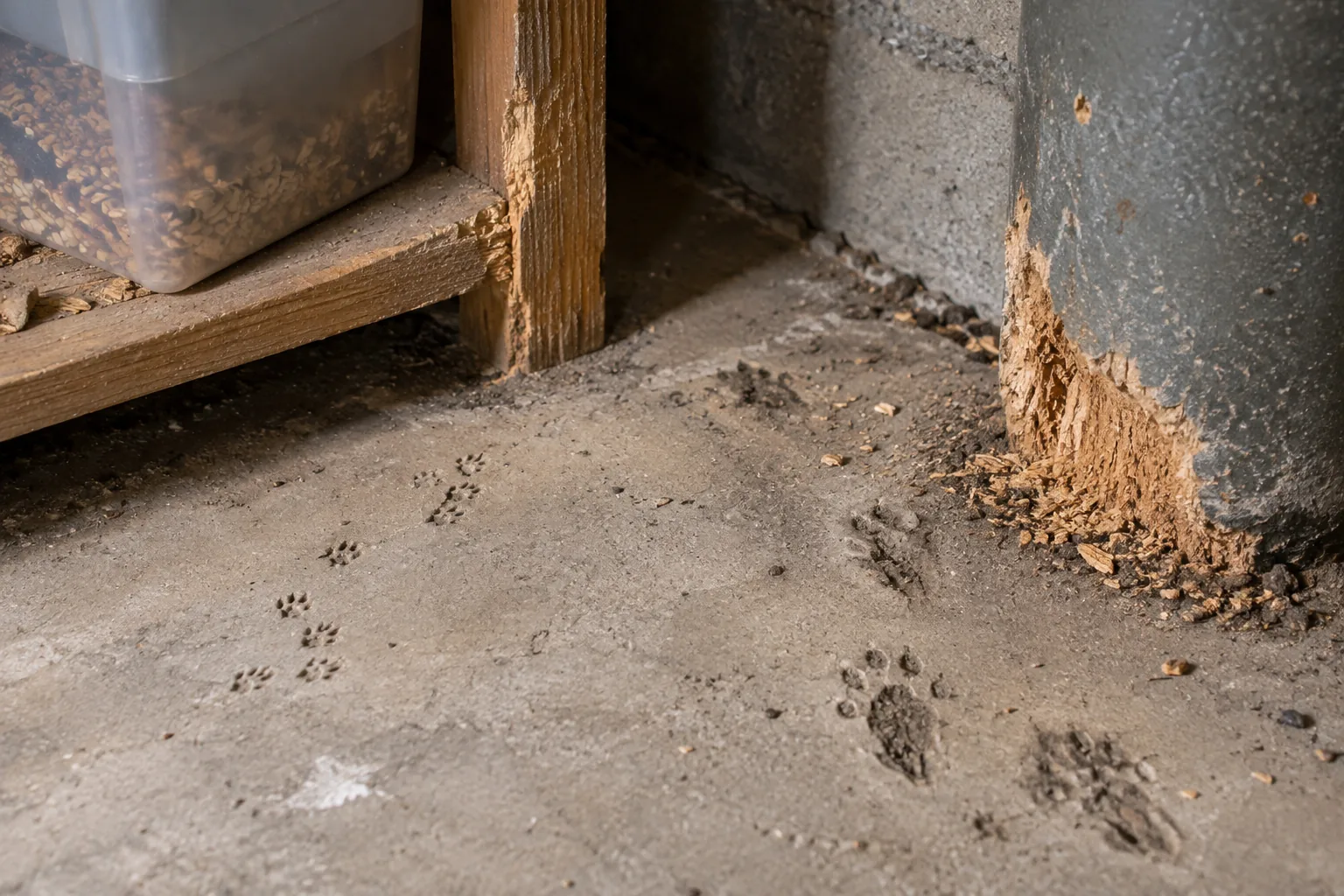
Both rats and mice gnaw.
Their front teeth grow continuously, so gnawing is a normal part of rodent behavior.
The difference is usually scale.
Mouse gnaw marks are smaller and may appear on food packaging, thin plastic, cardboard, small wood edges, or other accessible materials.
Rat gnawing can be much heavier.
Rats may damage thicker plastic, wood, storage containers, structural materials, and other objects that require more force.
The presence of gnawing does not automatically identify the species, but the size and severity of the damage can help.
Combine gnaw marks with droppings and tracks whenever possible.
Where Mice Commonly Live in a House
House mice are highly adapted to living close to people.
They may establish nests inside:
- wall voids
- cabinets
- pantries
- storage rooms
- garages
- attics
- insulation
- closets
- spaces behind appliances
- other small protected areas
Because mice need relatively little space, they can remain close to food and shelter without traveling far.
This is one reason mouse activity can sometimes be concentrated in a small part of a house.
A kitchen or pantry problem, for example, may involve mice nesting in a nearby wall or cabinet void.
For location-specific issues, use our rodent problem guides.
Where Rats Commonly Live
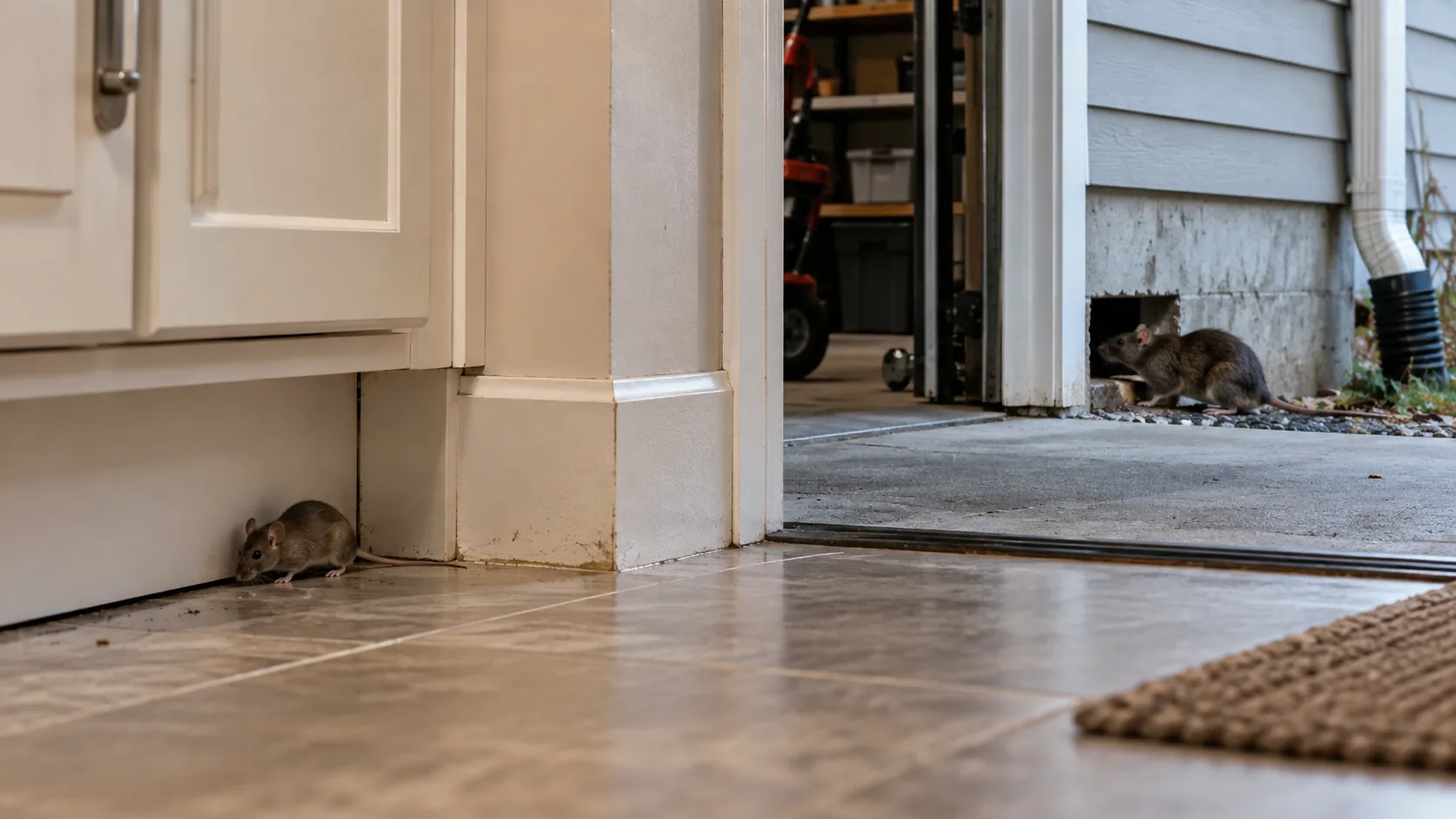
Rat behavior depends heavily on species.
Norway rats
Norway rats are strongly associated with ground-level and lower structural areas.
They may use:
- burrows
- crawl spaces
- basements
- garages
- foundation areas
- spaces beneath decks
- lower wall voids
- outdoor sheltered areas near buildings
A Norway rat problem may involve animals nesting outdoors and entering the house through lower structural openings.
Roof rats
Roof rats are strong climbers.
They may use:
- attics
- rooflines
- upper wall voids
- trees
- fences
- overhead utility routes
- elevated storage areas
- upper portions of garages or sheds
This is why the location of activity can be an important clue.
Large rodents moving through an attic or upper roof area may suggest a different rat species and access route than large rodents using burrows around a foundation.
Mouse Holes vs Rat Entry Points
Mice can exploit smaller openings than rats.
That does not mean every tiny gap is actively being used, but mouse control often requires a very detailed inspection of small construction gaps.
Common mouse entry areas include openings around utility penetrations, garage doors, siding, foundations, doors, vents, and other building joints.
Rats generally require larger openings, but they are powerful enough to exploit damaged materials, broken vents, larger utility gaps, door openings, foundation defects, and roofline access points.
The surrounding evidence matters.
A small opening with tiny droppings and light gnaw marks suggests something different from a larger damaged opening with heavy grease marks or large droppings.
See our prevention section for rodent entry-point and exclusion guidance.
Rat Sounds vs Mouse Sounds
Both rats and mice can create scratching, rustling, or movement sounds inside a structure.
The difference is not always clear from sound alone.
Mice may produce light scratching or quick movement inside walls, cabinets, or ceilings.
Rats are larger and can create heavier movement, stronger scratching, or more noticeable thumping sounds.
Building materials can amplify small sounds, however.
A mouse inside a hollow wall can sound surprisingly loud at night when the house is quiet.
Use noise as a clue to location rather than treating volume as proof of species.
If you hear repeated movement in the same wall, ceiling, or attic area, inspect nearby surfaces for droppings, tracks, gnawing, and entry points.
Behavior Around New Objects
Mice and rats do not always react the same way to changes in their environment.
Mice are often curious and may investigate new objects relatively quickly.
Rats can be more cautious around unfamiliar items.
That difference can matter when traps are introduced.
A rat may avoid a newly placed trap for a period of time even when the trap is positioned near an active route.
This is one reason rat trapping sometimes requires more patience and careful placement than homeowners expect.
Regardless of species, traps work best when they are placed where rodent activity has already been confirmed.
Our rodent control section explains the broader removal process for mice and rats.
Mouse Nests vs Rat Nests
Both rats and mice use protected nesting sites.
Mice may build nests from shredded paper, fabric, insulation, cardboard, or other soft materials.
Their nests can fit into relatively small spaces inside cabinets, walls, storage areas, insulation, and other protected voids.
Rat nests are generally larger.
Norway rats may nest in burrows or ground-level protected spaces, while roof rats may use elevated nesting areas.
A nest should not be identified by material alone.
Look at the size of the nesting area, nearby droppings, tracks, gnaw damage, and the route the rodent uses to reach it.
Is It Possible to Have Both Rats and Mice?
Yes.
A property can support more than one rodent species, especially when there are multiple food sources, exterior access points, storage areas, outbuildings, or neighboring rodent pressure.
However, rats and mice do not necessarily occupy exactly the same spaces in the same way.
If you find evidence that appears inconsistent in size, do not assume every dropping or track came from one species.
For example, very small droppings inside kitchen cabinets and much larger droppings in a detached garage could represent different rodent activity.
Treat each area as an inspection problem and identify the evidence before choosing control equipment.
Why Correct Identification Matters for Control
The distinction between rat and mouse is not just academic.
It affects:
- trap size
- trap placement
- number of devices needed
- inspection areas
- entry-point priorities
- likely nesting locations
- how cautious the rodent may be around new traps
- the scale of damage and contamination
- whether exterior burrows or upper-level routes need attention
A mouse problem may require intensive inspection of very small openings around cabinets and utility penetrations.
A Norway rat problem may require more attention to burrows, foundations, crawl spaces, and lower building openings.
A roof rat problem may shift the inspection toward attics, trees, rooflines, and elevated access.
Correct identification helps you spend time on the parts of the property most likely to matter.
What If You Still Cannot Tell Whether It Is a Rat or Mouse?
Do not guess from a single clue.
Collect more evidence.
Look for:
- droppings
- tracks
- gnaw marks
- nesting material
- travel routes
- entry points
- photographs
- repeated sightings
- where activity occurs vertically in the structure
A simple camera placed in an active area can sometimes provide a much clearer view than waiting for another brief sighting.
If the infestation continues and identification remains uncertain, professional inspection may be worthwhile.
A pest-control professional can often distinguish the likely rodent by combining physical evidence with the building layout and activity pattern.
Visit our professional rodent-control section if the problem is widespread, recurring, or difficult to identify.
Rat or Mouse? Use Several Clues Together
The simplest difference is size, but the most reliable identification comes from combining several features.
Mice are smaller, lighter-bodied, relatively large-eared, and able to use extremely small openings.
Rats are larger, heavier, stronger, and leave larger droppings, tracks, and gnaw damage.
Where the rodent is active also matters.
Small rodents in cabinets and narrow wall voids may point toward mice. Large rodents using ground-level burrows may indicate Norway rats. Large climbing rodents in attics and roof areas may indicate roof rats.
Instead of asking only, "Was that a rat or a mouse?" ask a broader set of questions:
How large was the animal? What size are the droppings? Where are the tracks? How severe is the gnawing? Where is the activity concentrated? What openings lead into that area?
Those clues usually provide a much stronger identification than a brief sighting alone.
For the complete overview of home rodents, return to [Rats & Mice in the Home](/). You can also continue with our identification guides, signs guides, problem guides, prevention guides, or rodent control section.