Mouse Droppings: What They Look Like & What They Mean
Learn what mouse droppings look like, where they are commonly found, what their location and freshness can suggest, and how to clean contaminated areas safely.
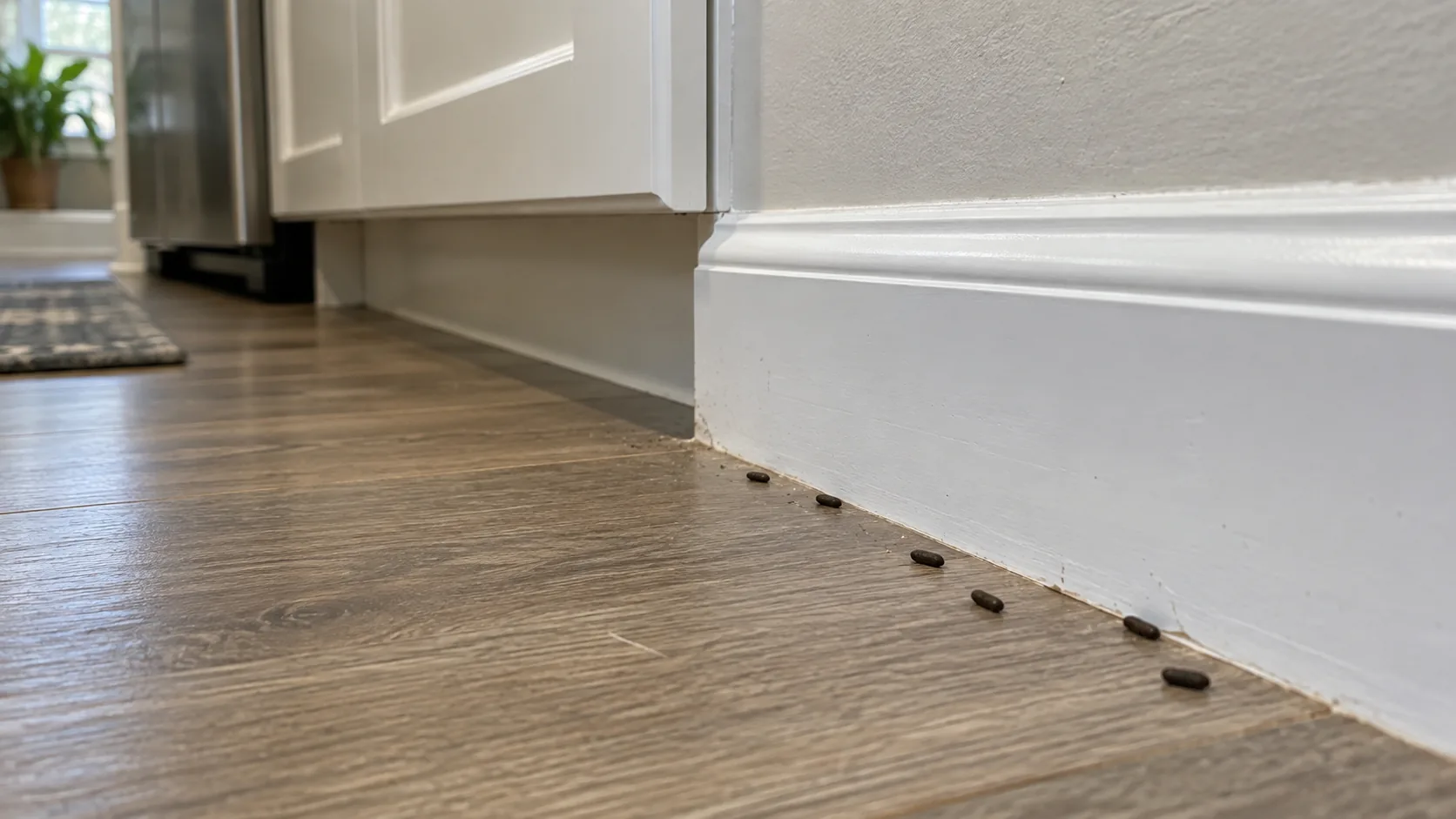
Mouse droppings are one of the most common signs that mice are active inside a home.
They may appear in kitchen cabinets, pantries, drawers, garages, attics, basements, storage areas, or along walls where mice travel. Because mice often remain hidden during the day, droppings can be the first evidence a homeowner notices.
Finding droppings does not automatically tell you how many mice are present, how long they have been there, or exactly where they are nesting. But the size, location, quantity, and freshness of the droppings can help you narrow down where mice are active and what to inspect next.
This guide explains what mouse droppings look like, where to look for them, what they can tell you about an infestation, how they differ from larger rat droppings, and how to clean contaminated areas safely.
What Do Mouse Droppings Look Like?
Mouse droppings are small, dark pellets.
They are usually much smaller than typical rat droppings and often look like tiny grains or narrow dark capsules scattered along a travel route or near a food source.
Common characteristics include:
- small size
- dark brown to nearly black color when fresh
- narrow or pellet-like shape
- smooth or slightly pointed ends
- scattered or grouped distribution
- repeated deposits in active areas
Exact appearance can vary with diet, age, moisture, and how long the droppings have been present.
Do not rely on color alone. Old droppings can fade, dry out, or collect dust, while fresh droppings may look darker and more distinct.
The most useful identification comes from combining droppings with other signs such as gnaw marks, tracks, nesting material, food damage, and sightings.
For a broader comparison of rodents, see Rat vs Mouse: How to Tell the Difference.
How Big Are Mouse Droppings?
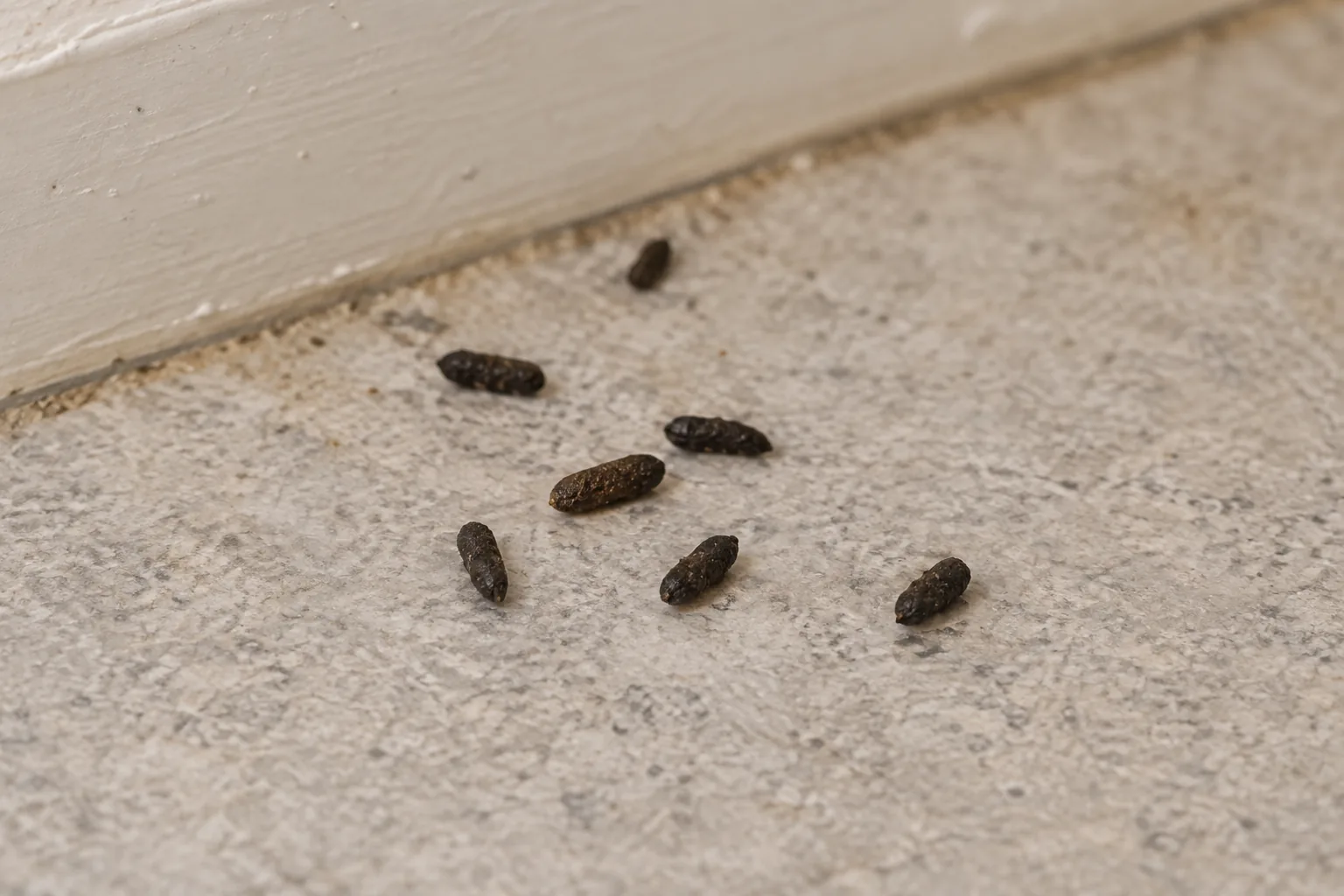
Mouse droppings are small enough that homeowners often mistake them for seeds, crumbs, insect debris, or other household material.
Typical mouse droppings are only a few millimeters long.
What matters most for practical identification is relative scale.
Mouse droppings are:
- much smaller than typical adult-rat droppings
- smaller and more uniform than many food crumbs
- usually found in multiples rather than as a single isolated object
- often concentrated along edges, inside cabinets, or near food
A juvenile rat can complicate identification because small rat droppings may overlap somewhat in appearance with large mouse droppings.
If you are uncertain, inspect the surrounding evidence rather than judging one pellet in isolation.
Look at the size of tracks, gnaw marks, entry openings, and the type of area where activity is occurring.
Where Do You Usually Find Mouse Droppings?
Mice tend to leave droppings along the routes they use repeatedly.
Common places include:
- kitchen cabinets
- pantry shelves
- drawers
- under sinks
- behind refrigerators
- behind stoves
- along baseboards
- inside garages
- in basements
- in attics
- in crawl spaces
- inside storage boxes
- near pet food
- near bird seed
- around utility penetrations
- beside suspected entry points
The location can help identify the most active part of the infestation.
A few droppings behind a refrigerator may point toward activity along the wall, under cabinets, or around nearby utility gaps.
Droppings in several rooms may indicate that mice are moving through wall voids or traveling farther through the house.
Our rodent problem guides cover common activity areas around the home.
Why Are Mouse Droppings Often Found Along Walls?
Mice frequently travel beside walls, cabinets, pipes, stored items, and other edges.
These routes provide cover and make movement less exposed than crossing the middle of a room.
As a result, droppings are often found:
- beside baseboards
- in cabinet corners
- behind appliances
- along garage walls
- next to stored materials
- near utility lines
- near openings into wall voids
This pattern can be useful when deciding where to inspect and where to place traps.
If droppings form a repeated line or cluster along an edge, that area may be part of an established travel route.
When dealing with an active infestation, our guide on how to get rid of mice explains how inspection, trapping, exclusion, sanitation, and monitoring fit together.
Fresh vs Old Mouse Droppings
Homeowners often want to know whether droppings are fresh.
Fresh droppings generally look darker and may appear slightly smoother or less dusty.
Older droppings may become:
- duller
- lighter
- dry
- brittle
- covered with dust
- less distinct from surrounding debris
However, appearance alone is not a perfect test.
Humidity, temperature, location, cleaning products, and other environmental conditions can change how quickly droppings dry or fade.
The better question is whether there is fresh evidence of ongoing mouse activity.
Look for:
- new droppings after an area has been cleaned safely
- recent food damage
- fresh gnaw marks
- trap activity
- new nesting material
- repeated nighttime sounds
- direct sightings
If you clean an area properly and new droppings appear afterward, that is much stronger evidence of active mice than trying to estimate the age of old droppings by color.
How Many Droppings Does One Mouse Leave?
A single mouse can leave many droppings over time.
That means a pile of droppings does not translate directly into a specific number of mice.
Likewise, finding only a few droppings does not prove that only one mouse is present.
Droppings are best treated as evidence of activity rather than a population count.
To estimate how widespread the problem may be, look at:
- how many rooms contain evidence
- whether droppings appear in several separate areas
- whether new droppings appear after cleanup
- how much food damage is present
- how often traps are triggered
- whether sightings occur in different parts of the house
A small localized problem and a house-wide infestation can both produce droppings, but the distribution pattern will usually be different.
Mouse Droppings in Kitchen Cabinets
Kitchen cabinets are one of the most common places to find mouse droppings.
Mice are attracted to food, shelter, and protected spaces.
Lower cabinets can also connect to wall voids, plumbing penetrations, dishwasher openings, and gaps behind cabinetry.
If you find droppings inside a cabinet:
- avoid handling them with bare hands
- remove or discard food that may have been contaminated
- clean the area safely
- inspect the back and corners of the cabinet
- look for gaps around pipes and wiring
- check nearby cabinets and appliances
- monitor for new droppings
Do not assume the cabinet itself is the nest.
It may simply be part of the route mice use between a wall void and a food source.
Mouse Droppings Behind Appliances
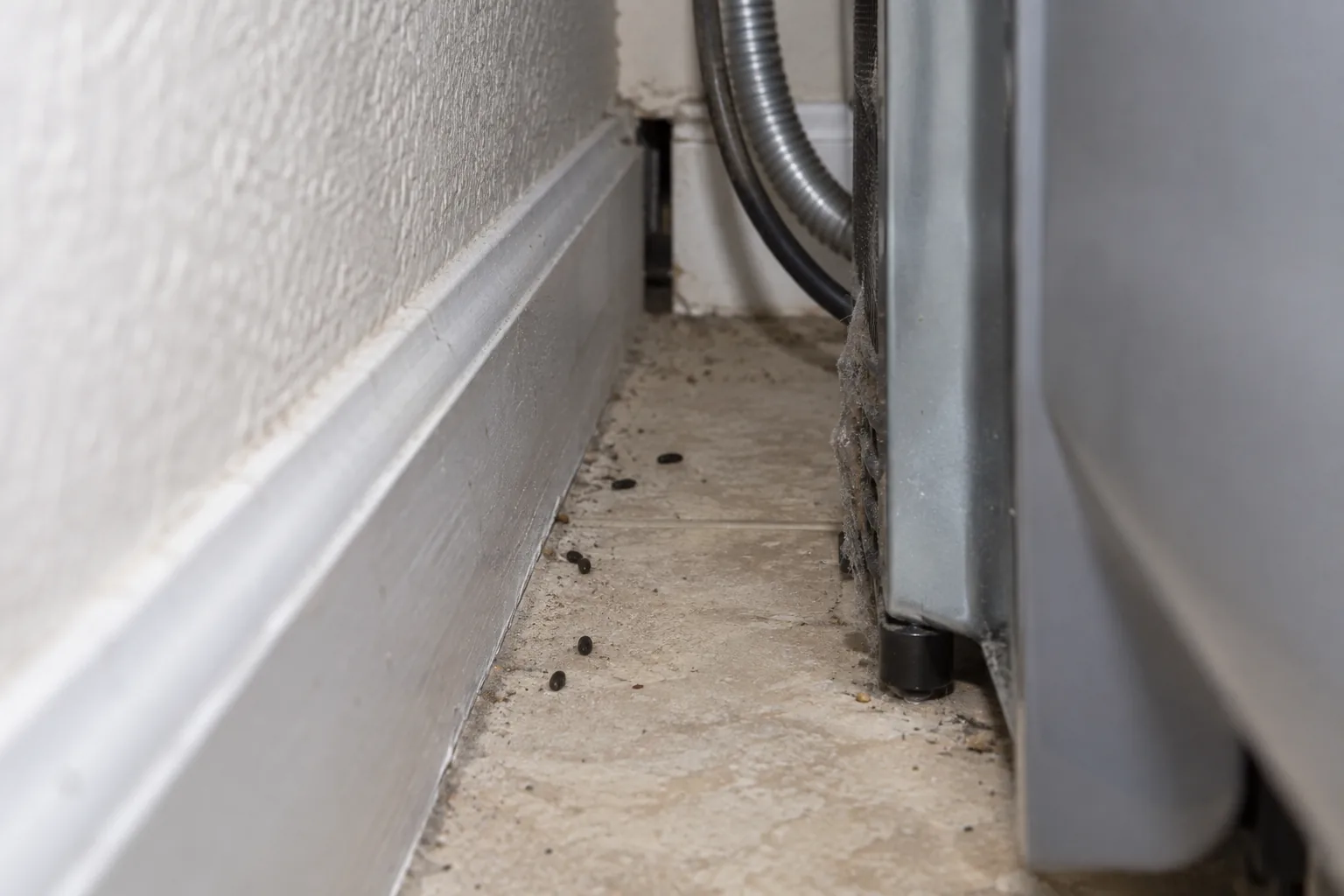
Refrigerators, stoves, dishwashers, and other appliances can create ideal mouse travel areas.
These spaces may provide:
- warmth
- food crumbs
- water or condensation
- darkness
- wall access
- utility penetrations
- protection from disturbance
Droppings behind an appliance are especially useful because they often identify an active route.
Inspect along the wall, nearby cabinets, pipe openings, floor gaps, and any path that connects the appliance area to another protected space.
Be careful when moving heavy appliances.
If the area is heavily contaminated or difficult to access safely, professional help may be appropriate.
Mouse Droppings in Attics, Garages, and Storage Areas
Droppings found outside kitchens can still indicate an active mouse problem.
Attics may provide nesting material and insulation.
Garages often contain stored food, bird seed, pet supplies, boxes, and multiple exterior entry points.
Storage areas can remain undisturbed for long periods, giving mice protected places to nest and travel.
In these locations, look for droppings together with:
- shredded paper or insulation
- damaged boxes
- gnawed bags
- tracks
- nesting material
- small entry openings
- food caches
The more types of evidence you find in one area, the more likely it is that the space is actively being used.
Mouse Droppings vs Rat Droppings
The main difference is size.
Typical adult-rat droppings are much larger than typical mouse droppings.
Rat droppings also tend to be associated with larger tracks, heavier gnaw marks, larger openings, and more substantial rodent movement.
If you find droppings that seem too large for a house mouse, do not automatically assume you have unusually large mice.
Inspect for other rat-sized evidence.
Our rodent identification section explains the major differences between mice and rats, and Rat vs Mouse provides a direct comparison.
Mouse Droppings vs Insect Debris
Mouse droppings can sometimes be confused with insect debris or other small dark material.
The context matters.
Rodent droppings are more likely when you also find:
- gnawed food packaging
- tracks
- scratching sounds
- small entry gaps
- nesting material
- repeated droppings along walls
- mouse sightings
Insect evidence often follows a different pattern and may be associated with smaller particles, smears, cast skins, egg cases, or live insects.
If the material cannot be identified confidently, avoid handling it unnecessarily and inspect the surrounding area for additional clues.
Do Mouse Droppings Mean You Have an Active Infestation?
Not always.
Droppings can remain after mice are gone.
A house may contain old evidence from a previous infestation, especially in attics, garages, wall-access areas, or storage spaces that are rarely cleaned.
The strongest sign of current activity is new evidence.
After droppings have been cleaned safely, monitor the area.
Fresh droppings, new food damage, trap activity, or repeated sounds indicate that mice may still be present.
If no new signs appear over time, the droppings may have been old.
This is why cleaning and monitoring are important parts of inspection, not just housekeeping.
Are Mouse Droppings Dangerous?
Rodent droppings should be treated as potentially contaminated material.
The level of risk depends on the rodent species, environment, amount of contamination, and type of exposure.
Avoid direct contact and avoid actions that create airborne dust.
The practical safety rules are straightforward:
- do not handle droppings with bare hands
- do not dry sweep fresh droppings
- do not vacuum fresh droppings before proper disinfection
- keep children and pets away from contaminated areas
- use appropriate gloves
- wet contaminated material with a suitable disinfectant according to its label before removal
- wash hands after cleanup
Large accumulations or contaminated enclosed areas can require more extensive precautions than a few isolated droppings on a hard surface.
Our rodent safety section covers broader health and contamination concerns.
How to Clean Up Mouse Droppings Safely
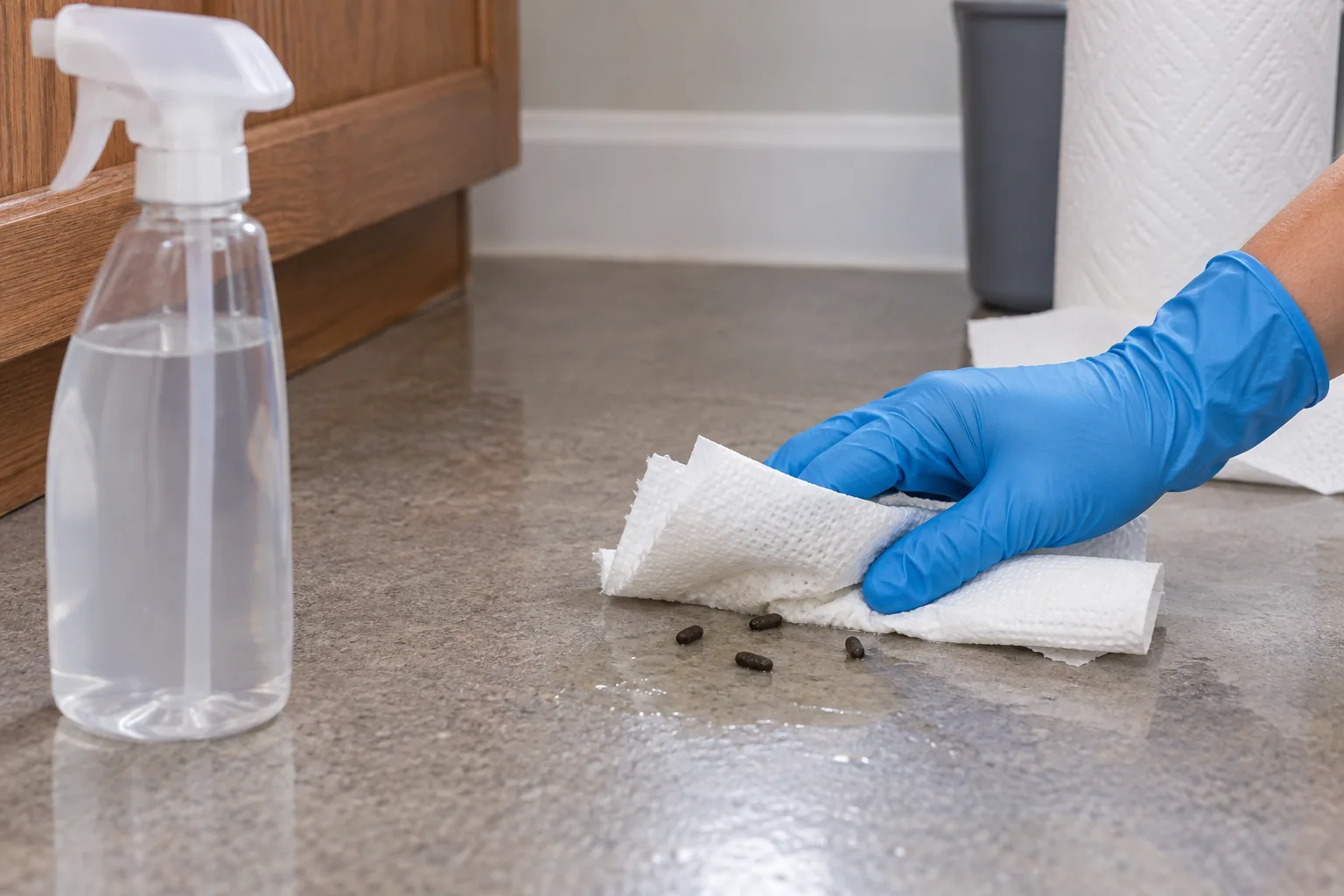
Do not begin by sweeping or vacuuming.
Dry cleanup can disturb contaminated material.
A safer general process is:
- keep people and pets away from the area
- ventilate the space when practical and appropriate
- wear suitable protective gloves
- wet the droppings and surrounding contaminated material thoroughly with an appropriate disinfectant according to its label
- allow the product's required contact time
- wipe up the wet material
- place waste in a suitable bag or container
- clean the surrounding hard surface as appropriate
- remove gloves carefully
- wash your hands
Heavily contaminated attics, crawl spaces, sheds, cabins, HVAC-related areas, or insulation can be more complicated.
Those situations may require additional protective measures or professional cleanup.
See our rodent cleanup section for more detailed cleanup topics.
Should You Vacuum Mouse Droppings?
Not before they have been properly disinfected.
Vacuuming fresh or dry rodent droppings can disturb contaminated particles.
The same applies to dry sweeping.
Wet-cleaning methods are preferred for initial removal.
After a contaminated area has been properly cleaned and disinfected, normal household cleaning may resume as appropriate for the surface.
If droppings are inside ducts, inaccessible wall spaces, heavily contaminated insulation, or another difficult area, do not improvise with a household vacuum.
Consider professional evaluation instead.
Should You Throw Away Food Near Mouse Droppings?
Food that has been directly contaminated or damaged by mice should not be treated as safe simply because the outside looks mostly intact.
Discard food in damaged packaging or food that has clearly been exposed to rodent contamination.
Pay special attention to:
- gnawed bags
- open boxes
- unsealed dry goods
- pet food bags
- bird seed
- food stored where droppings are present
After contaminated food is removed, clean the storage area safely and transfer unaffected vulnerable foods to durable sealed containers when practical.
This reduces both contamination risk and future access for mice.
What to Do After You Find Mouse Droppings
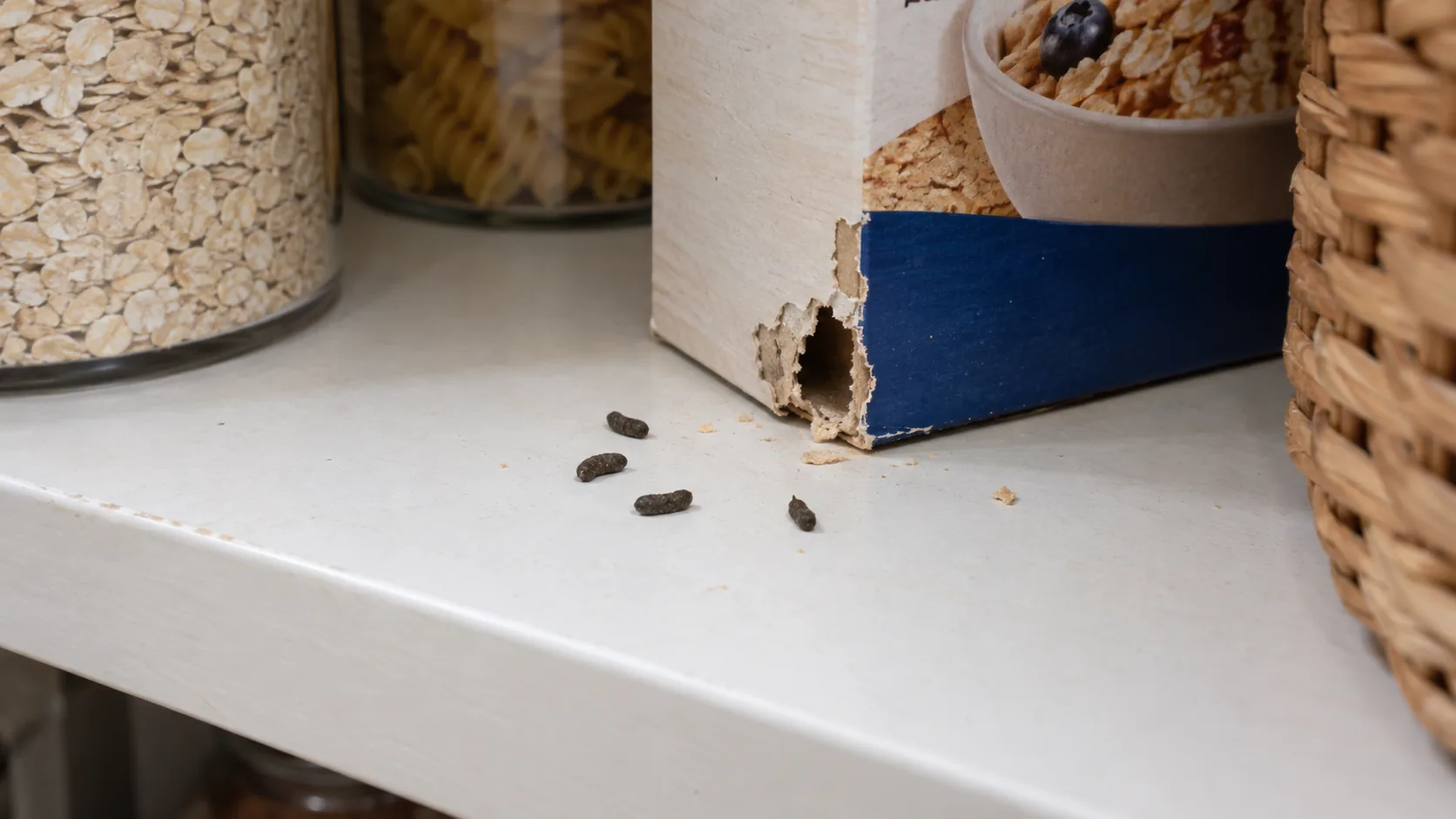
Finding droppings should trigger an inspection, not just a cleanup.
After the area has been cleaned safely:
- check nearby walls and cabinets
- inspect utility penetrations
- look behind appliances
- inspect food storage
- check adjacent rooms
- look for tracks and gnaw marks
- place traps along confirmed travel routes
- monitor for new droppings
- inspect the exterior for entry points
If you only clean the droppings but leave the mouse activity unchanged, the evidence is likely to return.
For an active infestation, follow the broader process in How to Get Rid of Mice in Your House.
When Mouse Droppings Suggest a Larger Problem
A few droppings in one cabinet may represent a localized issue.
A much broader distribution can suggest a more established infestation.
Warning signs include:
- droppings in multiple rooms
- droppings on different floors
- repeated fresh droppings after cleanup
- significant food damage
- nesting material
- frequent sightings
- activity in walls or ceilings
- contaminated attic or crawl-space areas
The more areas involved, the more important it becomes to inspect the entire structure rather than treating one room.
A widespread infestation may also involve multiple entry points.
When to Call a Professional
Professional rodent help may be useful when:
- fresh droppings keep returning
- mice are active in several parts of the home
- entry points cannot be located
- contamination is extensive
- droppings are inside difficult or sensitive areas
- rodents are associated with HVAC systems
- trapping has not reduced activity
- the infestation repeatedly returns
- you are unsure whether the evidence is from mice or rats
A good inspection should look beyond the droppings themselves.
The important questions are where mice are moving, where they are nesting, how they are entering, and what conditions are helping them remain inside.
Visit our professional rodent-control section for more information.
Mouse Droppings Are a Clue, Not the Whole Diagnosis
Mouse droppings are useful because they show where mice have been active.
But they do not tell you everything by themselves.
Use them together with tracks, gnaw marks, nesting material, sounds, food damage, entry points, and sightings.
Small droppings concentrated inside cabinets may point toward house-mouse activity near food and wall voids. Droppings behind appliances may reveal a travel route. Droppings across several rooms may suggest a wider infestation.
Clean contaminated areas safely, then monitor for new evidence.
If droppings return, the next step is not repeated cleaning alone. It is finding and correcting the source of the mouse activity.
Continue with our signs section, rodent identification guides, problem guides, prevention section, cleanup section, or the complete guide on how to get rid of mice.