Baby Rat: What Newborn & Young Rats Look Like
A newborn rat looks very different from the large brown or dark rat most people picture.
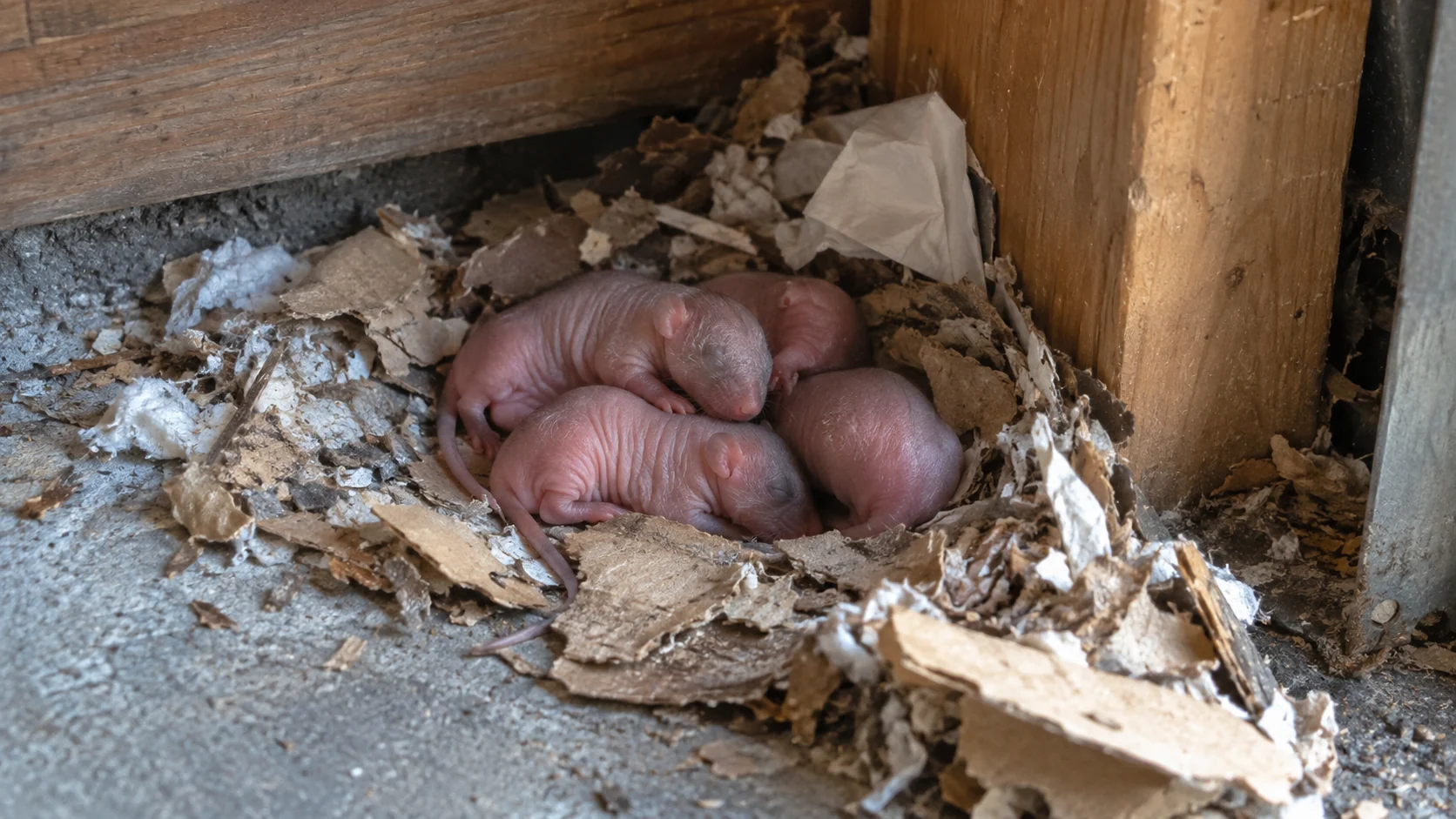
A newborn rat looks very different from the large brown or dark rat most people picture.
Very young rats are often called pinkies because they are:
- tiny
- hairless or nearly hairless
- pink or reddish-pink
- blind
- born with their ears folded close to the head
As they develop, the skin darkens, fur begins to appear, the ears become more defined, and the eyes open. Within only a few weeks, a young rat can look like a small version of an adult.
Finding baby rats inside a house, garage, attic, crawl space, shed, or wall void usually means something important:
there is or recently was a rat nest nearby.
That is stronger evidence than seeing one adult rat pass through.
A nest may be hidden in:
- wall voids
- insulation
- garages
- attics
- crawl spaces
- basements
- storage areas
- burrows near the structure
- protected utility spaces
This guide explains what newborn and young rats look like, how their appearance changes as they develop, how to distinguish baby rats from baby mice, where rat nests are commonly found, and what to do if you find baby rats on your property.
What Does a Newborn Rat Look Like?
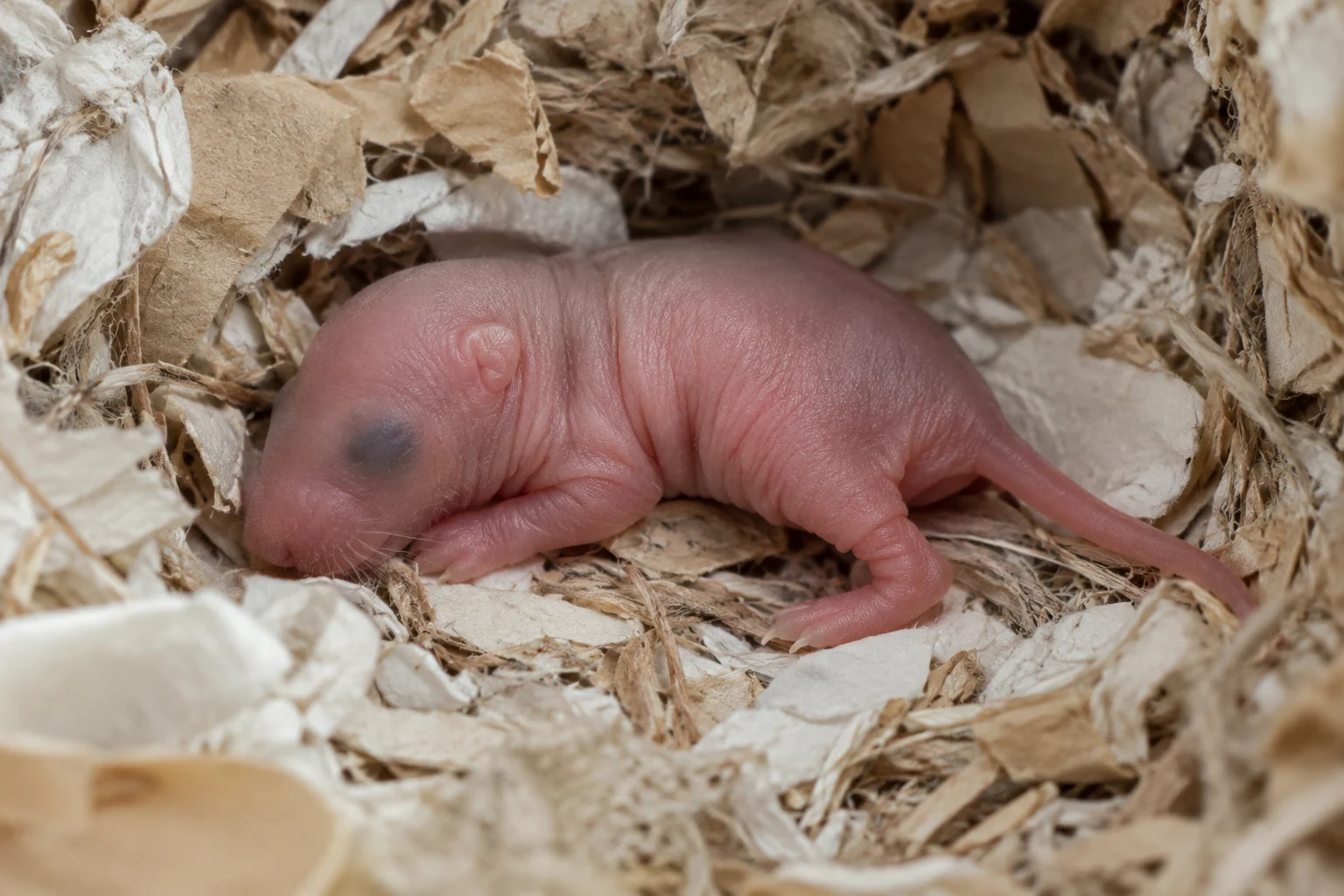
A newborn rat is very small and undeveloped.
Typical features include:
- pink skin
- little or no visible fur
- closed eyes
- folded ears
- a visible thin tail
- tiny feet
- a rounded body
- limited mobility
Very young rats may look almost translucent because the skin is thin and the coat has not developed.
They normally remain together in a nest and depend completely on the mother.
Why Are Baby Rats Called Pinkies?
“Pinkie” is a common term for very young rats and mice before their fur grows in.
The skin may look:
- pink
- reddish-pink
- pale gray-pink
As pigmentation and fur develop, the pink appearance gradually disappears.
A pinkie is not a separate species.
It is simply a very young developmental stage.
Baby Rat Development at a Glance
Rat pups change quickly.
A practical visual timeline looks like this:
| Stage | Typical Appearance |
|---|---|
| Newborn | Pink, hairless, eyes closed, ears folded |
| First several days | Skin darkens, early pigmentation becomes visible |
| Around one week | Fine fur becomes more noticeable, ears more developed |
| Around two weeks | Coat well developed, eyes begin opening around this period |
| Two to three weeks | Fully furred, mobile, increasingly adult-like |
| Several weeks old | Active juvenile, larger and more independent |
Development varies with:
- species
- litter
- nutrition
- individual growth
- environmental conditions
Do not use an exact day count as the only way to age a young rat.
What Does a 1-Day-Old Baby Rat Look Like?
A rat that is only about a day old is usually:
- hairless
- pink
- blind
- very small
- unable to travel far
The ears lie close to the head.
The tail is already visible but looks thin compared with an adult rat's tail.
Several newborn pups are usually clustered tightly together in nesting material.
What Does a Few-Day-Old Rat Look Like?
During the first several days, the rat still looks mostly hairless.
You may begin to notice:
- darker skin where the coat will develop
- more defined feet
- a longer-looking muzzle
- increasingly visible ears
- more active movement within the nest
The eyes remain closed.
At this age, exact species identification from appearance alone is difficult.
What Does a One-Week-Old Rat Look Like?
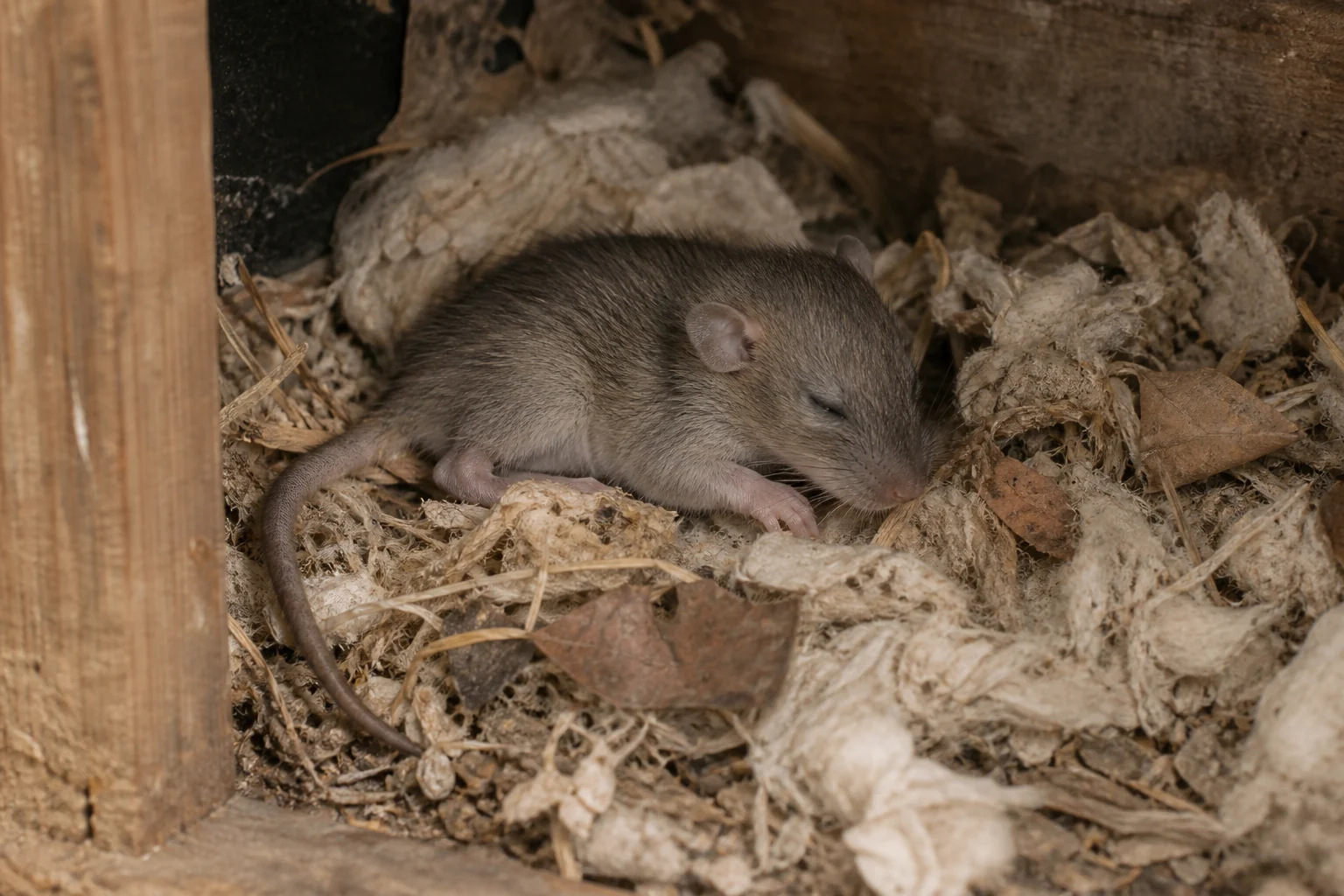
Around the first week, fur development becomes more obvious.
A young rat may have:
- a thin gray, brown, or dark coat
- closed eyes
- more upright ears
- stronger legs
- a more recognizable rat-shaped head
- a thicker-looking body than a baby mouse of similar age
The pup is still dependent on the nest.
When Do Baby Rats Grow Fur?
Rat pups begin developing visible fur during the first part of life.
The exact timing varies.
You may first see:
- skin pigmentation
- fine short hairs
- a thin coat
- gradually fuller fur
By the time the eyes begin opening, the coat is usually much more developed.
When Do Baby Rats Open Their Eyes?
Baby rats are born with their eyes closed.
Their eyes generally begin opening around the second week of life.
Individual timing can vary.
A rat with:
- full fur
- open eyes
- upright ears
- active movement
is no longer in the newborn pinkie stage.
What Does a Two-Week-Old Rat Look Like?
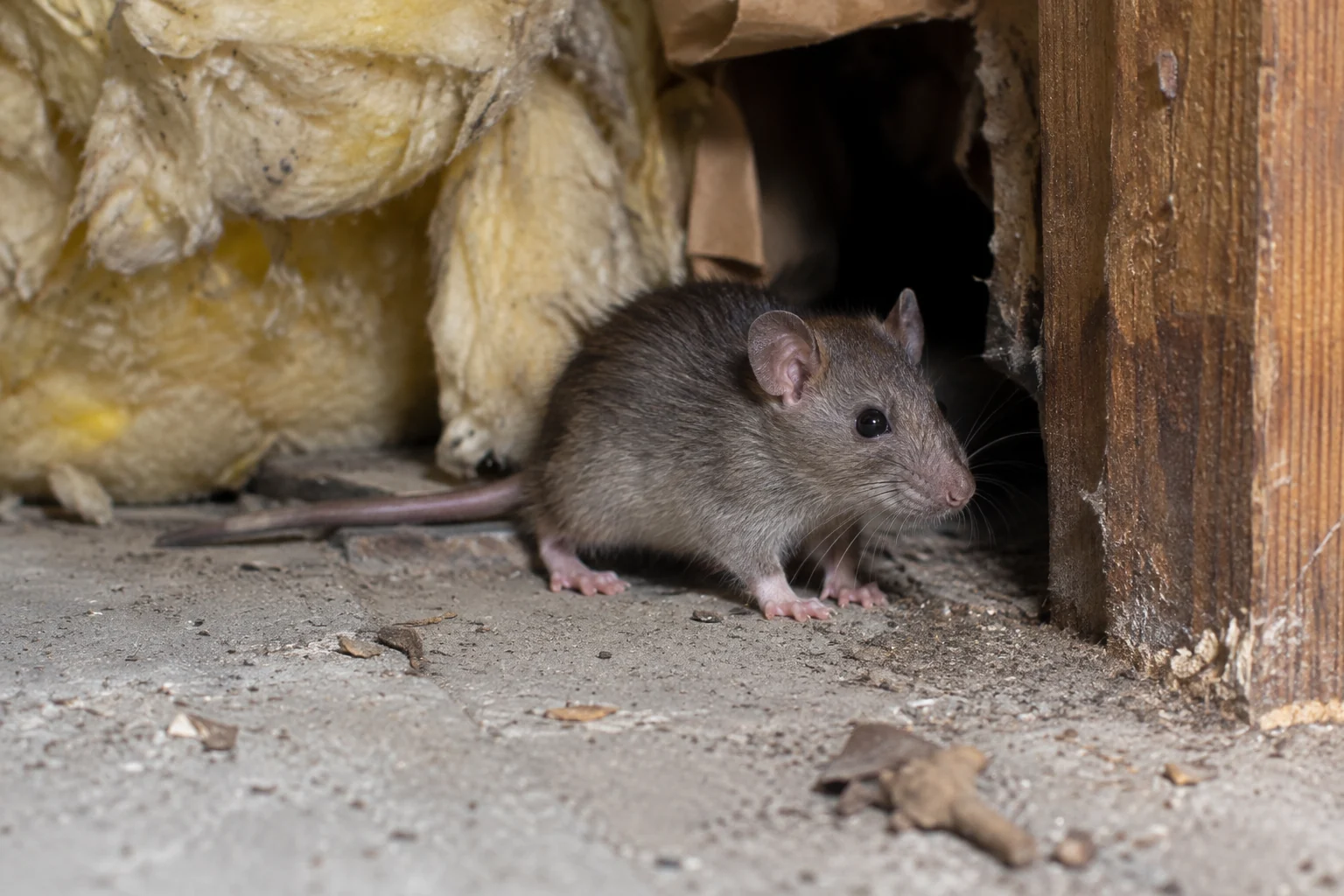
Around two weeks, a young rat looks much more recognizable.
Typical features include:
- a visible coat
- upright ears
- a defined muzzle
- eyes beginning to open or already open
- stronger legs
- active movement around the nest
At a quick glance, it may look like a very small adult rat.
What Does a Three-Week-Old Rat Look Like?
By roughly two to three weeks, a juvenile rat may be:
- fully furred
- mobile
- exploring outside the nest
- eating more solid food
- proportioned more like an adult
The body is still noticeably smaller than that of a mature rat.
Juvenile rats can sometimes be mistaken for large mice if the observer sees only a quick glimpse.
Baby Rat vs Adult Rat
The difference depends on age.
Newborn Baby Rat
A newborn is:
- pink
- hairless
- blind
- nest-dependent
Older Baby or Juvenile Rat
An older juvenile is:
- fully furred
- active
- small
- increasingly adult-like
Adult Rat
An adult has:
- full mature fur
- adult body mass
- stronger proportions
- independent movement and feeding
A fully furred rat is not necessarily an adult.
How Big Is a Baby Rat?
Size changes rapidly.
Newborn rats are small enough to fit closely together in a nest with several littermates.
Older juveniles can become surprisingly large while still being immature.
Exact body length is less useful than combining:
- fur development
- eye condition
- ear position
- mobility
- body build
- tail proportions
What Color Are Baby Rats?
Newborn rats are usually pink because their fur has not developed.
As they grow, their skin may darken before visible hair appears.
Older juveniles may become:
- brown
- gray-brown
- dark gray
- blackish
depending on species and individual coloration.
A young Norway rat will gradually develop a heavier brown-gray appearance.
A young roof rat may develop a slimmer darker appearance.
Can You Tell the Species of a Newborn Rat?
Usually not with confidence.
Very young Norway rats and roof rats share many features:
- pink skin
- closed eyes
- folded ears
- tiny bodies
- undeveloped fur
Adult identification traits are not yet obvious.
Species identification becomes easier as the juvenile develops.
See Roof Rat vs Norway Rat: How to Tell Them Apart for adult comparison traits.
Baby Norway Rat vs Baby Roof Rat
Newborn Norway and roof rats can look extremely similar.
At the pinkie stage, do not rely on appearance alone.
As they grow, body proportions begin to separate.
Young Norway Rat
May develop:
- heavier body
- broader head
- blunter muzzle
- relatively smaller ears
- shorter tail proportion
Young Roof Rat
May develop:
- slimmer body
- more pointed muzzle
- relatively larger ears
- longer tail proportion
- more agile body shape
Species identification becomes easier later in juvenile development.
See Norway Rat: Identification, Signs & Behavior and Roof Rat: Identification, Signs & Behavior.
Baby Rat vs Baby Mouse
Newborn rats and mice can look very similar.
Both may be:
- hairless
- pink
- blind
- clustered in nests
The strongest difference is usually overall scale and proportion as they develop.
Baby Rat
A rat pup generally becomes:
- larger
- heavier-bodied
- broader-headed
- larger-footed
- equipped with a thicker tail
Baby Mouse
A mouse pup remains:
- smaller
- lighter-bodied
- more delicate
- proportionally tiny
Very young pinkies can still be difficult to identify from a photograph alone.
See Baby Mouse: What Newborn & Young Mice Look Like and Rat vs Mouse: How to Tell the Difference.
What Does a Rat Nest Look Like?
A rat nest is usually made from soft or shredded material.
Possible materials include:
- paper
- cardboard
- fabric
- insulation
- plant material
- packing material
- shredded plastic or soft debris
The nest may look like:
- a loose bowl
- a mound
- a concealed pocket of shredded material
Norway rats may also nest in outdoor burrows rather than in visible indoor nesting material.
Roof rats are more likely to use elevated protected spaces such as attics.
Where Do Rats Have Babies in a House?
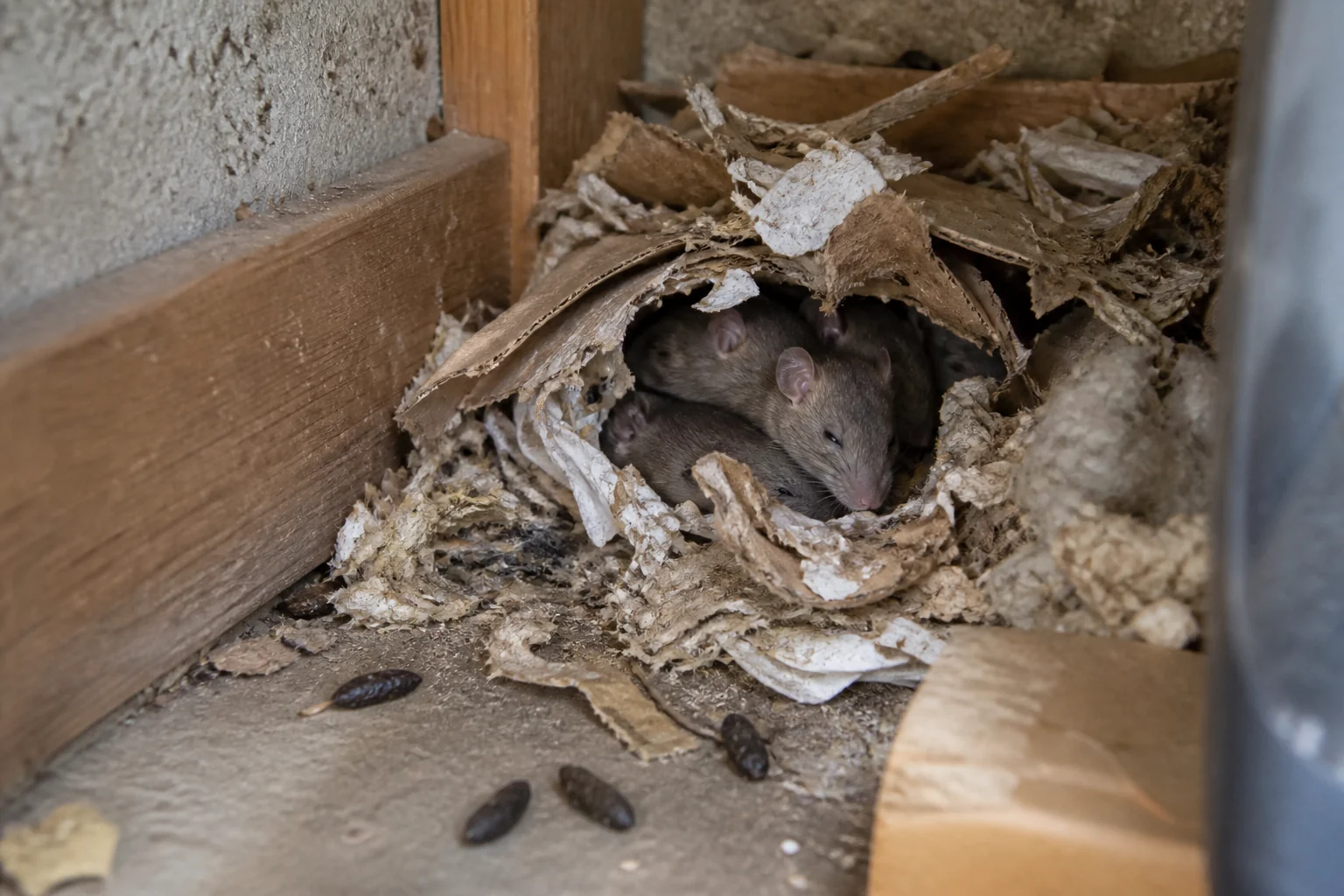
Rats choose protected, low-disturbance spaces.
Common nesting areas include:
- attics
- crawl spaces
- garages
- wall voids
- basements
- storage rooms
- utility spaces
- insulation
- hidden structural cavities
The preferred location depends partly on species.
Roof rats more often use elevated spaces.
Norway rats more often use lower levels and burrows.
Baby Rats in a Wall
If rat activity is occurring inside a wall, a nest may be hidden in or near the wall system.
Possible access points include:
- utility penetrations
- garage connections
- attic connections
- basement openings
- crawl-space routes
Opening the wall is not always the first step.
First identify where adult rats are entering and leaving the wall.
See Rats in Walls: Signs, Entry Points & What to Do.
Baby Rats in the Attic
An attic can provide:
- insulation
- warmth
- protected nesting space
- low disturbance
Roof rats are especially associated with attic activity.
A nest may be near:
- framing
- stored material
- insulation
- soffit access
- upper wall connections
See Rats in the Attic: Signs, Damage & Removal.
Baby Rats in a Crawl Space
Crawl spaces are more strongly associated with Norway rats.
A nest may be located:
- beside foundation walls
- near insulation
- close to utility penetrations
- near a protected corner
- near an exterior burrow route
Crawl spaces can be difficult and contaminated environments.
Do not enter an unsafe or heavily contaminated space without appropriate precautions.
Baby Rats in a Garage
Garages can provide:
- shelter
- stored food
- cardboard
- fabric
- wall routes
- attic access
Inspect:
- storage corners
- garage-door gaps
- wall penetrations
- shelving
- insulation
- pet-food or bird-seed storage
A garage nest may connect to the house through wall or attic routes.
Baby Rats in a Basement
Basements can provide protected nesting areas for Norway rats.
Look near:
- foundation walls
- storage
- utility lines
- floor drains
- crawl-space connections
- low wall voids
Large droppings or grease marks nearby can help identify the adult travel route.
Baby Rats Near an Outdoor Burrow
Norway rats frequently nest in burrows.
A burrow may be located:
- beside a foundation
- under a deck
- under dense vegetation
- near sheds
- near garbage storage
- along landscape edges
Young rats may begin appearing near the entrance as they become mobile.
If the burrow is close to the home, inspect the building for entry points.
What Does Finding Baby Rats Mean?
Finding newborn or very young rats strongly suggests breeding has occurred on or immediately around the property.
It may indicate:
- an active nest
- an adult female nearby
- reliable food and shelter
- an established travel route
- an entry point that may still be open
Do not treat the babies as an isolated event.
The adult rats and nesting location must also be addressed.
Does Finding One Baby Rat Mean There Are More?
Often, yes.
Rats normally produce litters rather than one pup.
One juvenile found away from the nest may mean:
- littermates remain nearby
- the nest was disturbed
- the juvenile began exploring
- adult rats moved through the area
Search nearby protected areas for supporting evidence.
Where Is the Mother Rat?
If newborn rats are alive in a nest, the mother may still be using the area even if you do not see her.
Adult rats are cautious and often remain hidden when people are present.
Look for:
- fresh droppings
- grease marks
- gnawing
- travel routes
- burrows
- trap activity
- entry gaps
Do not assume the nest is abandoned because the adult is temporarily absent.
Can Baby Rats Survive Without Their Mother?
Very young rat pups depend heavily on maternal care.
They rely on the mother for:
- milk
- warmth
- grooming
- protection
Older juveniles become increasingly independent.
If a wild rat nest is discovered during control work, the focus should be on the entire infestation rather than trying to raise wild rats.
Should You Touch Baby Rats?
Avoid unnecessary direct handling.
Do not touch baby rats, nesting material, droppings, or urine with bare hands.
If contact is necessary during removal or cleanup:
- wear suitable gloves
- keep children and pets away
- use safe rodent-waste handling practices
The surrounding nest area may be contaminated.
Are Baby Rats Dangerous?
Baby rats are not usually aggressive.
The main concern is the active rat infestation associated with the nest.
The surrounding area may contain:
- urine
- droppings
- contaminated nesting material
- food contamination
Finding young rats also means adult rats are or were nearby.
Can Baby Rats Carry Disease?
Do not assume a baby rat is disease-free because it is young.
You cannot determine health status by appearance.
Avoid direct contact with:
- rats
- droppings
- urine
- nesting material
Use safe cleanup practices around the nest area.
How to Clean Around a Rat Nest Safely
Do not dry sweep or vacuum fresh rat droppings or nesting material before proper wet cleanup.
A practical process is:
- keep children and pets away
- ventilate the area when appropriate
- wear suitable gloves
- wet droppings and nesting material with an appropriate disinfecting solution
- allow adequate contact time
- wipe up contaminated material
- bag waste appropriately
- clean the surrounding surface
- wash hands after removing gloves
For broader guidance, see the cleanup section and rodent safety section.
What to Do If You Find Baby Rats in the House
Treat the discovery as evidence of an active nesting problem.
A practical approach is:
- keep children and pets away
- identify the nest area
- inspect for adult rat activity
- look for droppings, grease marks, and routes
- identify whether the pattern better fits Norway rats or roof rats
- place rat-sized traps along accessible adult routes
- inspect the exterior for entry points or burrows
- coordinate removal with exclusion
- clean contaminated material safely
- monitor for fresh activity
Do not focus only on the visible babies.
The adults and access route are the larger control problem.
Should You Seal the Entry Point Immediately?
Not always.
If rats are still inside, sealing the only active route may trap them in the structure.
That can lead to:
- movement into new areas
- increased gnawing
- attempts to create another exit
- odor if an animal dies in an inaccessible void
Removal and exclusion should be coordinated.
See Rodent Exclusion: How to Keep Rats & Mice Out.
How Do Adult Rats Get Into the House Before Nesting?
Common rat entry points include:
- garage-door gaps
- foundation openings
- crawl-space defects
- utility penetrations
- vents
- soffits
- roofline gaps
Roof rats and Norway rats often prioritize different routes.
See How Rats Get Into Your House for the full entry-point guide.
What Traps Should You Use When Baby Rats Are Present?
Traps are mainly for mobile adults and older juveniles traveling outside the nest.
Use devices specifically designed for rats.
For many indoor situations, rat-sized snap traps are a practical starting point.
Place them:
- along walls
- near droppings
- beside grease-mark routes
- near utility gaps
- along garage, basement, crawl-space, or attic routes
Keep powerful rat traps inaccessible to children and pets.
See Best Rat Traps: Which Type Works Best & How to Choose and Rat Traps: Types, Placement & How to Use Them.
Why Baby Rats Can Mean the Infestation Is Established
Breeding requires more than a rat simply passing through.
A nest indicates that the property provided:
- shelter
- nesting space
- food access
- sufficient time for reproduction
It does not tell you the exact number of rats.
But it is strong evidence that a full property inspection is justified.
How Fast Can a Rat Problem Grow?
Rats can reproduce quickly under favorable conditions.
That is why a breeding nest should be addressed promptly.
Do not try to predict an exact future population from one litter.
Instead, remove the conditions that allow repeated breeding:
- food
- water
- shelter
- entry routes
- nesting sites
When to Call a Professional
Professional rat control may make sense when:
- babies are inside a wall or inaccessible void
- multiple nesting areas are suspected
- burrows are widespread
- rats are active in the attic or crawl space
- trapping does not reduce activity
- the entry route cannot be found
- roofline work is required
- contamination is extensive
See Rat Exterminator: What to Expect & When to Call One.
Baby Rat: The Bottom Line
A newborn rat is:
- tiny
- pink
- hairless
- blind
- completely dependent on the nest
As it develops, fur appears, the ears become more defined, the eyes open, and the animal quickly begins to look like a small adult rat.
Finding baby rats in a home or on the property usually means there is or recently was a nest nearby.
Do not rely on newborn appearance alone to identify Norway rat versus roof rat.
Instead:
- locate the nest
- inspect for adult activity
- identify travel routes
- look for burrows or elevated entry routes
- use rat-sized traps where appropriate
- coordinate exclusion
- clean contaminated areas safely
Continue with our Norway rat guide, roof rat guide, roof rat vs Norway rat guide, rat vs mouse guide, signs of rats guide, how rats get into a house, or rodent exclusion guide.
For the broader overview, return to Rats & Mice in the Home.