Roof Rat vs Norway Rat: How to Tell Them Apart
Roof rats and Norway rats are the two rat types most often compared around U.S. homes.
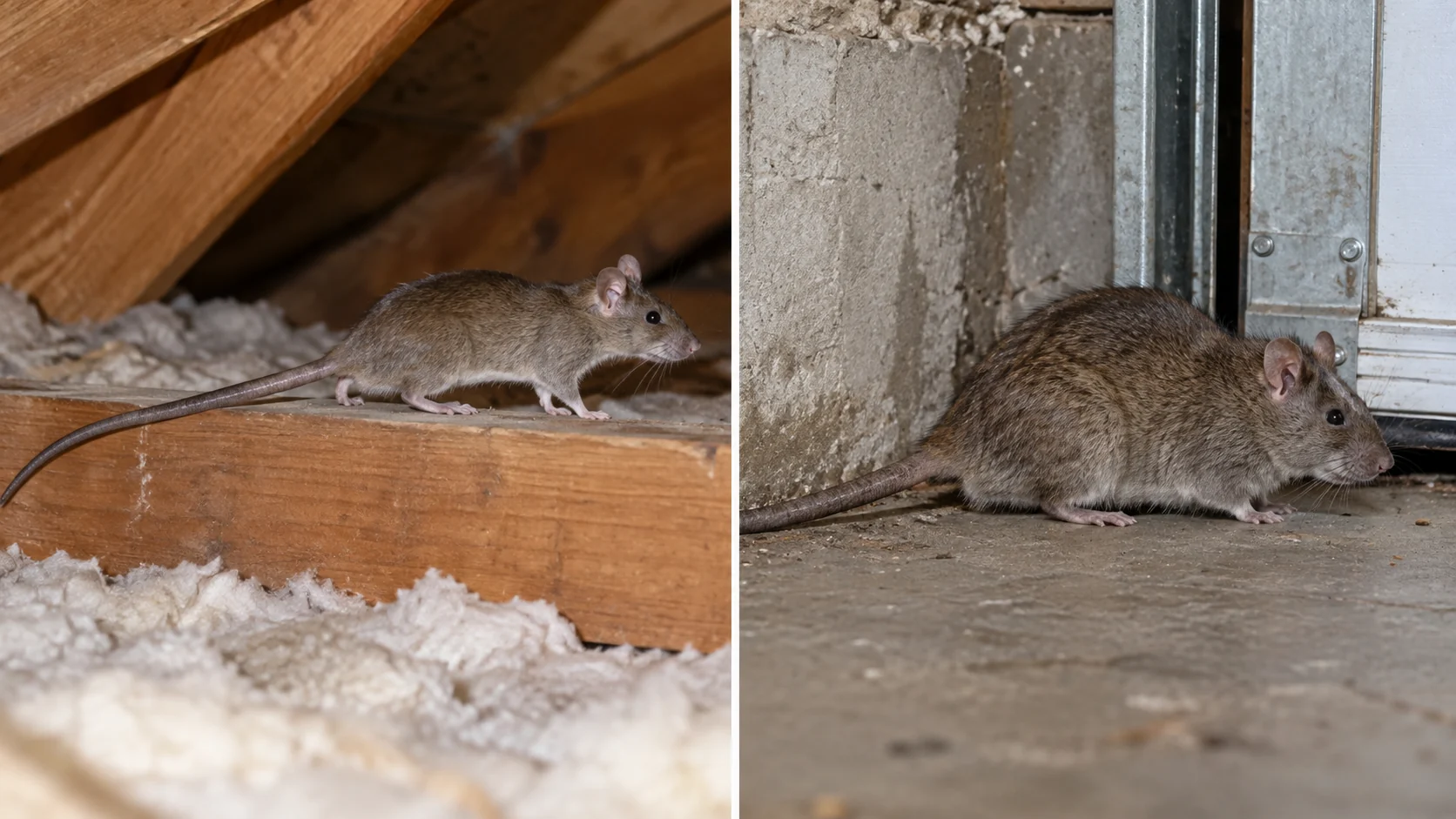
Roof rats and Norway rats are the two rat types most often compared around U.S. homes.
Both can enter buildings, contaminate food, damage materials, leave large droppings, and move through hidden parts of a structure. But their body proportions and preferred travel routes are different enough to provide useful identification clues.
The easiest differences to look for are:
- body shape
- muzzle shape
- ear size
- tail length
- where the rat is active
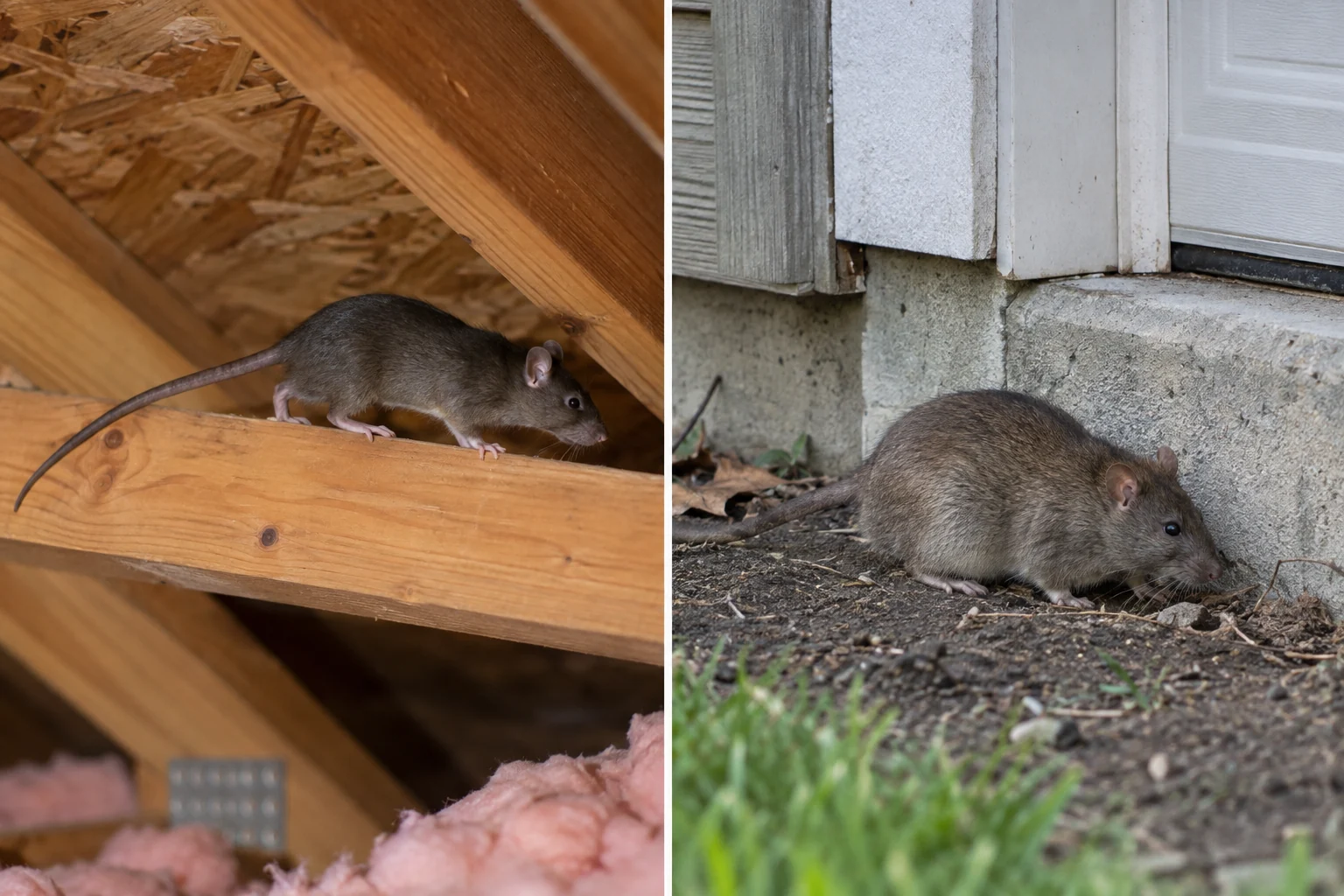
A Norway rat is usually heavier and stockier, with a blunt muzzle, relatively small ears, and a tail that is typically shorter than the combined length of its head and body.
A roof rat is usually slimmer, with a more pointed muzzle, relatively large ears, and a tail that is typically longer than the combined length of its head and body.
Location also matters.
Norway rats are strongly associated with ground-level routes, burrows, foundations, basements, crawl spaces, and garages.
Roof rats are better climbers and are more strongly associated with trees, fences, rooflines, attics, and upper structural areas.
This guide compares roof rats and Norway rats by appearance, droppings, behavior, habitat, entry routes, and signs around the home.
Roof Rat vs Norway Rat at a Glance
| Feature | Roof Rat | Norway Rat |
|---|---|---|
| Body build | Slim, agile | Heavy, stocky |
| Muzzle | Pointed | Blunter |
| Ears | Relatively large | Relatively small |
| Eyes | Relatively large | Smaller in proportion |
| Tail | Usually longer than head + body | Usually shorter than head + body |
| Typical color | Dark brown, gray-brown, sometimes blackish | Brown, gray-brown, coarse mixed fur |
| Strongest behavior clue | Climbing | Burrowing and ground travel |
| Common home location | Attics, rooflines, upper walls | Basements, garages, crawl spaces, lower walls |
| Outdoor route | Trees, fences, vines, elevated structures | Burrows, foundations, ground-level edges |
| Droppings | Often more tapered or spindle-shaped | Often thicker and more blunt-ended |
These are practical identification clues, not rigid rules.
Individual rats vary, and both species can use routes outside their typical pattern.
What Is a Roof Rat?
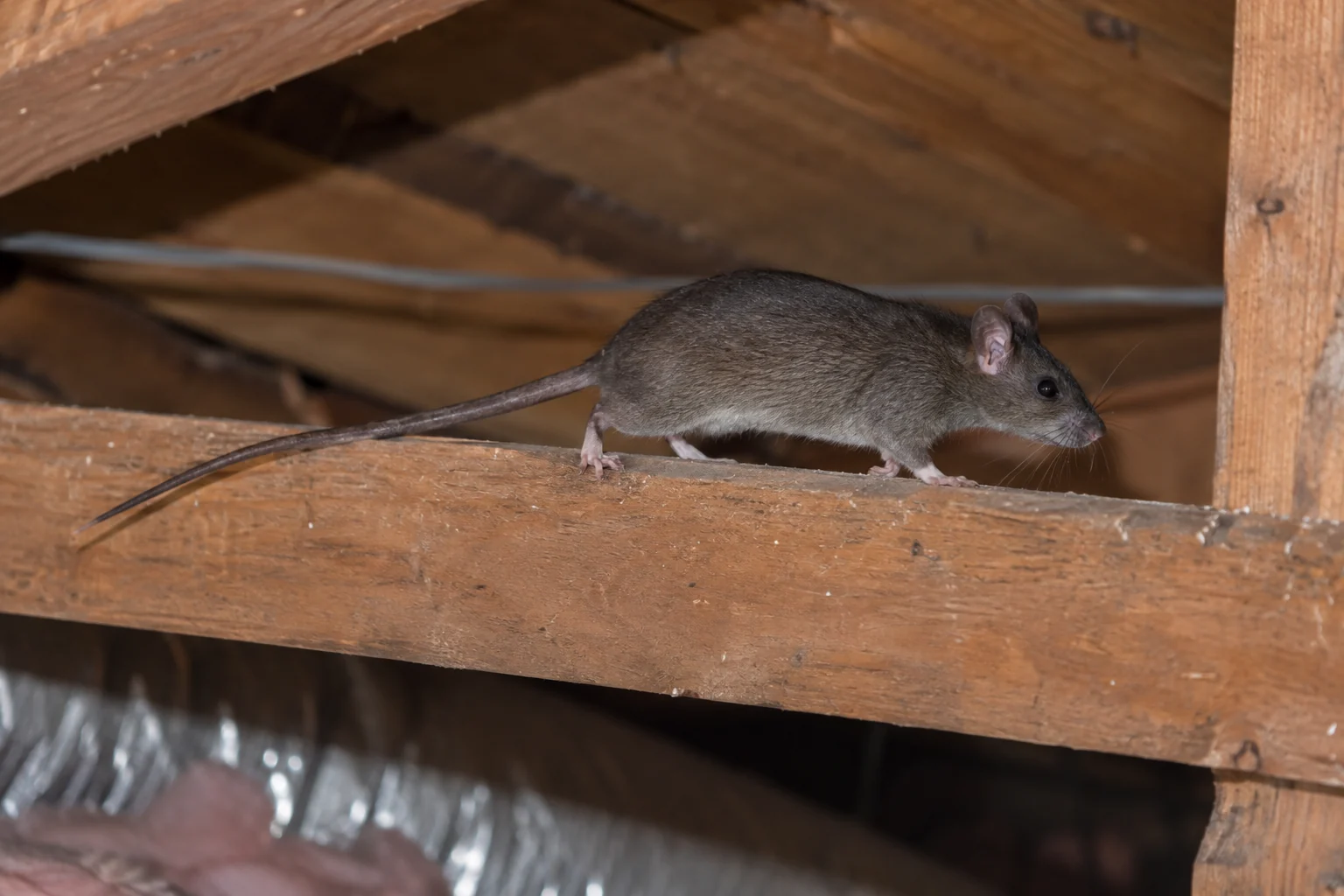
The roof rat is a slender, agile rat strongly associated with climbing and elevated travel.
It is also commonly called the black rat, although actual fur color can range from dark gray or brown to blackish tones.
Roof rats often use:
- trees
- fences
- vines
- utility lines
- roof edges
- attic spaces
- upper wall routes
They are especially important where vegetation or attached structures provide direct access to the roofline.
See Roof Rat: Identification, Signs & Behavior for the full species guide.
What Is a Norway Rat?
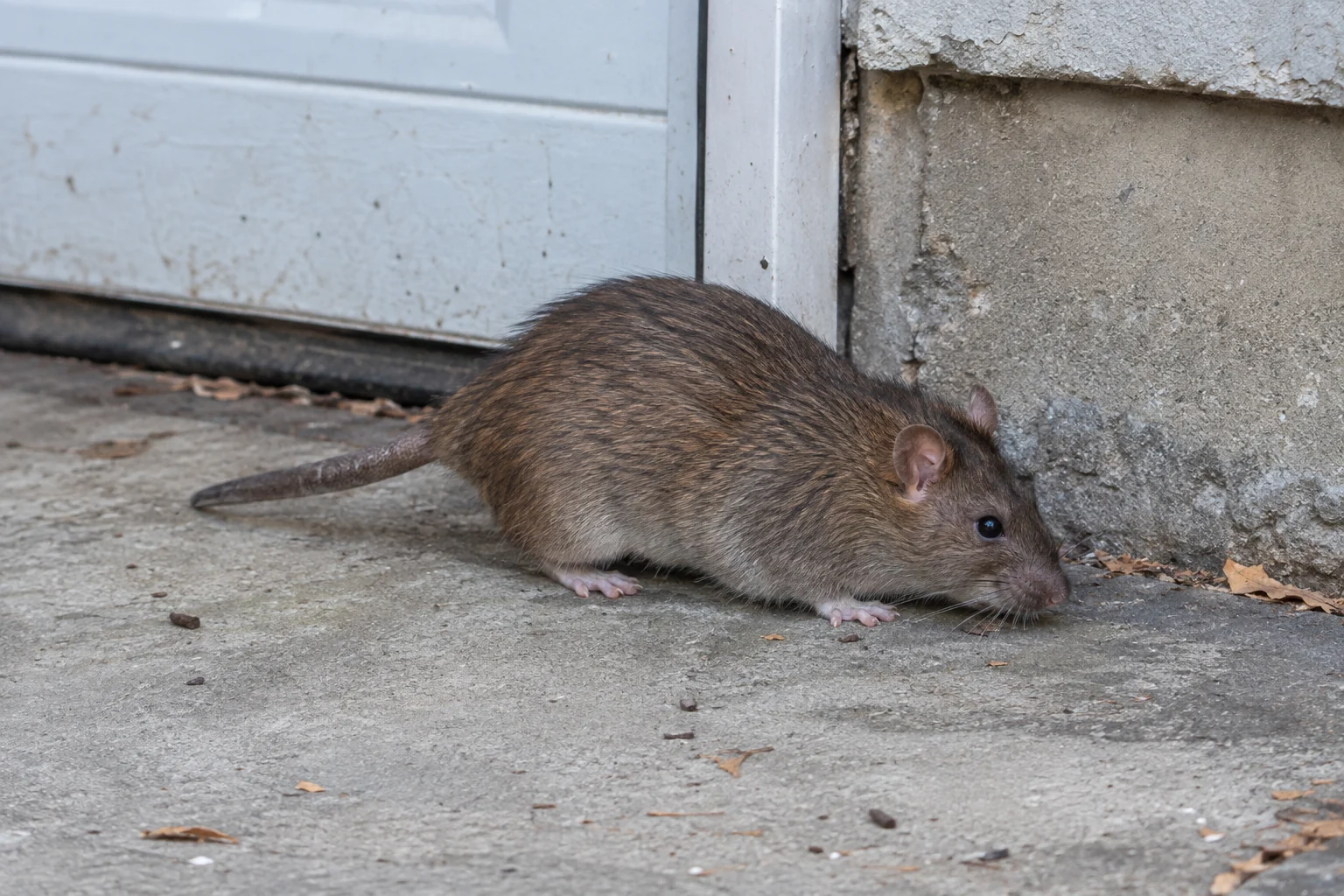
The Norway rat is a larger, heavier-bodied rat strongly associated with ground-level movement and burrowing.
It is also called the brown rat.
Norway rats commonly use:
- foundation edges
- burrows
- garages
- basements
- crawl spaces
- lower wall routes
- outdoor garbage areas
They are capable climbers, but their overall behavior is more strongly tied to the ground than that of roof rats.
See Norway Rat: Identification, Signs & Behavior for the full species guide.
1. Body Shape
Body build is one of the easiest differences when you see the entire animal.
Roof Rat
A roof rat usually looks:
- slim
- narrow-bodied
- agile
- relatively light-framed
The body often appears more elongated and delicate than a Norway rat.
Norway Rat
A Norway rat usually looks:
- heavy
- thick-bodied
- stocky
- muscular
The body is more robust, especially through the shoulders and torso.
If one rat looks noticeably heavier and blockier, Norway rat becomes more likely.
2. Muzzle Shape
The muzzle is another useful clue.
Roof Rat Muzzle
Roof rats usually have a more pointed, tapered muzzle.
The head can appear narrower from the side.
Norway Rat Muzzle
Norway rats usually have a broader, blunter muzzle.
The head often looks heavier and less sharply tapered.
A clear side-profile photograph can make this difference easier to see.
3. Ear Size
Ear proportions differ.
Roof Rat Ears
Roof rats usually have relatively large ears.
The ears can appear prominent compared with the head.
Norway Rat Ears
Norway rats usually have smaller ears relative to their head and body.
The ears often look less prominent because the entire animal is heavier.
Ear size is useful as a supporting clue, not a standalone identifier.
4. Eye Size
Roof rats typically have relatively large, prominent eyes.
Norway-rat eyes look smaller in proportion to the heavier head.
This difference can help in a clear photograph.
However, lighting and viewing angle can make eye size misleading.
Use it together with body shape, muzzle, ears, and tail.
5. Tail Length
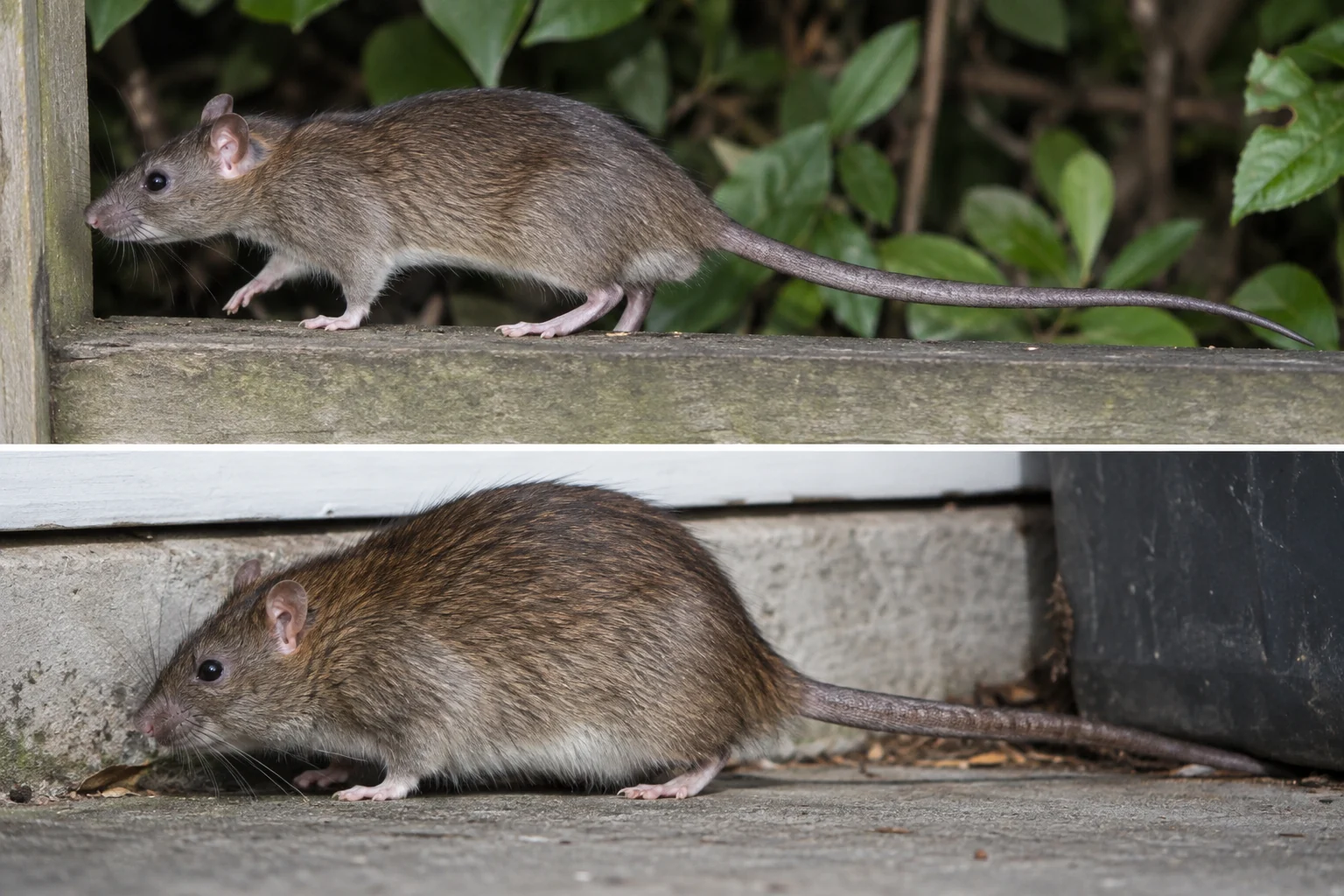
Tail length is one of the strongest structural differences.
Roof Rat Tail
A roof rat's tail is typically longer than the combined length of its head and body.
It often looks:
- long
- thin
- flexible
The long tail helps support balance while climbing.
Norway Rat Tail
A Norway rat's tail is typically shorter than the combined length of its head and body.
It is often:
- thicker
- heavier-looking
- less strikingly long in proportion to the body
If a clear side view shows the tail extending noticeably beyond the head-and-body length, roof rat becomes more likely.
6. Tail Thickness
Length is more useful than thickness, but thickness can support the identification.
Roof-rat tails usually look relatively slender compared with the body.
Norway-rat tails tend to look heavier and thicker, especially near the base.
Do not judge species from tail thickness alone.
7. Fur Color
Color is much less reliable than body proportions.
Roof Rat Color
Roof rats may be:
- dark brown
- gray-brown
- blackish
- mixed dark tones
Norway Rat Color
Norway rats may be:
- brown
- gray-brown
- coarse mixed brown and gray
The names "black rat" and "brown rat" can be misleading if treated literally.
There is enough color overlap that fur color alone should not determine the species.
8. Belly Color
Roof rats may have a lighter belly that contrasts somewhat with the back.
Norway rats may also have lighter underparts.
Belly color varies and is not one of the strongest identification features.
Use it only as supporting evidence.
9. Overall Size
Norway rats are generally heavier and more robust than roof rats.
But size can overlap because of:
- age
- sex
- nutrition
- individual variation
A young Norway rat may look smaller than a large adult roof rat.
That is why body proportions are usually more useful than size alone.
10. Which Rat Is the Better Climber?
Roof rats are the stronger climbing specialists.
They may move along:
- trees
- fences
- vines
- pipes
- roof edges
- beams
- attic framing
This behavior explains why roof-rat activity is often concentrated above ground level.
Norway rats can climb too.
Seeing a rat above ground does not automatically make it a roof rat.
But repeated elevated activity strongly supports roof rat when the body proportions also match.
11. Which Rat Is More Likely to Burrow?
Norway rats are strongly associated with burrowing.
Common burrow areas include:
- beside foundations
- under decks
- near sheds
- under dense vegetation
- along landscape edges
- near garbage areas
A substantial burrow network close to a building makes Norway rat more likely.
Roof rats can use ground-level shelter, but extensive burrowing is much more characteristic of Norway rats.
12. Roof Rat Habitat
Roof rats are strongly associated with elevated and sheltered environments.
Around homes, they may use:
- attics
- rafters
- rooflines
- upper wall voids
- trees
- palms
- fences
- dense vines
- overhead utility routes
They are especially common in warmer regions, although local populations vary.
Geography alone should not be used to identify a rat.
13. Norway Rat Habitat
Norway rats are strongly associated with ground-level environments.
Common locations include:
- basements
- crawl spaces
- garages
- foundations
- sewers and drainage environments
- burrows
- outdoor garbage areas
- sheds
They are widespread and highly adaptable.
A rat repeatedly moving along the lower exterior foundation is more consistent with Norway-rat behavior than a rat repeatedly traveling the roofline.
14. Which Rat Is More Likely in an Attic?
Roof rats are more strongly associated with attics.
Their climbing ability allows them to reach:
- soffits
- roof vents
- fascia gaps
- roof-wall intersections
- upper wall routes
However, Norway rats can reach attics in some buildings.
Attic location alone is not enough.
Look at:
- droppings
- tracks
- body proportions
- tail length
- entry route
See Rats in the Attic: Signs, Damage & Removal.
15. Which Rat Is More Likely in a Basement?
Norway rats are more strongly associated with basements and lower levels.
They may enter through:
- foundation defects
- utility penetrations
- damaged vents
- crawl-space routes
Large droppings and rub marks concentrated along basement walls support a ground-travel pattern.
Roof rats can enter lower levels too, but it is less characteristic.
16. Which Rat Is More Likely in a Crawl Space?
Norway rats are the more typical crawl-space species.
Crawl spaces provide:
- shelter
- foundation access
- plumbing routes
- low disturbance
Inspect for:
- large droppings
- tracks
- grease marks
- burrows near the exterior
- disturbed insulation
17. Which Rat Is More Likely in a Garage?
Either species can use a garage.
Norway rats may enter from:
- ground-level door gaps
- foundation routes
- nearby burrows
Roof rats may enter a garage and then move upward into:
- wall voids
- rafters
- attic connections
Use the rat's body proportions and the travel route together.
18. Roof Rat vs Norway Rat Droppings
Droppings can support identification but should not be used alone.
Roof Rat Droppings
Roof-rat droppings are often described as:
- elongated
- tapered
- spindle-shaped
- pointed at one or both ends
Norway Rat Droppings
Norway-rat droppings are often:
- thick
- capsule-like
- more blunt-ended
Both are much larger than typical mouse droppings.
For more detail, see Rat Droppings: What They Look Like & What They Mean and Mouse vs Rat Droppings: How to Tell the Difference.
Can Droppings Identify Roof Rat vs Norway Rat by Themselves?
Not reliably.
Dropping shape and size can vary with:
- age
- diet
- hydration
- individual rat size
- drying
Use droppings with:
- body sightings
- tail length
- tracks
- burrows
- rub marks
- activity height
- entry routes
A clear photograph of the animal is usually more useful.
Tracks
Both species leave rat-sized tracks.
Track size can overlap.
The location of tracks may be more helpful than the exact footprint dimensions.
Tracks on dusty attic framing support an elevated travel route.
Tracks beside foundation burrows support a ground-level route.
Grease or Rub Marks
Both roof rats and Norway rats can leave dark grease marks along repeated travel routes.
Look for marks on:
- wall edges
- beams
- pipes
- foundation routes
- attic framing
The height and location of the rub mark can support the identification.
A high beam route suggests roof-rat behavior.
A ground-level foundation route suggests Norway-rat behavior.
Gnawing
Both species gnaw.
Rat gnaw marks are heavier than mouse gnawing.
Possible damage includes:
- food containers
- wood
- plastic
- wiring insulation
- stored materials
Gnawing usually confirms rat activity better than it distinguishes roof rat from Norway rat.
Nesting Differences
Roof rats may nest in:
- attics
- rafters
- dense vegetation
- elevated protected spaces
Norway rats may nest in:
- burrows
- crawl spaces
- lower structural voids
- ground-level protected areas
Both species can adapt when ideal sites are unavailable.
Roof Rat Entry Points
Roof rats may enter through:
- soffit gaps
- fascia defects
- attic vents
- roof-wall intersections
- upper siding gaps
- openings reached from trees or fences
Inspect the route from the surrounding property to the roofline.
See How Rats Get Into Your House for a full entry-point guide.
Norway Rat Entry Points
Norway rats may enter through:
- foundation gaps
- crawl-space openings
- garage-door gaps
- exterior doors
- utility penetrations
- damaged lower vents
Also inspect for active burrows near the building.
Can Roof Rats Enter at Ground Level?
Yes.
Roof rats are excellent climbers, but they still spend time on the ground.
They may enter through a ground-level opening and climb inside the structure.
The name "roof rat" describes a strong behavioral tendency, not a rule that the animal always enters through the roof.
Can Norway Rats Climb?
Yes.
Norway rats can climb when needed.
They can use:
- rough surfaces
- pipes
- structural framing
- stacked objects
They are simply less specialized for elevated travel than roof rats.
Do not identify a rat solely because it climbed.
Which Rat Is More Likely Around Trees?
Roof rats are more strongly associated with trees and vegetation that provide elevated travel.
Properties with:
- fruit trees
- palms
- dense vines
- branches touching roofs
may provide roof-rat access.
But food and shelter can attract Norway rats to the same property.
Which Rat Is More Likely Near Burrows?
Norway rats are much more strongly associated with visible ground burrows.
An active burrow beside a foundation, deck, garbage area, or shed is a strong Norway-rat clue.
Look for supporting evidence such as:
- large droppings
- worn paths
- grease marks
- nighttime sightings
Which Rat Is More Common in the United States?
Norway rats are widespread across the United States.
Roof rats are also established in the country and are especially important in many warmer and coastal areas.
Local distribution varies.
Do not use a state or region alone to identify the species.
Structural evidence and body features are more reliable.
Can Both Species Live on the Same Property?
Yes.
A property can support both species, especially where there is:
- food
- water
- dense vegetation
- structures
- burrowing habitat
However, do not assume two species are present just because activity occurs at different heights.
Try to confirm species from clear evidence.
Does Species Change the Trap You Use?
Both require rat-sized traps.
The major difference is placement.
For Roof Rats
Prioritize confirmed elevated routes such as:
- attic framing
- upper wall routes
- garage rafters
- accessible ledges
For Norway Rats
Prioritize:
- ground-level walls
- garage routes
- basement edges
- crawl-space routes
- paths near burrows
See Best Rat Traps: Which Type Works Best & How to Choose and Rat Traps: Types, Placement & How to Use Them.
Trap Safety
Rat traps are powerful.
Keep them:
- inaccessible to children
- inaccessible to pets
- away from normal foot traffic
- secured or protected where necessary
Always follow the trap manufacturer's instructions.
Does Species Change the Exclusion Plan?
Yes, because the highest-priority entry points differ.
For roof rats, inspect:
- rooflines
- soffits
- attic vents
- trees
- fences
- elevated structures
For Norway rats, inspect:
- foundations
- burrows
- crawl spaces
- garage doors
- lower vents
- utility penetrations
A complete inspection should still cover the entire building.
See Rodent Exclusion: How to Keep Rats & Mice Out.
What to Do If You Find a Roof Rat
If the evidence points toward roof rats:
- inspect the attic and upper wall routes
- check roofline entry points
- inspect trees, fences, and vegetation touching or approaching the structure
- place rat-sized traps on confirmed accessible routes
- coordinate trapping with exclusion
- continue monitoring for fresh evidence
Do not perform unsafe roof work.
What to Do If You Find a Norway Rat
If the evidence points toward Norway rats:
- inspect foundations and garages
- check for burrows
- inspect basements and crawl spaces
- identify ground-level entry points
- place rat-sized traps on confirmed routes
- coordinate removal with exclusion
- monitor for fresh burrow activity
When to Call a Professional
Professional rat control may be useful when:
- you cannot identify the species
- rats are active in multiple areas
- roofline access is difficult
- burrows are widespread
- attic or crawl-space contamination is extensive
- DIY trapping is not reducing activity
- exclusion requires structural repair
See Rat Exterminator: What to Expect & When to Call One for the professional process.
Roof Rat vs Norway Rat: The Bottom Line
The strongest visual differences are body build and tail proportion.
A roof rat usually has:
- a slimmer body
- a pointed muzzle
- relatively large ears
- relatively large eyes
- a tail longer than the head and body
- stronger association with climbing and elevated routes
A Norway rat usually has:
- a heavier, stockier body
- a blunter muzzle
- relatively small ears
- smaller-looking eyes
- a tail shorter than the head and body
- stronger association with burrows and ground-level routes
Do not rely on color alone.
Do not rely on droppings alone.
Combine the animal's proportions with where the evidence occurs.
Continue with our roof rat guide, Norway rat guide, rat vs mouse guide, signs of rats guide, rat droppings guide, how rats get into a house, rodent exclusion guide, or best rat traps guide.
For the broader overview, return to Rats & Mice in the Home.