Mouse vs Rat Droppings: How to Tell the Difference
Mouse and rat droppings can look similar at first glance, but there are useful differences in size, shape, quantity, and where they are found.
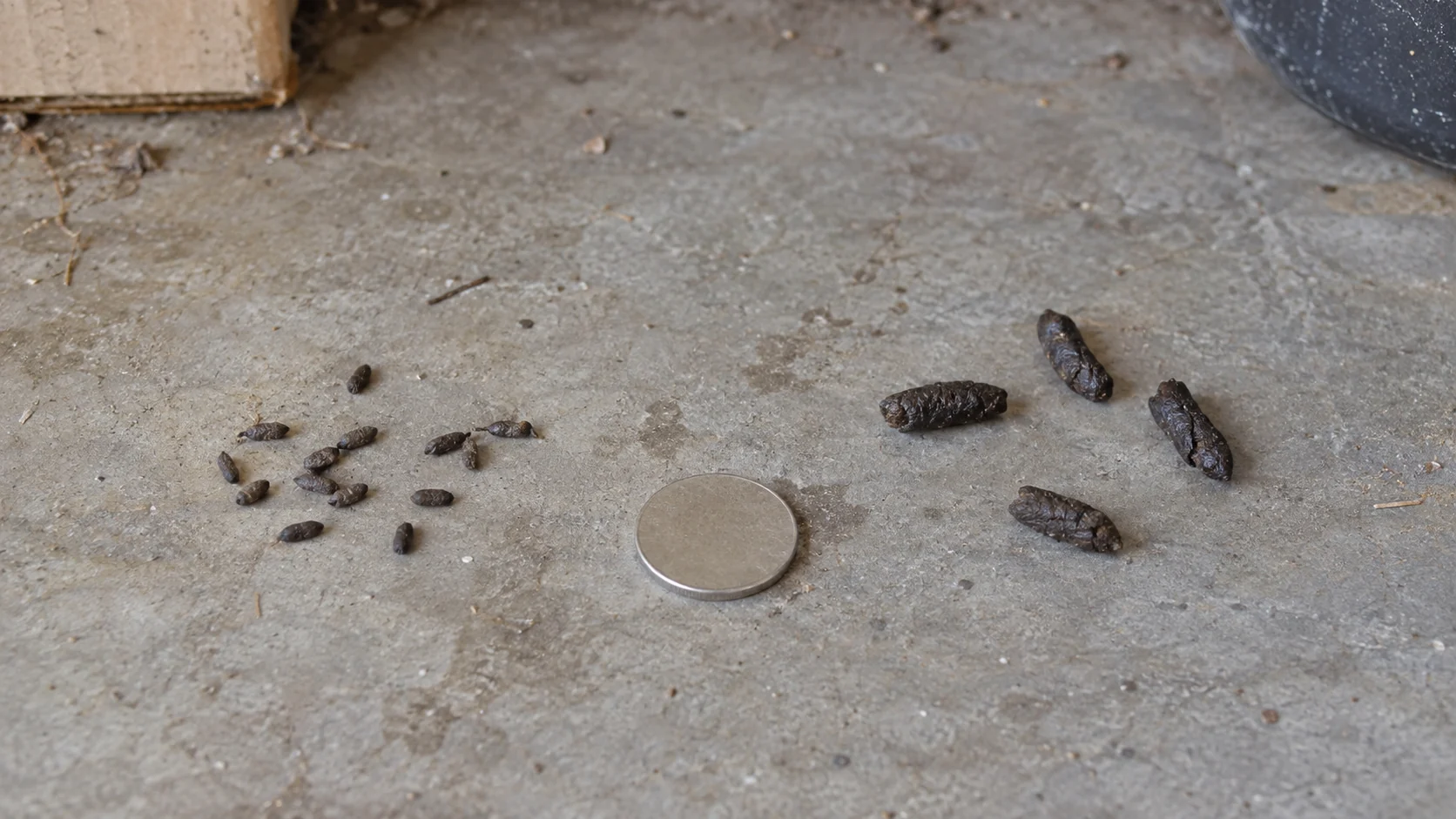
Mouse and rat droppings can look similar at first glance, but there are useful differences in size, shape, quantity, and where they are found.
In general:
- mouse droppings are smaller and more numerous
- rat droppings are larger and heavier
- mouse droppings often appear like small dark grains
- rat droppings are usually thicker and easier to notice individually
Droppings alone do not always identify the species with certainty.
The strongest identification comes from combining:
- dropping size
- dropping shape
- location
- tracks
- gnaw marks
- rub marks
- nesting evidence
- sightings
This guide explains the practical differences between mouse and rat droppings and what each pattern can mean inside a home.
Mouse vs Rat Droppings at a Glance
A quick comparison:
| Feature | Mouse Droppings | Rat Droppings |
|---|---|---|
| Typical size | Small, often roughly 1/8 to 1/4 inch | Larger, often roughly 1/2 inch or more |
| Shape | Narrow, rice-like, often pointed at one or both ends | Thicker, capsule- or spindle-like depending on species |
| Quantity | Often numerous and scattered | Often fewer but much larger |
| Common locations | Cabinets, drawers, behind appliances, pantries, garages, attics | Garages, basements, attics, crawl spaces, along walls, near burrows |
| Associated evidence | Small gnaw marks, tiny tracks, nesting material | Heavy gnawing, grease marks, larger tracks, burrows |
These are practical identification clues, not rigid measurements.
Dropping size can vary with:
- animal age
- diet
- hydration
- species
- individual size
Use the overall pattern rather than one dropping alone.
What Mouse Droppings Look Like
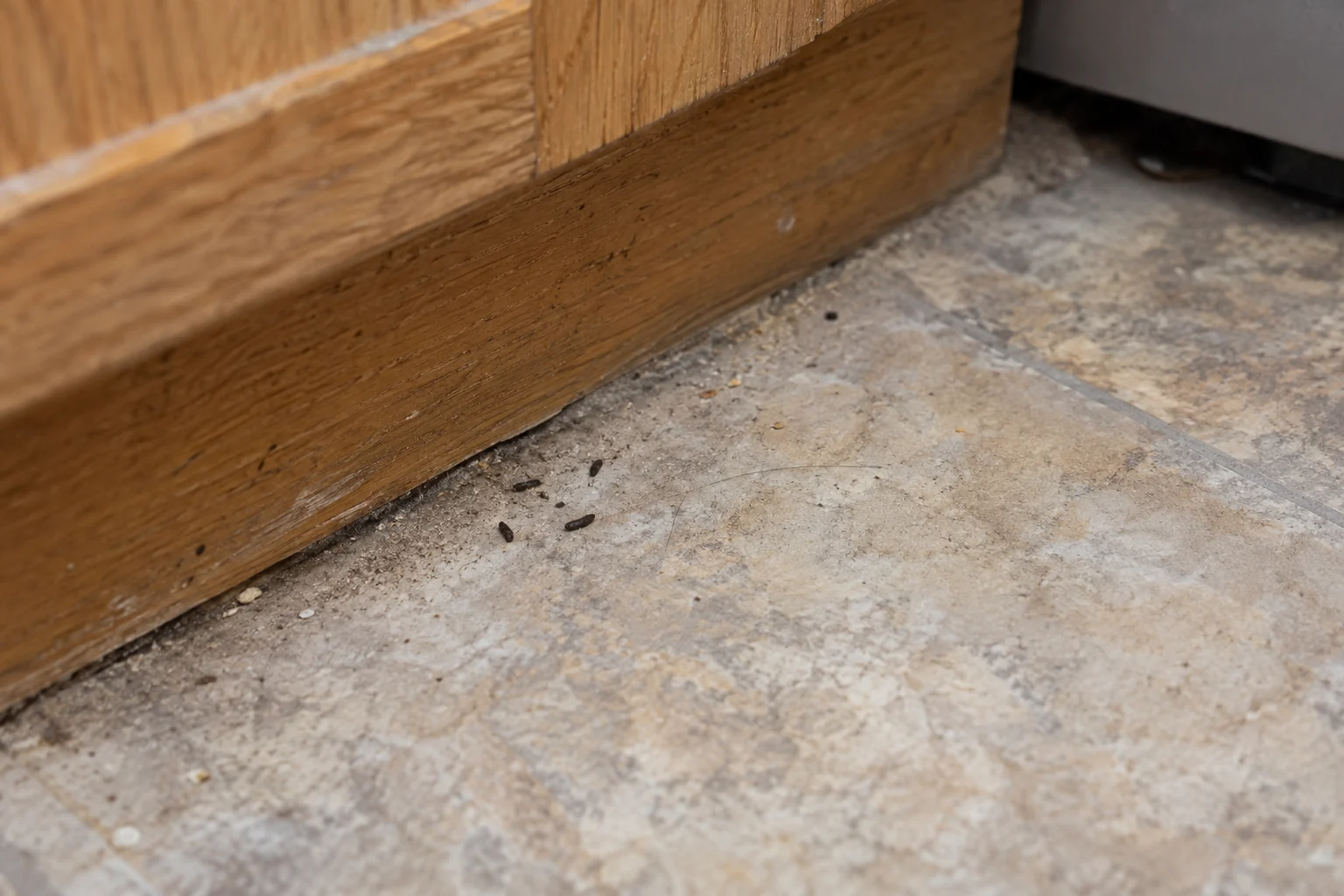
Mouse droppings are small, dark pellets.
They often look:
- narrow
- rice-like
- tapered
- scattered
- numerous
Fresh mouse droppings may appear:
- dark
- slightly shiny
- softer
Older droppings may become:
- dull
- grayish
- dry
- brittle
For a full guide, see Mouse Droppings: What They Look Like & What They Mean.
What Rat Droppings Look Like
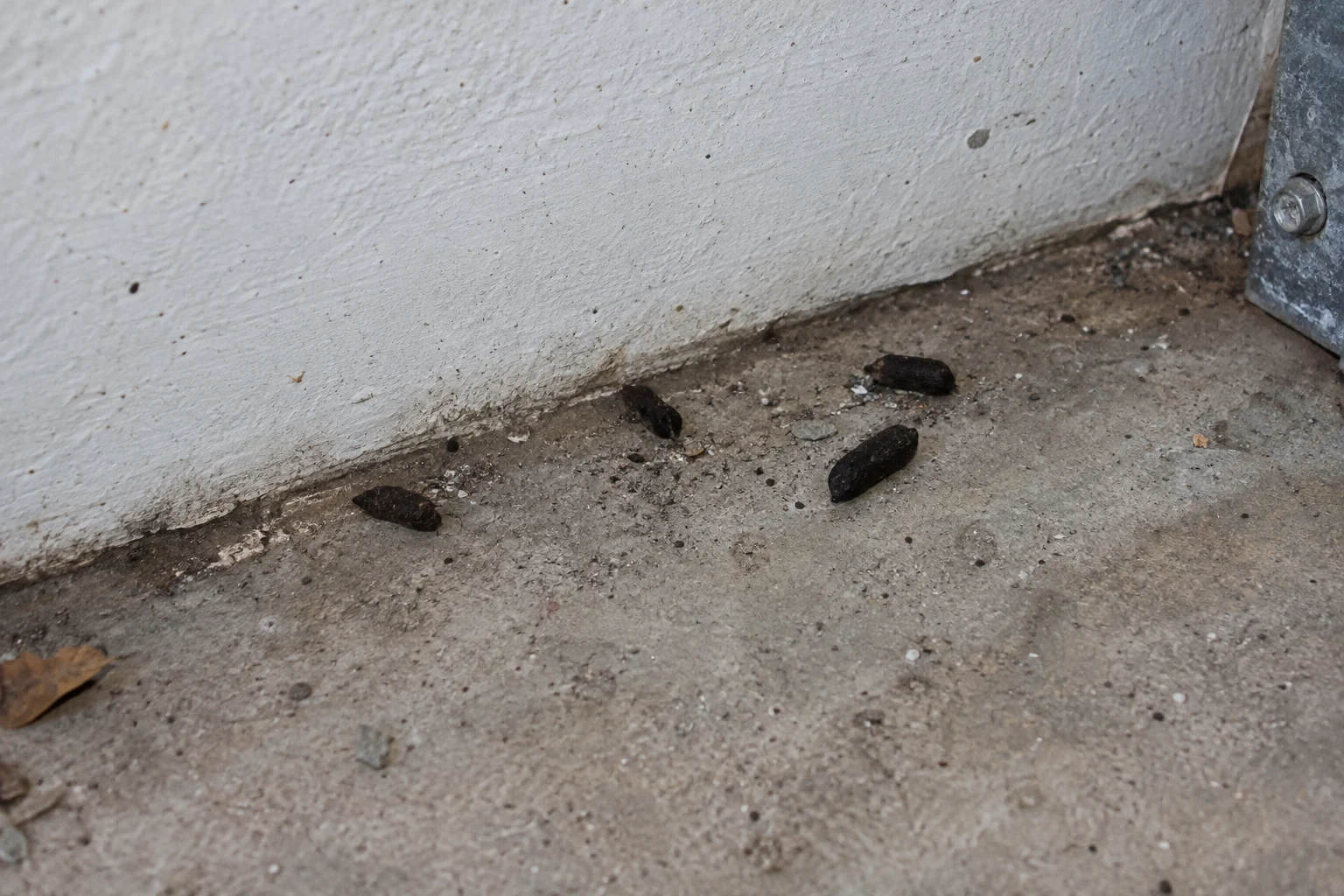
Rat droppings are noticeably larger than mouse droppings.
They are often:
- thicker
- heavier
- darker
- easier to see individually
Shape depends partly on the rat species.
Norway-rat droppings are often described as more blunt or capsule-like.
Roof-rat droppings may look more tapered or spindle-shaped.
For a full guide, see Rat Droppings: What They Look Like & What They Mean.
Size Difference: Mouse vs Rat Droppings
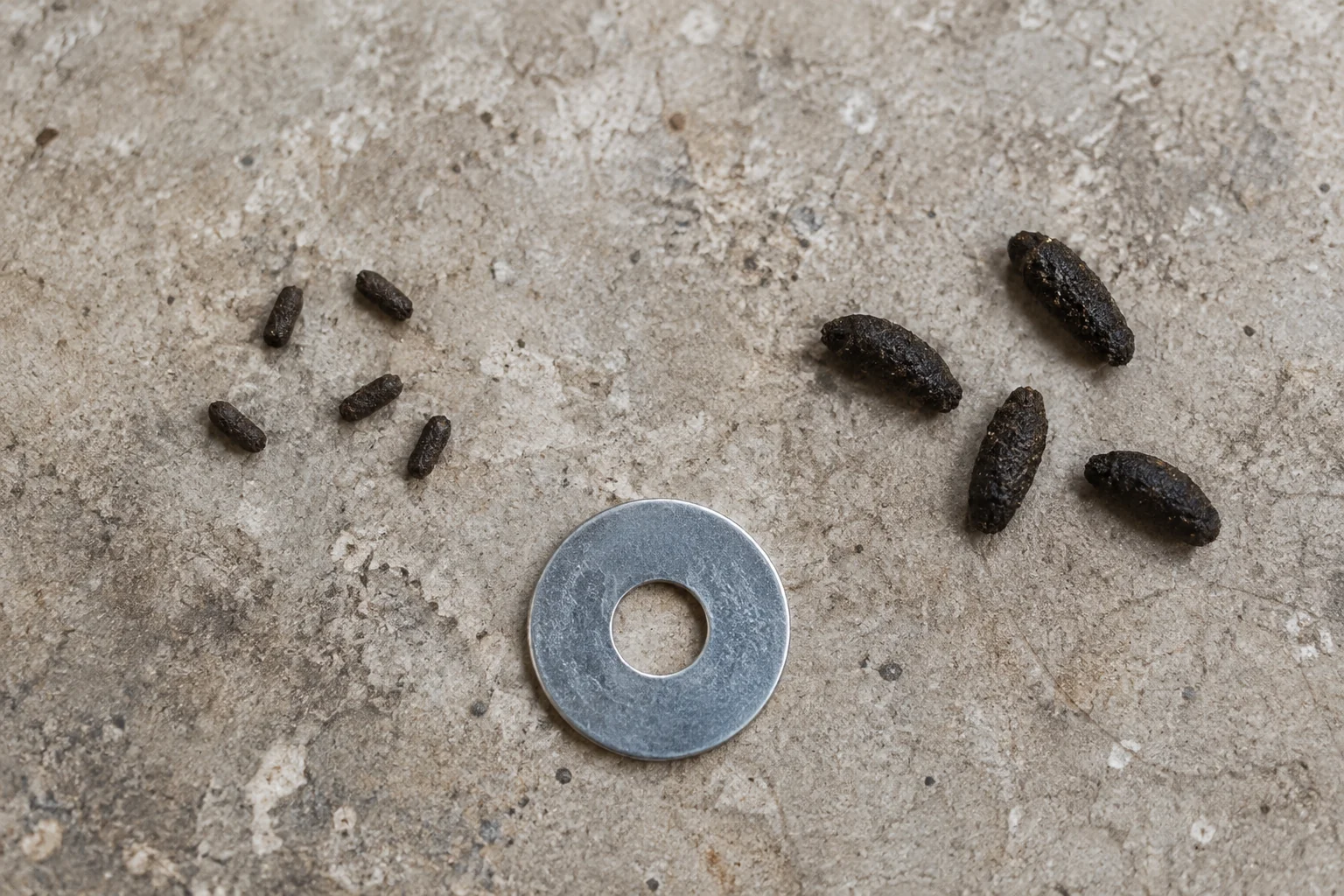
Size is one of the most useful first clues.
Mouse Droppings
Mouse droppings are often roughly:
- 1/8 to 1/4 inch long
- narrow
- lightweight-looking
They are often compared visually to small grains of rice.
Rat Droppings
Rat droppings are often roughly:
- around 1/2 inch or more
- much thicker
- easier to distinguish individually
Large adult rats can leave droppings noticeably larger than the upper end of typical mouse droppings.
The size difference is usually obvious when both are seen side by side.
Shape Difference
Shape can help when size is ambiguous.
Mouse Dropping Shape
Mouse droppings often have:
- narrow bodies
- pointed ends
- relatively uniform small size
Rat Dropping Shape
Rat droppings may be:
- thicker
- blunt-ended
- spindle-shaped
- more capsule-like
Norway-rat and roof-rat droppings can differ in shape.
That is one reason species identification should include more than feces alone.
Norway Rat Droppings
Norway-rat droppings are generally:
- large
- thick
- dark
- more blunt-ended than mouse droppings
They are often found in:
- basements
- garages
- crawl spaces
- lower wall routes
- areas near burrows
If the evidence is concentrated near ground level, Norway rats become more plausible.
See Norway Rat: Identification, Signs & Behavior.
Roof Rat Droppings
Roof-rat droppings are also much larger than mouse droppings but may look:
- narrower than Norway-rat droppings
- more tapered
- spindle-shaped
They are often associated with:
- attics
- rooflines
- upper wall routes
- garages connected to attics
- elevated storage
See Roof Rat: Identification, Signs & Behavior.
Quantity: Which Rodent Leaves More Droppings?
Mice often leave many small droppings along active routes.
You may find:
- dozens of pellets
- scattered droppings behind appliances
- repeated droppings in cabinets
- small clusters in drawers or pantries
Rat droppings are larger and usually easier to count individually.
The total number of droppings does not tell you exactly how many rodents are present.
One active rodent can leave repeated evidence over time.
Do not estimate infestation size from pellet count alone.
Where Mouse Droppings Are Commonly Found
Mouse droppings often appear in protected indoor spaces.
Common locations include:
- kitchen cabinets
- pantry shelves
- drawers
- under sinks
- behind refrigerators
- behind stoves
- garages
- attics
- utility rooms
- storage areas
Mice often travel close to walls and edges.
A line or cluster of small droppings can reveal the travel route.
Where Rat Droppings Are Commonly Found
Rat droppings may be found in:
- garages
- basements
- crawl spaces
- attics
- along foundation walls
- near utility penetrations
- near stored food
- near active burrows
Roof rats can leave droppings in elevated areas.
Norway rats are more strongly associated with lower structural routes.
Mouse Droppings Behind Appliances
Small droppings behind a refrigerator or stove often suggest mouse activity.
These areas provide:
- warmth
- food crumbs
- wall edges
- utility gaps
- low disturbance
Inspect nearby:
- baseboards
- utility penetrations
- cabinet voids
- wall gaps
Droppings should be treated as route evidence, not just a cleaning problem.
Rat Droppings in a Garage
Large droppings along garage walls can suggest rat activity.
Inspect nearby:
- garage-door corners
- stored pet food
- bird seed
- garbage
- wall penetrations
- foundation edges
Heavy gnaw marks or grease marks make rat activity even more likely.
Droppings in an Attic
Both mice and rats can leave droppings in attics.
Use size and associated evidence to distinguish them.
Mouse attic evidence
May include:
- tiny droppings
- light gnawing
- small tracks
- delicate nesting material
Rat attic evidence
May include:
- larger droppings
- heavier movement
- larger tracks
- stronger gnawing
- rub marks
See Mice in the Attic: Signs, Damage & Removal and Rats in the Attic: Signs, Damage & Removal.
Droppings in Walls
Rodents moving inside walls may leave droppings near:
- plumbing openings
- cabinet gaps
- utility penetrations
- attic connections
- garage wall routes
The droppings may appear only where the rodent exits the wall.
For hidden activity, see Mice in Walls and Rats in Walls.
Fresh vs Old Droppings
Freshness can help determine whether activity is current.
Fresh rodent droppings may appear:
- dark
- slightly shiny
- softer
Older droppings may become:
- dull
- dry
- grayish
- brittle
Do not handle droppings with bare hands to test freshness.
Use visual evidence and ongoing monitoring instead.
Does One Dropping Identify the Rodent?
Not reliably.
One dropping may be:
- damaged
- old
- misshapen
- partially dried
- from another small animal
Identification is stronger when you have several pieces of evidence.
Look for:
- multiple droppings
- tracks
- gnaw marks
- nesting
- rub marks
- sightings
- trap activity
Mouse Droppings vs Small Rat Droppings
A young rat can leave smaller droppings than a large adult rat.
That can create confusion.
If the droppings seem too large for a mouse but smaller than expected for a rat, inspect the rest of the evidence.
Look for:
- track size
- gnaw width
- rub marks
- burrows
- body sightings
- trap captures
Do not identify the species from one borderline pellet.
Mouse Droppings vs Insect Debris
Some insect debris can be confused with mouse droppings.
Mouse droppings are usually:
- larger than cockroach fecal specks
- more pellet-shaped
- easier to see individually
Small cockroach droppings may look more like:
- pepper
- coffee grounds
- dark specks
If the material is extremely small and numerous around cabinets or hinges, insect activity may be worth considering.
Mouse Droppings vs Lizard Droppings
Lizard droppings can sometimes be confused with rodent droppings.
A common clue is a light-colored or white urate portion attached to the dropping.
Rodent droppings usually do not have that white cap.
Location and local wildlife also matter.
Rat Droppings vs Other Animal Droppings
Large insect debris is usually much smaller than rat feces.
Other mammals can leave pellets that overlap somewhat in size.
If the droppings are unusually large, irregular, or located outdoors away from typical rat routes, do not assume rats automatically.
Use tracks and other evidence.
Can You Tell How Many Mice or Rats You Have From Droppings?
No.
Dropping quantity can show:
- active routes
- repeated use
- high-use areas
But it does not provide an accurate rodent count.
A small number of rodents can produce a large amount of evidence over time.
The best measure of control is whether fresh signs continue after treatment.
What a Concentrated Dropping Area Means
A concentrated area may indicate:
- a feeding location
- a nesting area
- a protected travel route
- a place where rodents pause frequently
Inspect nearby for:
- food
- nesting material
- gaps
- plumbing
- appliance spaces
- wall voids
The concentration helps prioritize inspection.
What Scattered Droppings Mean
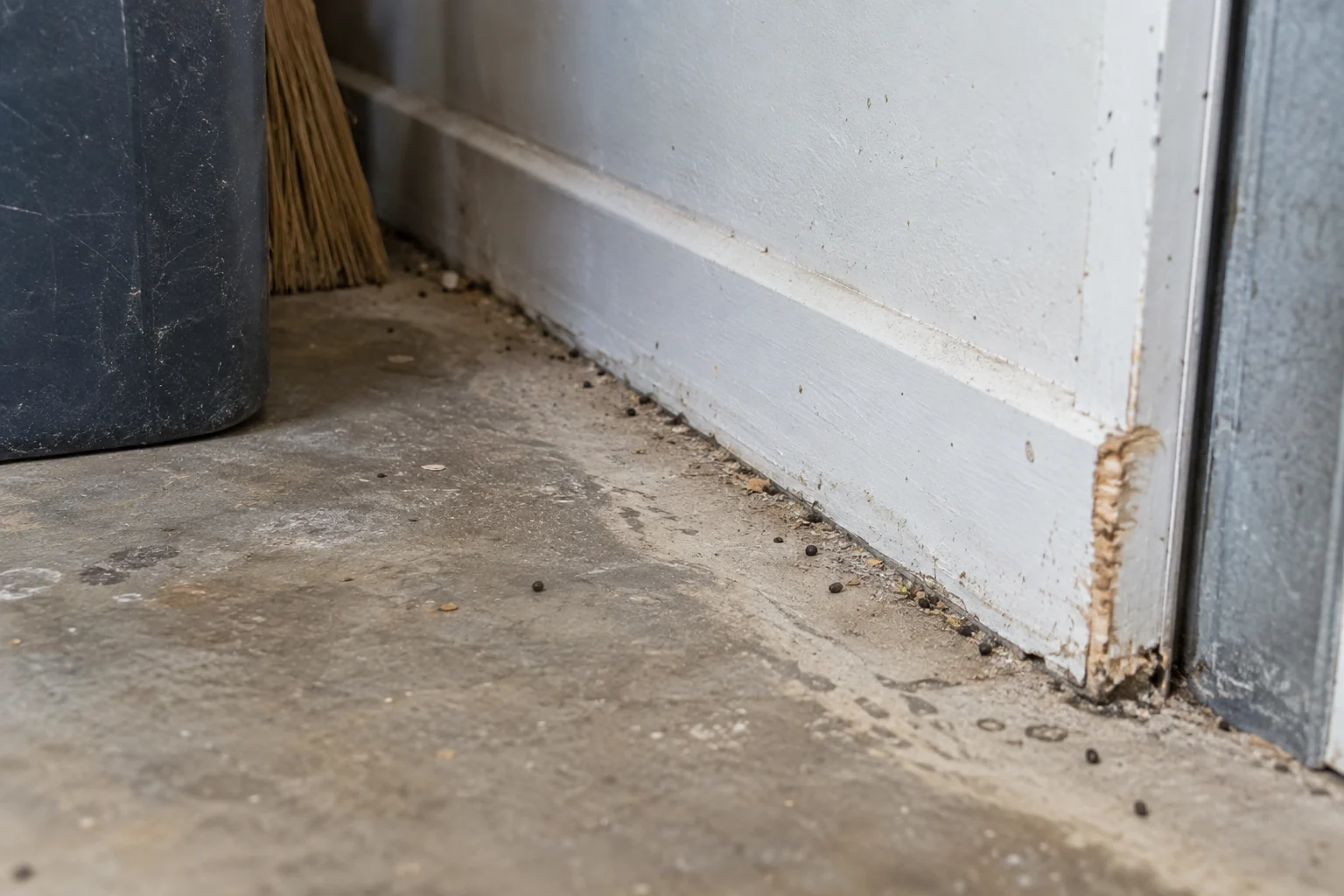
Scattered droppings along walls may show an active travel route.
Follow the pattern toward:
- food
- shelter
- entry points
- wall gaps
- garage doors
- utility penetrations
This can help reveal how rodents move through the structure.
Do Mouse and Rat Droppings Smell Different?
The droppings themselves are not usually the easiest way to distinguish odor.
A strong rodent odor may come from a combination of:
- urine
- droppings
- nesting material
- body oils
- dead rodents
Heavy rat activity may create a stronger odor simply because the animals are larger.
Do not rely on smell alone for species identification.
Are Mouse Droppings Dangerous?
Mouse droppings should be treated as contaminated material.
Avoid:
- touching them with bare hands
- dry sweeping fresh droppings
- vacuuming fresh droppings before proper wet cleanup
- allowing children or pets into contaminated areas
Use suitable gloves and wet-cleanup methods.
See our rodent safety section and cleanup section.
Are Rat Droppings Dangerous?
Rat droppings should also be treated as contaminated material.
The same general precautions apply:
- avoid direct contact
- keep children and pets away
- use gloves
- wet contaminated material before cleanup
- avoid dry sweeping or vacuuming fresh waste
Heavily contaminated attics or crawl spaces may require professional cleanup.
How to Clean Up Mouse or Rat Droppings Safely
A practical cleanup process is:
- keep people and pets away from the area
- ventilate the space when appropriate
- wear suitable gloves
- wet droppings and contaminated material with an appropriate disinfecting solution
- allow adequate contact time
- wipe up the material
- place waste in a suitable bag
- clean the surrounding surface
- wash hands after removing gloves
Do not dry sweep or vacuum fresh rodent waste before wetting and disinfecting it.
Should You Save a Dropping for Identification?
Usually, a clear photograph with scale is safer and more useful than handling the dropping.
If you need help distinguishing mouse from rat evidence:
- photograph several droppings together
- include a common object for scale without touching the waste
- photograph nearby tracks or gnaw marks
- note the location
Avoid unnecessary handling.
What to Do If You Find Mouse Droppings
If the droppings appear mouse-sized:
- identify where they are concentrated
- inspect nearby wall edges and utility gaps
- place mouse-sized traps along active routes
- check for new droppings
- inspect the exterior for entry points
- coordinate trapping with exclusion
For the full removal process, see How to Get Rid of Mice in Your House.
What to Do If You Find Rat Droppings
If the droppings appear rat-sized:
- identify the main route
- check for rub marks and gnawing
- inspect garages, basements, crawl spaces, and attics
- look for burrows outside
- place rat-sized traps on confirmed routes
- inspect entry points
- monitor for fresh evidence
For the full removal process, see How to Get Rid of Rats in Your House.
Mouse vs Rat Droppings and Trap Choice
Dropping size can help you choose the correct trap size.
Mouse-sized evidence
Use:
- mouse-sized snap traps
- mouse-sized enclosed traps
- other devices designed specifically for mice
See Best Mouse Traps: Which Type Works Best & How to Choose.
Rat-sized evidence
Use:
- rat-sized snap traps
- rat-sized enclosed traps
- devices designed for adult rats
See Best Rat Traps: Which Type Works Best & How to Choose.
Using the wrong trap size can reduce effectiveness.
Mouse vs Rat Droppings and Entry Points
Mouse-sized droppings suggest you should inspect even very small gaps around:
- doors
- garage doors
- pipes
- cables
- siding
- vents
Rat-sized evidence shifts more attention toward:
- larger foundation openings
- crawl spaces
- garage gaps
- burrows
- roofline defects
For prevention, see Rodent Exclusion: How to Keep Rats & Mice Out.
When Droppings Keep Returning After Cleanup
If fresh droppings return:
- rodents are still active
- the travel route may still be open
- trapping may be incomplete
- exclusion may be missing an entry point
Clean the area safely, then monitor it.
The return of fresh droppings helps confirm active use.
When to Call a Professional
Professional rodent control may make sense when:
- you cannot tell whether the evidence is mouse or rat
- droppings appear in several rooms
- attic or crawl-space contamination is extensive
- trapping does not reduce activity
- rats are burrowing near the home
- entry points are difficult to find
- roofline work is required
See Rodent Exterminator: What to Expect & When to Call One.
Mouse vs Rat Droppings: The Bottom Line
The easiest practical difference is size.
Mouse droppings are usually small, narrow, and numerous.
Rat droppings are usually much larger, thicker, and more obvious individually.
But do not rely on one pellet.
Combine the droppings with:
- location
- tracks
- gnawing
- rub marks
- nesting material
- sightings
Then choose the correct trap size, trace the active route, and fix the entry point that allows the rodent to enter.
Continue with our mouse droppings guide, rat droppings guide, rat vs mouse guide, signs of mice guide, signs of rats guide, and rodent exclusion guide.
For the broader overview, return to Rats & Mice in the Home.