Deer Mouse vs House Mouse: Key Differences
Deer mice and house mice can both enter homes, garages, sheds, cabins, and other structures, but they are different rodents with useful visual and behavioral differences.
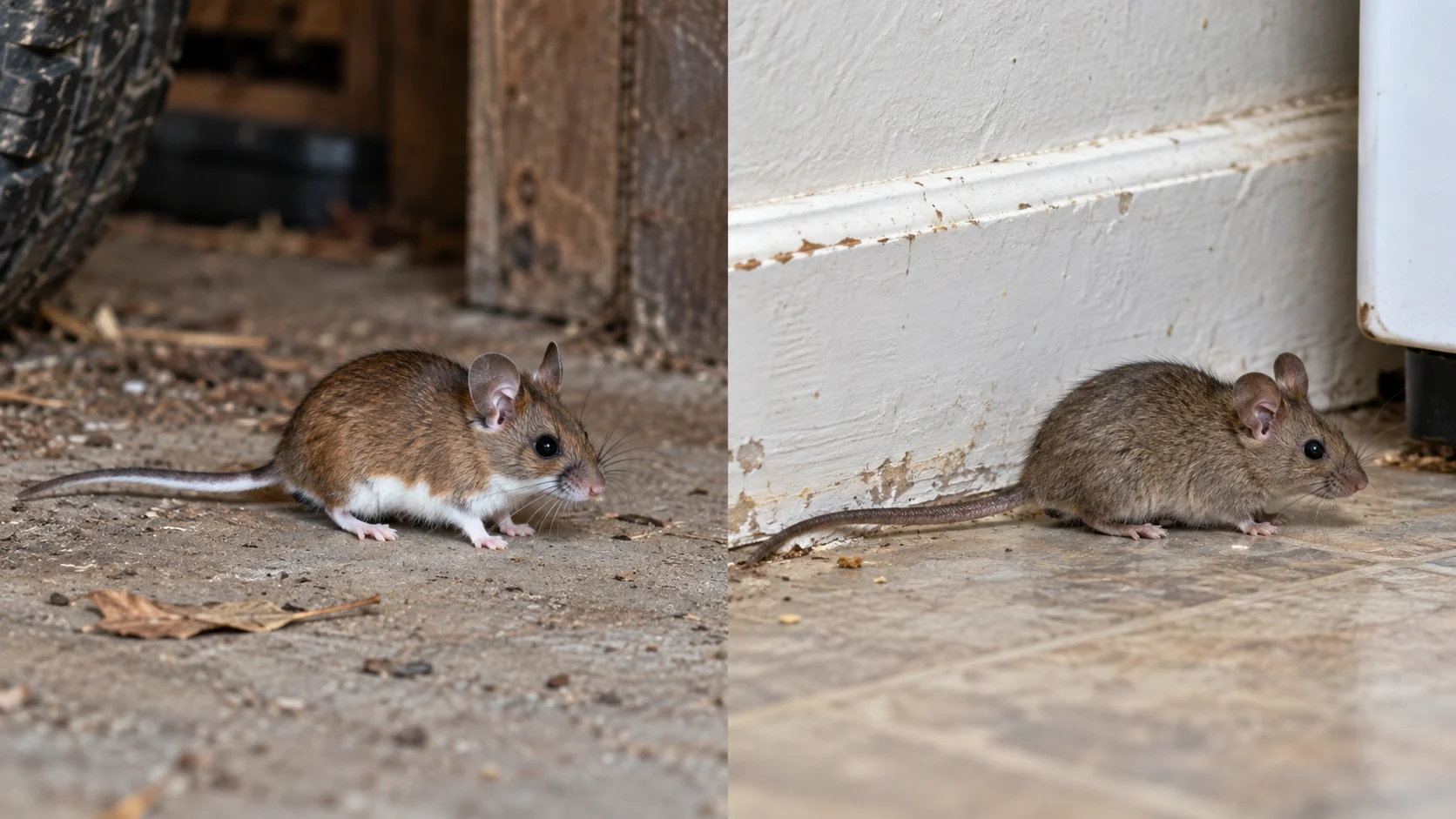
Deer mice and house mice can both enter homes, garages, sheds, cabins, and other structures, but they are different rodents with useful visual and behavioral differences.
The easiest clues are usually:
- body color
- belly color
- tail pattern
- eye and ear size
- where the mouse was found
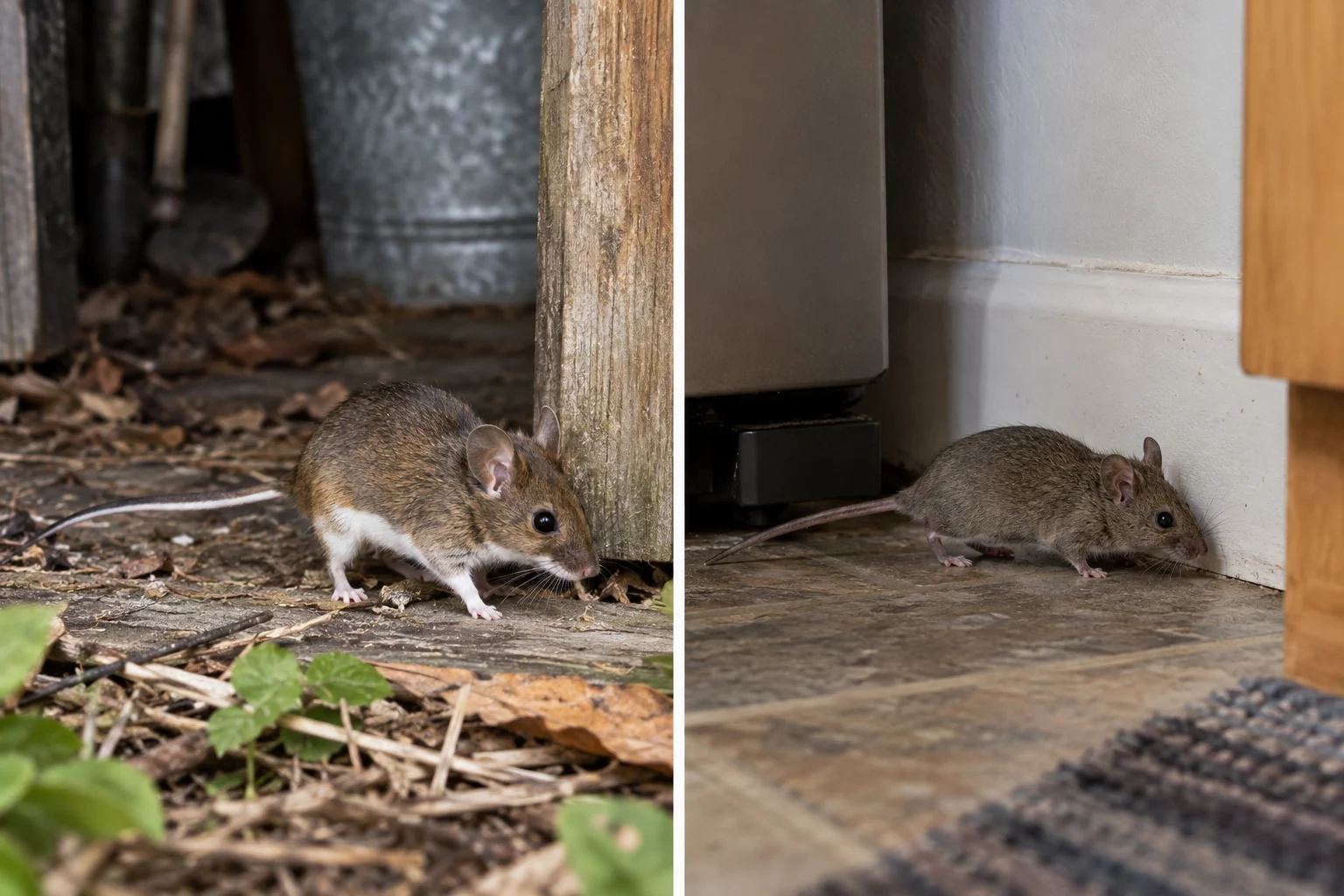
A deer mouse often has a brown or tan upper body with a noticeably white belly and feet, plus a sharply two-toned tail that is darker above and lighter below.
A house mouse is usually more uniformly gray, gray-brown, or dusty brown, with less contrast between the back and belly. Its tail is generally more uniformly colored and has the familiar scaly appearance of a commensal house mouse.
Habitat also matters.
House mice are strongly adapted to living around people and can remain indoors year-round. Deer mice are more strongly associated with outdoor and rural environments but may enter buildings for shelter, especially cabins, garages, sheds, barns, and homes near natural habitat.
This guide compares deer mice and house mice by appearance, behavior, droppings, nesting, habitat, and home-entry patterns.
Deer Mouse vs House Mouse at a Glance
| Feature | Deer Mouse | House Mouse |
|---|---|---|
| Scientific group | Peromyscus species, commonly deer mouse | Mus musculus |
| Upper body | Brown, tan, or gray-brown | Gray, gray-brown, or dusty brown |
| Belly | Usually distinctly white or pale | Usually grayish or only somewhat lighter |
| Feet | Often white | Usually similar to body tone |
| Tail | Often distinctly dark above and pale below | More uniformly colored, scaly |
| Eyes | Relatively large and prominent | Smaller in proportion |
| Ears | Relatively large | Moderate, rounded |
| Common setting | Rural, wooded, grassy, cabins, sheds, garages | Homes, kitchens, walls, garages, warehouses |
| Indoor adaptation | Often enters from outdoor habitat | Highly adapted to living around people |
| Hantavirus relevance | Some deer mice can carry hantaviruses | House mice are not the primary U.S. reservoir associated with Sin Nombre virus |
No single feature should be used alone.
Lighting, age, individual variation, and viewing angle can make identification harder.
What Is a Deer Mouse?
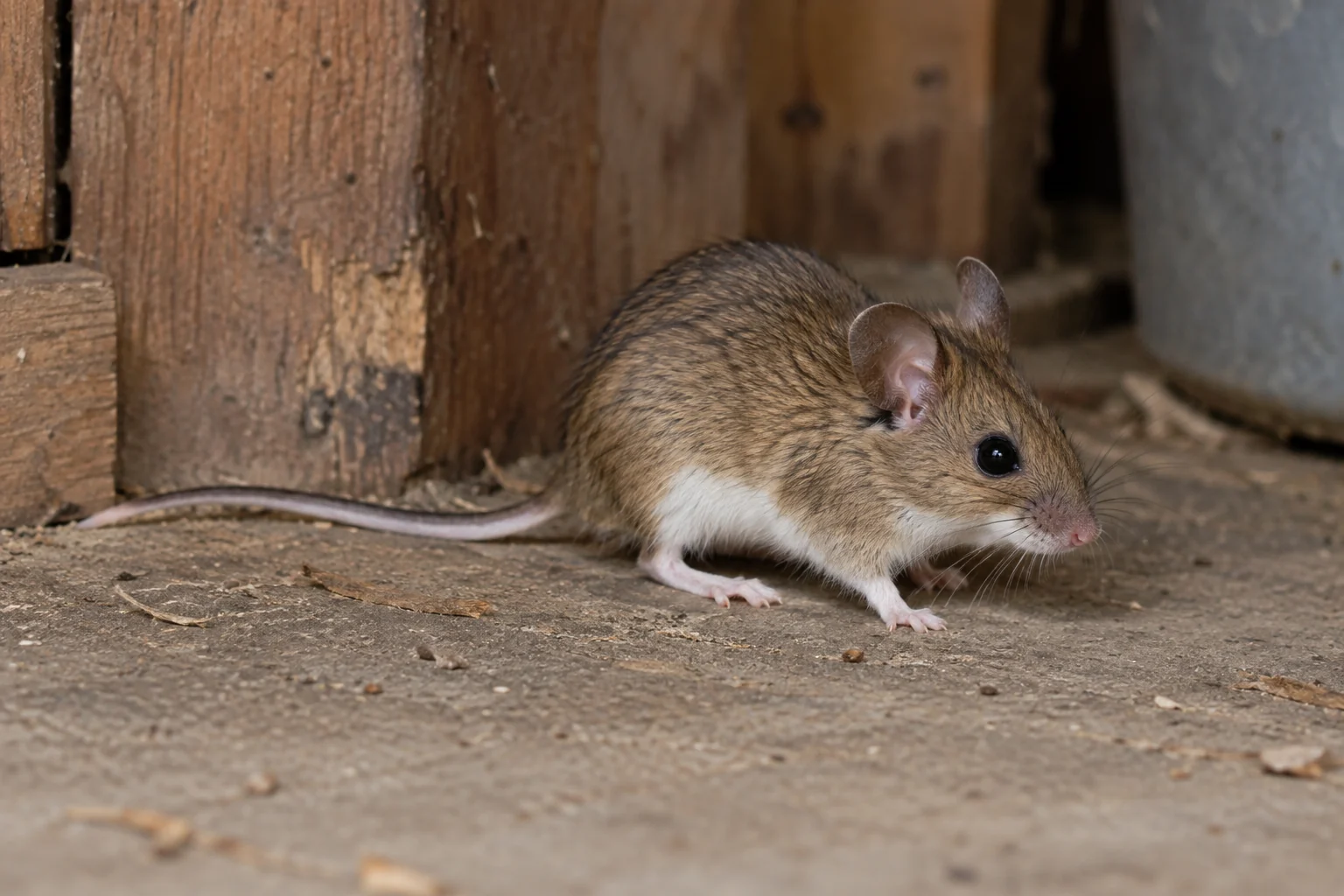
The deer mouse is a small native North American mouse in the genus Peromyscus.
It is strongly associated with outdoor environments such as:
- fields
- woodland edges
- grasslands
- farms
- sheds
- cabins
- garages
- stored equipment areas
Deer mice may enter buildings when shelter and food are available.
They are especially relevant in structures close to natural habitat.
A typical deer mouse has a strong two-tone appearance:
- darker brown or tan above
- white or pale below
- white feet
- a tail with contrasting upper and lower surfaces
See Deer Mouse: Identification, Signs & Behavior for the full species guide.
What Is a House Mouse?
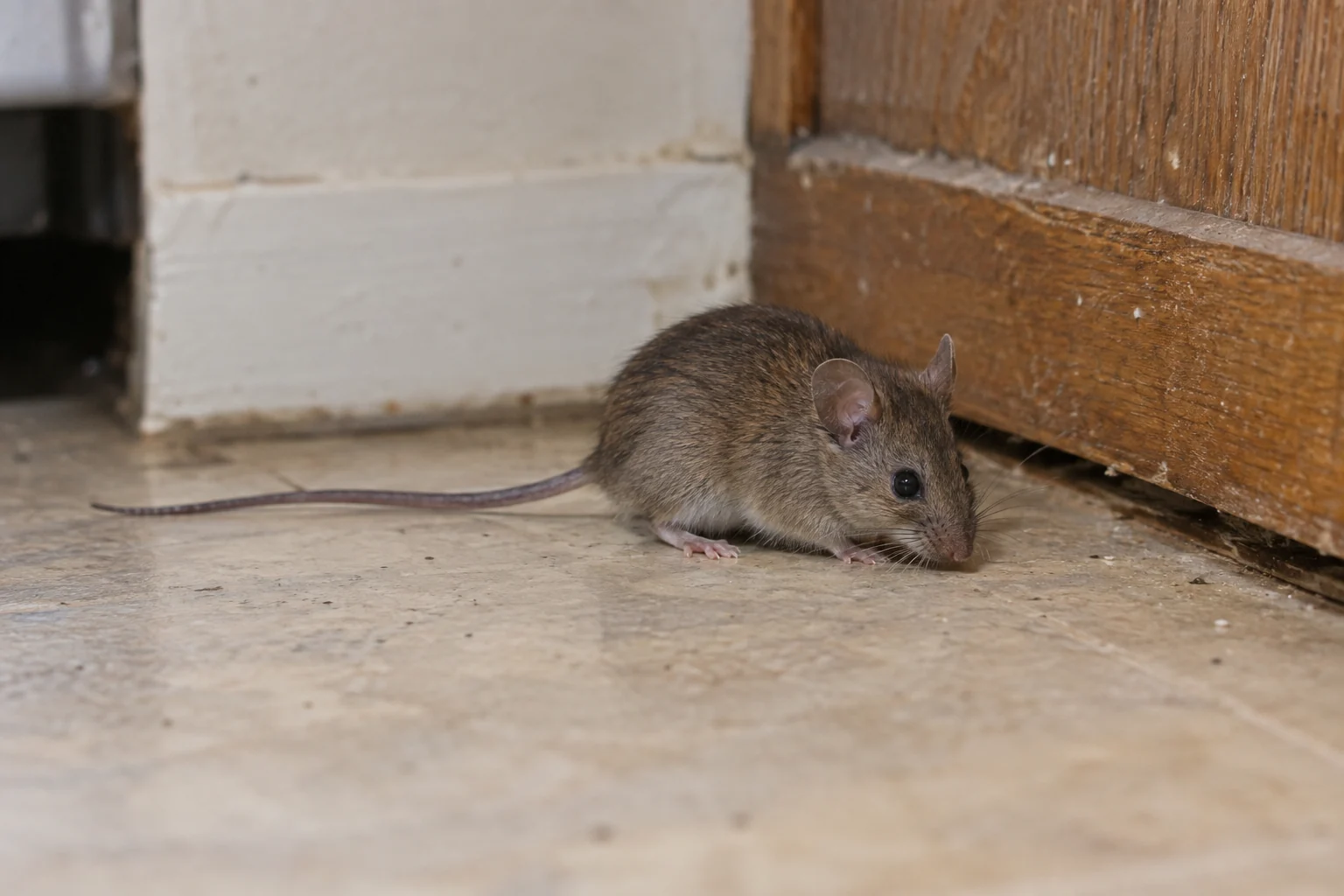
The house mouse is one of the rodents most closely associated with human buildings.
It can live and reproduce indoors when it has access to:
- food
- water
- nesting material
- hidden travel routes
- wall voids
- cabinets
- storage
House mice are commonly found in:
- kitchens
- pantries
- garages
- wall cavities
- attics
- warehouses
- utility rooms
Their appearance is generally more uniform than that of a deer mouse.
See House Mouse: Identification, Signs & Behavior for the full profile.
1. Body Color
Body color is a useful first clue.
Deer Mouse
A deer mouse often has:
- brown
- reddish-brown
- tan
- gray-brown
fur across the back and sides.
The upper color usually contrasts strongly with the white or pale underside.
House Mouse
A house mouse is more often:
- gray
- gray-brown
- dusty brown
with a more gradual transition between the back and belly.
The overall look is usually less sharply divided into dark and light areas.
2. Belly Color
The belly is one of the strongest visual differences.
Deer Mouse Belly
Deer mice typically have a clearly pale or white belly.
The contrast can be obvious when the mouse is viewed from the side.
House Mouse Belly
House mice usually have a grayish, buff, or somewhat lighter underside, but the contrast is generally less dramatic.
If the mouse has a crisp brown-over-white pattern, deer mouse becomes more likely.
3. White Feet
White feet are another deer-mouse clue.
A deer mouse often has:
- white feet
- pale lower legs
A house mouse usually lacks the same clean white-footed contrast.
However, do not identify a mouse from the feet alone.
Poor lighting can change how the fur appears.
4. Tail Color
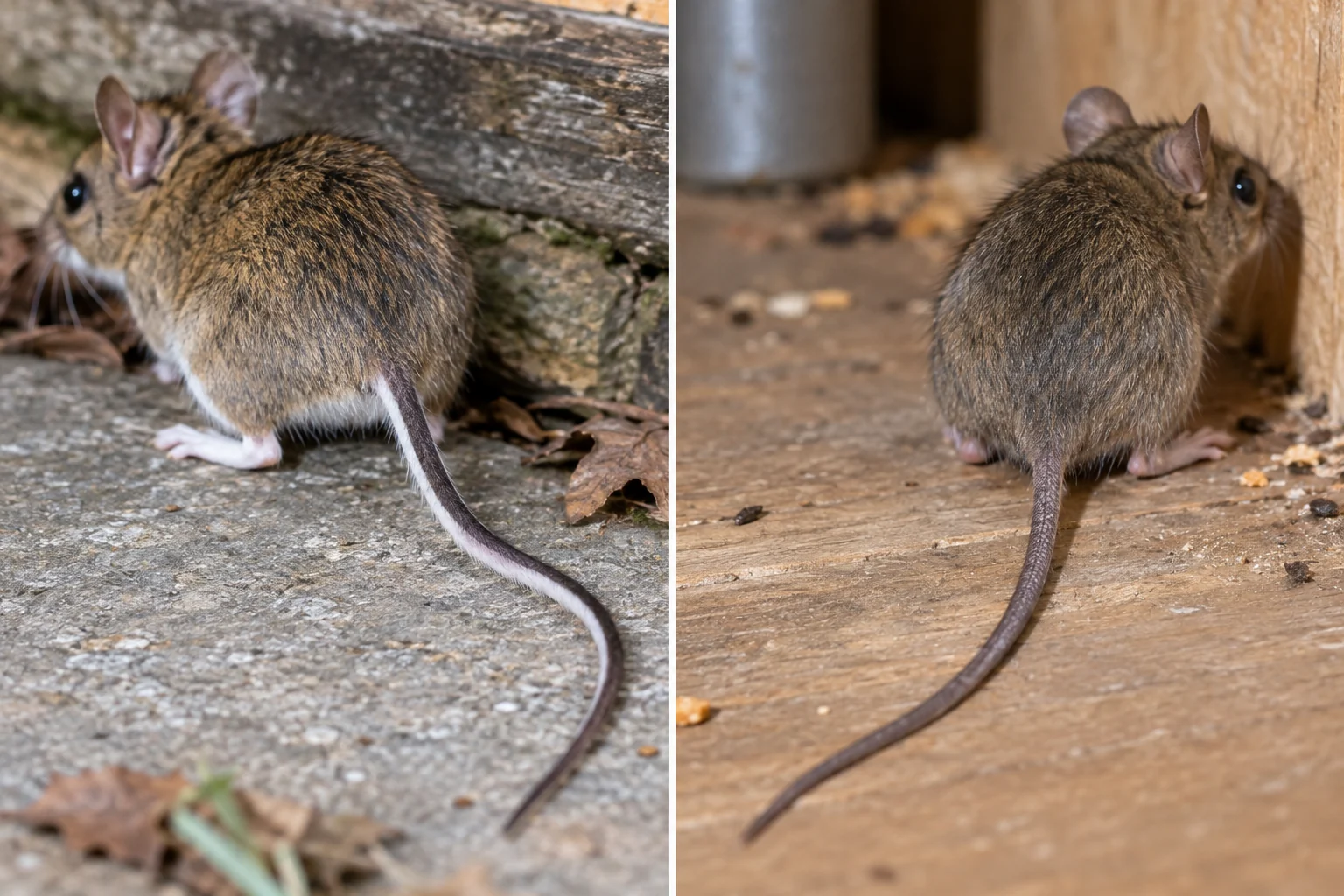
The tail is one of the most useful comparison features.
Deer Mouse Tail
A deer mouse tail is often distinctly bicolored:
- dark on top
- white or pale underneath
The tail may also appear more furred than a typical house-mouse tail.
House Mouse Tail
A house mouse tail is usually:
- more uniformly colored
- gray-brown
- visibly scaly
- less sharply divided into dark and light surfaces
A clear two-tone tail strongly favors deer mouse.
5. Eye Size
Deer mice typically have relatively large, dark, prominent eyes.
This reflects their strong nocturnal adaptation.
House mice also have dark eyes, but the eyes usually appear smaller relative to the head.
When photographs are clear, eye proportion can support identification.
6. Ear Size
Deer mice often have relatively large ears for their head size.
House mice also have rounded ears, but they usually do not create the same large-eyed, large-eared appearance.
Again, this is a supporting clue rather than a standalone identifier.
7. Body Shape
Both are small mice.
Deer mice may look:
- slightly more delicate
- long-legged
- large-eyed
- strongly two-toned
House mice often look:
- compact
- uniformly colored
- adapted to narrow indoor routes
Body posture varies, so color pattern is usually more reliable than shape alone.
8. Size Difference
Size overlap is substantial.
A large house mouse can overlap with a small deer mouse.
That means body length alone is not a reliable way to separate them.
Use size together with:
- belly color
- feet
- tail pattern
- eyes
- habitat
Do not assume the larger mouse is automatically a deer mouse.
9. Deer Mouse Habitat
Deer mice are commonly associated with outdoor or semi-rural habitat.
They may occur around:
- fields
- wooded lots
- brush
- barns
- sheds
- detached garages
- cabins
- seasonal buildings
A mouse found in a rural cabin after a period of vacancy is more likely to raise the possibility of a deer mouse than a mouse living continuously inside a city apartment.
Habitat does not prove species, but it changes the probability.
10. House Mouse Habitat
House mice are strongly commensal, meaning they thrive around people.
They commonly live inside:
- houses
- apartment buildings
- restaurants
- warehouses
- barns
- garages
A small gray-brown mouse repeatedly active behind kitchen cabinets or appliances is often more consistent with a house mouse.
11. Which Mouse Is More Likely to Live Indoors?
The house mouse is more strongly adapted to permanent indoor life.
It can complete its entire life cycle inside a building.
Deer mice can also occupy structures, but indoor activity is often more connected to nearby outdoor habitat.
They may use:
- cabins
- sheds
- garages
- barns
- attics
- storage spaces
as shelter.
12. Which Mouse Is More Likely in a Cabin?
A deer mouse becomes more plausible in:
- rural cabins
- seasonal homes
- hunting cabins
- buildings near woods or fields
especially when the structure is vacant for periods of time.
House mice can also occur in cabins.
Identification should still rely on the animal's appearance and evidence.
13. Which Mouse Is More Likely in a Kitchen?
House mice are especially common in kitchens.
They readily use:
- cabinets
- appliance gaps
- pantry edges
- plumbing penetrations
- wall voids
A deer mouse can enter a kitchen, but a persistent indoor kitchen population is more typical of house mice.
14. Which Mouse Is More Likely in a Garage?
Either species can occur in a garage.
A garage near:
- fields
- woods
- stored seed
- outdoor equipment
may attract deer mice.
A garage connected directly to a house may support house mice traveling between the garage and interior wall systems.
Use appearance and evidence to distinguish them.
15. Which Mouse Is More Likely in an Attic?
Both species can enter attics.
House mice may reach attics through:
- wall voids
- utility routes
- garage connections
Deer mice may enter from outdoor habitat through:
- roofline gaps
- vents
- attached structures
Attic location alone does not identify the species.
See Mice in the Attic: Signs, Damage & Removal for attic-specific guidance.
Deer Mouse Droppings vs House Mouse Droppings
Droppings from deer mice and house mice can be difficult to distinguish reliably.
Both can leave:
- small
- dark
- pellet-shaped
droppings.
Dropping location and the appearance of the animal are usually more useful than trying to separate these two species by feces alone.
If you find small mouse droppings, first confirm that the evidence is mouse-sized rather than rat-sized.
See Mouse Droppings: What They Look Like & What They Mean and Mouse vs Rat Droppings: How to Tell the Difference.
Deer Mouse Nests vs House Mouse Nests
Both species can build nests from soft materials.
Possible nesting material includes:
- paper
- fabric
- insulation
- dried plant material
- fibers
- cardboard
House-mouse nests are commonly found in hidden indoor areas close to food.
Deer-mouse nests in structures may contain more outdoor plant material, but nest material alone is not a dependable species test.
Gnawing Differences
Both deer mice and house mice gnaw.
The marks are generally mouse-sized and much smaller than heavy rat gnawing.
Gnawing can appear on:
- food packaging
- cardboard
- wood edges
- stored materials
- soft plastics
Gnaw width is more useful for distinguishing mice from rats than for separating deer mice from house mice.
Track Differences
Both species leave small tracks.
Track size overlaps significantly.
Unless the tracks are exceptionally clear, they usually cannot identify deer mouse versus house mouse with confidence.
Tracks are better used to identify:
- travel routes
- active areas
- direction of movement
Behavior Differences
House mice are highly adapted to human environments.
They may remain close to food and nesting sites and repeatedly use the same indoor routes.
Deer mice are more closely tied to outdoor habitat and may be more likely to enter structures from nearby natural areas.
Both species are:
- mostly nocturnal
- capable climbers
- good at using small gaps
- able to move through wall and storage spaces
Do Deer Mice Carry Hantavirus?
Some deer mice can carry hantaviruses, including the virus associated with hantavirus pulmonary syndrome in parts of the United States.
That does not mean every deer mouse is infected.
You cannot determine infection by looking at the mouse.
The practical safety response is to treat rodent urine, droppings, and nesting material as potentially contaminated and use appropriate cleanup methods.
Do not handle a deer mouse or its waste with bare hands.
Do House Mice Carry Hantavirus?
House mice are not the primary U.S. reservoir associated with Sin Nombre virus, the hantavirus most often linked with hantavirus pulmonary syndrome in the United States.
That does not make house-mouse contamination harmless.
House-mouse urine, droppings, nesting material, and contaminated food areas should still be handled carefully.
Safe rodent-waste cleanup practices are appropriate regardless of species.
Safe Cleanup for Either Mouse
Do not dry sweep or vacuum fresh rodent droppings or nesting material before wetting and disinfecting the area.
A practical approach is:
- keep children and pets away
- ventilate the area when appropriate
- wear suitable gloves
- wet contaminated material with an appropriate disinfecting solution
- allow adequate contact time
- wipe up the waste
- bag the material appropriately
- clean the surrounding surface
- wash hands after removing gloves
See our cleanup section and rodent safety section for broader guidance.
How Deer Mice Get Into Homes
Deer mice may enter through:
- garage-door gaps
- door gaps
- utility penetrations
- foundation defects
- siding gaps
- vents
- roofline openings
Homes next to fields or wooded habitat can experience seasonal entry.
For a detailed entry-point guide, see How Mice Get Into Your House.
How House Mice Get Into Homes
House mice use the same structural weaknesses, including:
- doors
- garage doors
- pipes
- cable penetrations
- foundation gaps
- siding
- vents
Once inside, they are especially capable of establishing long-term indoor populations.
This makes exclusion important even after trapping removes the visible mice.
Can Deer Mice and House Mice Live in the Same Building?
It is possible for different mouse species to use the same property or structure, especially where indoor and outdoor habitats overlap.
However, a homeowner should not assume that every mouse sighting represents a different species.
Try to document:
- body pattern
- tail pattern
- location
- droppings
- photographs
before reaching a conclusion.
Which Trap Should You Use?
Both species can generally be controlled with appropriately sized mouse traps.
For most indoor problems, a mouse-sized snap trap is a practical starting point.
Place traps:
- along walls
- near droppings
- beside cabinet edges
- near utility gaps
- along garage routes
- on stable attic framing
See Best Mouse Traps: Which Type Works Best & How to Choose and Mouse Traps: Types, Placement & How to Use Them.
Does Species Change the Control Plan?
The basic control process is similar:
- confirm mouse activity
- identify active routes
- trap mice already inside
- remove food and nesting opportunities
- locate entry points
- seal the building
- continue monitoring
Species identification can change where you focus the inspection.
For deer mice, pay more attention to the connection between the building and nearby outdoor habitat.
For house mice, pay especially close attention to established indoor routes and hidden nesting areas.
Deer Mouse vs House Mouse Entry-Point Priorities
Deer Mouse
Pay particular attention to:
- detached or attached garages
- sheds
- cabins
- roofline openings
- vents
- exterior storage areas
- buildings beside fields or woods
House Mouse
Pay particular attention to:
- kitchens
- garage-to-house connections
- plumbing gaps
- cabinet voids
- utility penetrations
- door and garage-door seals
Both species still require a full exterior inspection.
When to Call a Professional
Professional rodent control may be useful when:
- you cannot identify the mouse
- activity keeps returning
- several rooms are involved
- the attic or crawl space is contaminated
- the entry point cannot be found
- trapping does not reduce activity
- exclusion requires difficult structural work
See Mouse Exterminator: What to Expect & When to Call One for the professional process.
Deer Mouse vs House Mouse: The Bottom Line
The clearest practical difference is appearance.
A deer mouse usually has:
- brown or tan upper fur
- a white belly
- white feet
- a distinctly two-toned tail
- relatively large eyes and ears
A house mouse is usually:
- more uniformly gray or gray-brown
- less sharply divided between back and belly
- equipped with a more uniformly colored scaly tail
- strongly adapted to living indoors around people
Habitat strengthens the identification.
A two-toned mouse in a rural cabin or garage near woods is more suggestive of a deer mouse.
A uniform gray-brown mouse repeatedly living behind kitchen cabinets is more suggestive of a house mouse.
Do not rely on droppings alone to separate the two.
Continue with our deer mouse guide, house mouse guide, rat vs mouse guide, mouse droppings guide, signs of mice guide, how mice get into a house, or rodent exclusion guide.
For the broader overview, return to Rats & Mice in the Home.