Field Mouse vs House Mouse: What’s the Difference?
“Field mouse” and “house mouse” sound like two specific species, but only one of those names is precise.
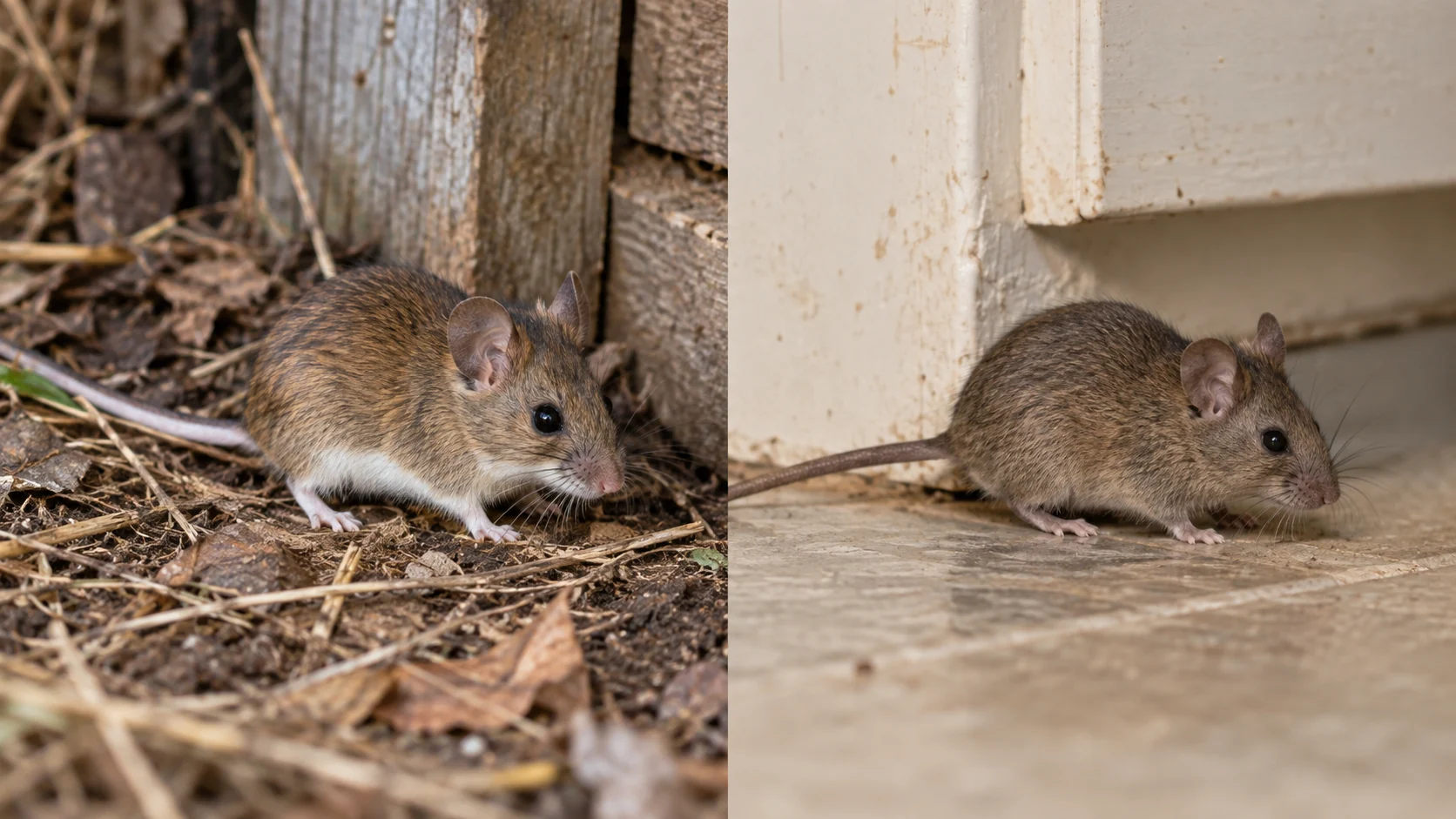
“Field mouse” and “house mouse” sound like two specific species, but only one of those names is precise.
A house mouse is a specific species: Mus musculus.
A field mouse is a broad common name people use for several small mice that normally live outdoors in fields, grasslands, farms, woodland edges, and similar habitat.
In the United States, a mouse described as a “field mouse” may often be a deer mouse or another outdoor Peromyscus species rather than a true house mouse.
That means the comparison is usually:
- an outdoor-adapted mouse that entered a building
- versus a house mouse that is strongly adapted to living around people
The easiest clues are:
- body coloration
- belly and foot color
- tail pattern
- eye and ear proportions
- where the mouse was found
- whether activity is temporary or established indoors
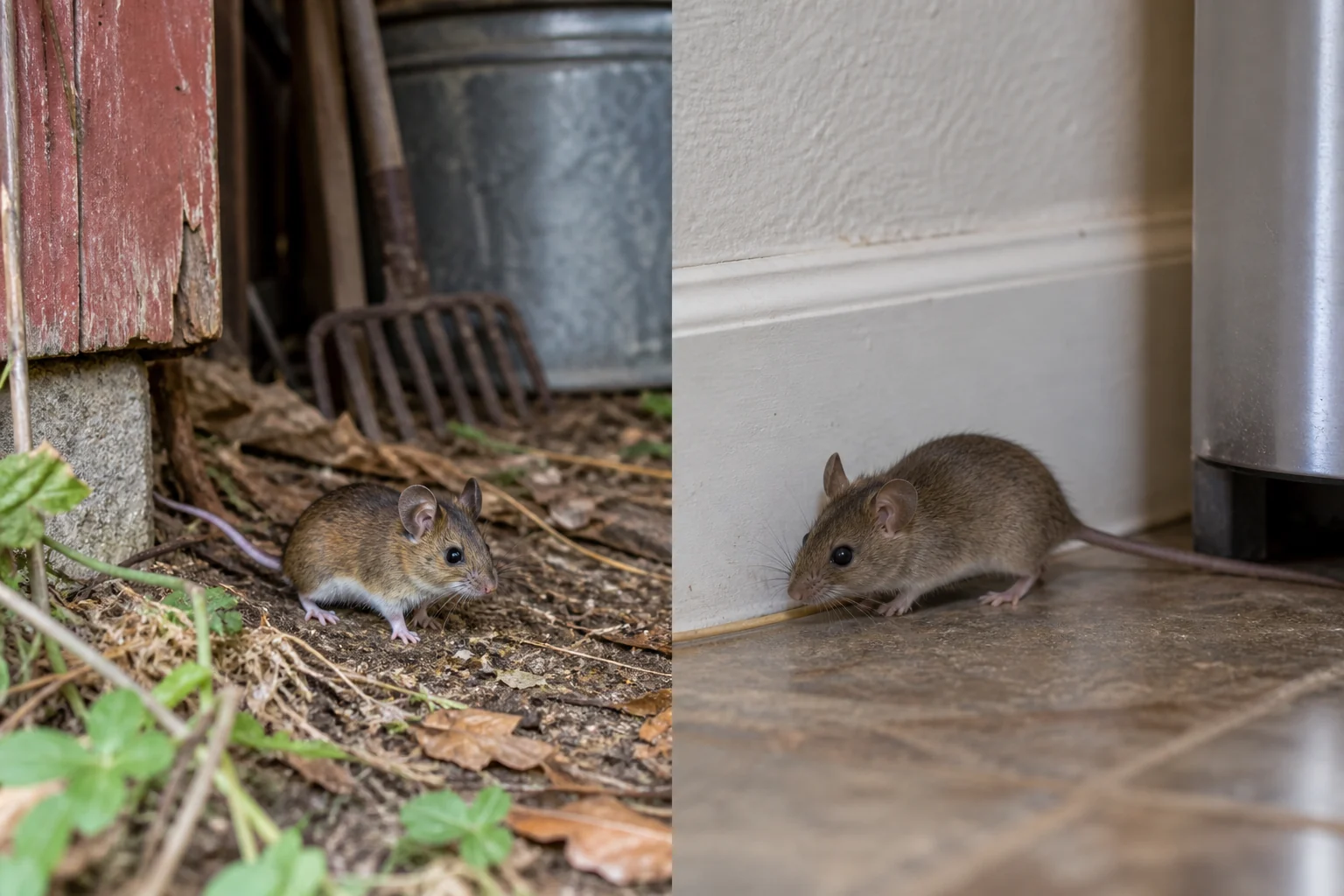
A field-type mouse such as a deer mouse often has stronger light-and-dark contrast, larger-looking eyes, and a two-toned tail.
A house mouse is usually more uniformly gray or gray-brown and has a more uniformly colored scaly tail.
This guide explains the practical differences and why the term “field mouse” should be used carefully.
Field Mouse vs House Mouse at a Glance
| Feature | “Field Mouse” | House Mouse |
|---|---|---|
| Meaning | Broad common term, not one exact species | Specific species: Mus musculus |
| Typical setting | Fields, woods, farms, sheds, cabins, garages | Homes, kitchens, walls, warehouses, garages |
| Body color | Often brown or tan above | Usually gray, gray-brown, or dusty brown |
| Belly | Often pale or white in deer-mouse-type species | Usually grayish or only somewhat lighter |
| Feet | May be pale or white | Usually similar to body tone |
| Tail | May be distinctly two-toned depending on species | Usually more uniformly colored and scaly |
| Eyes | Often appear relatively large in outdoor Peromyscus mice | Smaller in proportion |
| Indoor adaptation | Often enters from outdoor habitat | Highly adapted to living indoors |
| Best identification method | Identify the actual species | Confirm house-mouse traits |
The term “field mouse” is too broad to identify an animal by itself.
What Does “Field Mouse” Mean?
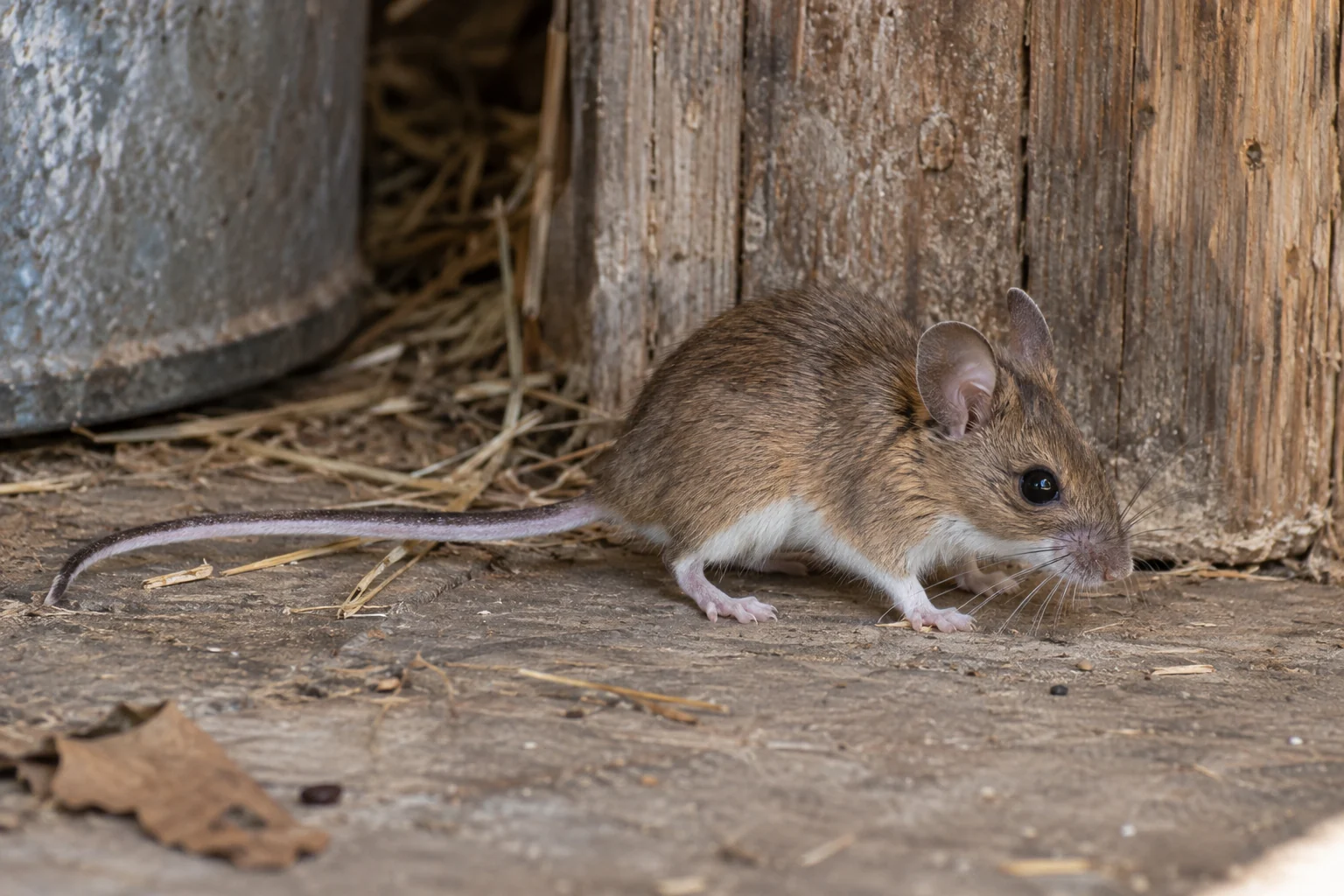
“Field mouse” is a common-language label.
People may use it for small mice found in:
- fields
- barns
- sheds
- garages
- cabins
- gardens
- woodland edges
In North America, the term is often applied loosely to deer mice and related outdoor mice.
That does not mean every mouse found outdoors is a deer mouse.
Different regions have different native small rodents.
The safest approach is to identify the actual animal instead of treating “field mouse” as one species.
What Is a House Mouse?
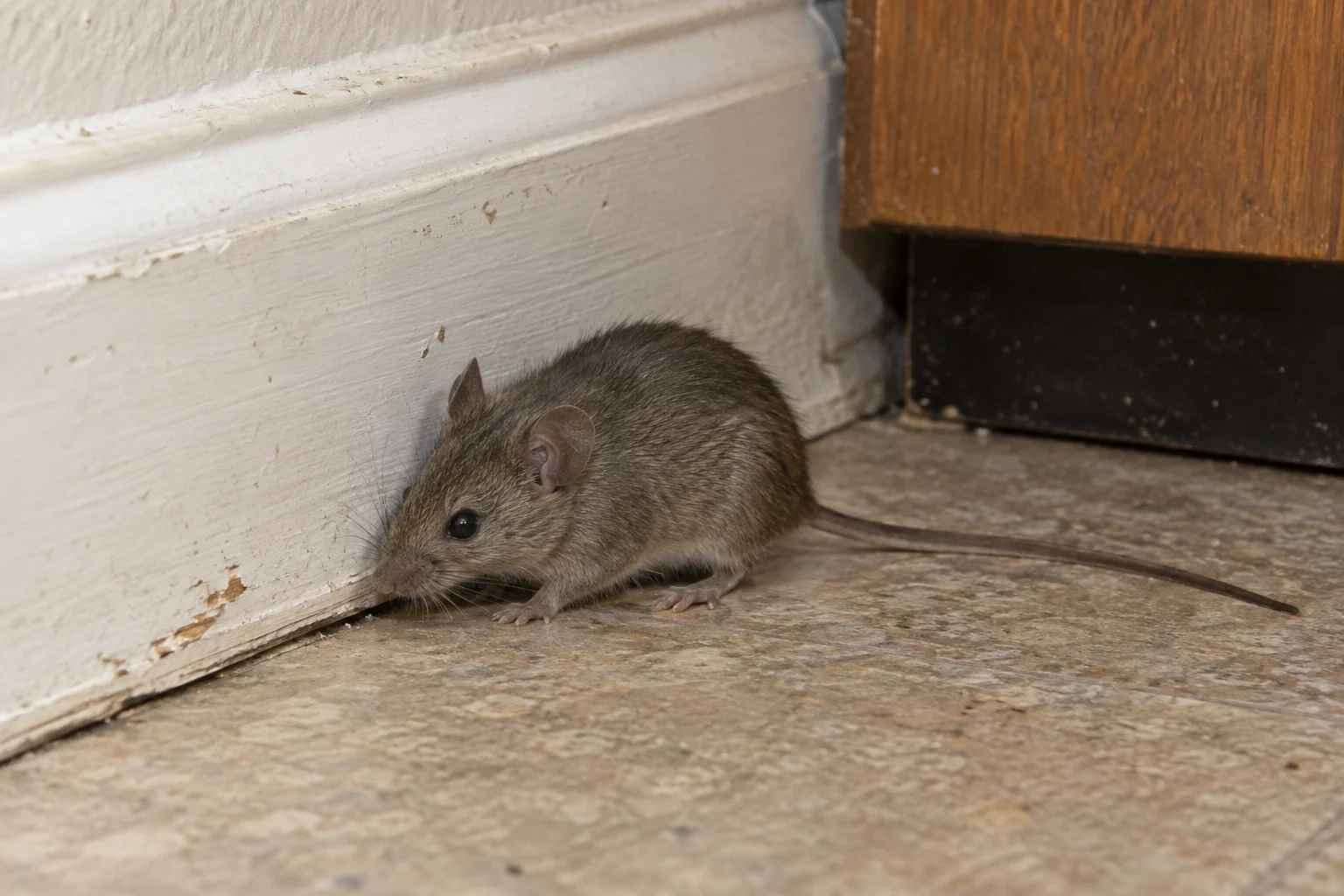
The house mouse is a specific rodent species closely associated with human buildings.
House mice can live indoors year-round when they have access to:
- food
- water
- nesting material
- wall voids
- cabinets
- protected travel routes
They commonly occur in:
- kitchens
- pantries
- garages
- attics
- warehouses
- utility rooms
- wall cavities
See House Mouse: Identification, Signs & Behavior for the full species profile.
Is a Deer Mouse a Field Mouse?
A deer mouse is often what people mean when they say “field mouse,” especially in rural or semi-rural settings.
Deer mice are small native mice commonly associated with:
- fields
- brush
- woodland edges
- farms
- cabins
- sheds
- garages
They often have:
- brown or tan upper fur
- a white belly
- white feet
- a clearly two-toned tail
- relatively large eyes and ears
See Deer Mouse: Identification, Signs & Behavior for the full profile.
1. Body Color
Color can help when the outdoor mouse has a strong deer-mouse-type pattern.
Field-Type Mouse
Many outdoor mice described as field mice may look:
- brown
- tan
- reddish-brown
- gray-brown
Some have a clearly darker back and pale underside.
House Mouse
A house mouse is usually more uniformly:
- gray
- gray-brown
- dusty brown
The transition from back to belly is usually less dramatic.
Color alone is not enough because “field mouse” can refer to more than one species.
2. Belly Color
A crisp white belly strongly suggests that the mouse may be an outdoor Peromyscus-type mouse rather than a typical house mouse.
Field-Type Mouse
A deer-mouse-type field mouse often has:
- white or pale belly fur
- clear contrast with the darker back
House Mouse
A house mouse usually has:
- grayish
- buff
- only moderately lighter
belly fur.
A sharp brown-over-white division is less typical of house mice.
3. Foot Color
White feet are a useful clue for deer-mouse-type field mice.
A house mouse usually does not have the same clean white-footed contrast.
However, lighting can make pale feet look brighter than they really are.
Use foot color with the tail and belly pattern.
4. Tail Pattern
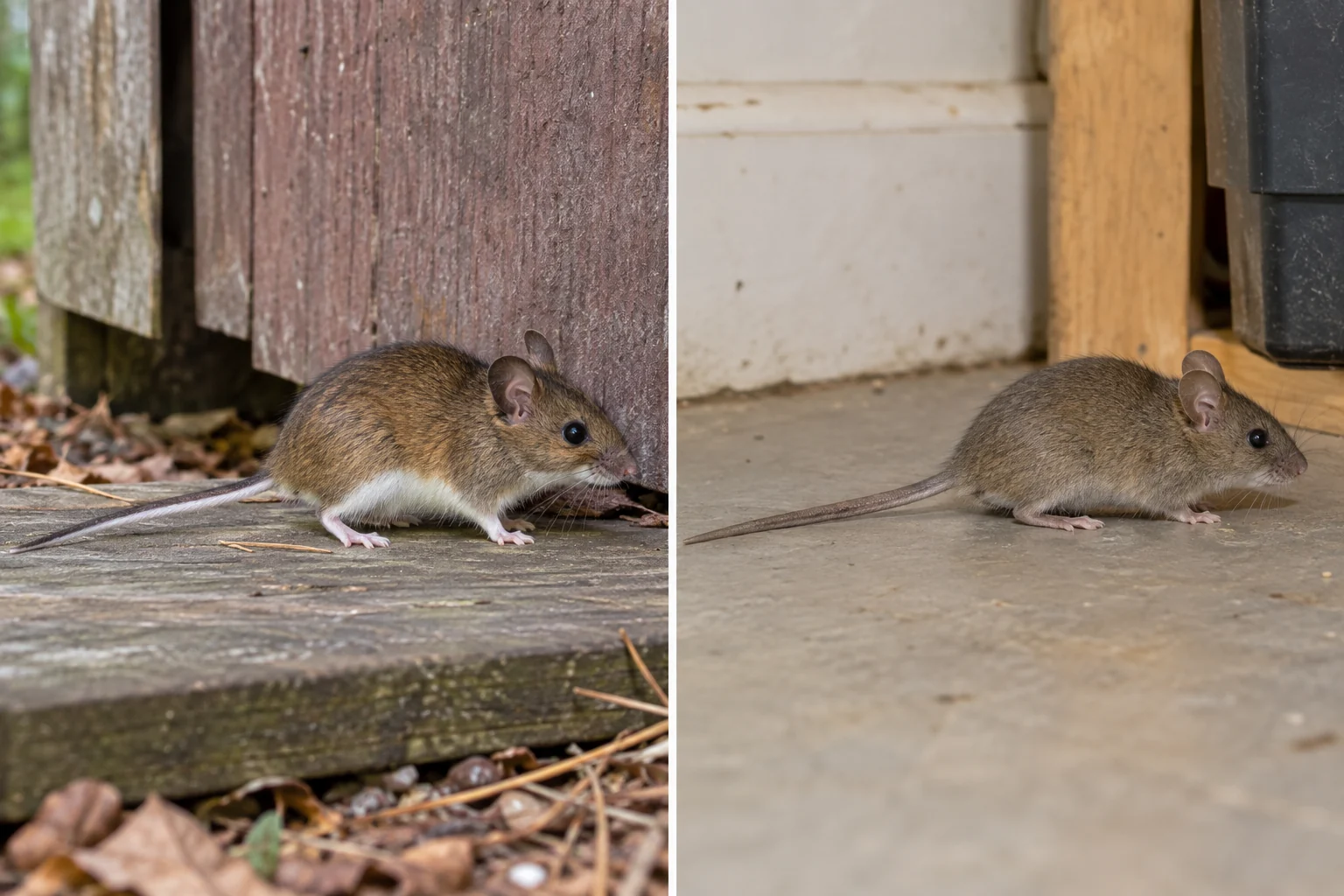
The tail is one of the strongest practical clues.
Field-Type Mouse
A deer mouse often has a tail that is:
- dark above
- pale or white below
- slightly more furred-looking
House Mouse
A house-mouse tail is usually:
- more uniformly colored
- gray-brown
- visibly scaly
- less sharply divided into dark and light sides
A strongly bicolored tail points away from a typical house mouse.
5. Eye Size
Many outdoor Peromyscus mice have relatively large, dark eyes.
House mice also have dark eyes, but they usually look smaller in proportion to the head.
Eye size supports identification but should not be used alone.
6. Ear Size
Deer-mouse-type field mice often have relatively large ears.
House mice have rounded ears too, but they generally do not produce the same large-eyed, large-eared appearance.
Viewing angle can distort ear size, so use several features together.
7. Body Size
Size overlap is substantial.
A field-type mouse is not automatically larger than a house mouse.
Age, sex, nutrition, and species all affect body size.
A large house mouse can overlap with a small deer mouse.
Do not use body length as the primary identification clue.
8. Where Field Mice Normally Live
Mice called field mice are usually associated with outdoor or semi-outdoor habitat.
Common settings include:
- fields
- farm edges
- woodland margins
- brush
- gardens
- sheds
- barns
- cabins
- detached garages
They may enter buildings when outdoor conditions change or when shelter and food are available.
9. Where House Mice Normally Live
House mice are strongly adapted to buildings.
They may live permanently in:
- homes
- apartment buildings
- restaurants
- warehouses
- barns
- garages
A population can reproduce indoors without needing to return outside.
That is one of the biggest behavioral differences between a true house mouse and many outdoor mice.
10. Which Mouse Is More Likely in a Kitchen?
A house mouse is more likely to establish persistent activity inside a kitchen.
Kitchens provide:
- food
- water
- cabinets
- appliance gaps
- plumbing routes
- wall voids
A field-type mouse can enter a kitchen, but repeated long-term indoor activity is more characteristic of house mice.
11. Which Mouse Is More Likely in a Cabin?
A field-type mouse becomes more plausible in a:
- rural cabin
- seasonal property
- hunting cabin
- building near woods or fields
especially when the building sits vacant for periods of time.
A deer mouse is one common possibility.
House mice can also occupy cabins, so appearance still matters.
12. Which Mouse Is More Likely in a Shed?
Outdoor mice are common around:
- sheds
- barns
- detached garages
- stored equipment
- feed areas
A mouse in a shed beside a field may reasonably be called a field mouse in everyday language.
But if exact identification matters, document the animal's:
- belly
- feet
- tail
- ears
- eyes
before assigning a species.
13. Which Mouse Is More Likely in a Garage?
Either can occur.
A garage near fields or woods may receive outdoor mice.
A garage attached to a house can support house mice moving into:
- wall voids
- kitchens
- attics
- utility rooms
Use the animal's appearance and the surrounding habitat together.
14. Which Mouse Is More Likely in an Attic?
Both can enter attics.
House mice may reach an attic through:
- wall cavities
- garage connections
- utility routes
Outdoor mice may enter through:
- roofline defects
- vents
- siding gaps
- attached structures
Attic location alone does not identify the mouse.
See Mice in the Attic: Signs, Damage & Removal.
15. Do Field Mice Live Inside Houses?
Yes, outdoor mice can enter and occupy houses.
But they are generally less specialized for permanent indoor living than house mice.
A field-type mouse may use a building as:
- seasonal shelter
- temporary refuge
- food source
- nesting site
A house mouse is much more strongly associated with continuous indoor populations.
16. Do House Mice Live Outdoors?
Yes.
House mice can live around outdoor structures, farms, yards, and buildings.
The name “house mouse” does not mean the species is always indoors.
It means the species is especially well adapted to living around humans.
Field Mouse Droppings vs House Mouse Droppings
Droppings are not a reliable way to distinguish a field mouse from a house mouse.
Many small mouse species leave droppings that are:
- dark
- small
- pellet-shaped
The overlap is too large for confident species identification.
Droppings are more useful for confirming mouse activity and mapping travel routes.
See Mouse Droppings: What They Look Like & What They Mean.
Field Mouse Nests vs House Mouse Nests
Both may build nests from:
- paper
- fabric
- insulation
- fibers
- dried plant material
- cardboard
House-mouse nests are often tucked into hidden indoor areas near food.
Outdoor mice may bring more plant material into sheds, garages, cabins, or attics.
Nest material alone does not reliably identify the species.
Gnaw Marks
Both field-type mice and house mice gnaw.
Possible targets include:
- food packaging
- cardboard
- stored materials
- wood edges
- plastic
- insulation around wiring
Mouse gnawing is much smaller than typical rat gnawing.
Gnawing confirms activity better than it distinguishes one small mouse species from another.
Tracks
Both leave tiny tracks.
Track size overlaps enough that a homeowner usually cannot separate field mice from house mice by tracks alone.
Tracks are more useful for:
- locating active routes
- finding travel direction
- identifying high-use areas
Behavior Differences
House mice are especially comfortable living close to people.
They may repeatedly use the same:
- cabinet routes
- appliance spaces
- wall voids
- pantry edges
Outdoor mice are more strongly connected to natural habitat and may enter buildings seasonally.
Both types are:
- mostly nocturnal
- good climbers
- capable of using small gaps
- able to nest in hidden spaces
Seasonal Entry
Outdoor mice often become more noticeable in buildings when outside conditions change.
Movement into structures may increase when:
- temperatures fall
- vegetation changes
- food availability shifts
- nearby fields are disturbed
- seasonal buildings sit vacant
House mice can also become more visible during colder periods.
Season alone does not identify the species.
Do Field Mice Carry Hantavirus?
Some outdoor mice, including deer mice, can carry hantaviruses.
That does not mean every field mouse is infected.
The term “field mouse” is too broad to make a species-specific health claim.
The practical rule is to treat rodent urine, droppings, and nesting material as potentially contaminated.
Do not handle rodent waste with bare hands.
Do House Mice Carry Hantavirus?
House mice are not the primary U.S. reservoir associated with Sin Nombre virus.
That does not make house-mouse contamination harmless.
Urine, droppings, nesting material, and contaminated food areas should still be handled carefully.
Use safe rodent-waste cleanup practices regardless of species.
Safe Cleanup for Either Type of Mouse
Do not dry sweep or vacuum fresh rodent droppings or nesting material before proper wet cleanup.
A practical process is:
- keep children and pets away
- ventilate the space when appropriate
- wear suitable gloves
- wet contaminated material with an appropriate disinfecting solution
- allow adequate contact time
- wipe up the material
- bag waste appropriately
- clean the surrounding surface
- wash hands after removing gloves
See the cleanup section and rodent safety section for broader guidance.
How Field Mice Get Into Houses
Outdoor mice may enter through:
- garage-door gaps
- exterior doors
- foundation openings
- utility penetrations
- siding gaps
- vents
- roofline defects
Structures beside natural habitat can experience recurring entry.
See How Mice Get Into Your House for a full entry-point guide.
How House Mice Get Into Houses
House mice use the same kinds of openings.
Common routes include:
- garage doors
- door corners
- pipes
- cable penetrations
- foundations
- siding
- vents
Once inside, house mice are particularly capable of establishing long-term populations.
Can Field Mice and House Mice Live in the Same Building?
It is possible.
A property that connects indoor shelter with fields, barns, gardens, or wooded habitat may support multiple small-mouse species.
But do not assume mixed species just because activity appears in different rooms.
Try to document clear identification traits first.
Which Trap Should You Use?
If the animal is clearly mouse-sized, use traps designed for mice.
A mouse-sized snap trap is a practical starting point for many indoor problems.
Place traps:
- along walls
- near droppings
- beside cabinet edges
- near utility penetrations
- along garage routes
- on stable attic framing
See Best Mouse Traps: Which Type Works Best & How to Choose and Mouse Traps: Types, Placement & How to Use Them.
Does the Exact Species Change the Control Plan?
The basic process remains similar:
- confirm mouse activity
- map active routes
- trap mice already inside
- reduce food and nesting opportunities
- find exterior entry points
- seal the building
- monitor for fresh signs
Species changes where you place the most inspection effort.
For an outdoor field-type mouse, inspect the connection between natural habitat and the structure.
For a house mouse, pay especially close attention to established indoor travel routes.
Field Mouse Entry-Point Priorities
For outdoor mice, inspect:
- sheds
- detached garages
- cabins
- lower exterior walls
- roofline openings
- vents
- exterior storage areas
- vegetation near the structure
House Mouse Entry-Point Priorities
For house mice, inspect:
- kitchens
- garage-to-house connections
- plumbing penetrations
- cabinet voids
- door gaps
- garage-door seals
- utility openings
Both still require a full exterior inspection.
Can You Tell the Difference From a Photo?
Often, if the image clearly shows:
- side profile
- belly color
- foot color
- tail pattern
- ears
- eyes
A blurry top-down photo may not be enough.
A clear side image usually provides more useful identification features.
When to Call a Professional
Professional mouse control may be useful when:
- you cannot identify the rodent
- mice keep returning
- several rooms are involved
- the attic or crawl space is contaminated
- trapping does not reduce activity
- the entry point cannot be found
- exclusion requires difficult repairs
See Mouse Exterminator: What to Expect & When to Call One.
Field Mouse vs House Mouse: The Bottom Line
The biggest difference is that house mouse is a species, while field mouse is a broad common term.
A field-type mouse such as a deer mouse often has:
- brown or tan upper fur
- a pale or white belly
- pale or white feet
- a two-toned tail
- relatively large eyes and ears
- a stronger connection to outdoor habitat
A house mouse is usually:
- more uniformly gray or gray-brown
- less sharply divided between back and belly
- equipped with a more uniformly colored scaly tail
- strongly adapted to living indoors around people
Do not identify the species from droppings alone.
If exact identification matters, photograph the mouse clearly and compare its body pattern, tail, ears, eyes, and habitat.
Continue with our deer mouse vs house mouse guide, deer mouse guide, house mouse guide, mouse droppings guide, signs of mice guide, how mice get into a house, or rodent exclusion guide.
For the broader overview, return to Rats & Mice in the Home.