Mice Behind the Refrigerator: Why They Hide There
The space behind a refrigerator is one of the most common places for mouse activity in a kitchen because it can provide darkness, warmth, cover, crumbs, grease residue, and protected wall routes.
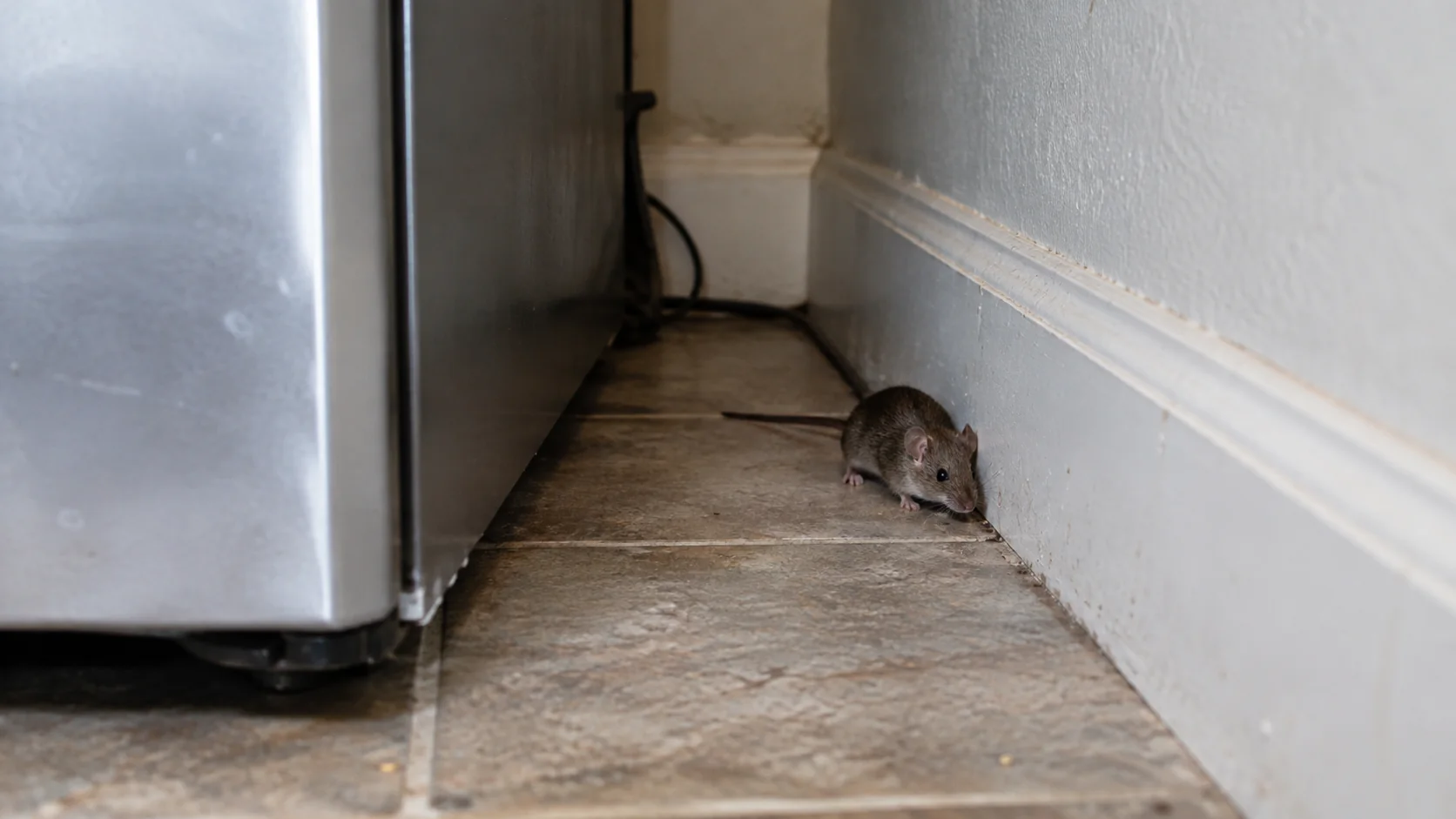
The space behind a refrigerator is one of the most common places for mouse activity in a kitchen.
It can provide:
- darkness
- warmth
- cover
- crumbs and grease
- access to nearby cabinets
- a protected wall edge
- water from condensation or a small leak
- nearby utility penetrations
A mouse may hide:
- behind the refrigerator
- beside the refrigerator
- beneath the appliance edge
- behind an adjacent cabinet
- inside a wall void behind the appliance
That does not always mean the mouse is living inside the refrigerator itself.
The practical goal is to determine:
- whether mouse activity is current
- whether mice are simply traveling behind the refrigerator or nesting nearby
- where they are entering the kitchen
- whether the route connects to walls, cabinets, basement, crawl space, or garage
- where traps can be placed safely
- when exclusion can be completed after active mice are removed
This guide explains why mice hide behind refrigerators, what signs to look for, how to inspect the area safely, and how to stop them from returning.
Why Do Mice Hide Behind Refrigerators?
Refrigerators create a protected edge against a wall.
The area may be:
- dark
- rarely disturbed
- warmer than the surrounding room
- close to food
- close to water
- connected to cabinets or wall openings
Mice prefer to travel along edges rather than across open floor space.
The gap behind a refrigerator can become part of a route between:
- baseboards
- lower cabinets
- wall cavities
- plumbing penetrations
- nearby pantry areas
Does Refrigerator Heat Attract Mice?
Warmth can make the area appealing.
Older or freestanding refrigerators may release heat around:
- the compressor area
- condenser components
- lower rear sections
The warmth itself does not create the infestation.
Mice still need a route into the structure.
Food, shelter, water, and nearby openings usually matter more than heat alone.
Are Mice Actually Inside the Refrigerator?
Sometimes mice can enter open lower mechanical spaces or insulation cavities in certain appliance designs.
But many “mice in the refrigerator” reports are actually mice:
- behind the appliance
- beneath the edge
- inside the wall
- behind nearby cabinets
Do not assume the mouse is inside the sealed food compartment or internal refrigeration system.
Do not dismantle the appliance just to look for a mouse.
Can Mice Get Into the Refrigerator Food Compartment?
An intact refrigerator food compartment is usually separated from the wall and floor around it.
A mouse is more likely to access food through:
- open cabinets
- pantry shelves
- food left on counters
- torn bags
- gaps around nearby cabinetry
If you find direct contamination inside the refrigerator compartment, inspect the appliance condition carefully and consider professional service.
What Attracts Mice Behind a Refrigerator?
Common attractants include:
- crumbs
- spilled dry food
- grease
- pet food
- food debris beneath cabinets
- standing water
- a leaking refrigerator water line
- nearby pantry food
- trash
The mouse may feed somewhere else and use the refrigerator area only as shelter.
Mouse Droppings Behind the Refrigerator
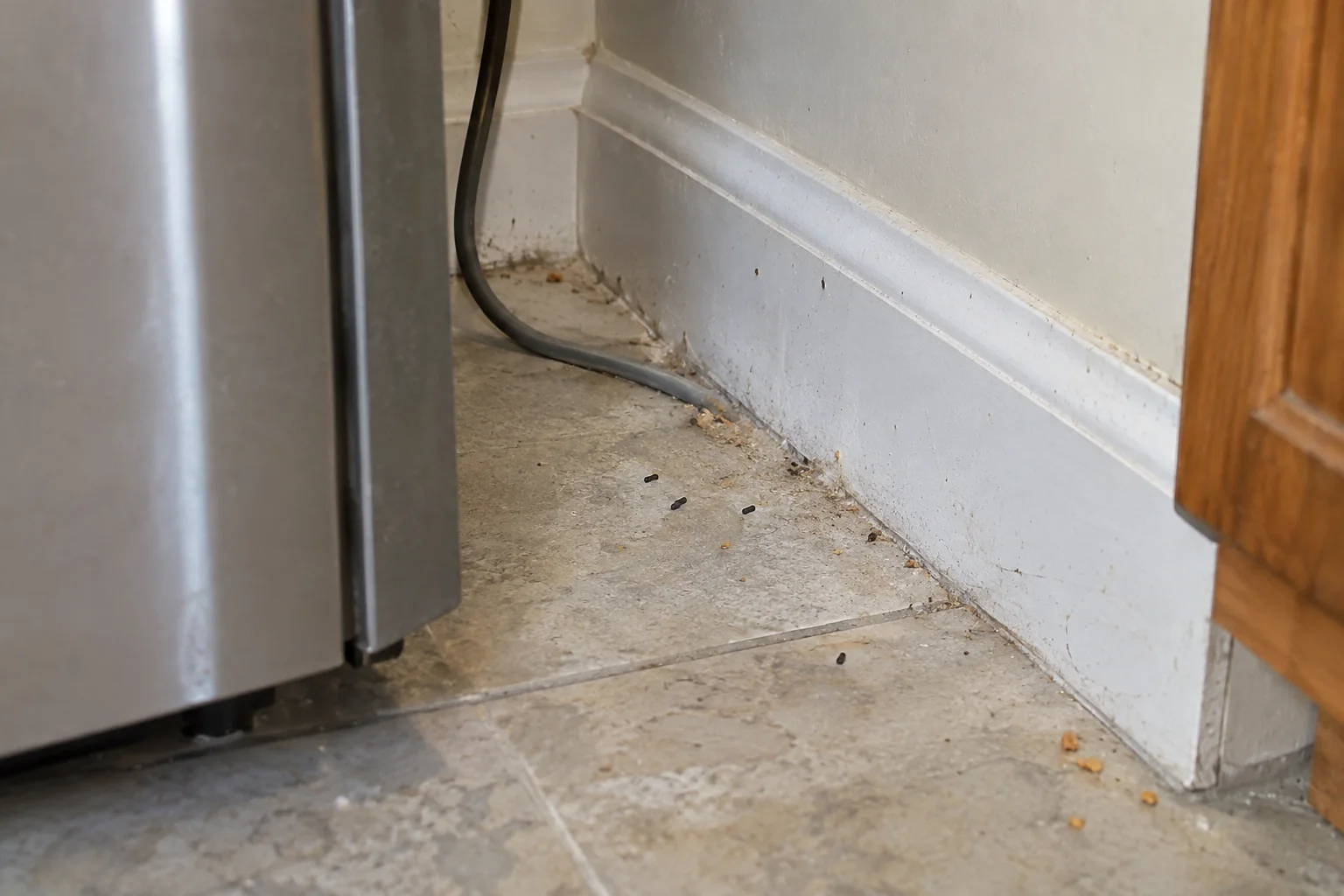
Droppings are one of the clearest signs of mouse travel.
They may appear:
- along the wall
- beside the refrigerator
- near the rear corners
- beneath adjacent cabinets
- near utility openings
Mouse droppings are small and dark.
Do not use the number of droppings to estimate how many mice are present.
See Mouse Droppings: What They Look Like & What They Mean.
Mouse Gnaw Marks Behind the Refrigerator
Mice may gnaw:
- cardboard
- baseboard edges
- soft plastic
- cabinet material
- sealant
- wire insulation
Fine gnaw marks become more useful when droppings or tracks are also present.
See Mouse Gnaw Marks: How to Identify Rodent Damage.
Mouse Tracks Behind the Refrigerator
Dusty floor edges can preserve tiny tracks.
Look along:
- wall-floor junctions
- cabinet edges
- appliance gaps
Mouse tracks are often incomplete.
One mouse can make many footprints.
See Mouse Tracks: What They Look Like & Where to Find Them.
Mouse Urine Smell Behind the Refrigerator
Repeated activity can create a musky or urine-like odor.
The smell may be stronger in a confined space behind the appliance.
But odor alone does not prove mice.
Other possible sources include:
- spilled food
- mold
- drain odor
- appliance moisture
- a dead insect or animal
See Mouse Urine Smell: What It Smells Like & How to Find It.
Do Mice Nest Behind Refrigerators?
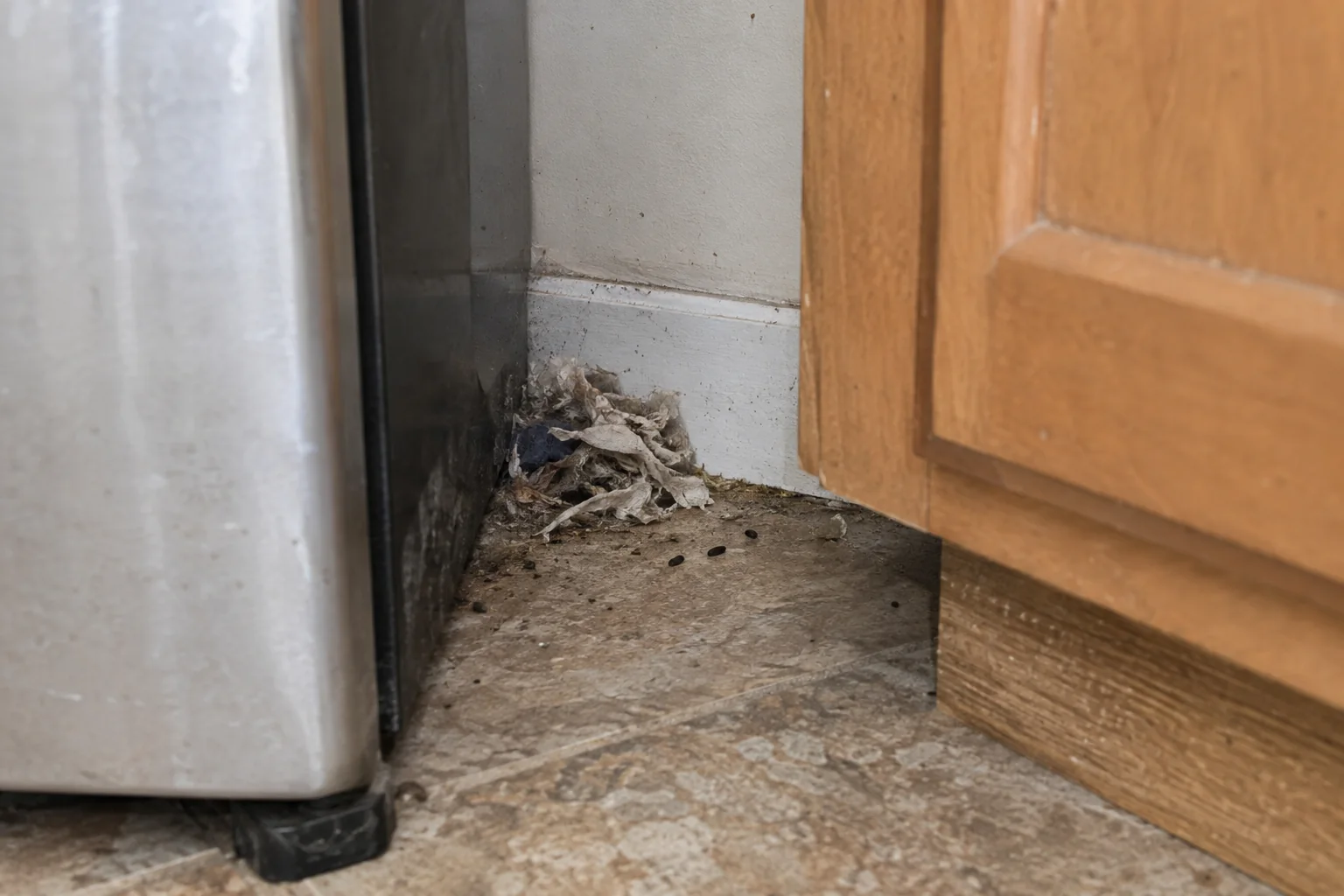
They can.
Possible nesting areas include:
- the floor-wall corner
- behind nearby cabinets
- beneath a cabinet toe kick
- inside an accessible wall void
- among stored paper or soft debris nearby
A small nest may contain:
- shredded paper
- fabric-like fibers
- insulation
- soft debris
But seeing one mouse behind a refrigerator does not prove a nest is there.
See Mouse Nests: What They Look Like & Where to Find Them.
Do Mice Nest Inside Refrigerator Machinery?
It is possible for mice to enter some open appliance cavities, especially lower rear sections.
However, do not assume that every refrigerator mouse is nesting inside the compressor area.
Do not remove:
- electrical covers
- compressor guards
- sealed panels
- fan housings
unless you are qualified to service the appliance.
The safest inspection usually focuses on accessible space around the refrigerator.
Where Do Mice Enter Behind a Refrigerator?
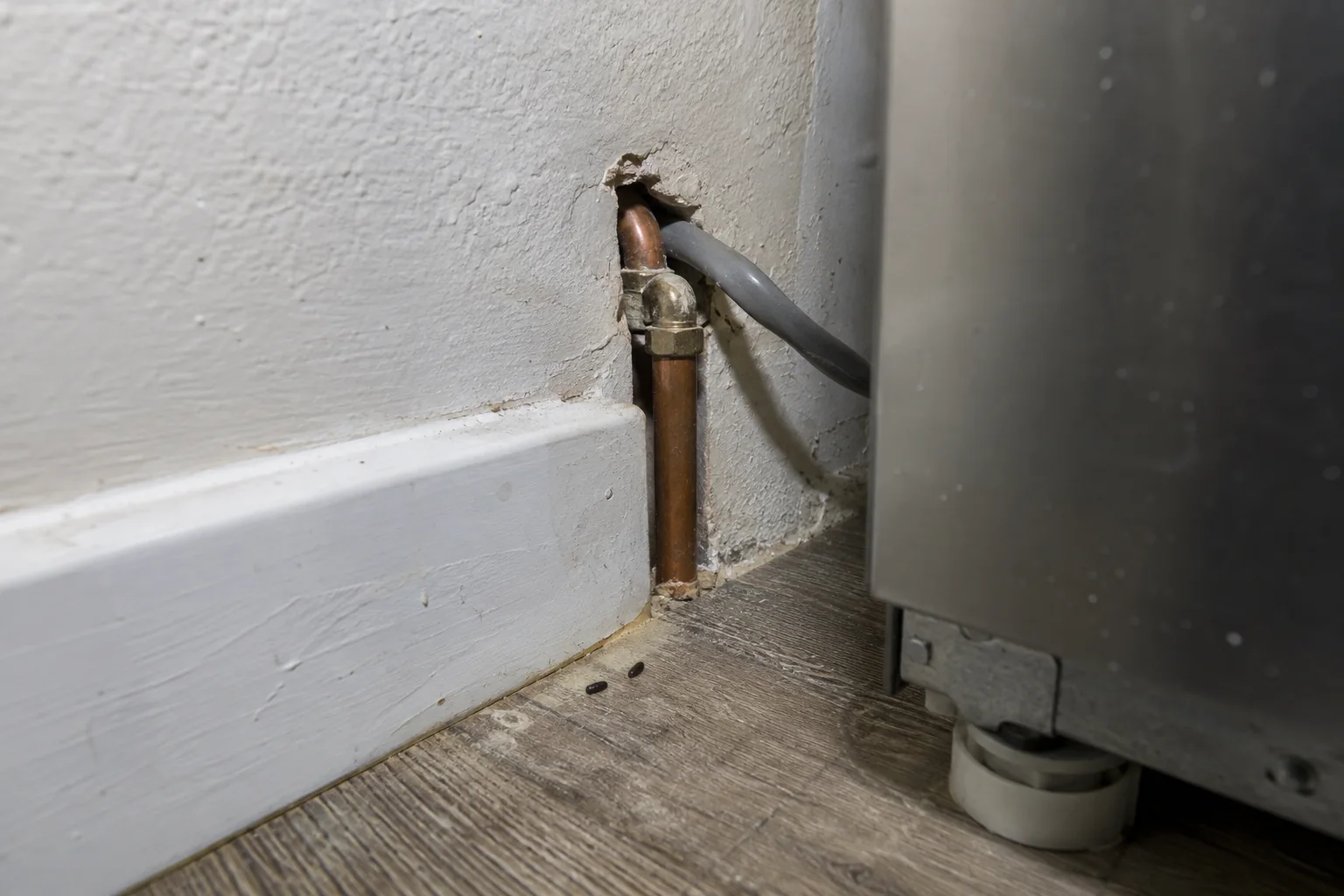
Common routes include:
- gaps at the wall-floor junction
- baseboard gaps
- cabinet voids
- openings around water lines
- cable or electrical penetrations
- wall cavities
- floor penetrations
The refrigerator may hide the actual structural entry point.
See How Mice Get Into Your House.
Mouse Gap Around a Refrigerator Water Line
A refrigerator water line may pass through:
- a wall
- a cabinet
- the floor
If the opening around the line is oversized, mice may use it as a route.
Inspect the surrounding gap.
Do not:
- kink the line
- disconnect it casually
- apply material directly to a moving or serviceable connection
Repair the structural opening without damaging the water line.
Mouse Gap Around an Electrical Outlet or Cable
The appliance cord usually connects to an outlet behind or beside the refrigerator.
Mice may use structural gaps around:
- outlet boxes
- cable penetrations
- wall openings
Do not remove outlet covers or work on electrical systems unless qualified.
If wiring appears damaged, treat it as an electrical hazard.
Mice Coming From the Wall Behind the Refrigerator
A kitchen wall can connect to:
- lower cabinets
- plumbing chases
- utility routes
- basement framing
- crawl-space routes
A mouse may emerge behind the refrigerator even though the main route is inside the wall.
See Mice in Walls: Signs, Entry Points & What to Do.
Mice Coming From the Basement
In homes with kitchens above basements, mice may move upward through:
- plumbing
- wiring
- wall cavities
- floor penetrations
See Mice in the Basement: Why They’re There & What to Do.
Mice Coming From the Crawl Space
A kitchen floor above a crawl space may contain penetrations around:
- plumbing
- electrical lines
- framing transitions
Mouse activity below the kitchen can connect to the refrigerator area.
See Mice in the Crawl Space: Signs & Removal.
Mice Coming From the Garage
An attached garage may connect to kitchen walls or utility spaces.
Mice can move from:
- garage storage
- wall voids
- utility penetrations
into the kitchen.
See Mice in the Garage: Entry Points, Nests & Control.
Is a Mouse Behind the Refrigerator Different From Mice in the Kitchen?
The refrigerator is one specific high-value hiding area within a broader kitchen mouse problem.
See Mice in the Kitchen: Why They’re There & What to Do for the whole-room guide.
This page focuses specifically on:
- the appliance gap
- nearby wall openings
- trap placement
- appliance safety
- hidden evidence behind the refrigerator
Should You Pull the Refrigerator Out to Inspect?
Only if it can be moved safely.
A refrigerator can be:
- heavy
- top-heavy
- connected to a water line
- connected by a power cord
- tightly fitted between cabinets
Do not drag or tip a heavy refrigerator alone.
Before moving it:
- check the appliance instructions
- confirm the floor can tolerate movement
- make sure the power cord has slack
- make sure a water line is not being stretched
- get help when needed
Built-in refrigerators may require professional service access.
What Should You Check Before Moving the Refrigerator?
Look first from accessible angles.
Check:
- both side gaps
- the floor in front
- nearby baseboards
- cabinet toe kicks
- visible droppings
- accessible utility openings
You may be able to confirm mouse activity without moving the appliance.
What If the Refrigerator Has a Water Line?
Move the refrigerator only enough to avoid:
- kinking
- pulling
- disconnecting
- damaging
the water line.
If the line is tight or inaccessible, stop.
A damaged water line can create a leak and additional building damage.
What If the Refrigerator Is Built In?
Do not force a built-in refrigerator out of cabinetry.
Built-in appliances may have:
- mounting hardware
- tight clearances
- water connections
- electrical connections
Professional appliance service may be safer.
What If You See Damaged Wiring?
If the refrigerator cord, outlet area, or accessible wiring appears gnawed:
- do not touch exposed conductors
- do not continue reaching behind the appliance
- keep people away from the damaged area
- have the electrical or appliance damage evaluated appropriately
Rodent control does not replace electrical repair.
Should You Remove the Refrigerator Back Panel?
Not unless you are qualified and the manufacturer’s service procedure calls for it.
Do not remove:
- compressor covers
- electrical housings
- fan guards
- sealed service panels
simply to hunt for a mouse.
Focus on the accessible structural route around the appliance.
What to Do Right After Finding Mouse Evidence Behind the Refrigerator
A practical response is:
- document the evidence
- inspect accessible wall and cabinet edges
- look for the entry gap
- remove food debris
- check the water line and nearby moisture
- place mouse-sized traps on accessible confirmed routes
- monitor for fresh activity
- coordinate exclusion after active mice are addressed
Do not begin by spraying chemicals or sealing every gap immediately.
Clean Food Debris Behind the Refrigerator
Crumbs and grease can support repeat activity.
Clean accessible debris once the area is safe to reach.
Also check:
- nearby cabinet floors
- pantry edges
- pet food areas
- trash storage
Sanitation helps but does not replace trapping and exclusion.
How to Clean Mouse Droppings Behind a Refrigerator Safely
For a small accessible contaminated area:
- keep children and pets away
- wear suitable gloves
- avoid dry sweeping or vacuuming
- wet droppings and the nearby hard surface with an appropriate disinfecting solution
- allow the product’s required contact time
- wipe or collect the waste
- bag it appropriately
- clean the surrounding hard surface
- wash hands after removing gloves
Do not spray liquid onto:
- electrical outlets
- power cords
- compressor components
- fan motors
- exposed wiring
See the cleanup section and rodent safety section.
Should You Vacuum Mouse Droppings Behind the Refrigerator?
Do not use a normal household vacuum on fresh mouse droppings before wet cleanup.
Vacuuming can disturb contaminated dust.
Use wet-cleanup principles instead.
What If Droppings Are Inside an Appliance Cavity?
Do not reach into an energized or mechanically complex appliance cavity.
If contamination is inside an area requiring panel removal or service access, professional appliance or pest service may be appropriate.
Where Should You Put Mouse Traps Near the Refrigerator?
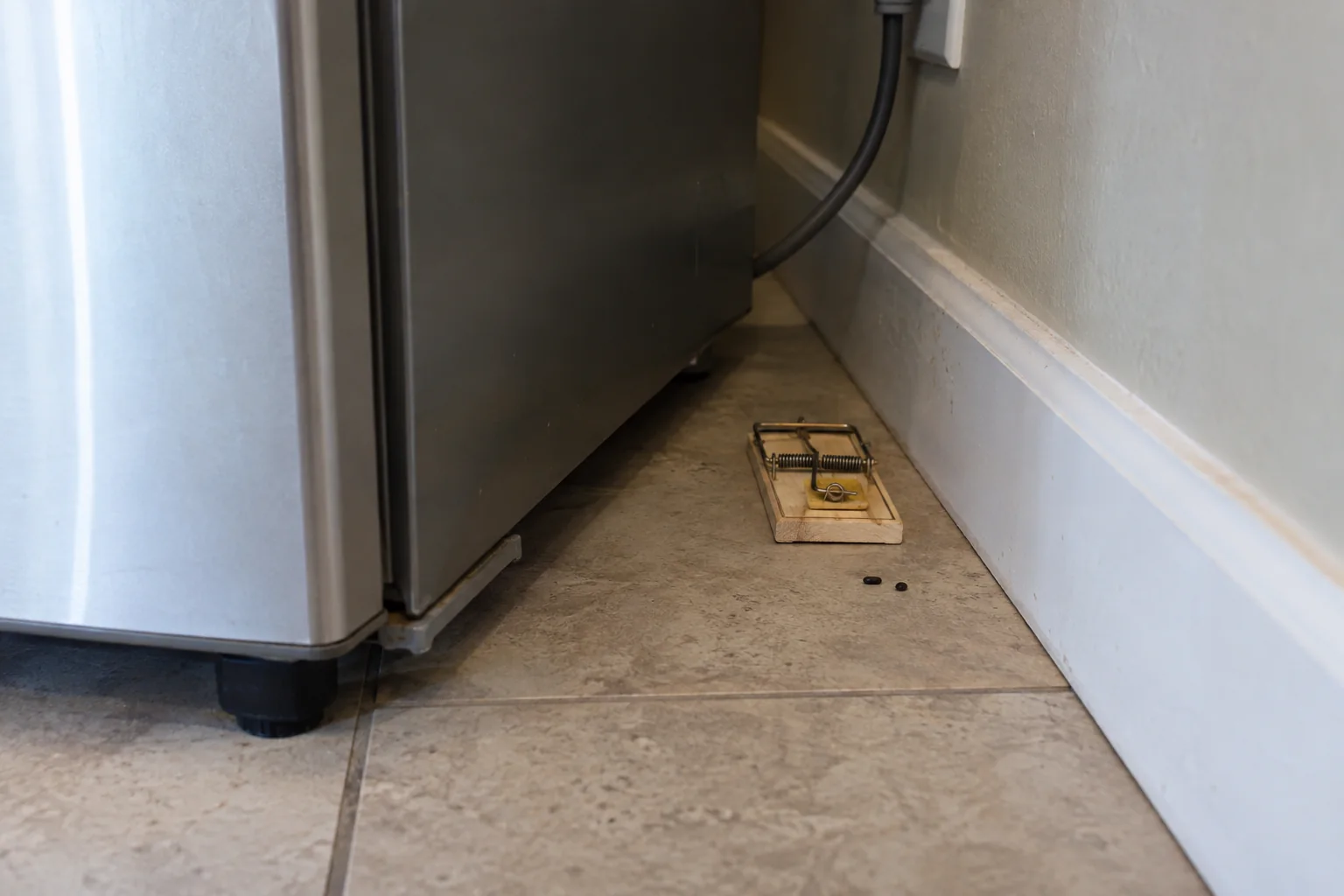
Use mouse-sized traps on confirmed travel routes.
Possible locations include:
- along the wall beside the refrigerator
- behind the refrigerator if safely accessible
- beside a cabinet edge
- near the structural gap mice are using
Keep traps:
- stable
- accessible for checking
- away from children and pets
- outside appliance machinery
See Mouse Traps: Types, Placement & How to Use Them and Best Mouse Traps: Which Type Works Best & How to Choose.
Should You Put a Mouse Trap Inside the Refrigerator?
No.
Do not place traps:
- inside the food compartment
- inside compressor machinery
- behind sealed panels
- where the trap cannot be retrieved safely
Use the accessible structural route outside the appliance.
Should You Put Poison Behind the Refrigerator?
Do not scatter loose rodenticide behind or inside the refrigerator.
Rodenticides must be used according to:
- the product label
- placement requirements
- child and pet safety requirements
A poisoned mouse may die:
- inside a wall
- inside a cabinet void
- behind the appliance
- inside another inaccessible space
and create an odor problem.
Monitored trapping plus exclusion is often easier to evaluate for indoor kitchen activity.
Should You Seal the Gap Behind the Refrigerator Immediately?
Not always.
If mice are still active inside the structure and you seal the only route, they may:
- move into another cabinet
- enter another room
- gnaw a new opening
- die in an inaccessible wall
Coordinate trapping, monitoring, and exclusion.
See Rodent Exclusion: How to Keep Rats & Mice Out.
How to Seal Mouse Entry Points Behind a Refrigerator
The repair depends on the opening.
Possible durable materials include:
- metal mesh
- flashing
- mortar
- rodent-resistant backing plus suitable sealant
Do not interfere with:
- electrical boxes
- appliance ventilation
- water-line movement
- drainage
- required service access
The goal is to close the building opening, not alter the refrigerator.
Can Mice Damage a Refrigerator?
They can damage accessible materials around or inside open lower appliance spaces.
Possible damage includes:
- gnawed cord insulation
- damaged soft tubing
- shredded insulation
- contamination
If appliance components are damaged, have the appliance evaluated.
Do not continue using equipment with known unsafe electrical damage.
Can Mice Damage the Refrigerator Water Line?
Soft tubing may be vulnerable to gnawing.
Inspect for:
- moisture
- drips
- tooth marks
- damaged tubing
A leaking line should be repaired promptly.
Water can create:
- floor damage
- mold
- additional rodent water access
Can Mice Climb Behind a Refrigerator?
Yes.
Mice are capable climbers.
They may use:
- wall texture
- cabinet edges
- pipes
- cords
- structural gaps
to move vertically.
But seeing evidence behind the refrigerator does not tell you the full route.
Inspect nearby walls and cabinets.
How to Know Whether the Problem Is Improving
Monitor for:
- no new droppings
- no trap activity
- no new gnawing
- no repeated sightings
- no new odor
- no new tracks
One quiet night is not proof that mice are gone.
Look for the absence of fresh evidence over time.
When to Call a Professional
Professional help may make sense when:
- droppings keep returning
- mice are active in multiple kitchen areas
- the entry point cannot be found
- the refrigerator is built in or difficult to move
- wiring appears damaged
- the water line is damaged
- contamination is inside appliance machinery
- trapping does not reduce activity
- mice are active in walls or adjacent rooms
- exclusion requires cabinet or wall repair
See Mouse Exterminator: What to Expect & When to Call One.
Mice Behind the Refrigerator: The Bottom Line
Mice hide behind refrigerators because the area can provide:
- darkness
- warmth
- cover
- food debris
- water
- access to walls and cabinets
Useful signs include:
- tiny droppings
- gnaw marks
- tracks
- urine odor
- nesting material
- direct sightings
If you find mouse activity behind the refrigerator:
- inspect safely before moving the appliance
- do not drag or tip a heavy refrigerator alone
- protect the power cord and water line
- do not remove appliance panels unless qualified
- clean accessible droppings using wet-cleanup methods
- keep liquids away from electrical and mechanical components
- place mouse-sized traps on accessible wall routes outside the appliance
- inspect wall, cabinet, and utility openings
- coordinate trapping with exclusion
- monitor until fresh evidence stops
The long-term solution is not simply moving the refrigerator or cleaning behind it.
It is identifying the mouse route, removing active mice, and closing the structural openings that allowed them into the kitchen.
Continue with our mice in the kitchen guide, mouse droppings guide, mouse gnaw marks guide, mouse tracks guide, mouse nest guide, mice in walls guide, how to get rid of mice, how mice get into a house, or rodent exclusion guide.
For the broader overview, return to [Rats & Mice in the Home](/).