Mouse Tracks: What They Look Like & Where to Find Them
Mouse tracks are tiny footprints and travel marks left as mice move across dusty, dirty, or soft surfaces.
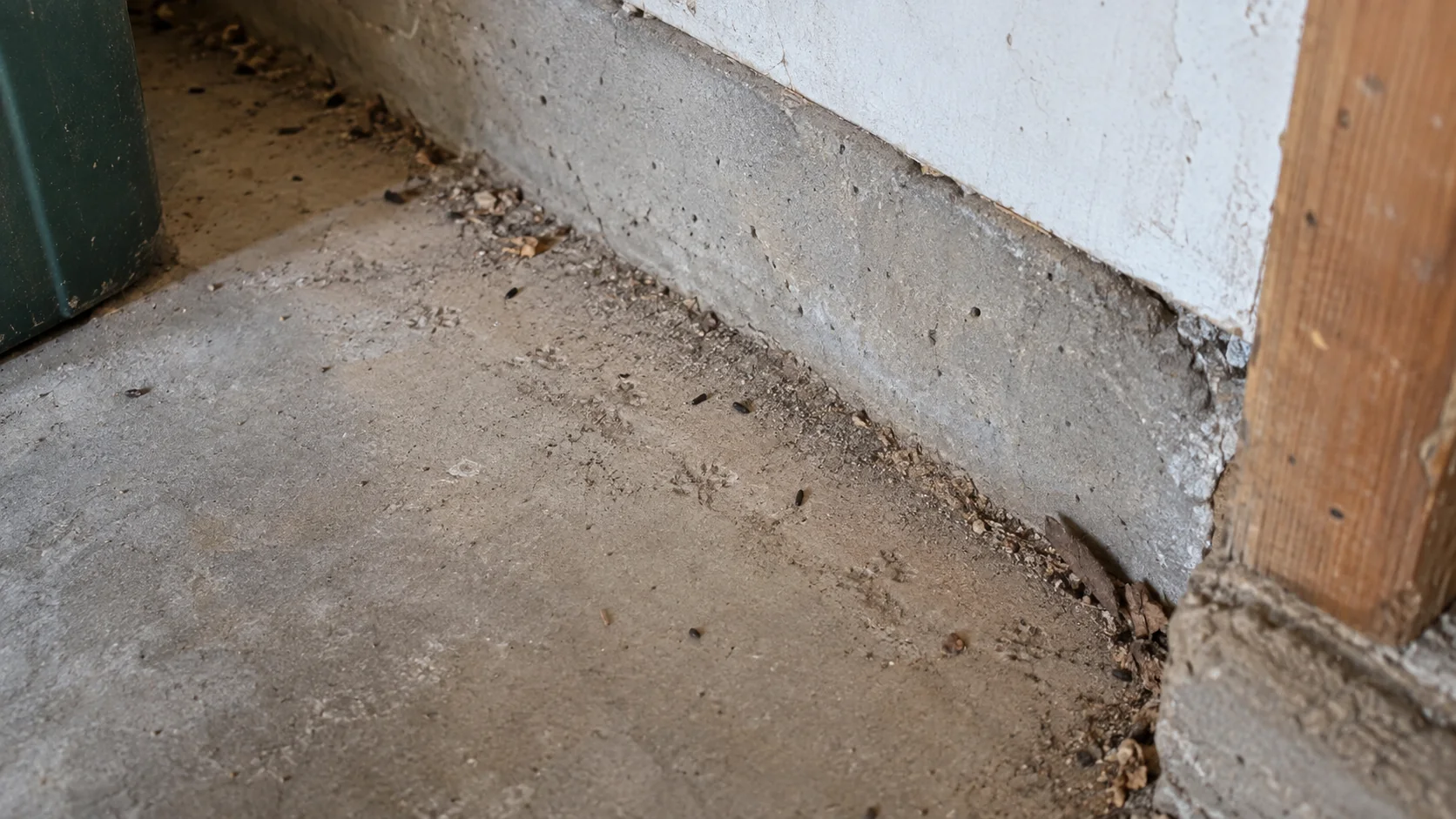
Mouse tracks are tiny footprints and travel marks left as mice move across dusty, dirty, or soft surfaces.
They can be useful evidence when mice are active in:
- garages
- attics
- basements
- pantries
- cabinets
- wall edges
- storage areas
- crawl spaces
A typical mouse track pattern may show:
- very small front footprints
- slightly longer hind footprints
- tiny toe impressions
- repeated prints following a wall or protected edge
- an occasional thin tail mark
Mouse tracks are easy to miss on clean floors.
They are more likely to show up in:
- dust
- fine dirt
- attic insulation dust
- garage debris
- soft soil
- rarely disturbed storage areas
Tracks become much stronger evidence when they appear with:
- mouse droppings
- gnaw marks
- nesting material
- scratching sounds
- food damage
- mouse sightings
This guide explains what mouse tracks look like, where to search for them, how mouse and rat tracks differ, what tail marks mean, and how to use tracks as part of a broader mouse inspection.
What Do Mouse Tracks Look Like?
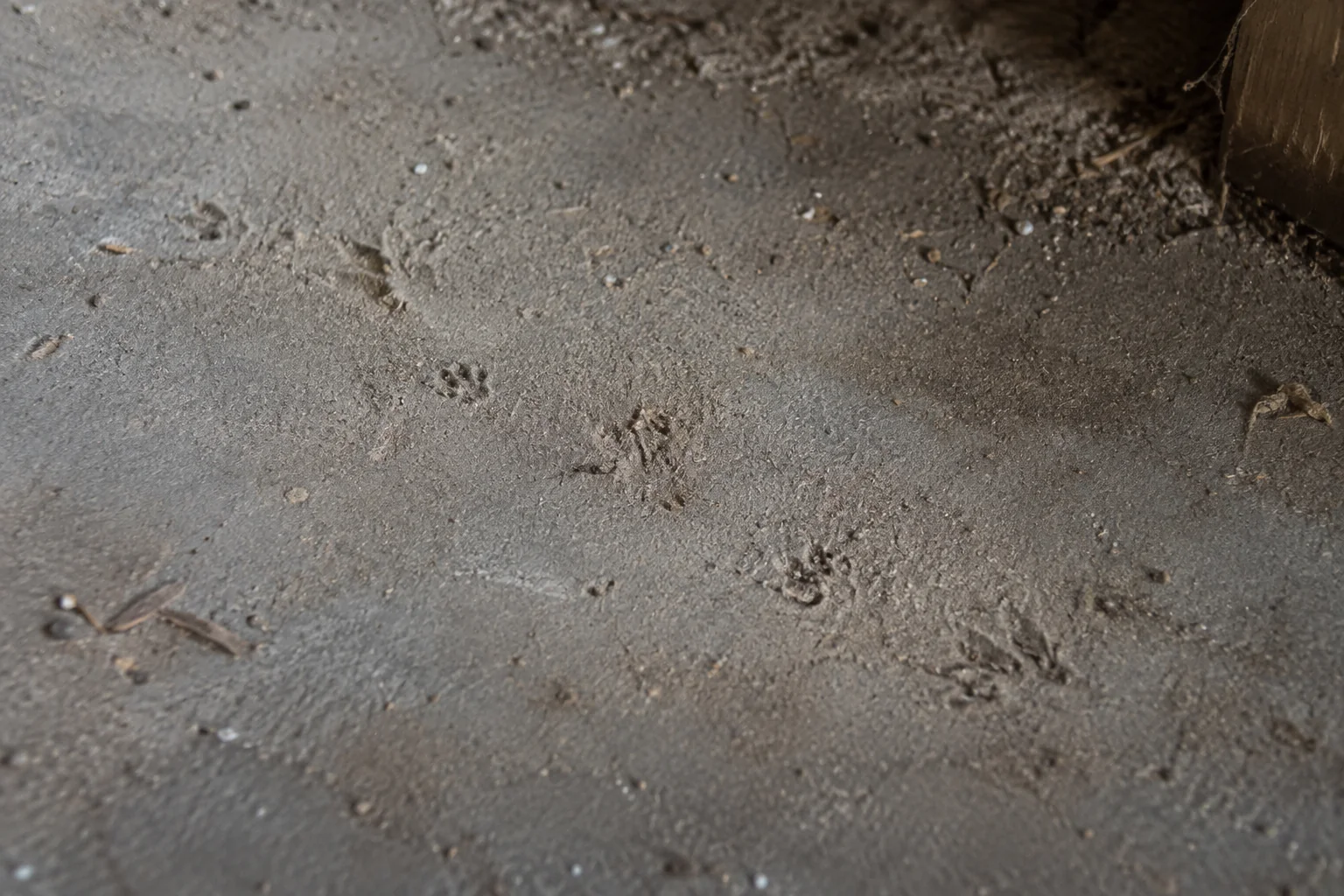
Mouse footprints are small and delicate.
The front and hind feet do not look exactly the same.
Typical features include:
- front prints smaller than hind prints
- narrow toe marks
- a tiny overall footprint
- sets of prints repeating along a travel route
On a clear surface, the front foot may register four obvious forward toes.
The hind foot commonly shows five toe impressions and is longer.
Not every toe prints clearly.
On rough, dusty, or uneven surfaces, you may see only:
- partial toes
- small dark impressions
- disturbed dust
- repeated tiny marks
Do not expect every mouse track to look like a perfect textbook footprint.
What Do Mouse Front Footprints Look Like?
A mouse’s front feet are smaller than its hind feet.
A clear front print may show:
- four obvious toe impressions
- a small central pad area
- a compact overall shape
The tiny inner digit may not register clearly.
On many household surfaces, the print is incomplete.
You may see only:
- two or three toe tips
- a faint pad mark
- a short smudge
That is why one isolated print can be difficult to identify.
What Do Mouse Hind Footprints Look Like?
The hind feet are longer.
A clear hind print may show:
- five toe impressions
- an elongated shape
- a larger print than the front foot
Hind prints can appear ahead of the front prints during certain movement patterns.
On dusty floors, the overall trail may look like repeated pairs or small clusters rather than four perfectly separated footprints.
How Big Are Mouse Tracks?
Mouse tracks are tiny compared with rat tracks.
Exact footprint size varies with:
- mouse species
- age
- surface
- how deeply the foot pressed into the material
For home inspection, relative scale is more useful than one hard measurement.
Mouse prints should look consistent with a very small rodent.
If the footprints are broad, heavy, and clearly much larger than typical mouse evidence, consider rat activity or another animal.
Do Mouse Tracks Show Toes?
Sometimes.
Clear prints can show tiny toe impressions.
But in real homes, tracks are often incomplete because the mouse is moving across:
- thin dust
- rough concrete
- insulation
- cardboard
- uneven debris
Do not reject a possible mouse track simply because every toe is not visible.
Look at the full pattern.
Do Mouse Tracks Have Tail Marks?
They can.
A mouse tail may occasionally leave a thin line or drag mark between footprints.
But tail marks are not always present.
A tail may:
- stay above the surface
- touch only intermittently
- leave no visible mark on a hard floor
Therefore:
no tail line does not rule out mice.
And a thin line by itself does not prove a mouse was present.
What Does a Mouse Tail Drag Mark Look Like?
A possible tail mark may look like:
- a thin line
- a faint wavering groove
- a narrow drag through dust
- an intermittent mark between footprints
The line should be interpreted with nearby footprints.
Random scratches, fibers, tools, or moving objects can create similar lines.
Where Are Mouse Tracks Usually Found?
The best places to look are protected routes that collect dust or debris.
Common locations include:
- along walls
- behind appliances
- inside garages
- attic framing
- insulation edges
- pantry corners
- cabinet interiors
- storage rooms
- basement walls
- crawl-space surfaces
Mice prefer to move near cover.
Tracks in the center of a clean open room are less common than tracks along a wall edge.
Mouse Tracks Along Walls
Wall edges are important mouse runways.
Mice often use the same protected routes repeatedly.
Look near:
- baseboards
- cabinet toe-kicks
- storage edges
- pipes
- corners
A trail of tiny prints along a wall becomes more meaningful when you also find:
- mouse droppings
- fine gnaw marks
- rub or smudge marks
See Signs of Mice in Your House for the broader evidence pattern.
Mouse Tracks Behind Appliances
Behind refrigerators, stoves, and other appliances, mice may find:
- food debris
- warmth
- utility gaps
- wall-edge cover
Dust may preserve tiny tracks.
Inspect for:
- footprints
- mouse droppings
- gnawing
- nesting material
Do not move heavy appliances unsafely.
Mouse Tracks in the Garage
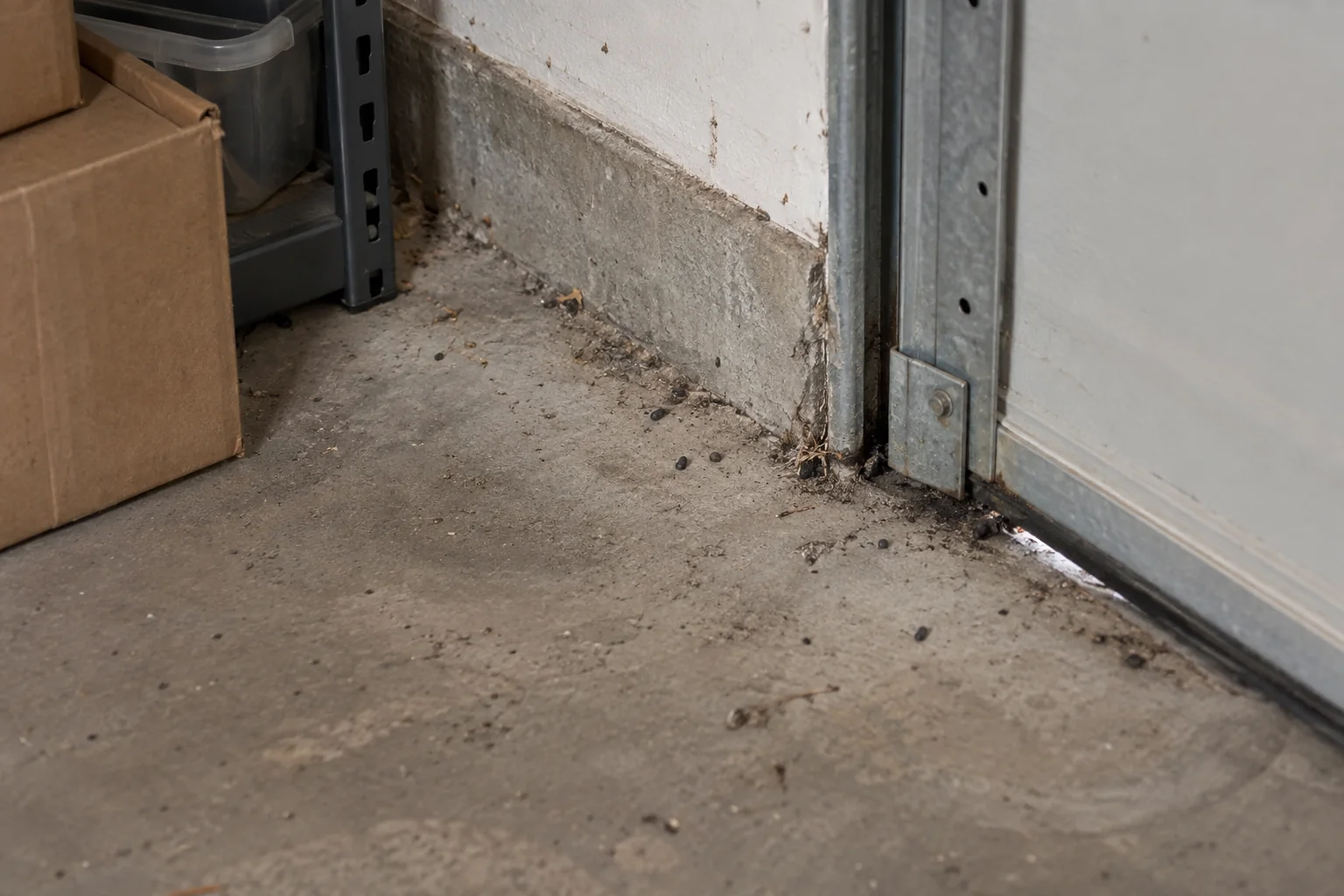
Garages can be excellent places to find tracks because they often have:
- dusty concrete
- stored boxes
- wall edges
- exterior access
- low-disturbance corners
Look near:
- garage-door corners
- shelving
- stored pet food
- wall penetrations
- boxes
Mouse tracks may cross a small patch of dust and disappear again on cleaner concrete.
Mouse Tracks in the Attic
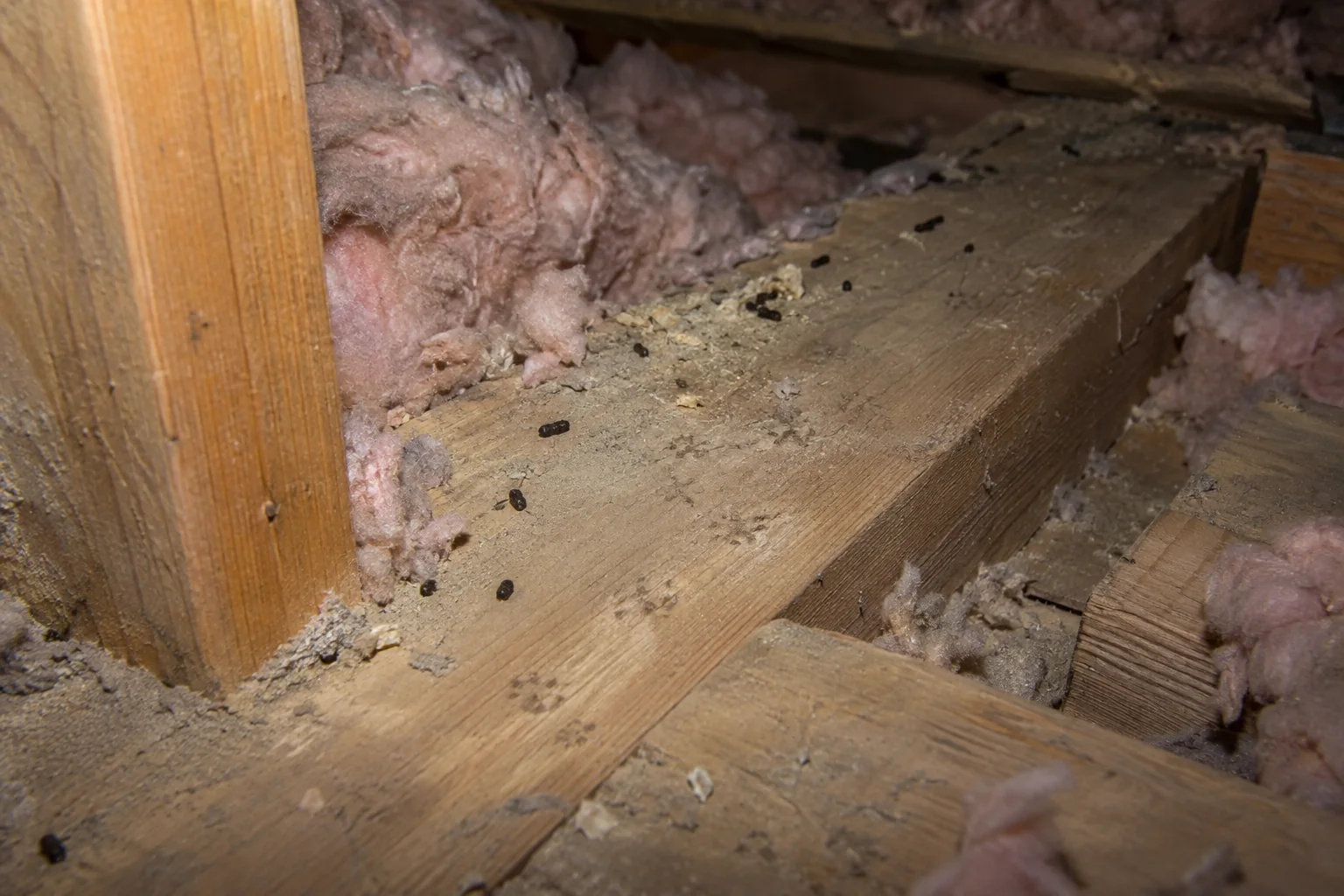
Attics may preserve mouse tracks in:
- dust on framing
- insulation surfaces
- stored boxes
- low-disturbance corners
Look for a repeated route rather than one isolated mark.
Other attic evidence may include:
- mouse droppings
- shredded nesting material
- gnawing
- disturbed insulation
See Mice in the Attic: Signs, Damage & Removal.
Mouse Tracks in Insulation
Insulation does not always preserve a recognizable footprint.
Instead, mouse activity may create:
- tiny compressed paths
- disturbed fibers
- narrow tunnels
- droppings along a route
Do not assume every depression in attic insulation is a mouse track.
Look for multiple signs.
Mouse Tracks in a Pantry
Pantries may show activity around:
- shelf edges
- food packages
- floor-wall corners
- cabinet gaps
Tracks may be hard to see on clean shelving.
Other clues are often more obvious:
- droppings
- gnawed packaging
- urine odor
- food debris
See Mouse Droppings: What They Look Like & What They Mean.
Mouse Tracks in Cabinets
Lower cabinets may collect dust in back corners.
Look near:
- plumbing penetrations
- wall openings
- cabinet seams
- stored items
A few tiny footprints near a pipe gap can help identify a travel route.
But do not reach blindly into hidden openings.
Mouse Tracks in Basements
Basements can preserve tracks on:
- dusty concrete
- shelving
- utility surfaces
- wall edges
Look around:
- pipe routes
- storage
- foundation transitions
- door edges
Mouse-sized tracks should be interpreted separately from larger rat footprints.
Mouse Tracks in Crawl Spaces
Crawl spaces may contain tracks in:
- dust
- soil
- insulation
- sill areas
- utility routes
Species identification from one footprint can be difficult in these environments.
If the crawl space is tight, unsafe, or heavily contaminated, professional inspection may be more practical.
What Is a Mouse Runway?
A mouse runway is a repeatedly used travel route.
It may follow:
- a wall
- a cabinet edge
- shelving
- framing
- a utility route
Signs of a runway may include:
- repeated footprints
- droppings
- small gnaw marks
- smudges
- disturbed dust
A runway can help determine where traps and exclusion work should be focused.
Mouse Tracks vs Rat Tracks
Mouse and rat tracks have a similar basic rodent pattern.
The biggest practical difference is scale.
Mouse Tracks
Usually:
- tiny
- delicate
- narrow
- associated with mouse-sized droppings
Rat Tracks
Usually:
- noticeably larger
- broader
- heavier
- associated with larger droppings and stronger rub marks
Do not identify the animal from one blurry footprint.
Compare tracks with other evidence.
See Rat vs Mouse: How to Tell the Difference.
Mouse Tracks vs Rat Droppings
A track and a dropping answer different questions.
Tracks can show:
- route
- direction of movement
- activity area
Droppings can help confirm:
- rodent presence
- likely size class
If footprints are tiny but the nearby droppings are large, reconsider the identification.
See Mouse vs Rat Droppings: How to Tell the Difference.
Mouse Tracks vs Insect Marks
Insects can leave:
- tiny trails
- disturbed dust
- specks
- narrow lines
But insect marks generally do not create a repeated four-foot rodent gait pattern.
Mouse activity is more likely when tracks appear with:
- droppings
- gnaw marks
- nests
- food damage
Mouse Tracks vs Lizard or Small Reptile Tracks
In some U.S. homes, garages, or warm climates, small reptiles may enter structures.
Their tracks can look different because toes may be:
- longer
- more spread
- differently oriented
A lizard trail may also show a more obvious central tail drag.
Do not identify an animal from one partial print.
Use the surrounding evidence.
Mouse Tracks vs Small Bird Tracks
Bird tracks usually show:
- longer distinct toes
- a different walking pattern
- more open footprint spacing
Indoor bird activity is also usually tied to a clear access point.
Mouse tracks tend to follow protected wall edges and occur with rodent evidence.
Can Mouse Tracks Tell You Which Mouse Species Is Present?
Usually not reliably.
House mice, deer mice, and other small mice can leave footprints that overlap in size and appearance.
Use other clues such as:
- body appearance
- habitat
- tail coloration
- ear and eye proportions
- location
- direct sighting
See House Mouse: Identification, Signs & Behavior and Deer Mouse vs House Mouse: Key Differences.
Are Fresh Mouse Tracks Darker?
Not necessarily.
Track appearance depends more on the surface than age.
Fresh tracks may look more distinct if they have recently disturbed dust.
Older tracks may:
- blur
- collect new dust
- become crossed by other marks
But color alone cannot reliably date a footprint.
How to Tell If Mouse Tracks Are Fresh
The best method is monitoring.
You can:
- photograph the track area
- note the date
- avoid disturbing the route unnecessarily
- inspect again later
- compare new tracks and droppings
Fresh activity is more likely if:
- new prints appear
- new droppings appear
- traps record activity
- new gnawing appears
Do not rely only on how sharp a print looks.
Can You Use Dust to Find Mouse Tracks?
Existing dust is often enough.
You do not need to cover large household areas with loose powder.
Loose powders can:
- create unnecessary mess
- contaminate food areas
- be inhaled
- produce confusing marks
Instead, inspect naturally dusty low-disturbance areas first.
If professional tracking media are used, follow the product instructions and keep them away from food, children, and pets.
Can Flour Show Mouse Tracks?
People sometimes use flour to reveal tracks.
However, spreading food powder in a rodent-active area can create:
- contamination
- cleanup problems
- misleading marks
For a normal home inspection, first use:
- existing dust
- visual evidence
- droppings
- traps
- photographs
There is usually no need to spread flour through the home.
How to Photograph Mouse Tracks
A photograph can help with monitoring.
For clearer documentation:
- use side lighting
- keep the camera close enough to show detail
- include nearby fixed context for scale
- photograph the same area again later
Avoid placing your hands directly in contaminated areas just to show scale.
Do not disturb droppings or nesting material for the photograph.
Why Side Lighting Helps
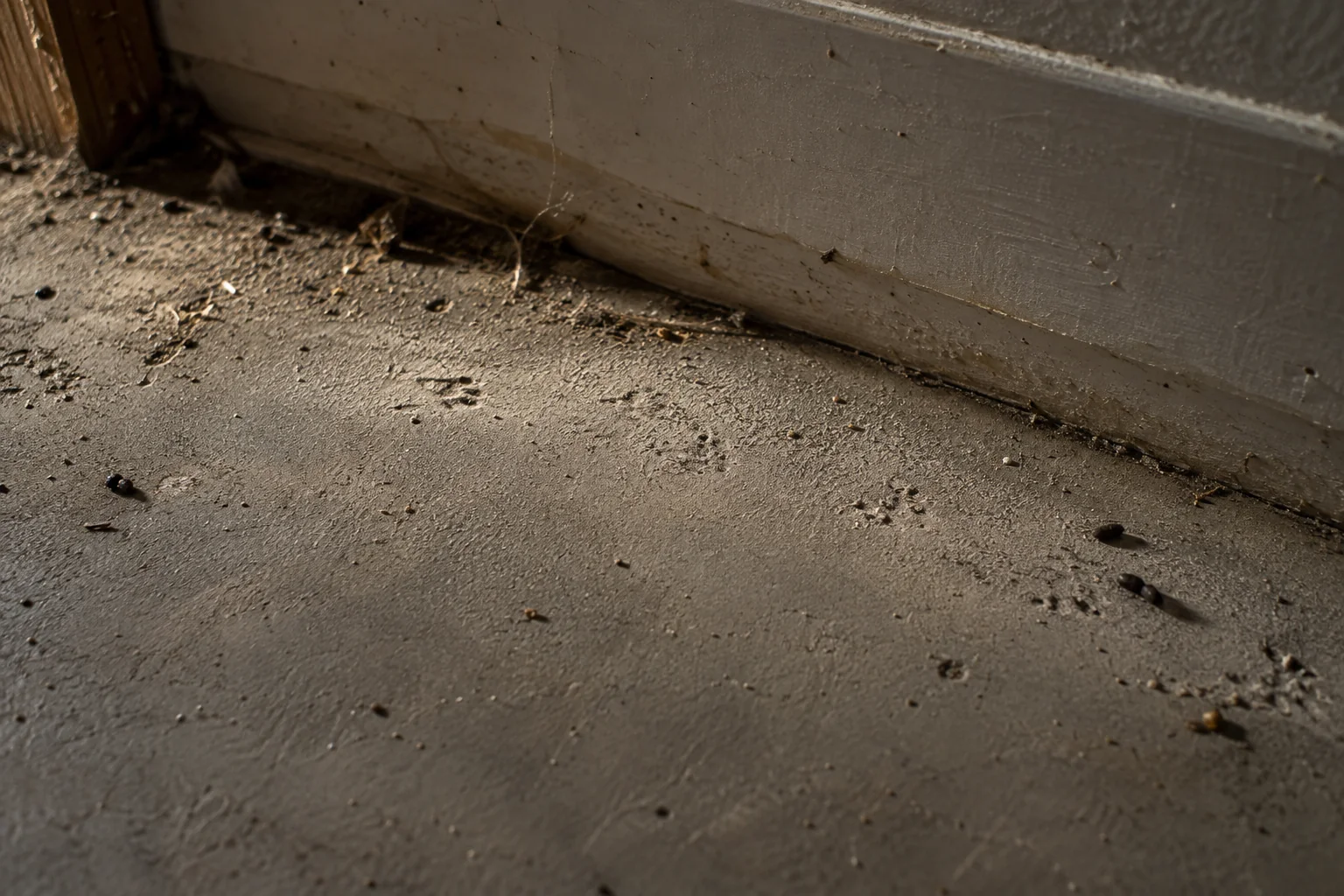
Low-angle light can make tiny depressions cast small shadows.
This can reveal:
- toe marks
- pad impressions
- shallow tracks
A flashlight beam from the side may make tracks easier to see than overhead room lighting.
You do not need to touch the track area.
Mouse Tracks and Droppings Together
Tracks plus mouse-sized droppings are stronger evidence than tracks alone.
Look for droppings:
- along the same wall edge
- behind appliances
- near cabinet gaps
- near food
See Mouse Droppings: What They Look Like & What They Mean.
Mouse Tracks and Gnaw Marks Together
A runway with:
- tiny tracks
- fine gnaw marks
- small droppings
is a strong mouse activity pattern.
See Mouse Gnaw Marks: How to Identify Rodent Damage.
Mouse Tracks Near a Nest
Tracks may lead toward a nesting area.
Look for:
- shredded paper
- insulation
- fabric
- cardboard fibers
But a runway can extend well away from the nest.
See Mouse Nests: What They Look Like & Where to Find Them.
Mouse Tracks Near a Wall With Scratching Sounds
If you hear nighttime scratching and find tiny tracks nearby, the evidence becomes more consistent with mouse activity.
Still check the size of:
- droppings
- openings
- gnaw marks
See Scratching in Walls at Night: Could It Be Mice or Rats?.
Does One Mouse Track Mean You Have an Infestation?
One possible footprint does not tell you how many mice are present.
It may be:
- incomplete
- old
- misidentified
A repeated trail plus fresh droppings or other evidence is much more useful.
Do not estimate population size from footprint count.
What to Do If You Find Mouse Tracks
A practical response is:
- photograph the track area
- inspect the route for droppings
- inspect nearby food and storage
- look for gnaw marks
- identify nearby gaps
- place mouse-sized traps on confirmed accessible routes
- reduce food access
- coordinate trapping with exclusion
- monitor for new tracks and droppings
Do not rely on tracks alone.
Where Should You Put Traps Near Mouse Tracks?
Place traps on the active runway.
Common positions include:
- along walls
- behind appliances
- beside cabinet edges
- near garage routes
- along stable attic framing
Use mouse-sized traps.
Keep them inaccessible to children and pets.
See Mouse Traps: Types, Placement & How to Use Them and Best Mouse Traps: Which Type Works Best & How to Choose.
Can Tracks Help You Find the Entry Point?
Sometimes.
Follow the pattern toward likely access areas such as:
- plumbing penetrations
- garage-door corners
- exterior door gaps
- utility openings
- foundation gaps
- attic connections
See How Mice Get Into Your House.
Should You Seal an Entry Point as Soon as You Find Tracks?
Not always.
If mice are still inside, sealing the only active route can trap them in the structure.
Coordinate trapping with exclusion.
See Rodent Exclusion: How to Keep Rats & Mice Out.
When to Call a Professional
Professional mouse inspection may make sense when:
- tracks appear in several parts of the house
- fresh droppings keep appearing
- the route enters a wall
- attic or crawl-space access is difficult
- trapping does not reduce activity
- the entry point cannot be found
- you are unsure whether the tracks are mouse or rat tracks
See Mouse Exterminator: What to Expect & When to Call One.
Mouse Tracks: The Bottom Line
Mouse tracks are tiny rodent footprints that are easiest to find on:
- dusty floors
- garage edges
- attic framing
- insulation
- storage surfaces
- wall runways
A clear track may show:
- smaller front prints
- slightly longer hind prints
- tiny toe impressions
- an occasional tail mark
But real household tracks are often partial.
Do not expect perfect footprints.
Mouse tracks become much more useful when they occur with:
- mouse droppings
- gnaw marks
- nests
- nighttime scratching
- food damage
- sightings
Use tracks to map the travel route, not to estimate exactly how many mice are present or to identify an exact mouse species from one print.
Continue with our signs of mice guide, mouse droppings guide, mouse gnaw marks guide, mouse nest guide, scratching-in-walls guide, house mouse guide, how mice get into a house, or rodent exclusion guide.
For the broader overview, return to [Rats & Mice in the Home](/).