Mice in the Crawl Space: Signs & Removal
Crawl spaces can give mice exactly what they need: shelter, darkness, protection from weather, nesting material, access to wall voids, and routes around plumbing and utilities.
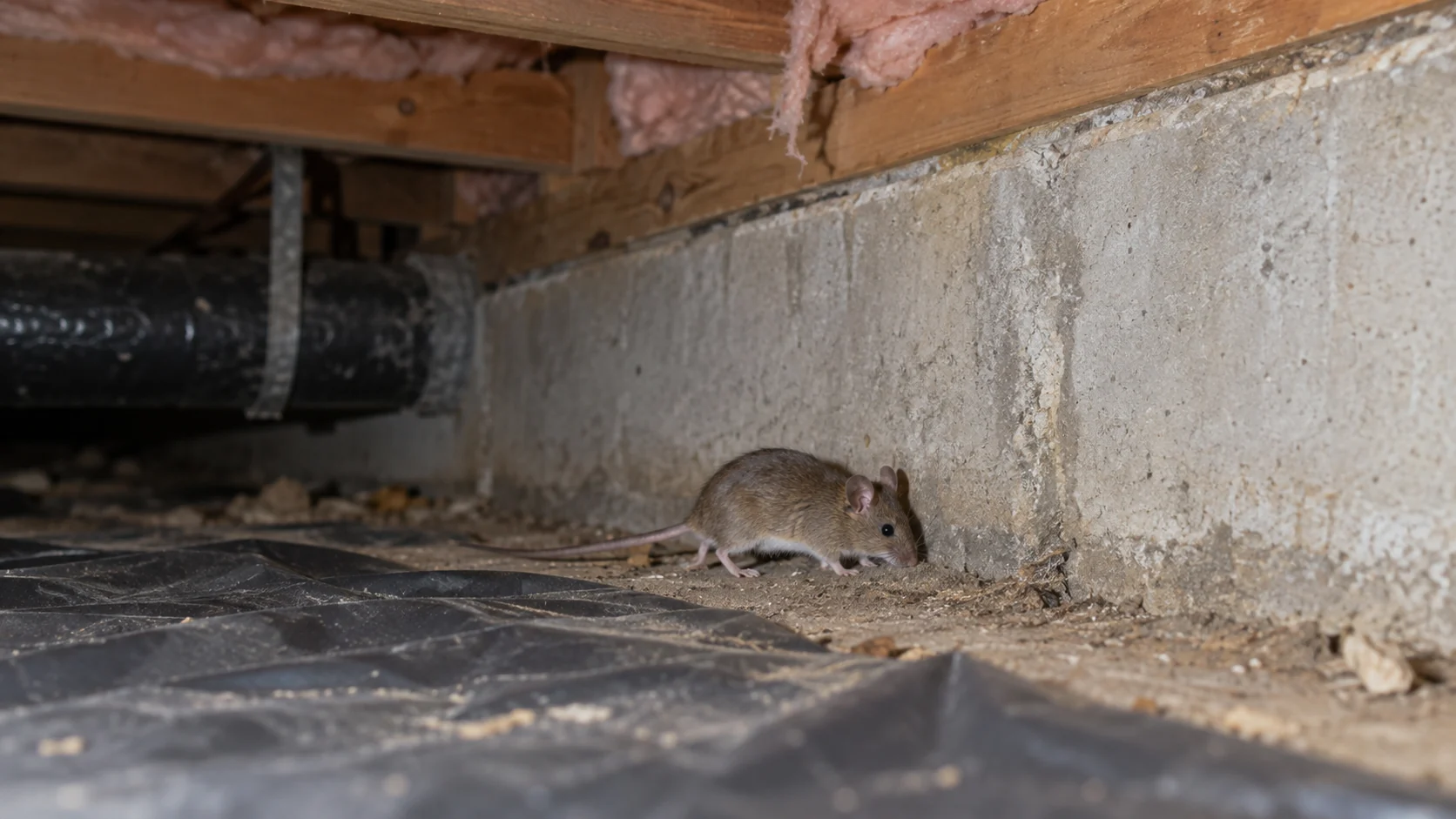
Crawl spaces can give mice exactly what they need:
- shelter
- darkness
- protection from weather
- nesting material
- access to wall voids
- routes around plumbing and utilities
A mouse may enter a crawl space directly from outdoors through:
- a foundation gap
- a damaged vent
- a utility penetration
- an access door
- a sill or rim-joist opening
- a connection from a garage or basement
From there, mice can move into:
- walls
- kitchens
- utility rooms
- attics
- other parts of the house
Common signs of mice in a crawl space include:
- small mouse droppings
- tiny tracks in dust or soil
- gnaw marks
- shredded nesting material
- disturbed insulation
- musky or urine-like odor
- scratching under floors
- a live mouse sighting
Finding one sign does not tell you exactly how many mice are present.
The practical goal is to determine:
- whether activity is current
- where mice are traveling
- whether they are nesting in the crawl space
- which openings connect the crawl space to the exterior
- whether activity has spread into the house
- how to remove mice already inside before completing exclusion
This guide explains what to look for, where crawl-space mice enter, how to remove them safely, and how to reduce the chance of them returning.
Why Do Mice Get Into Crawl Spaces?
Crawl spaces are attractive because they are often:
- dark
- quiet
- protected
- rarely disturbed
They may also contain:
- insulation
- paper backing
- stored materials
- condensation
- plumbing leaks
- utility routes
Mice do not need a food source directly in the crawl space if they can travel into nearby living areas.
A crawl space can function mainly as:
- shelter
- a travel corridor
- an entry route into the house
Can Mice Live in a Crawl Space?
Yes.
Mice can use crawl spaces for:
- shelter
- nesting
- movement between exterior and interior areas
But seeing a mouse there does not prove the crawl space contains the main nest.
The mouse may be moving between:
- outdoors
- a wall void
- a garage
- a kitchen
- an attic
Use multiple signs to determine how the crawl space fits into the larger route.
What Attracts Mice to a Crawl Space?
Common conditions include:
- open foundation gaps
- damaged vent screens
- pipe penetrations
- insulation
- clutter
- moisture
- quiet shelter
Food may be nearby rather than inside the crawl space.
Mice may travel upward into living areas to reach:
- pantry food
- pet food
- crumbs
- stored dry food
So sanitation helps, but structural exclusion is essential.
Where Do Mice Enter a Crawl Space?
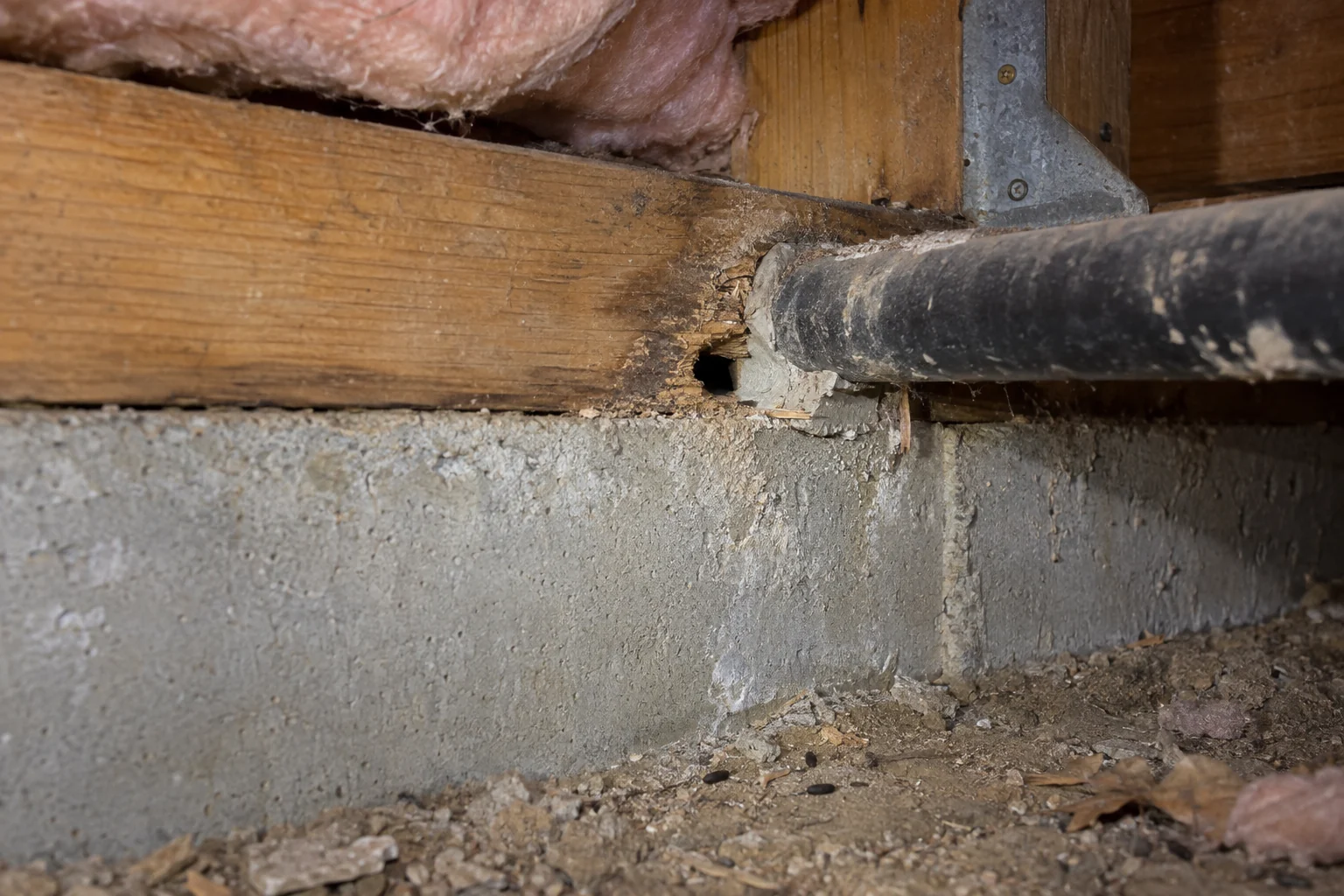
Important inspection points include:
- foundation vents
- crawl-space doors
- utility penetrations
- plumbing openings
- cable entries
- foundation joints
- sill and rim-joist gaps
- damaged screening
- gaps around attached garages
The active opening may be small.
Prioritize openings that align with:
- droppings
- tracks
- gnawing
- rub or smudge marks
- repeated sightings
See How Mice Get Into Your House for the broader entry-point guide.
Mice Entering Through Crawl-Space Vents
Foundation vents can become entry points when:
- screening is missing
- mesh is damaged
- framing has gaps
- edges are loose
Inspect the full perimeter of the vent.
A mouse may use a defect at the frame even if the center screen appears intact.
Do not block ventilation that the crawl-space design requires.
Repairs should preserve the intended function of the vent.
Mice Entering Around Pipes
Plumbing penetrations often create small gaps.
Inspect around:
- water lines
- drain pipes
- hose penetrations
- utility sleeves
A gap around a pipe can connect:
- exterior soil
- crawl space
- wall cavity
- cabinet void
Do not damage plumbing while inspecting or sealing.
Mice Entering Around Cable or Electrical Penetrations
Cable and electrical routes can also create access points.
Look around:
- conduit
- service penetrations
- low-voltage cable
- utility boxes
Do not work on energized electrical equipment unless qualified.
If a gap is adjacent to electrical components, use an appropriate repair method for that location.
Mice Entering at the Sill or Rim Joist
The area where framing meets the foundation can contain small gaps.
Inspect:
- sill plates
- rim-joist areas
- corners
- transitions around utilities
Look for:
- droppings
- gnawing
- staining
- a visible opening
Do not assume every construction joint is an active mouse route.
Evidence should guide repairs.
Mice Entering Through the Crawl-Space Access Door
An access door or hatch may have:
- worn weatherstripping
- a damaged frame
- a gap at the bottom
- loose panels
Inspect the entire perimeter.
A durable repair should close the gap without making the access unsafe or impossible to use.
Mice From the Garage Into the Crawl Space
Attached garages can connect to crawl spaces through:
- wall voids
- utility routes
- structural gaps
- shared foundation areas
If mouse activity is present in both areas, inspect the connection.
See Mice in the Garage: Entry Points, Nests & Control.
Can Mice Move From the Crawl Space Into Walls?
Yes.
Crawl spaces can connect directly to wall cavities.
Mice may move upward through:
- pipe chases
- framing gaps
- utility openings
- unfinished structural voids
If you hear scratching in lower walls and also find crawl-space evidence, the routes may be connected.
See Mice in Walls: Signs, Entry Points & What to Do.
Can Mice Reach the Kitchen From the Crawl Space?
Yes.
Plumbing and cabinet penetrations can create connected paths from a crawl space into:
- sink cabinets
- wall voids
- floor openings
- utility spaces
If mouse evidence appears in both the crawl space and kitchen, inspect the route around plumbing.
See Mice in the Kitchen: Why They’re There & What to Do.
Can Mice Reach the Attic From the Crawl Space?
They can.
Mice can move through wall cavities and framing from lower levels to upper areas.
Crawl-space activity plus attic activity may indicate a connected structural route.
See Mice in the Attic: Signs, Damage & Removal.
Where Do Mice Hide in Crawl Spaces?
Possible hiding areas include:
- insulation
- sill areas
- wall connections
- stored material
- utility zones
- corners behind pipes
- protected framing pockets
Mice usually prefer cover.
They are less likely to remain exposed in the center of an open crawl space unless moving between routes.
Do Mice Nest in Crawl Spaces?
Yes.
Possible nesting locations include:
- insulation
- paper-backed material
- stored cardboard
- fabric
- protected corners
- wall voids
A crawl-space sighting does not prove the nest is there.
Look for an actual nest plus nearby supporting evidence.
See Mouse Nests: What They Look Like & Where to Find Them.
What Does a Mouse Nest in a Crawl Space Look Like?
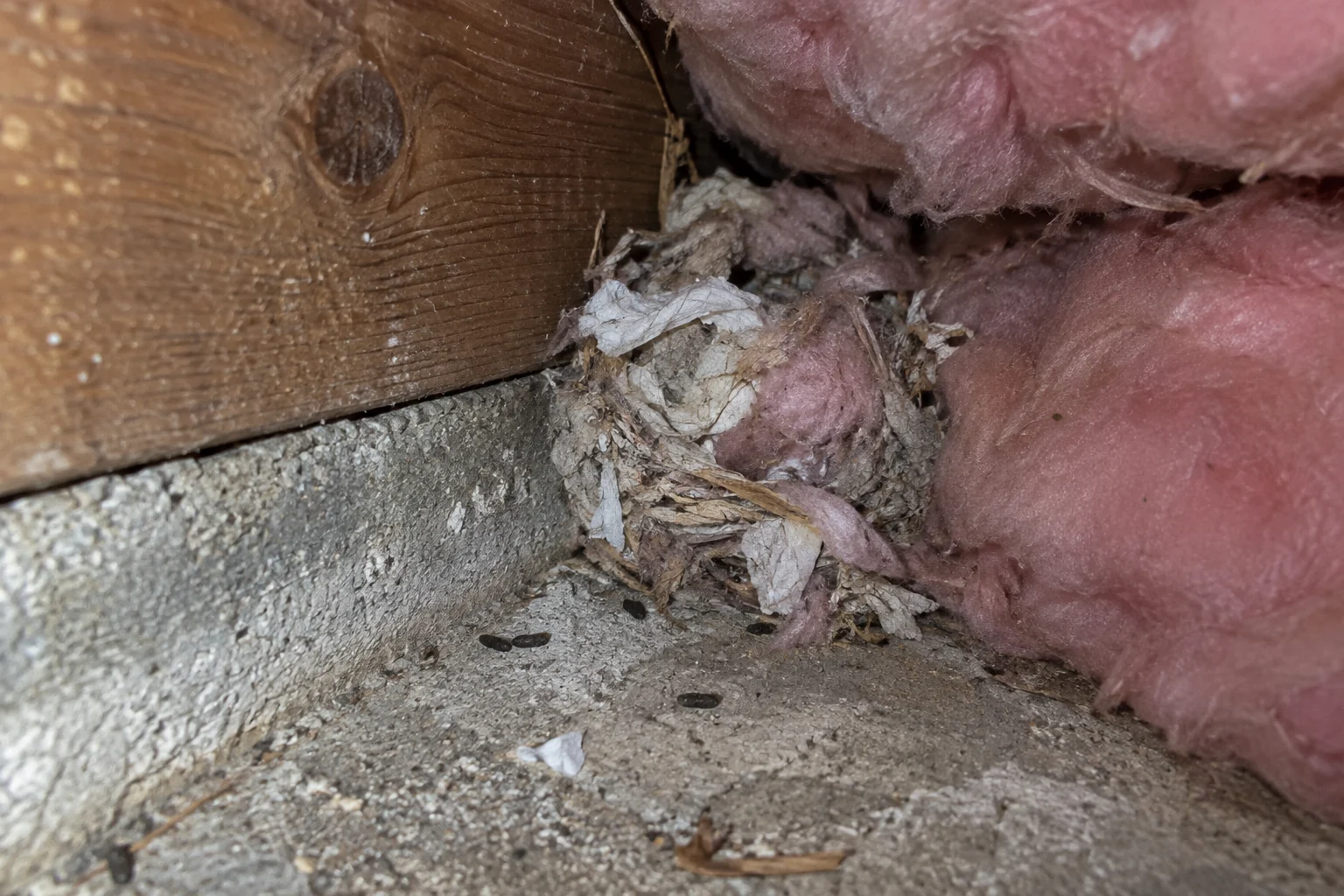
A mouse nest is usually an irregular accumulation of soft material.
It may contain:
- shredded paper
- insulation fibers
- fabric
- cardboard fibers
Nearby evidence may include:
- mouse droppings
- urine odor
- gnawing
It should not look like a neat bird nest.
Do not handle nesting material with bare hands.
Mouse Droppings in the Crawl Space
Droppings may appear:
- along foundation walls
- on vapor barriers
- near pipes
- along sill areas
- under insulation
- near access doors
Mouse droppings are typically small and dark.
Do not use dropping count to estimate population.
See Mouse Droppings: What They Look Like & What They Mean.
Mouse Tracks in a Crawl Space
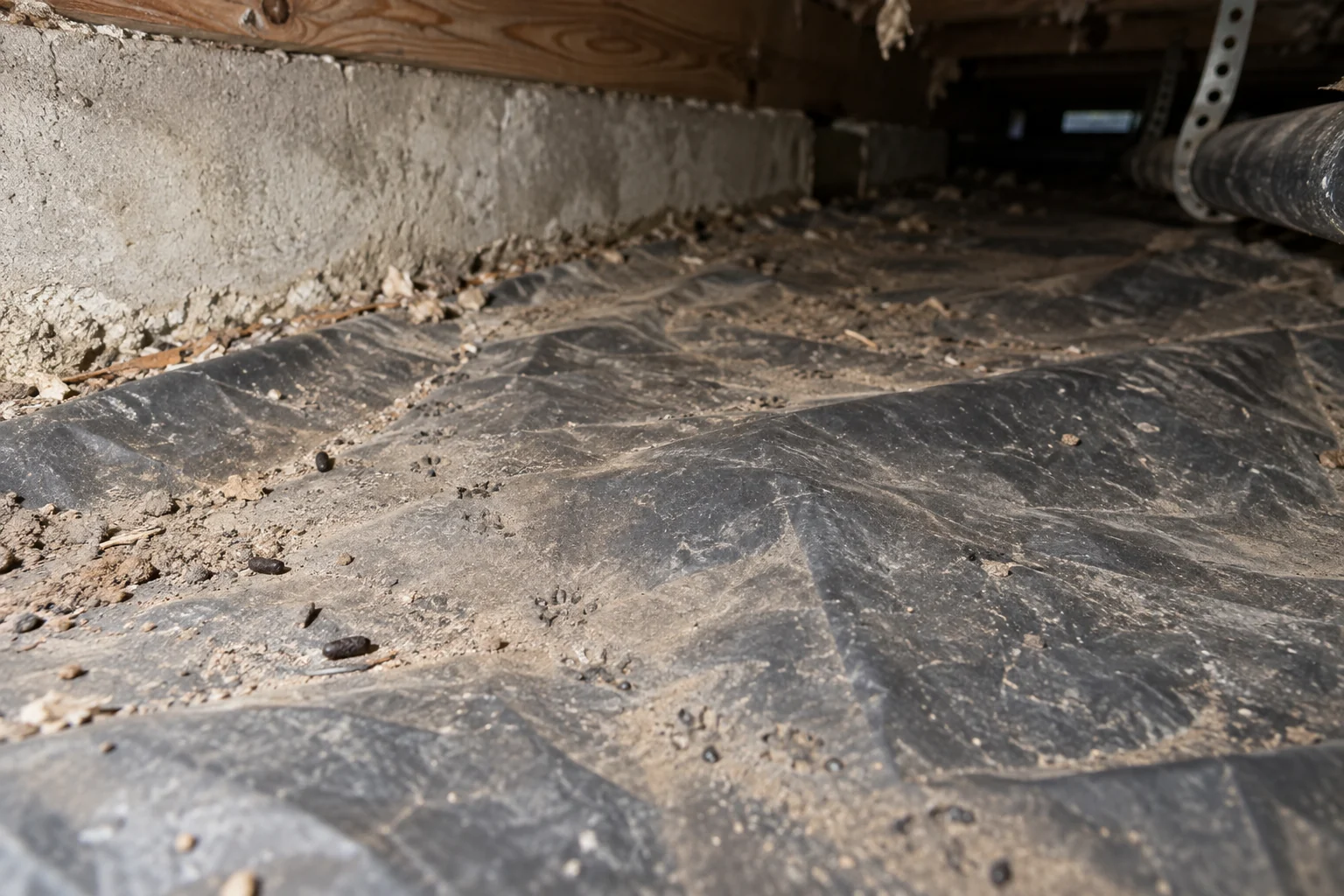
Tracks may appear in:
- dust
- soft soil
- debris
- vapor barriers
- insulation dust
Mouse tracks are tiny and often incomplete.
Look for repeated routes rather than perfect footprints.
See Mouse Tracks: What They Look Like & Where to Find Them.
Mouse Gnaw Marks in a Crawl Space
Common targets include:
- insulation backing
- cardboard
- soft wood edges
- plastic
- wire insulation
- utility-opening edges
Small fine gnawing becomes more meaningful when droppings or tracks are nearby.
See Mouse Gnaw Marks: How to Identify Rodent Damage.
Disturbed Insulation
Mice can move through or around insulation.
Possible clues include:
- narrow disturbed routes
- compressed material
- shredded fibers
- nesting pockets
But insulation can also be disturbed by:
- maintenance work
- airflow
- other animals
Use supporting evidence before blaming mice.
Mouse Urine Smell in the Crawl Space
Repeated activity can create a musky or urine-like odor.
Odor may be stronger:
- near a nest
- in insulation
- in enclosed corners
- around repeated routes
Smell alone does not prove mice.
See Mouse Urine Smell: What It Smells Like & How to Find It.
Scratching Under the Floor
Mice in a crawl space or lower wall can create:
- light scratching
- rustling
- gnawing sounds
But sounds beneath a floor can also come from:
- rats
- plumbing
- ducts
- building movement
- other animals
Do not identify mice from sound alone.
See Scratching in Walls at Night: Could It Be Mice or Rats?.
Could Crawl-Space Droppings Be From Rats?
Yes.
Rat droppings are substantially larger.
Rat tracks and gnawing are also heavier.
If the evidence seems too large for mice, compare it carefully.
See Mouse vs Rat Droppings: How to Tell the Difference and Rat vs Mouse: How to Tell the Difference.
Can Mice Damage Crawl-Space Insulation?
Yes.
Mice may:
- tunnel through loose material
- compress insulation
- pull fibers into nests
- contaminate material with droppings and urine
Minor disturbance does not always require insulation replacement.
Heavily contaminated porous material may be difficult to clean effectively.
Can Mice Damage Wiring in a Crawl Space?
Yes.
Mice can gnaw wire insulation.
If wiring appears damaged:
- do not touch exposed conductors
- keep away from unsafe wiring
- have electrical damage evaluated appropriately
Do not work around energized components unless qualified.
Rodent control does not replace electrical repair.
Can Mice Damage Plumbing?
Mice are more likely to use plumbing routes than damage metal plumbing itself.
They may gnaw:
- soft insulation
- flexible materials
- nearby sealant
- soft plastic components
If a plumbing leak is present, repair it because moisture can make the area more attractive.
Is It Safe to Enter a Crawl Space With Mouse Activity?
Not always.
Before entering, consider:
- headroom
- standing water
- damaged wiring
- unstable surfaces
- exposed nails
- insulation
- mold
- heavy rodent contamination
- other animals
- difficult access
Do not enter a crawl space that appears unsafe.
A professional inspection may be more appropriate when access is tight or hazards are present.
When Should You Avoid Crawl-Space Entry?
Avoid entering if you see:
- standing water near electrical systems
- visibly damaged wiring
- unstable framing
- severe contamination
- very tight confined access
- aggressive wildlife
- unknown hazards
Do not treat a crawl space like a normal room.
Safe access comes first.
What to Do Right After Finding Mouse Signs
A practical response is:
- document where the evidence appears
- inspect accessible perimeter routes
- identify droppings, tracks, gnawing, and nesting material
- inspect foundation vents and utility penetrations
- check whether activity extends into walls or living areas
- place mouse-sized traps on confirmed accessible routes
- remove accessible food sources elsewhere in the home
- correct moisture problems where practical
- coordinate trapping with exclusion
- monitor for fresh signs
Do not crawl blindly through contaminated insulation looking for one mouse.
Where Should You Put Mouse Traps in a Crawl Space?
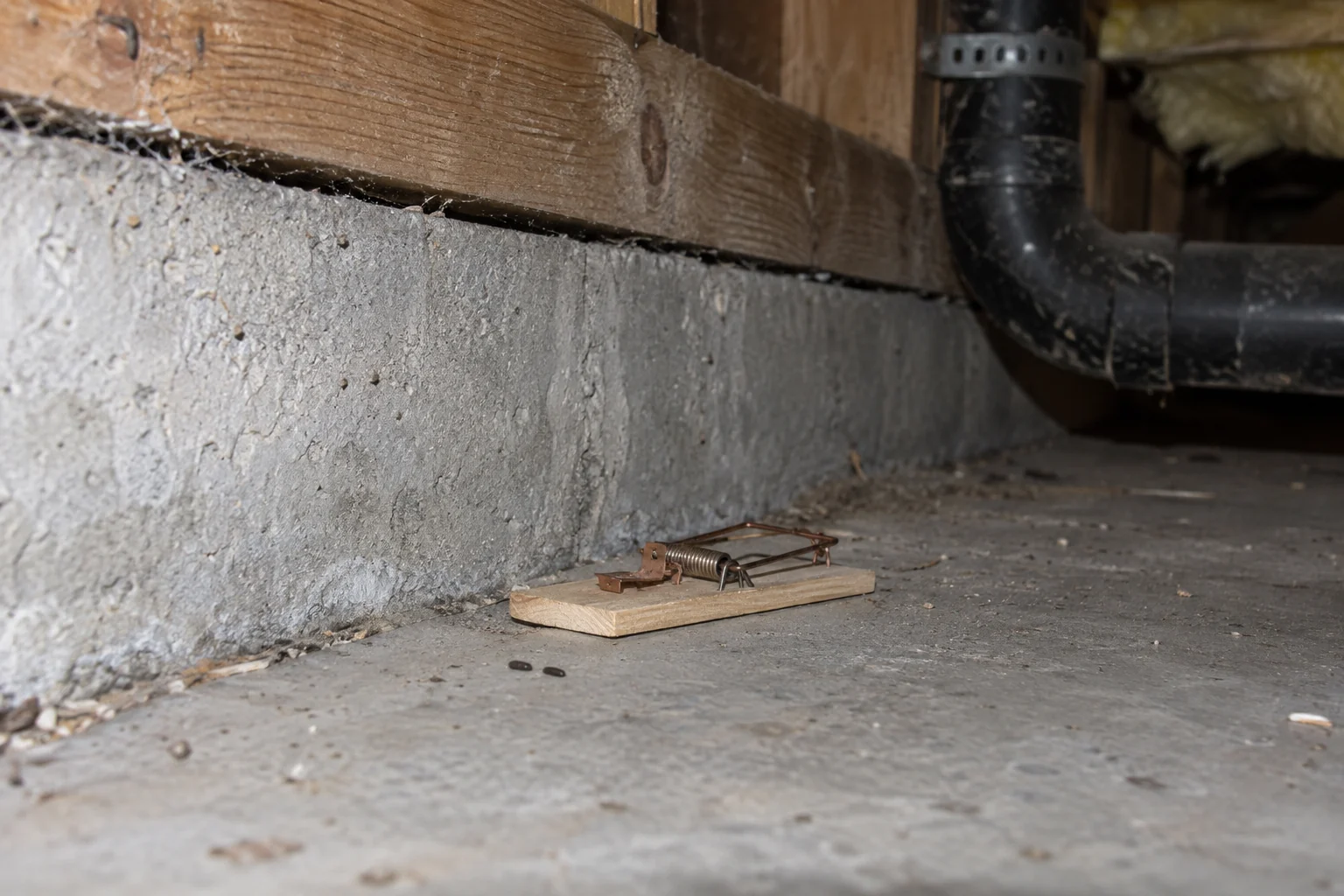
Place traps on confirmed accessible mouse routes.
Possible locations include:
- along foundation walls
- near access points
- beside utility penetrations
- along stable structural edges
Use traps designed for mice.
Keep them:
- stable
- accessible for checking
- protected from children and pets
- away from situations where they could fall into inaccessible voids
Follow the trap manufacturer’s instructions.
See Mouse Traps: Types, Placement & How to Use Them and Best Mouse Traps: Which Type Works Best & How to Choose.
Should You Put Traps Everywhere?
No.
Random trap placement is less useful than placing traps on confirmed routes.
Use evidence such as:
- droppings
- tracks
- gnaw marks
- travel paths
to guide placement.
Monitor and adjust based on fresh activity.
Should You Use Poison in a Crawl Space?
Do not assume rodenticide is the simplest solution.
Rodenticides must be used according to:
- the product label
- applicable placement requirements
- child and pet safety requirements
A poisoned mouse may die in an inaccessible wall, insulation cavity, or structural void and create an odor problem.
Monitored trapping plus exclusion is often easier to evaluate for indoor structural activity.
Should You Seal Crawl-Space Gaps Immediately?
Not always.
If mice are still inside and you seal the only active route, they may:
- move farther into the structure
- enter living areas
- gnaw another opening
- die in an inaccessible void
Coordinate removal and exclusion.
See Rodent Exclusion: How to Keep Rats & Mice Out.
How to Seal Mouse Entry Points Around a Crawl Space
The repair depends on the opening.
Durable exclusion may involve:
- metal mesh
- flashing
- mortar
- rodent-resistant backing plus suitable sealant
- repaired vent screening
- improved access-door weatherstripping
Do not block:
- required ventilation
- drainage
- utility access
Repairs should fit the construction detail.
Should Crawl-Space Vents Be Sealed?
Do not automatically seal ventilation openings.
Some crawl-space designs rely on venting.
Others may be intentionally sealed or conditioned.
The correct approach depends on the building design.
If a vent is required, repair the screen or frame without blocking its intended function.
How to Clean Mouse Droppings in a Crawl Space Safely
For a small accessible contaminated area, use wet-cleanup principles.
A practical sequence is:
- keep unnecessary people and pets away
- wear suitable gloves
- wet droppings and contaminated material with an appropriate disinfecting solution
- allow the product’s required contact time
- wipe or collect the waste
- bag waste appropriately
- clean the surrounding hard surface
- wash hands after removing gloves
Do not dry sweep or vacuum fresh mouse droppings or nesting material before wet cleanup.
See the cleanup section and rodent safety section.
What About Heavy Crawl-Space Contamination?
A heavily contaminated crawl space is different from a few droppings on an accessible surface.
Professional cleanup may be more appropriate when:
- droppings are widespread
- insulation is heavily contaminated
- access is difficult
- contamination extends across a large area
- moisture or mold is also present
Do not disturb large contaminated areas unnecessarily.
Should Contaminated Insulation Be Removed?
Not every disturbed section needs removal.
Removal may be considered when insulation is:
- heavily contaminated
- saturated
- damaged
- extensively used for nesting
The decision depends on:
- contamination level
- material type
- access
- building conditions
Professional assessment may be useful for large areas.
Reduce Moisture in the Crawl Space
Moisture does not cause mice, but it can make the space more attractive and create other building problems.
Address:
- plumbing leaks
- standing water
- drainage problems
- persistent condensation
Do not attempt repairs beyond your skill level.
Check Whether Mice Have Reached the House
Inspect connected areas such as:
- kitchen
- garage
- utility room
- lower walls
- attic
Fresh signs in multiple areas can reveal the route.
The crawl space may be only one part of the activity pattern.
How to Know Whether the Mouse Problem Is Improving
Monitor for:
- new droppings
- new tracks
- trap activity
- new gnaw marks
- additional scratching
- repeat sightings
Improvement means fresh evidence declines and eventually stops.
Do not assume one quiet night means the crawl space is clear.
When to Call a Professional
Professional mouse control may make sense when:
- crawl-space access is difficult
- fresh droppings keep returning
- mice are active in walls
- several structural routes are involved
- wiring is damaged
- contamination is extensive
- trapping does not reduce activity
- the exterior entry point cannot be found
- exclusion work requires structural repair
See Mouse Exterminator: What to Expect & When to Call One.
Mice in the Crawl Space: The Bottom Line
Mice enter crawl spaces because these areas can provide:
- shelter
- nesting material
- utility routes
- structural access
- connections to living spaces
Common signs include:
- mouse droppings
- tracks
- gnaw marks
- nests
- disturbed insulation
- urine odor
- scratching
- sightings
If you find mice in the crawl space:
- inspect accessible entry points
- place mouse-sized traps on confirmed routes
- wet-clean contamination safely
- correct moisture problems where practical
- inspect connected walls and rooms
- coordinate trapping with exclusion
- repair vents, utility gaps, access doors, and structural openings appropriately
- monitor until fresh activity stops
The long-term solution is not simply catching one mouse.
It is removing active mice while correcting the structural routes that allowed them into the crawl space.
Continue with our signs of mice guide, mouse droppings guide, mouse tracks guide, mouse gnaw marks guide, mouse nest guide, mice in the garage guide, how to get rid of mice, how mice get into a house, or rodent exclusion guide.
For the broader overview, return to [Rats & Mice in the Home](/).