Rats Under a Deck: Signs, Burrows & What to Do
The space under a deck can give rats several things they look for: shelter from weather, darkness, protected ground, cover from people and predators, and nearby food and water.
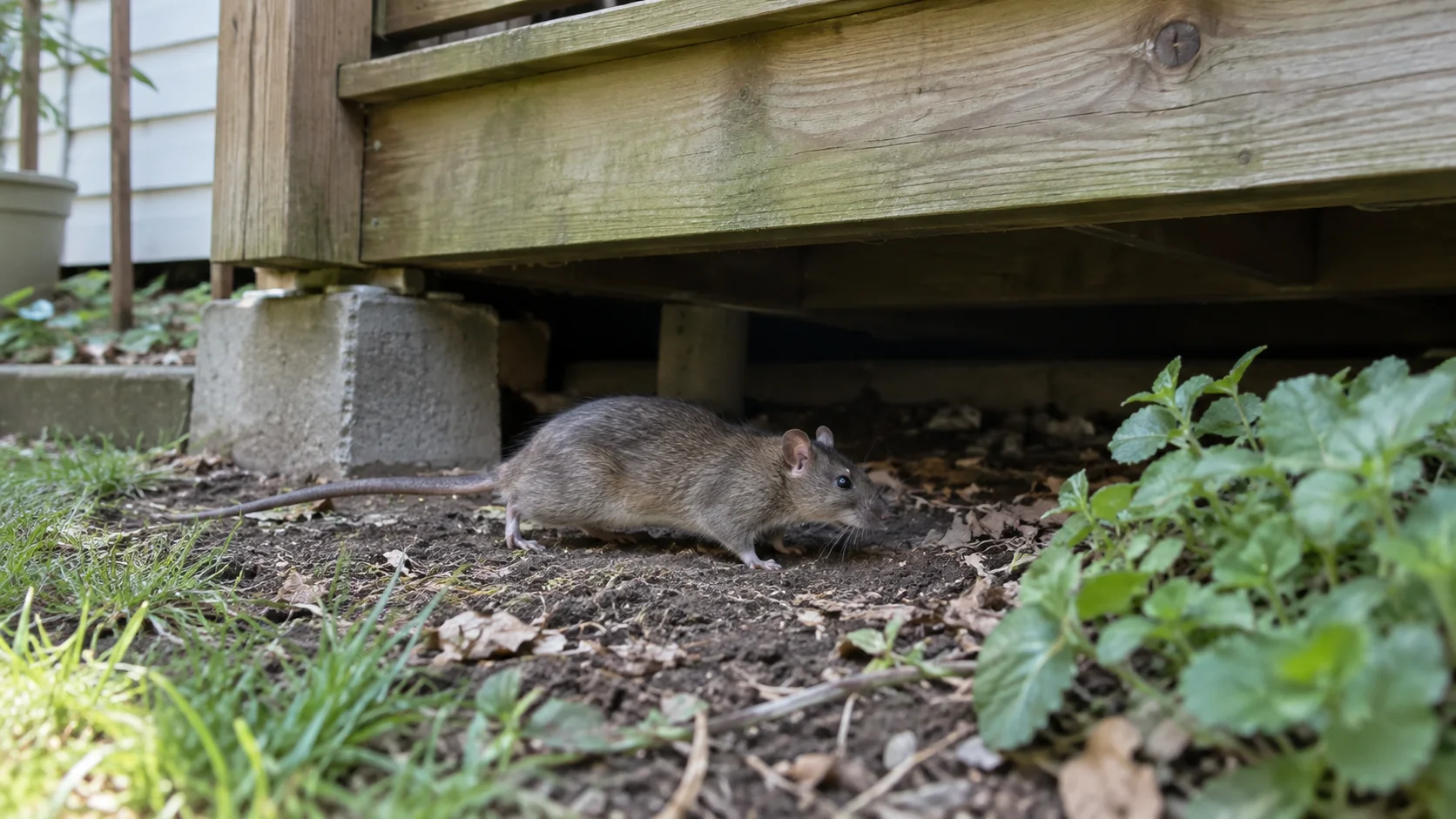
The space under a deck can give rats several things they look for:
- shelter from weather
- darkness
- protected ground
- cover from people and predators
- nearby food and water
- access to a house, garage, crawl space, or yard route
Rats may use a deck area for:
- burrowing
- resting
- nesting
- feeding
- travel between structures
Common signs include:
- burrow openings near the deck edge or footings
- rat-sized droppings
- worn runways
- tracks in soil or dust
- rub marks
- gnawing
- shredded nesting material
- repeated sightings
- nighttime movement under the deck
But one hole or one sighting does not tell you how many rats are present.
The practical goal is to determine:
- whether rat activity is current
- whether rats are burrowing under the deck or only traveling through
- what food, water, or shelter is supporting the activity
- whether the route connects to the house or another structure
- how to control active rats safely
- when to repair or close access under the deck
This guide explains why rats hide under decks, what signs to look for, how to respond safely, and how to reduce the chance of rats returning.
Why Do Rats Hide Under Decks?
Decks can create an ideal protected ground-level space.
The area underneath may be:
- shaded
- dry
- rarely disturbed
- hidden by skirting or vegetation
- close to food
- close to building foundations
Rats prefer protected edges and routes.
A deck can provide a covered connection between:
- the yard
- a foundation
- a crawl space
- a garage
- a shed
- a fence line
Do Rats Live Under Decks?
They can.
Rats may:
- burrow in the soil
- nest in protected debris
- rest beneath framing
- travel through the space without nesting there
A rat seen entering beneath a deck does not prove the main nest is under the deck.
The animal may be moving between:
- a yard burrow
- a neighboring property
- a crawl space
- a garage
- a basement
- another sheltered structure
Look for multiple signs before deciding where activity is centered.
What Attracts Rats Under a Deck?
Common attractants include:
- spilled bird seed
- pet food
- garbage
- compost
- fallen fruit
- outdoor cooking debris
- animal feed
- standing water
- leaking faucets
- dense vegetation
- stored materials
The space itself may provide shelter even when no food is directly under the deck.
Rats can feed elsewhere and return to the deck for cover.
Does a Clean Yard Prevent Rats Under a Deck?
Not always.
A clean property can still provide:
- a deck cavity
- structural access
- water
- a nearby food source
- neighboring rat activity
Sanitation helps, but it is only one part of control.
The most useful approach is to identify the specific resources and routes supporting the activity.
What Are the Main Signs of Rats Under a Deck?
Look for:
- rat burrows
- rat-sized droppings
- worn travel paths
- tracks
- rub marks
- gnawed materials
- nesting debris
- repeated sightings
One sign is more convincing when other evidence appears nearby.
See Signs of Rats: How to Tell If You Have Rats.
What Does a Rat Burrow Under a Deck Look Like?
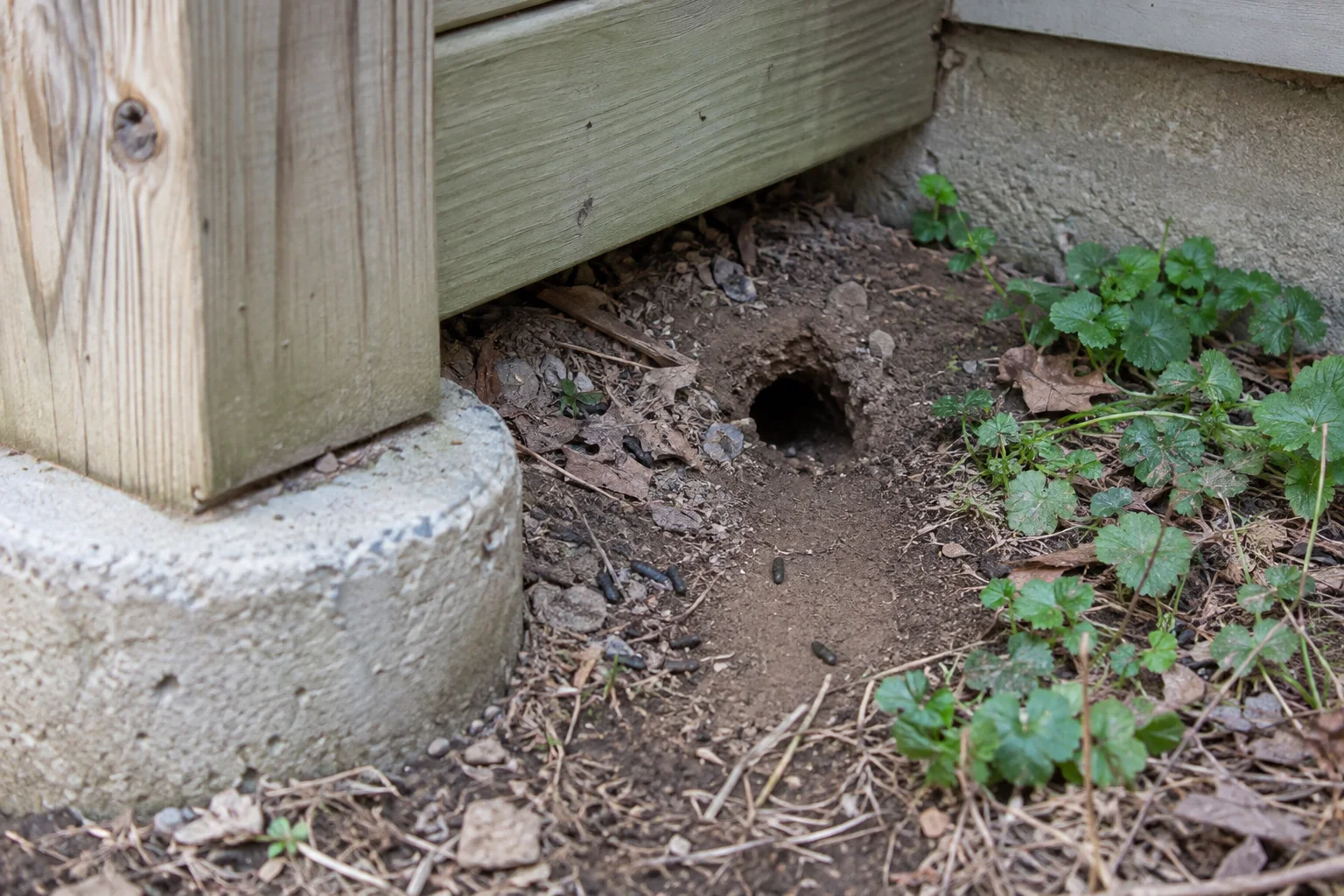
A rat burrow may appear as a ground opening near:
- deck edges
- footings
- steps
- foundation walls
- stored materials
- dense vegetation
Possible clues of current use include:
- smooth entry edges
- fresh soil
- worn ground
- droppings nearby
- repeated sightings
Do not assume every hole belongs to a rat.
Other animals can create burrows.
How Big Is a Rat Burrow Entrance?
Rat burrow openings are generally larger than mouse openings.
But size alone is not enough to identify the animal.
A practical inspection should consider:
- opening size
- tracks
- droppings
- worn routes
- location
- repeated activity
Avoid enlarging or disturbing a burrow simply to inspect it.
Are Rats Under a Deck Usually Norway Rats?
Norway rats are strongly associated with:
- ground-level activity
- burrows
- foundations
- basements
- crawl spaces
- protected soil
So a burrow beneath a deck often fits Norway-rat ecology.
However, deck location alone does not identify species.
Roof rats can also move through deck structures, fences, and nearby elevated routes.
See Norway Rat: Identification, Signs & Behavior and Roof Rat vs Norway Rat: How to Tell Them Apart.
Can Roof Rats Use Decks?
Yes.
Roof rats are more strongly associated with climbing and elevated travel.
They may use:
- deck railings
- fences
- shrubs
- tree branches
- utility routes
and then move under or around a deck for shelter.
A rat under a deck is not automatically a Norway rat.
Rat Droppings Under a Deck
Rat droppings may appear:
- along deck edges
- near burrows
- beside walls
- under steps
- near food sources
Outdoor droppings weather over time.
Fresh-looking droppings are more useful when combined with other evidence.
Do not use dropping count to estimate population size.
See Rat Droppings: What They Look Like & What They Mean.
Rat Tracks Under a Deck
Tracks may appear in:
- soft soil
- dust
- mud
- fine debris
Rat tracks may show:
- smaller front prints
- longer hind prints
- occasional tail drag marks
Real tracks are often incomplete.
See Rat Tracks: What They Look Like & Where to Find Them.
Rat Runways Under a Deck
Repeated movement can create a narrow worn route.
Look along:
- foundation edges
- deck skirting
- fence lines
- stored materials
- vegetation
A runway is stronger evidence when combined with:
- droppings
- tracks
- burrows
- sightings
Rat Rub Marks Around Deck Structures
Rats may leave dark greasy-looking marks where they repeatedly contact:
- skirting edges
- posts
- wall openings
- pipes
- foundation surfaces
Do not identify rats from a dark stain alone.
Dirt, water, and ordinary wear can look similar.
Rat Gnaw Marks Under a Deck
Rats may gnaw:
- wood
- plastic
- soft trim
- storage containers
- utility-opening materials
Heavier gnawing can support rat activity when other signs are nearby.
See Rat Gnaw Marks: How to Identify Rodent Damage.
Do Rats Nest Under Decks?
They can.
Possible nest material includes:
- shredded paper
- cardboard
- fabric
- soft debris
- dry plant material
But many rats under decks live in ground burrows rather than an exposed nest.
A sighting does not prove a nest is directly beneath the deck.
See Rat Nests: What They Look Like & Where to Find Them.
Are Rats Under a Deck Dangerous to the House?
They can become a structural entry risk.
Deck activity may place rats close to:
- foundation gaps
- crawl-space vents
- basement windows
- garage walls
- utility penetrations
The yard or deck can become the last outdoor shelter before a rat enters the house.
See Rats in the Yard: Why They’re There & How to Control Them.
Can Rats Move From Under a Deck Into a Crawl Space?
Yes.
A deck built close to a crawl-space foundation can hide:
- damaged vents
- sill gaps
- access-door defects
- utility openings
Inspect these areas if they are safely accessible.
See Rats in the Crawl Space: Signs & Removal.
Can Rats Move From a Deck Into a Basement?
Yes.
Decks may sit near:
- basement windows
- bulkhead doors
- pipe penetrations
- foundation openings
Ground-level rat activity near these routes deserves attention.
See Rats in the Basement: Why They’re There & What to Do.
Can Rats Move From a Deck Into a Garage?
Yes.
A deck beside an attached garage may connect rats to:
- door gaps
- wall penetrations
- utility routes
- storage areas
See Rats in the Garage: Entry Points, Nests & Control.
Is It Safe to Crawl Under a Deck to Inspect?
Not always.
Do not enter beneath a deck if there is:
- very low clearance
- unstable framing
- standing water
- exposed or damaged wiring
- sharp debris
- heavy rodent contamination
- aggressive wildlife
- difficult exit access
Inspect from the perimeter when possible.
A professional may be more appropriate when access is unsafe.
What Should You Inspect Around the Deck Perimeter?
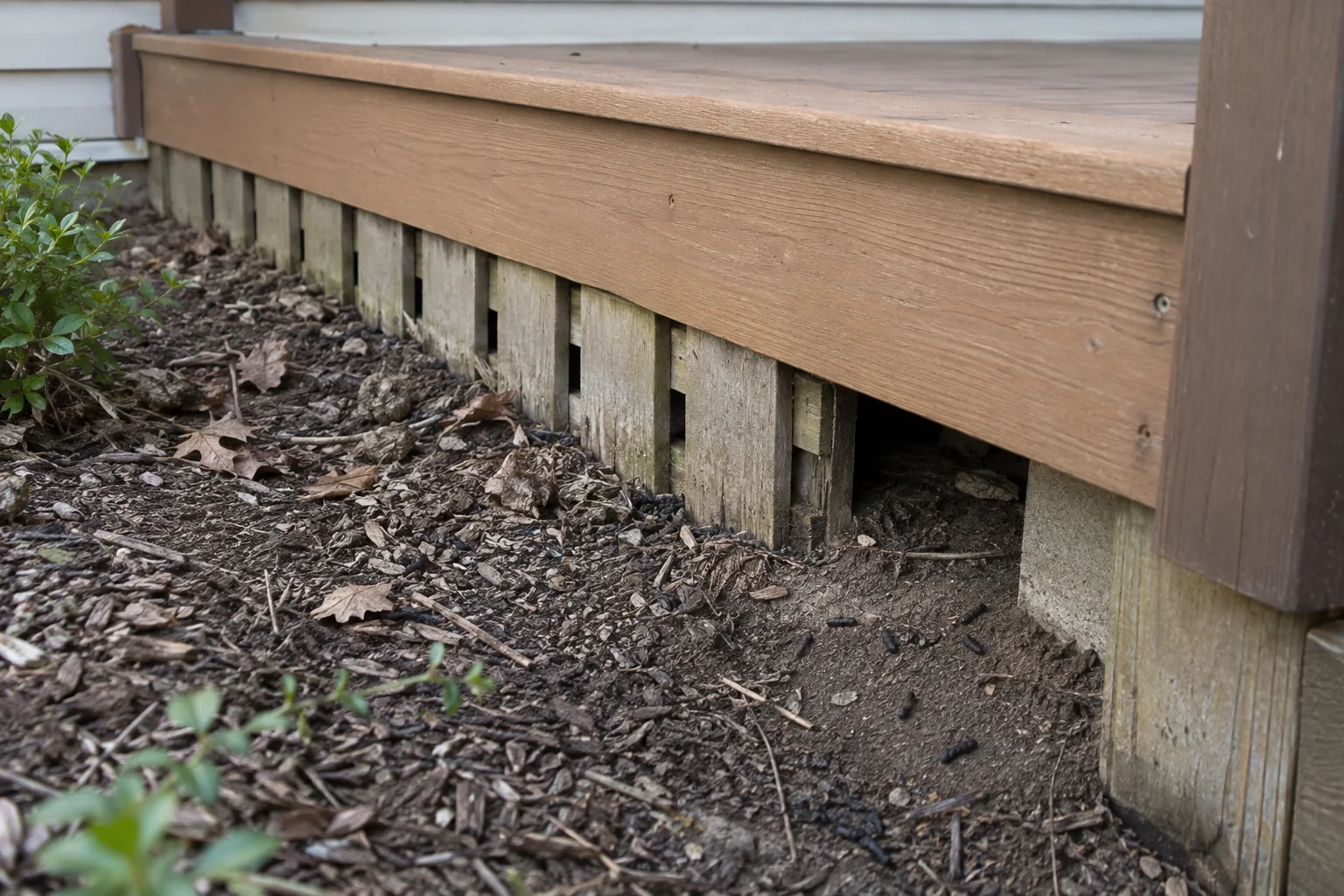
Check accessible areas for:
- burrow openings
- worn soil
- droppings
- tracks
- foundation gaps
- damaged skirting
- gaps under steps
- utility penetrations
- nearby food sources
The perimeter often reveals more useful evidence than crawling into the center of the deck space.
Rats Under Deck Steps
Steps can create small protected voids.
Inspect:
- lower risers
- stringer edges
- soil beneath stairs
- nearby wall gaps
Do not dismantle stable deck stairs simply because rat activity is suspected.
Use evidence to narrow the route first.
Rats Under Deck Skirting
Deck skirting may hide rat activity.
Signs can include:
- gaps at the bottom
- gnawing
- worn openings
- soil disturbance
- droppings
Do not automatically seal every skirting gap while rats may still be underneath.
Should You Seal Deck Skirting Immediately?
Not always.
If active rats are under the deck, sealing the perimeter first may:
- trap rats beneath the deck
- redirect them toward the house
- cause new gnawing
- make monitoring harder
Control active rats first, then repair or improve skirting when appropriate.
What Kind of Deck Skirting Helps Keep Rats Out?
The exact solution depends on the deck design.
Durable exclusion may involve:
- properly installed metal mesh
- hardware cloth appropriate for the application
- solid skirting with protected lower edges
- repairs around structural gaps
But exclusion must preserve:
- drainage
- ventilation where needed
- access for inspection
- structural function
- local building requirements
Do not bury or attach material in a way that creates drainage or structural problems.
Should You Dig Around the Deck to Stop Burrowing?
Do not excavate blindly around:
- footings
- piers
- utilities
- foundations
Aggressive digging can damage:
- structural support
- buried lines
- drainage
If buried exclusion is being considered, it should be planned around the actual deck and site conditions.
Should You Flood a Rat Burrow Under a Deck?
No.
Flooding may:
- fail to remove rats
- redirect them
- damage soil
- affect footings or foundations
- worsen drainage
- harm non-target animals
Do not pour large amounts of water into suspected burrows.
Should You Smoke, Burn, or Gas Rats Out From Under a Deck?
No.
Do not use:
- fire
- smoke
- gasoline
- engine exhaust
- improvised gases
- household chemicals
- boiling water
under a deck or inside burrows.
These methods create serious hazards and may damage the structure.
Should You Collapse Rat Burrows Under a Deck?
Not blindly.
If a burrow appears active, first coordinate it with the larger control plan.
Simply collapsing the opening may:
- redirect rats
- lead to new digging
- make monitoring harder
- leave food and shelter conditions unchanged
Confirm activity and address the rats before treating burrow closure as the final step.
Remove Food Sources Near the Deck
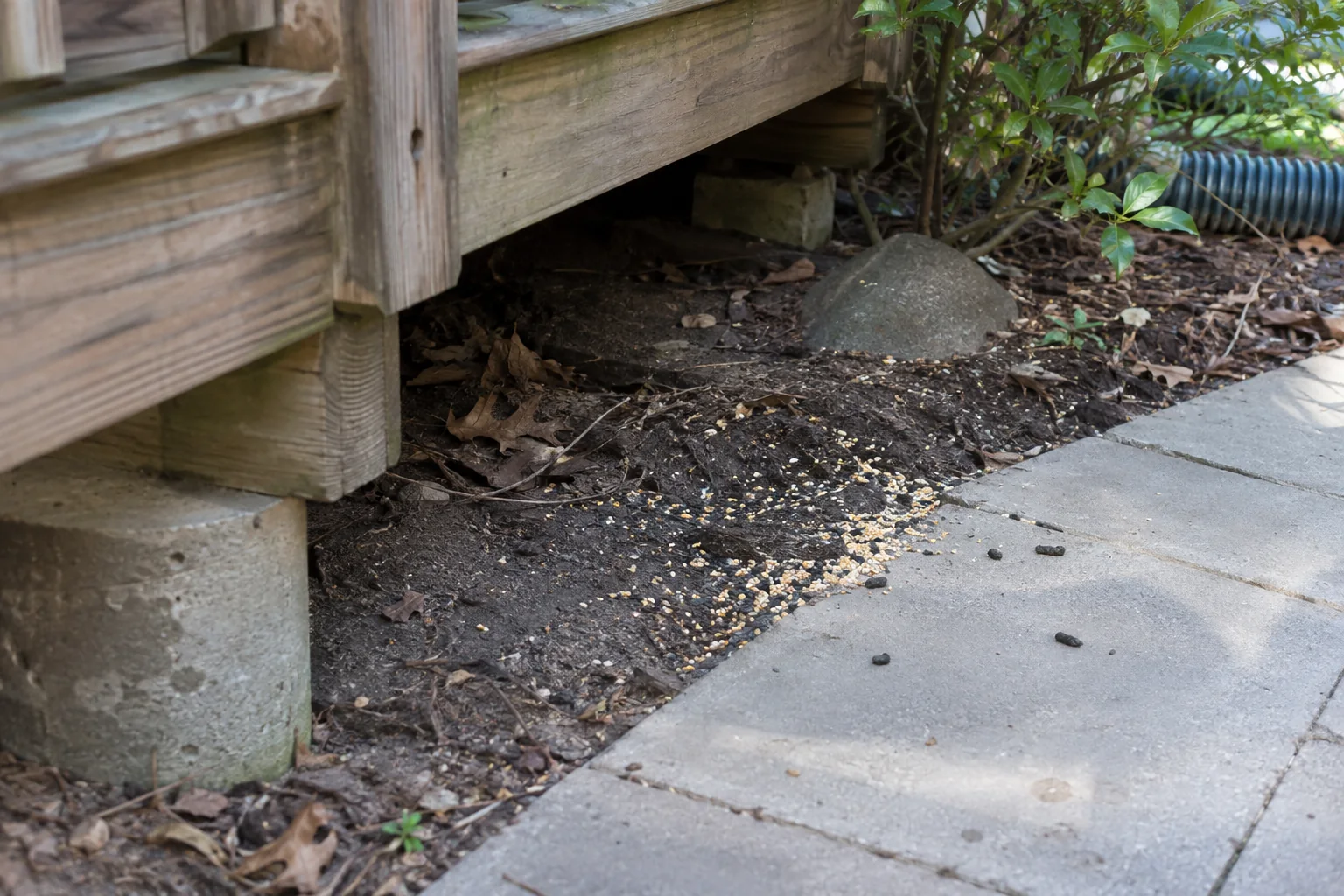
Check for:
- bird seed
- pet food
- animal feed
- garbage
- fallen fruit
- outdoor cooking debris
- compost
Clean repeated food spills.
Store vulnerable food in sturdy containers.
Reducing food pressure can make other control steps more effective.
Reduce Water Sources
Inspect for:
- leaking faucets
- irrigation leaks
- standing water
- drainage problems
- pet water left unnecessarily overnight
Keep necessary water available for pets or livestock.
The goal is to remove avoidable water, not deprive animals.
Reduce Shelter Around the Deck
Possible shelter includes:
- dense ground cover
- stacked lumber
- stored containers
- unused materials
- debris
Remove or reorganize only what is practical and safe.
Do not destabilize deck supports or create unsafe storage while cleaning.
Should You Remove Vegetation Around the Deck?
You do not need to strip all landscaping.
Focus on vegetation that:
- hides active burrows
- blocks foundation inspection
- creates dense ground-level cover along rat routes
Targeted trimming is usually more useful than removing everything.
Where Should You Put Rat Traps Near a Deck?
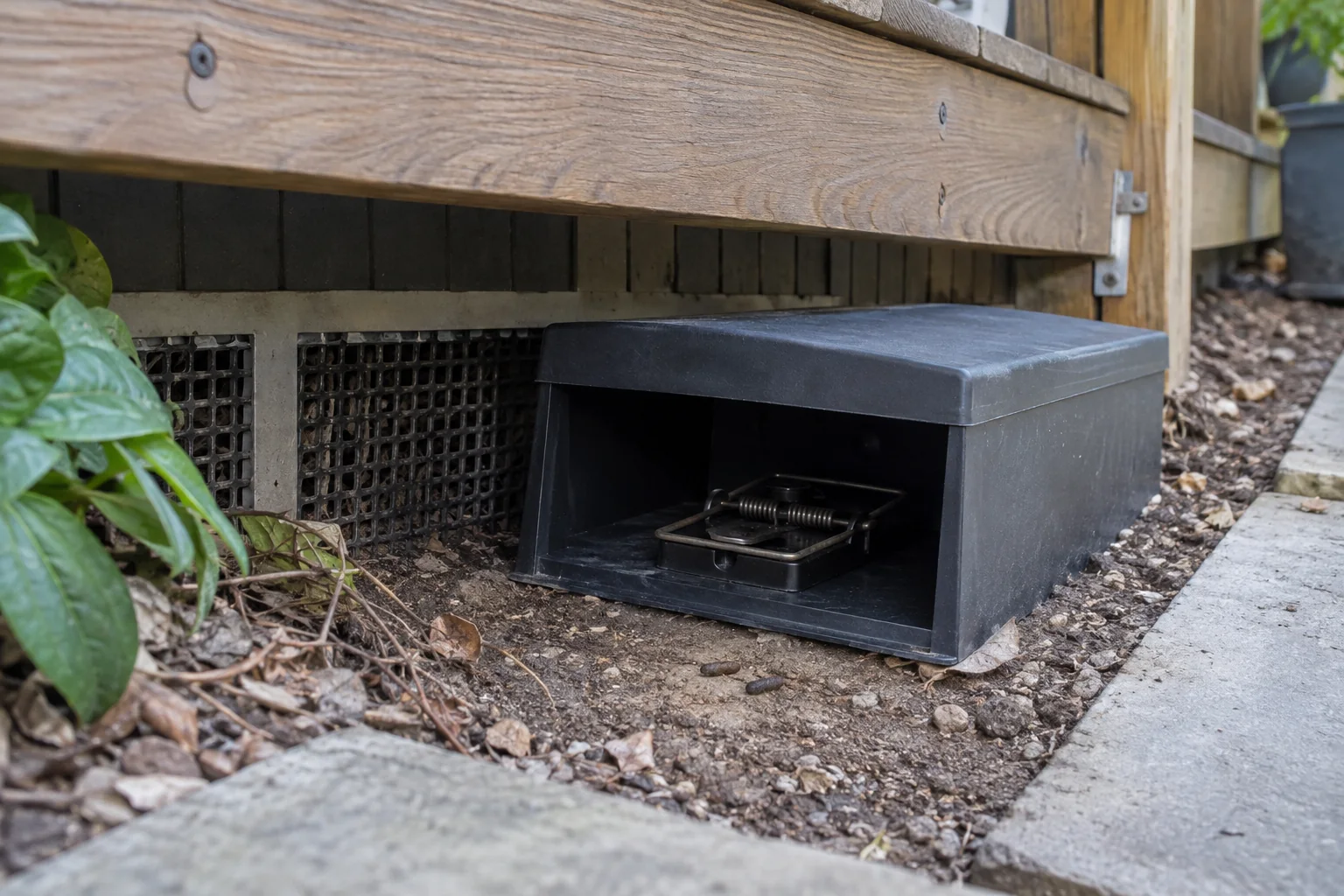
Use rat-sized traps only on confirmed accessible routes.
Possible protected locations include:
- along a wall edge
- beside a confirmed runway
- near a deck perimeter route
- inside a suitable protected trapping setup
Keep traps:
- stable
- accessible for checking
- protected from children and pets
- protected from birds, squirrels, and other wildlife
Do not leave powerful rat traps exposed in an open yard.
See Rat Traps: Types, Placement & How to Use Them and Best Rat Traps: Which Type Works Best & How to Choose.
Should You Put Traps Deep Under the Deck?
Not if they cannot be:
- checked
- retrieved
- kept stable
- protected from non-target animals
A trap placed where you cannot monitor it is a poor control point.
Use accessible routes whenever possible.
Should You Put Poison Under a Deck?
Do not scatter loose rodenticide under a deck.
Rodenticides must be used according to:
- the product label
- applicable laws
- placement requirements
- child and pet safety requirements
Where a product requires a secured bait station, use an appropriate tamper-resistant station.
Outdoor use must also consider:
- wildlife
- pets
- inaccessible carcasses
- possible movement into the house
If you are unsure how to use rodenticide legally and safely, professional control may be more appropriate.
Can a Poisoned Rat Die Under the Deck or Inside the House?
Yes.
A rat may die:
- inside a burrow
- under the deck
- in a crawl space
- in a wall
- in another inaccessible void
and create an odor problem.
That is one reason monitored trapping may be easier to evaluate in many residential situations.
What to Do Right After Finding Rats Under a Deck
A practical response is:
- document where the rat or evidence was seen
- inspect the perimeter
- look for burrows, droppings, tracks, and runways
- identify nearby food and water
- inspect the house foundation and connected structures
- reduce accessible attractants
- choose a safe control method
- monitor for fresh activity
- complete exclusion after active rats are addressed
Do not begin by sealing every opening or pouring something into a burrow.
Inspect the House for Entry Points
Check nearby:
- foundation gaps
- crawl-space vents
- garage-door edges
- basement windows
- utility penetrations
- damaged doors
If deck rat activity is close to the house, structural inspection is important.
See Rodent Exclusion: How to Keep Rats & Mice Out.
How to Know Whether Activity Is Improving
Monitor for:
- fresh droppings
- new tracks
- reopened burrows
- new gnawing
- repeated sightings
- trap activity
- new soil disturbance
Improvement means fresh evidence declines and eventually stops.
One quiet day is not proof that the deck area is clear.
When to Repair or Close Burrows
After active rat activity has been addressed, inactive burrow openings may be closed or repaired as appropriate for the site.
The method depends on:
- soil
- deck design
- footings
- drainage
- nearby utilities
Do not compromise structural supports or drainage.
When to Call a Professional
Professional rat control may make sense when:
- burrows are active near the foundation
- rats keep returning
- the deck has very low clearance
- access beneath the deck is unsafe
- traps cannot be protected from non-target animals
- rats may already be inside the house
- structural exclusion is complicated
- deck skirting or repairs require construction work
- you are unsure how to use rodenticide legally and safely
See Rat Exterminator: What to Expect & When to Call One.
Rats Under a Deck: The Bottom Line
Rats use spaces under decks because they can provide:
- shelter
- protected soil
- cover
- food access
- water
- travel routes
- proximity to buildings
Useful signs include:
- burrows
- rat-sized droppings
- tracks
- runways
- rub marks
- gnawing
- repeated sightings
If you find rats under a deck:
- inspect the perimeter safely
- confirm whether burrows are active
- remove accessible food and unnecessary water
- reduce shelter around active routes
- do not flood, smoke, burn, gas, or pour chemicals into burrows
- use protected rat trapping only where children, pets, and wildlife cannot reach it
- use rodenticides only according to the label and applicable requirements
- inspect the house for entry points
- coordinate active-rat control with exclusion
- repair skirting or structural access after activity is addressed
- monitor for fresh signs
The long-term solution is not simply closing the space under the deck.
It is reducing the conditions that support rat activity, removing active rats safely, and preventing the deck area from becoming a route into the house.
Continue with our rats in the yard guide, rat droppings guide, rat tracks guide, rat gnaw marks guide, Norway rat guide, roof rat guide, rats in the crawl space guide, rats in the basement guide, rats in the garage guide, how to get rid of rats, how rats get into a house, or rodent exclusion guide.
For the broader overview, return to [Rats & Mice in the Home](/).