Rat Nests: What They Look Like & Where to Find Them
A rat nest is usually a protected accumulation of shredded or gathered material used for shelter and raising young.
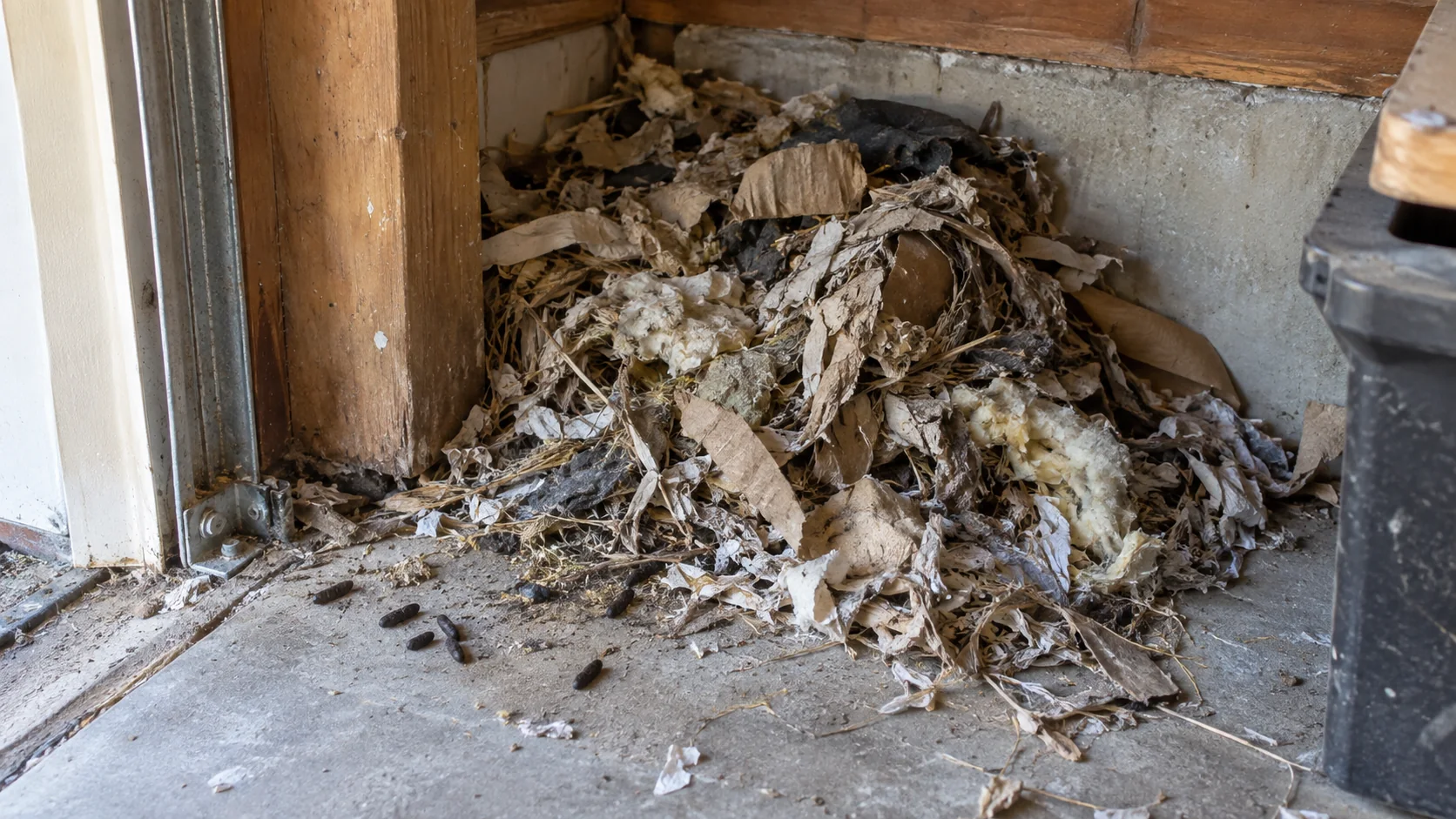
A rat nest is usually a protected accumulation of shredded or gathered material used for shelter and raising young.
Inside or around a home, a rat nest may contain:
- paper
- cardboard
- fabric
- insulation
- dried plant material
- leaves
- soft debris
- packing material
The exact appearance depends on the rat species and location.
Norway rats are more strongly associated with:
- ground-level shelter
- basements
- crawl spaces
- lower wall voids
- burrows near foundations
Roof rats are more strongly associated with:
- attics
- rafters
- upper wall voids
- roofline-accessible spaces
- elevated storage
A rat nest does not always look like a neat bowl.
It may appear as:
- a bulky mass of shredded material
- a compressed pocket inside insulation
- a concealed pile behind stored items
- a burrow chamber outside
- a hidden nest inside a wall or structural void
Finding a rat nest is strong evidence that rats have used the area for more than casual travel.
If baby rats are present, breeding occurred there recently.
This guide explains what rat nests look like, where to search, how Norway-rat and roof-rat nests differ, how to tell whether a nest may still be active, and how to handle contaminated nesting material safely.
What Does a Rat Nest Look Like?
A rat nest is usually built from material the animal can carry, shred, or arrange.
Common materials include:
- paper
- cardboard
- cloth
- insulation
- soft plastic
- plant fibers
- leaves
- dry grass
- packing material
The nest may look:
- loose
- layered
- compacted
- hidden inside a cavity
- partially mixed with surrounding debris
Rat nests are generally larger and more substantial than typical house-mouse nests.
But nest size alone cannot identify the rodent.
Always compare the nest with:
- dropping size
- gnaw marks
- tracks
- body sightings
- activity height
- burrows
How Big Is a Rat Nest?
There is no single standard size.
Nest size depends on:
- rat species
- available space
- litter presence
- duration of use
- amount of nesting material
An indoor roof-rat nest in attic insulation may be compact and hidden.
A Norway-rat nest connected to a burrow system may be mostly out of sight.
A garage nest behind stored materials can spread over a larger area.
Do not use nest dimensions alone to determine infestation size.
What Materials Do Rats Use for Nests?
Rats use soft and accessible material.
Indoor materials may include:
- shredded cardboard
- paper
- cloth
- insulation
- foam
- fabric stuffing
- plastic packaging
- string
Outdoor or semi-outdoor nests may also contain:
- leaves
- grass
- plant fibers
- dry vegetation
The material often reflects what is nearby.
If you find large rodent droppings and shredded material together, inspect the area carefully.
Do Rats Shred Paper and Cardboard?
Yes.
Rats may tear and carry paper or cardboard into protected nesting spaces.
Signs can include:
- torn box corners
- shredded paper
- damaged packaging
- cardboard pulled behind stored items
Rat gnawing is usually heavier than mouse gnawing.
Shredded paper by itself does not prove rats.
Look for larger droppings, rub marks, or rat-sized tracks.
Do Rats Use Insulation for Nests?
Yes.
Rats may use attic, wall, or crawl-space insulation as:
- nesting material
- shelter
- cover around a resting area
They can:
- compress insulation
- tunnel through it
- pull it into a cavity
- mix it with paper or fabric
Disturbed insulation alone is not enough to identify a rat nest.
Confirm with additional evidence.
Where Do Rats Build Nests in a House?
Common indoor and structural locations include:
- attics
- wall voids
- garages
- basements
- crawl spaces
- storage rooms
- utility spaces
- insulation
- protected shelving areas
The likely location depends partly on species.
Roof rats tend to favor elevated protected spaces.
Norway rats more often use lower levels and burrows.
See Roof Rat vs Norway Rat: How to Tell Them Apart.
Rat Nests in Attics
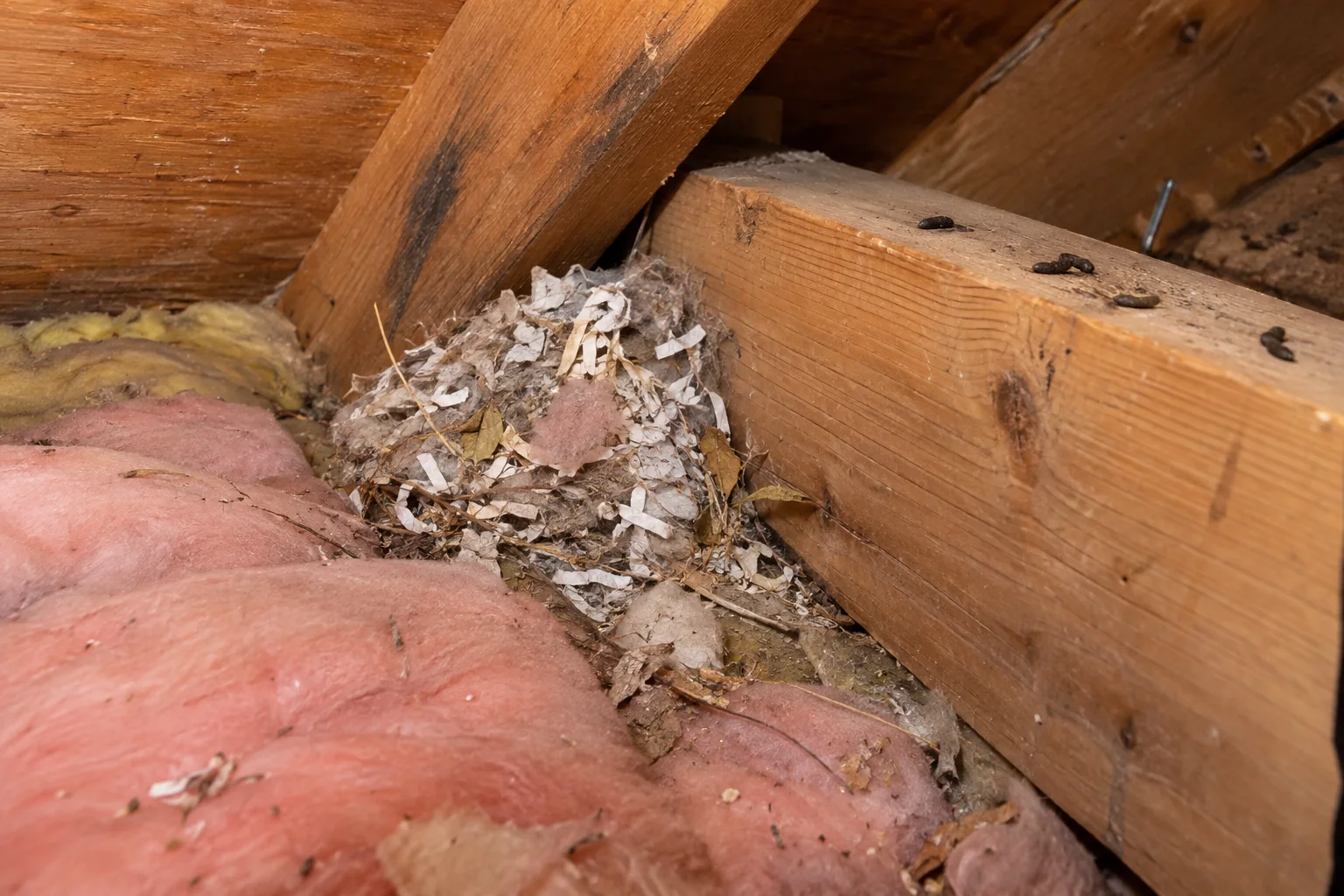
Attics are strongly associated with roof-rat activity.
A roof-rat nest may be hidden:
- under insulation
- beside framing
- behind stored items
- near soffit access
- in upper wall connections
Look for:
- rat-sized droppings
- rub marks
- tracks
- gnawing
- disturbed insulation
- nighttime movement
See Rats in the Attic: Signs, Damage & Removal.
Rat Nests in Walls
Rats can nest or shelter inside wall systems.
Clues may include:
- scratching
- heavier movement sounds
- droppings near openings
- rub marks
- shredded material near utility gaps
Do not open a wall as the first step.
First identify where rats enter and leave the wall system.
See Rats in Walls: Signs, Entry Points & What to Do.
Rat Nests in Garages
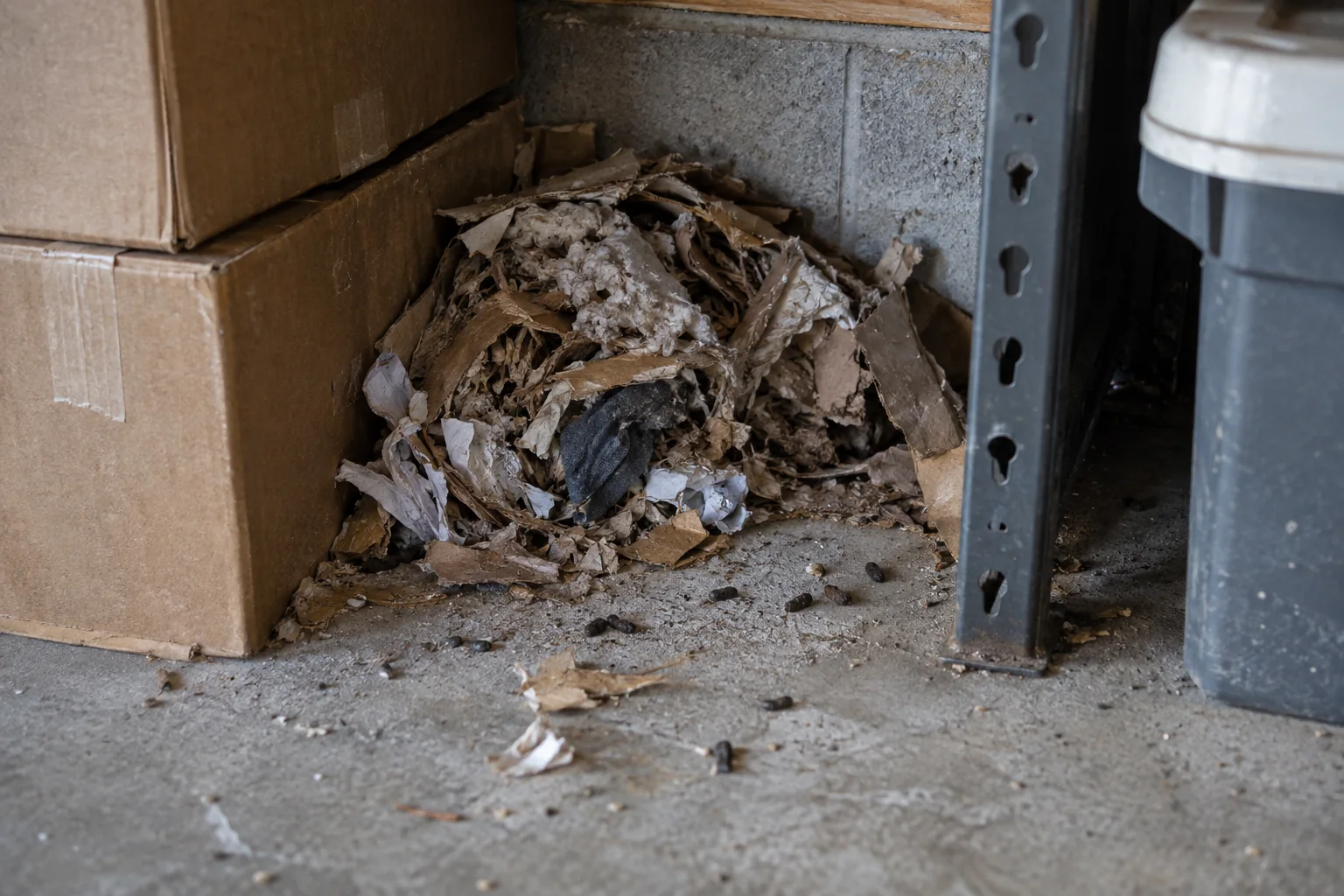
Garages can support either roof rats or Norway rats.
Common nest areas include:
- behind storage
- shelving
- cardboard piles
- wall corners
- insulation
- rafters
- attic connections
Norway rats may enter at ground level.
Roof rats may use the garage as a route into upper structural areas.
Look at both the nest location and the animal’s travel route.
Rat Nests in Basements
Basements are more strongly associated with Norway rats.
Possible nesting zones include:
- foundation edges
- stored materials
- utility spaces
- lower wall voids
- crawl-space connections
Supporting evidence may include:
- large blunt-ended droppings
- grease marks
- burrows outside
- heavy gnawing
See Norway Rat: Identification, Signs & Behavior.
Rat Nests in Crawl Spaces
Crawl spaces can provide:
- darkness
- shelter
- foundation access
- utility routes
- low disturbance
Norway rats are especially associated with these lower structural areas.
A nest may be near:
- foundation walls
- pipes
- insulation
- structural corners
- exterior burrow routes
Avoid entering a tight or heavily contaminated crawl space without appropriate precautions.
Rat Nests in Storage Areas
Rats may nest behind or beneath:
- cardboard boxes
- stored fabric
- unused furniture
- equipment
- feed bags
- stacked materials
A nest often appears where the area stays undisturbed for long periods.
Inspect nearby food sources and entry routes.
Rat Nests in Sheds
Sheds may provide:
- easy exterior access
- low disturbance
- nesting material
- stored food
- sheltered corners
Norway rats may use ground-level access.
Roof rats may use rafters or upper storage.
If you find a bulky nest in a shed, confirm rat-sized droppings before assuming the species.
Rat Nests in Burrows
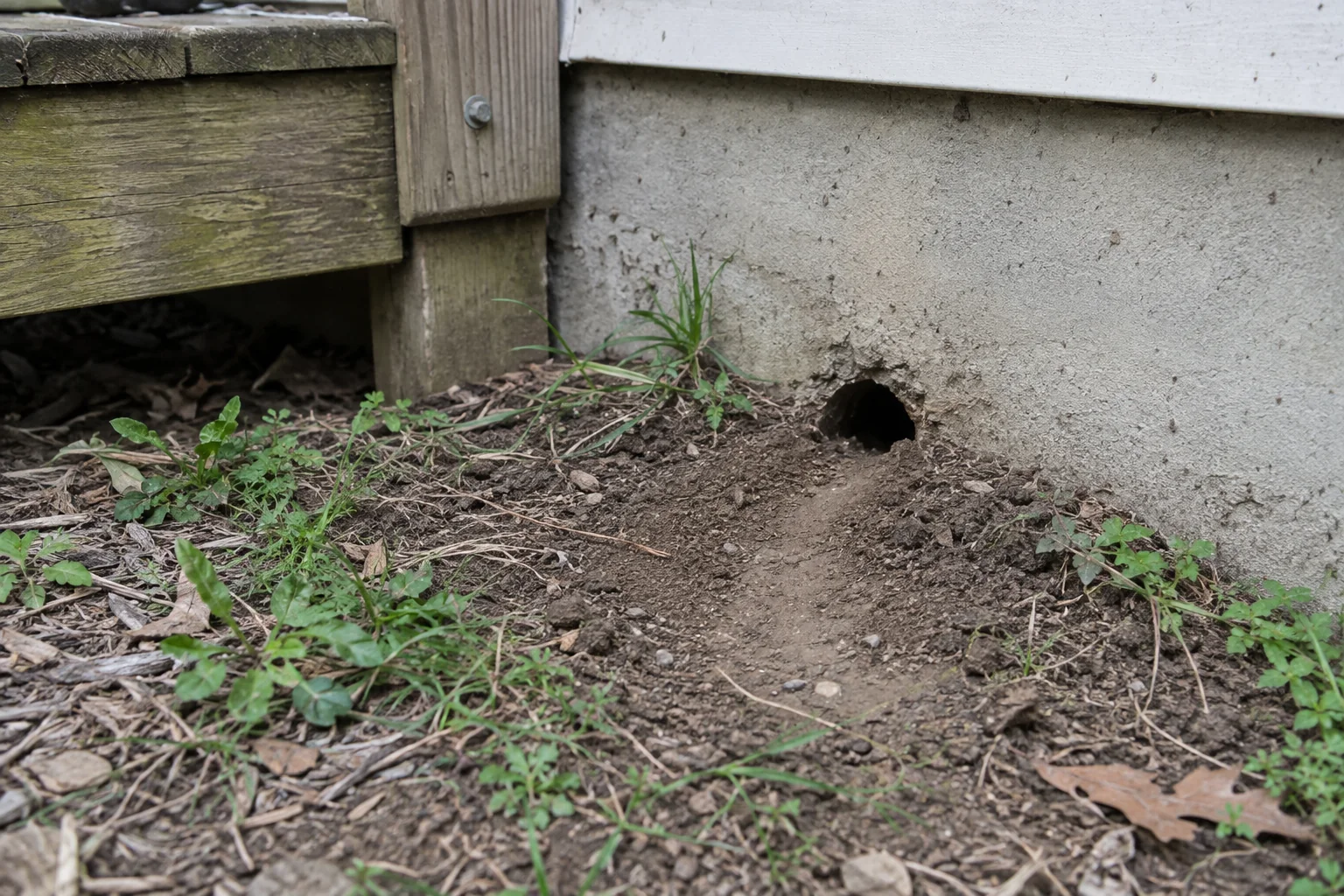
Norway rats often nest in underground burrow systems.
Burrows may occur:
- beside foundations
- under decks
- near sheds
- under dense vegetation
- near garbage areas
- along landscape edges
The actual nest chamber is usually underground and not directly visible.
Above-ground clues can include:
- worn openings
- smooth travel paths
- fresh soil
- large droppings nearby
- nighttime rat sightings
A burrow network near a home strongly supports Norway-rat activity.
Roof Rat Nests
Roof rats usually select elevated protected areas.
Common nesting locations include:
- attics
- rafters
- upper walls
- dense vegetation
- trees
- elevated storage
Nest material may include:
- insulation
- paper
- cloth
- plant material
- shredded packaging
The location is often more useful than the material itself.
See Roof Rat: Identification, Signs & Behavior.
Norway Rat Nests
Norway rats are more strongly associated with lower and ground-level nesting.
They may nest:
- in burrows
- beneath structures
- in crawl spaces
- in basements
- in lower wall voids
- behind ground-level storage
They may also use indoor spaces when shelter is available.
Do not assume every rat nest in a house belongs to a roof rat.
Roof Rat Nest vs Norway Rat Nest
The strongest difference is usually location.
Roof Rat Pattern
More likely:
- attic
- rafter
- upper wall
- roofline-accessible cavity
Norway Rat Pattern
More likely:
- burrow
- basement
- crawl space
- foundation area
- lower wall
These are tendencies, not absolute rules.
Both species can use atypical locations.
Rat Nest vs Mouse Nest
Rat nests are generally associated with larger evidence.
Rat activity tends to produce:
- larger droppings
- heavier gnaw marks
- wider travel paths
- larger body sightings
Mouse activity tends to produce:
- tiny droppings
- delicate gnawing
- smaller nests
- narrow travel routes
The same nesting materials can be used by both rodents.
See Mouse Nests: What They Look Like & Where to Find Them and Mouse vs Rat Droppings: How to Tell the Difference.
Rat Nest vs Pack Rat Midden
A pack-rat midden can look much more elaborate.
It may include:
- sticks
- leaves
- plant material
- accumulated debris
- collected objects
A typical roof-rat or Norway-rat nest is more focused on soft nesting material and shelter.
Pack rats are also a different group of rodents.
See Woodrat / Pack Rat: Identification & Home Problems.
What Does an Active Rat Nest Look Like?
You cannot confirm activity from appearance alone.
Supporting signs of recent use include:
- fresh-looking droppings
- newly disturbed material
- recent gnawing
- nighttime sounds
- sightings
- trap activity
- fresh burrow soil
- recent tracks or rub marks
Do not touch droppings or nesting material to judge freshness.
Use visual monitoring.
What Does an Old Rat Nest Look Like?
An old nest may appear:
- dusty
- dry
- compressed
- partially decomposed
- mixed with old debris
But old-looking material may still be contaminated.
A building can contain an old nest while rats remain active elsewhere.
Inspect the surrounding structure for fresh signs before cleanup.
Does a Rat Nest Mean You Have an Infestation?
A nest proves that rats used the location for shelter or breeding.
If baby rats are present, breeding occurred there.
That is stronger evidence of established activity than one isolated sighting.
However, one nest does not tell you:
- how many rats are present
- how many nests exist
- whether the nest is currently occupied
Use current signs to evaluate ongoing activity.
Does One Rat Nest Mean There Are More?
Possibly.
A property can contain:
- one active nest
- old abandoned nests
- more than one activity area
Do not estimate the number of rats from nest count.
Look at:
- fresh droppings
- trap activity
- sightings
- burrows
- gnawing
- route use
Do Baby Rats Mean the Nest Is Active?
Finding newborn or very young rats strongly suggests the nest is active or was active very recently.
Rat pups depend on the mother.
Do not assume a nest is abandoned just because the adult is not visible.
See Baby Rat: What Newborn & Young Rats Look Like.
How Many Baby Rats Are in a Nest?
Litter size varies.
Do not use one litter to estimate the total rat population.
The more important questions are:
- where adults are traveling
- how they entered
- whether another nest exists
- whether activity is continuing
What Do Rat Droppings Near a Nest Mean?
Rat droppings near a nest can confirm that rats used the area.
Droppings may help identify:
- travel routes
- feeding zones
- resting areas
Roof-rat droppings may be more tapered.
Norway-rat droppings may be thicker and blunter.
But dropping shape alone does not reliably identify the species.
See Rat Droppings: What They Look Like & What They Mean.
Do Rat Nests Smell?
A rat nest can contribute to a strong rodent odor.
Odor may come from:
- urine
- droppings
- body oils
- contaminated nesting material
- spoiled food
Heavy activity can produce a more noticeable musky smell.
Odor alone does not identify the exact nest location.
Are Rat Nests Dangerous?
The primary concern is contamination.
A nest area may contain:
- urine
- droppings
- contaminated material
- damaged food packaging
- insects associated with rodent activity
Avoid direct contact.
Keep children and pets away.
Can Rat Nests Carry Disease?
Rodent nesting material should be treated as potentially contaminated.
You cannot determine whether a nest is safe by appearance.
Avoid bare-hand contact with:
- nests
- droppings
- urine
- dead rodents
Use appropriate cleanup precautions.
See the rodent safety section.
How to Clean Up a Rat Nest Safely
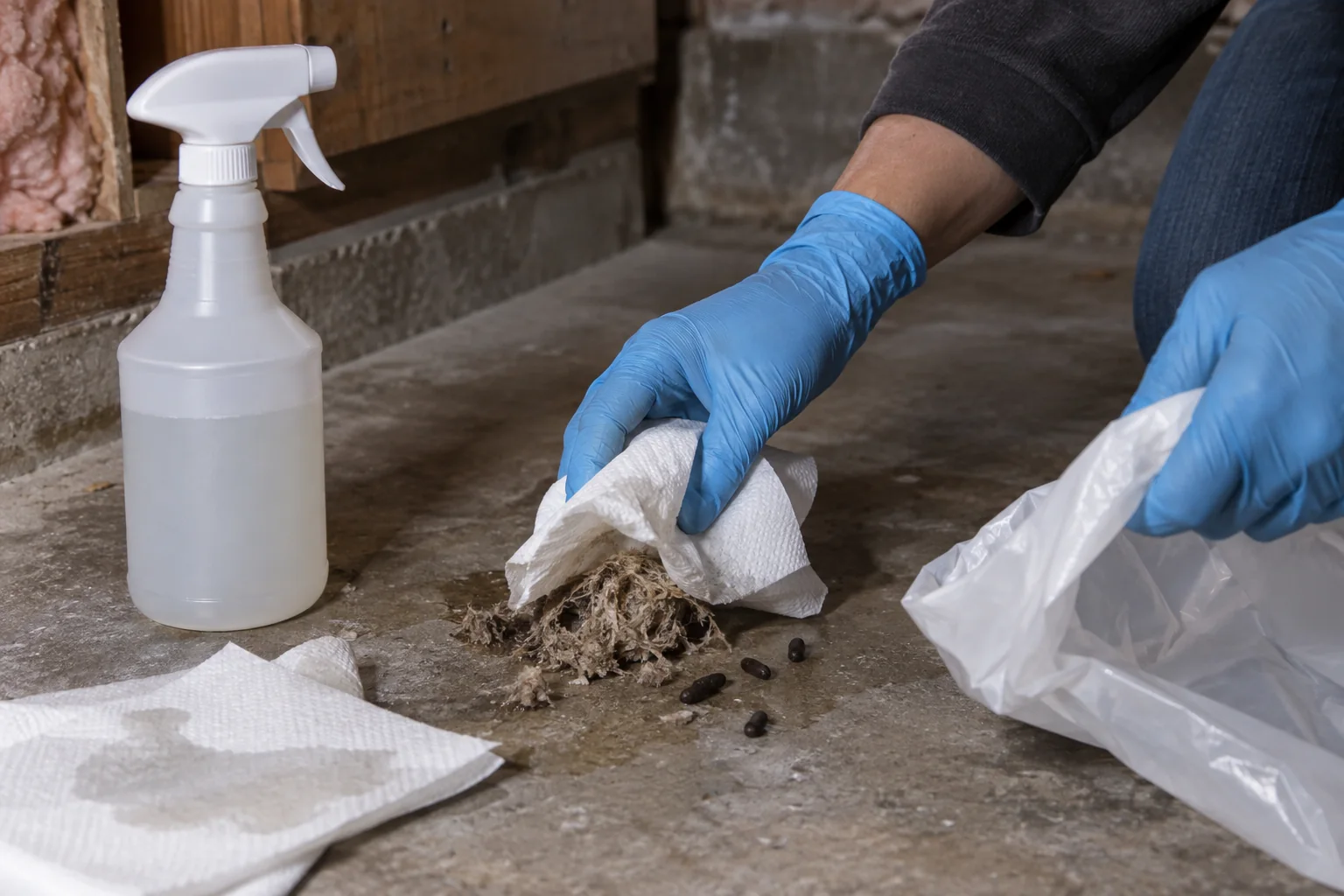
Do not dry sweep or vacuum fresh rat droppings or nesting material before proper wet cleanup.
A practical process is:
- keep children and pets away
- ventilate the area when appropriate
- wear suitable gloves
- wet the nest, droppings, and contaminated material with an appropriate disinfecting solution
- allow adequate contact time according to the product instructions
- wipe up or collect the material
- bag waste appropriately
- clean the surrounding surface
- wash hands after removing gloves
Avoid stirring contaminated dust.
See the cleanup section for broader guidance.
Should You Vacuum a Rat Nest?
Do not vacuum fresh rodent droppings or nesting material before wet cleanup.
Dry vacuuming can disturb contaminated dust.
Wet and disinfect the material first, then follow appropriate cleanup procedures.
Should You Remove the Nest Immediately?
Nest removal is only one part of control.
If adult rats are still using the building, they may:
- rebuild
- move into another cavity
- create another nesting area
Address:
- adult rats
- travel routes
- food sources
- entry points
along with nest cleanup.
What to Do After Finding a Rat Nest
A practical sequence is:
- keep people and pets away
- document the nest location
- inspect for droppings, rub marks, and adult routes
- determine whether the pattern better fits roof rats or Norway rats
- identify entry points or burrows
- place rat-sized traps on accessible active routes
- reduce food sources
- coordinate trapping with exclusion
- remove contaminated nesting material safely
- monitor for fresh activity
Do not seal the only active route while rats remain inside.
See How to Get Rid of Rats in Your House and Rodent Exclusion: How to Keep Rats & Mice Out.
Where Should You Put Traps Near a Rat Nest?
Place traps along adult travel routes, not inside the nest itself.
Potential locations include:
- along walls
- beside garage routes
- near rub marks
- near utility penetrations
- on stable attic framing
- along crawl-space routes
- near accessible burrow-to-building paths
Use traps designed specifically for rats.
Keep them inaccessible to children and pets.
See Best Rat Traps: Which Type Works Best & How to Choose and Rat Traps: Types, Placement & How to Use Them.
How to Find the Entry Point From the Nest
Work outward from the active area.
If the nest is high in the building
Inspect:
- soffits
- attic vents
- roof-wall intersections
- fascia gaps
- trees and fences near the roofline
If the nest is low in the building
Inspect:
- foundation gaps
- garage-door corners
- crawl-space vents
- utility penetrations
- exterior burrows
See How Rats Get Into Your House.
When to Call a Professional
Professional rat control may make sense when:
- the nest is inside a wall
- baby rats are in an inaccessible cavity
- burrows are widespread
- attic or crawl-space contamination is extensive
- trapping is not reducing activity
- the entry point cannot be found
- roofline work is required
- structural exclusion is complicated
See Rat Exterminator: What to Expect & When to Call One.
Rat Nests: The Bottom Line
A rat nest usually looks like a protected accumulation of:
- paper
- cardboard
- fabric
- insulation
- plant material
- soft debris
The location often gives the strongest species clue.
Roof rats are more strongly associated with:
- attics
- rafters
- upper walls
- elevated protected spaces
Norway rats are more strongly associated with:
- burrows
- basements
- crawl spaces
- foundations
- lower walls
Finding a rat nest means rats used that area for shelter.
Finding baby rats or fresh evidence makes current activity more likely.
Do not simply remove the nest and assume the problem is solved.
Identify the rat routes, trap the rats already inside, find the entry point or burrow, complete exclusion, and clean contaminated material safely.
Continue with our signs of rats guide, rat droppings guide, baby rat guide, roof rat guide, Norway rat guide, how to get rid of rats, how rats get into a house, or rodent exclusion guide.
For the broader overview, return to [Rats & Mice in the Home](/).