Rats in the Garage: Entry Points, Nests & Control
Garages are common rat activity areas because they combine outdoor access with shelter, storage, food, and structural openings.
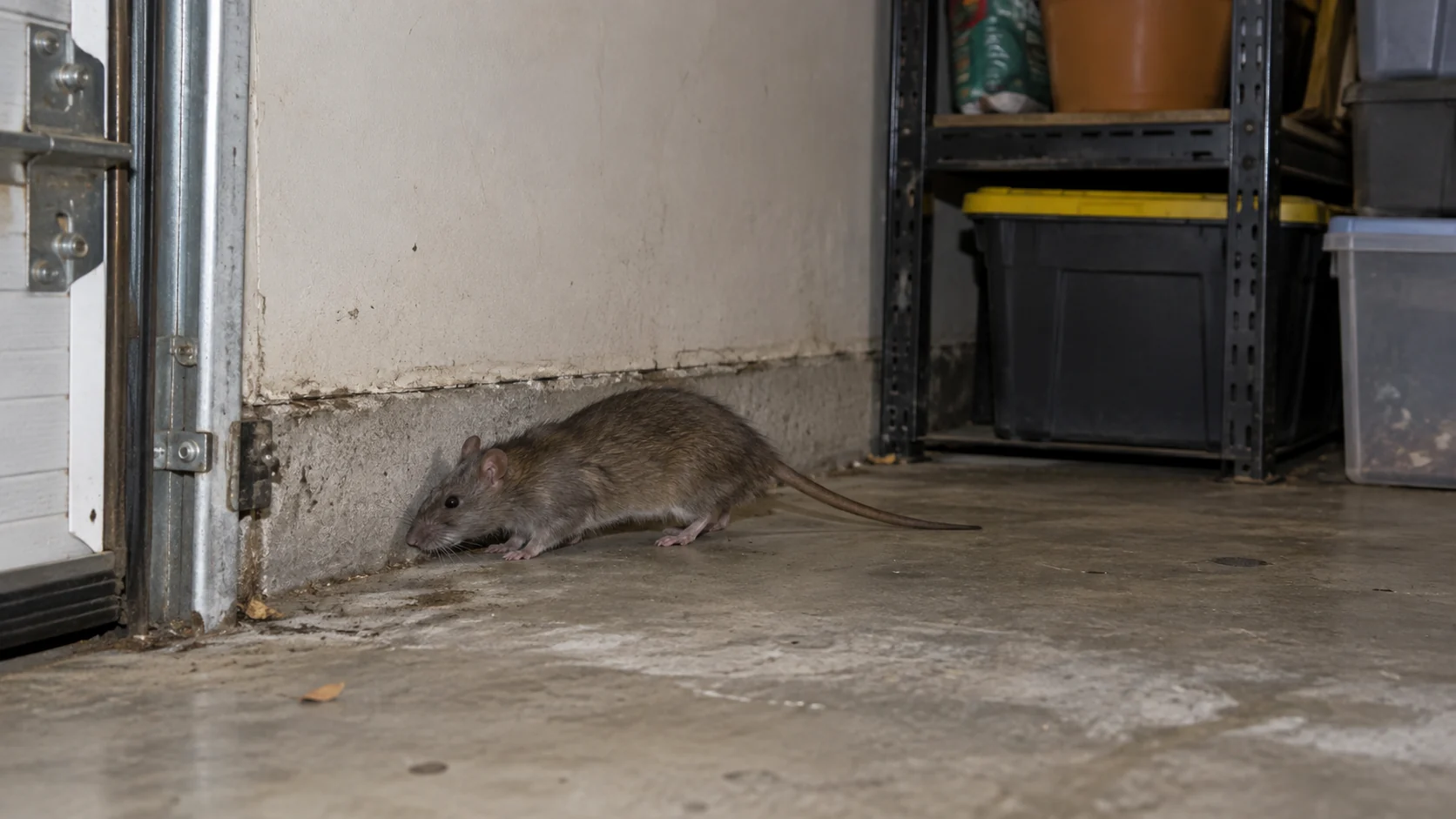
Garages are common rat activity areas because they combine outdoor access with shelter, storage, food, and structural openings.
A rat may enter a garage through:
- a gap under or beside the garage door
- a damaged side door
- a utility penetration
- a foundation opening
- a crawl-space or basement connection
- a roofline or attic route
- a wall void shared with the house
Once inside, rats may travel along walls, behind stored items, around appliances, or through structural voids.
Common signs include:
- rat-sized droppings
- heavy gnaw marks
- grease or rub marks
- tracks
- damaged food or seed bags
- nesting material
- burrows outside the garage
- scratching or heavier movement sounds
- rat sightings
Seeing one rat does not tell you exactly how many rats are present.
It also does not prove the nest is inside the garage.
The practical goal is to identify:
- where the rat entered
- which route it is using
- whether the activity is ground-level or elevated
- whether rats are nesting in or near the garage
- whether activity extends into the house
- how to remove rats already inside before completing exclusion
This guide explains where garage rats hide, what attracts them, how to inspect entry points, how to trap them safely, and how to prevent them from returning.
Why Do Rats Get Into Garages?
A garage can provide:
- shelter from weather
- food
- water
- nesting material
- protected travel routes
- access to the house
Compared with finished living areas, garages also tend to have more structural gaps.
Common weak points include:
- garage-door corners
- worn bottom seals
- side doors
- utility penetrations
- foundation joints
- wall gaps
- attic or roofline connections
Rats need more space than mice, but they can still exploit relatively modest openings.
See How Rats Get Into Your House for the broader entry-point guide.
Are Garages Attractive to Rats Even Without Food?
Yes.
Food increases attraction, but shelter alone can be valuable.
A garage may provide:
- protection from weather
- low-disturbance corners
- storage
- access to walls
- attic connections
- access to basements or crawl spaces
A clean garage can still develop rat activity if the structure has usable entry points.
What Food Attracts Rats in a Garage?
Common attractants include:
- pet food
- bird seed
- livestock feed
- grass seed
- stored dry food
- garbage
- fallen fruit stored nearby
- food left in vehicles
Rats can damage stronger packaging than mice.
Thin plastic, cardboard, and paper sacks are especially vulnerable.
Store susceptible food in sturdy containers with secure lids.
Does Clutter Cause Rats?
No.
Clutter does not create rats.
But it can provide:
- cover
- nesting material
- protected travel routes
- areas that are difficult to inspect
Dense storage also makes droppings, tracks, rub marks, and nests easier to miss.
Reducing clutter around active routes improves inspection and control.
Where Do Rats Hide in a Garage?
Common hiding and travel areas include:
- behind stored boxes
- under shelving
- beside appliances
- behind cabinets
- along wall edges
- near utility penetrations
- around garage-door corners
- inside wall voids
- near attic access
- near crawl-space or basement connections
Rats usually prefer protected routes over open floor space.
A rat seen crossing the garage may simply be moving between two sheltered areas.
Rats Near the Garage Door
The main garage door is a common entry point.
Inspect:
- lower corners
- bottom seal
- side seals
- frame-to-floor junctions
- damaged trim
Look for:
- rat droppings
- gnawing
- rub marks
- tracks
- a visible gap
A worn door seal can become part of an active travel route.
Worn Garage-Door Bottom Seals
A damaged bottom seal may leave openings large enough for rats.
Common problems include:
- torn rubber
- missing sections
- poor contact with the slab
- corner gaps
Replacing a worn seal can be part of exclusion.
But the door must still:
- open and close safely
- maintain needed clearance
- preserve drainage where required
If rats are already inside, trapping and exclusion should be coordinated.
Gaps at Garage-Door Corners
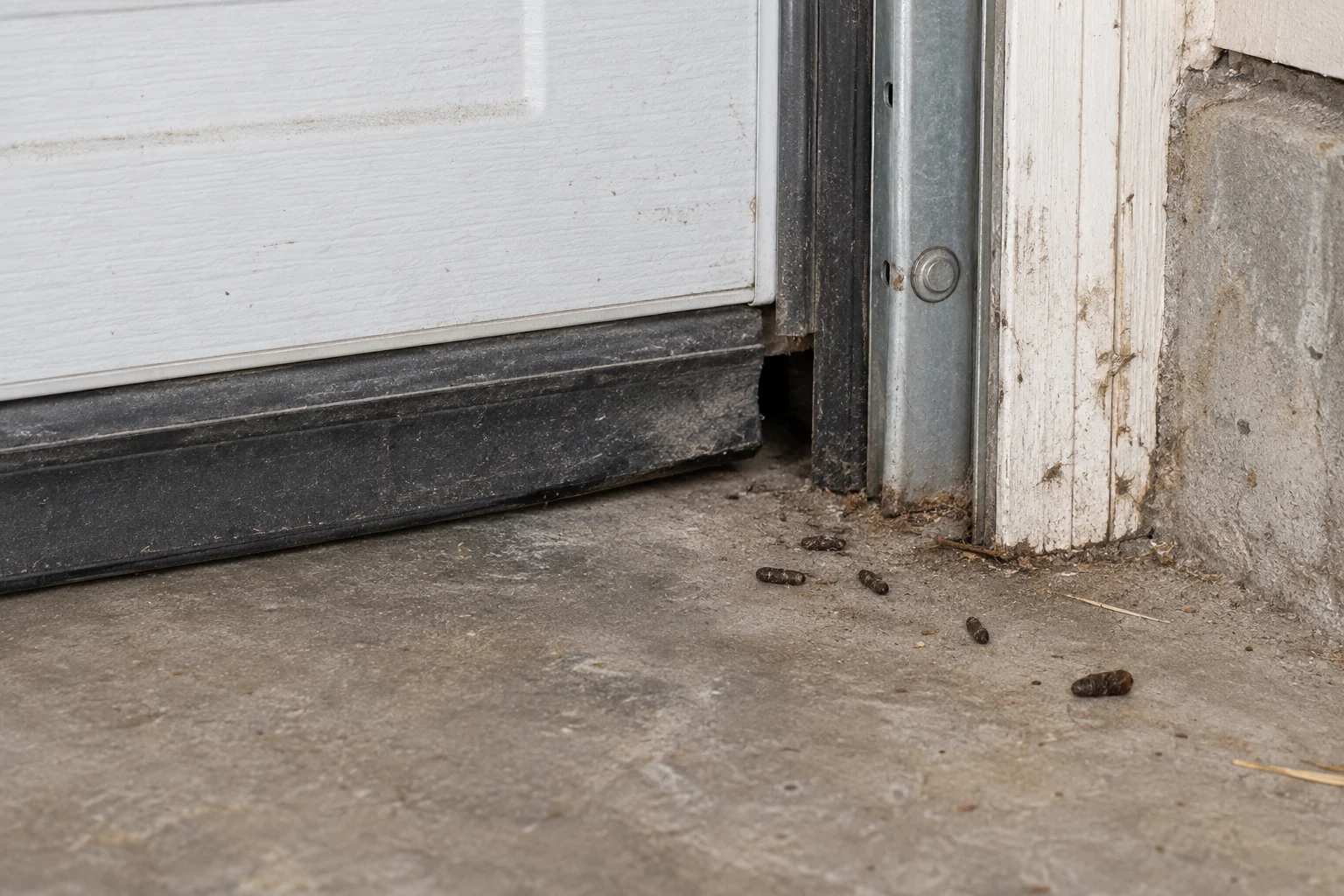
Corners deserve special attention because several materials meet there.
Inspect where the:
- bottom seal
- side seal
- door frame
- concrete slab
come together.
Rat droppings, rub marks, or gnawing at the same corner make the route more suspicious.
Do not assume every dark mark is a rat rub.
Look for multiple signs.
Rats Coming Through the Side Door
A side or service door may have:
- worn weatherstripping
- a damaged threshold
- loose trim
- a gap under the door
Inspect the exterior side as well.
A durable repair should close the route without interfering with safe door operation.
Rats Entering Around Pipes or Cables
Garages often contain penetrations for:
- plumbing
- electrical conduit
- cable
- refrigerant lines
- other utilities
Openings around these penetrations can connect to:
- wall cavities
- utility rooms
- basements
- crawl spaces
Inspect both sides when accessible.
Do not disturb electrical components unless qualified to do so.
Rats at the Foundation or Wall Joint
Inspect the transition between:
- slab
- foundation
- framing
- siding
Larger rats may exploit damaged construction joints or existing openings.
Look for:
- droppings
- rub marks
- gnawing
- tracks
- direct openings
Prioritize gaps that line up with actual rat evidence.
Can Rats Enter the Garage From a Crawl Space or Basement?
Yes.
A garage can connect to lower structural areas.
Norway rats are especially associated with:
- basements
- crawl spaces
- foundations
- ground-level routes
A rat may enter the building at one point and appear in the garage later.
See Norway Rat: Identification, Signs & Behavior.
Can Rats Reach the Garage From the Attic?
Yes.
Roof rats are strongly associated with elevated routes.
A garage may connect to:
- attic framing
- rafters
- upper wall voids
- roofline openings
A rat seen in the garage does not prove the route is ground-level.
See Roof Rat: Identification, Signs & Behavior.
Norway Rats vs Roof Rats in a Garage
Both can use garages.
The surrounding route provides better context than the room alone.
Norway Rat Pattern
More strongly associated with:
- ground-level garage entry
- foundation routes
- basements
- crawl spaces
- exterior burrows
Roof Rat Pattern
More strongly associated with:
- attic connections
- rafters
- upper-wall routes
- roofline entry
These are tendencies, not absolute rules.
Do not identify the species from one dropping, one gnaw mark, or one sighting location.
See Roof Rat vs Norway Rat: How to Tell Them Apart.
Can Rats Get From the Garage Into the House?
Yes.
Attached garages can connect to living areas through:
- wall voids
- utility penetrations
- the door into the house
- attic routes
- plumbing or electrical pathways
A garage rat may therefore become an indoor rat problem.
Inspect the garage-to-house connection carefully.
If activity extends toward food-preparation areas, see Rats in the Kitchen: Why They’re There & What to Do.
Can Rats Live Inside Garage Walls?
Yes.
Wall voids provide:
- shelter
- protected travel
- access to other rooms
Possible signs include:
- heavier scratching
- droppings near openings
- rub marks
- gnawing
- repeat sightings along one wall
Do not open drywall as the first inspection step.
Use accessible evidence to narrow the active route.
See Rats in Walls: Signs, Entry Points & What to Do.
Do Rats Nest in Garages?
They can.
Garages may contain useful nesting material such as:
- cardboard
- paper
- insulation
- fabric
- stored bags
Possible nest locations include:
- behind storage
- under shelving
- inside wall voids
- cabinet corners
- protected utility areas
A rat sighting does not prove the nest is in the garage.
See Rat Nests: What They Look Like & Where to Find Them.
What Does a Rat Nest in a Garage Look Like?
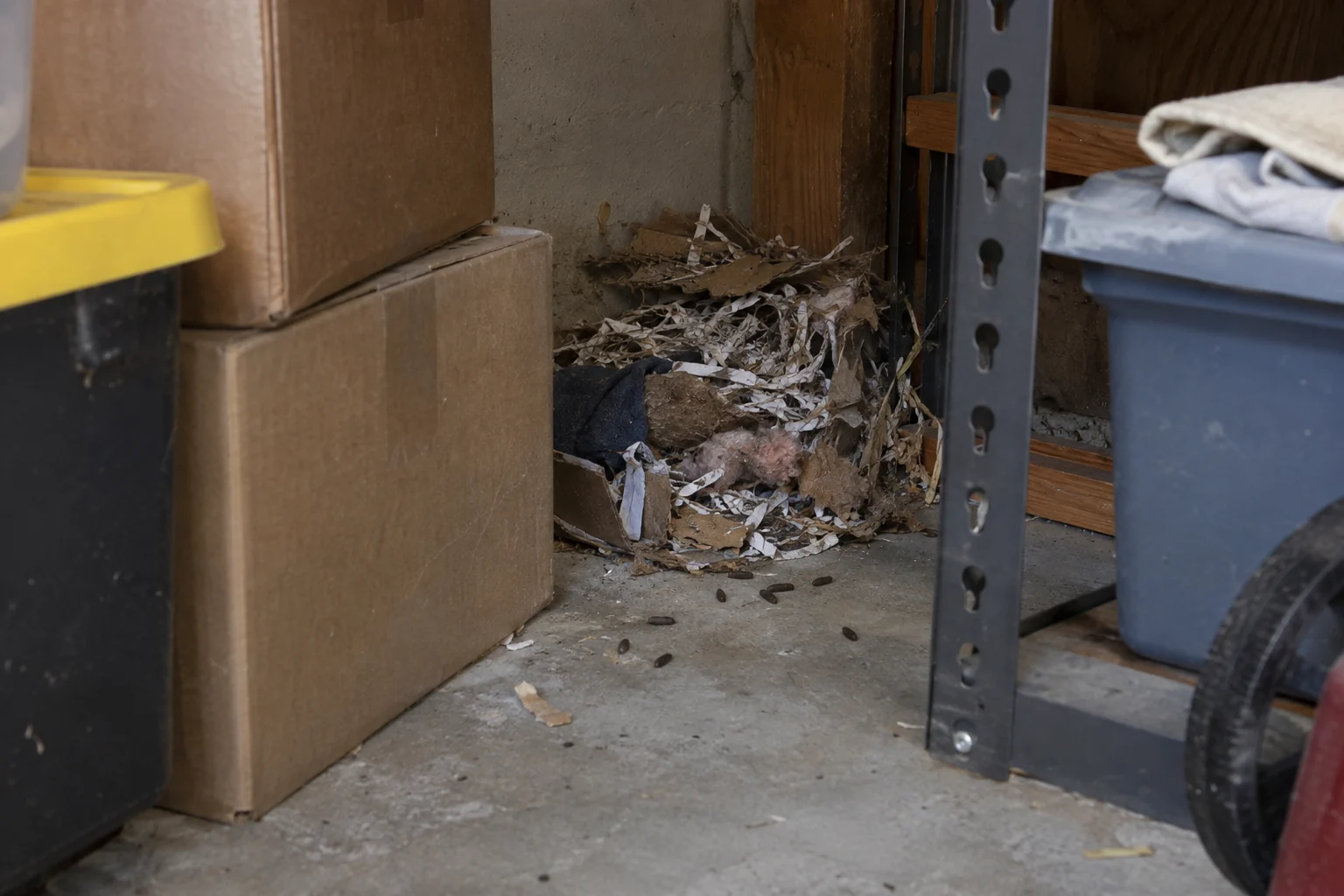
A rat nest may be an irregular accumulation of:
- shredded paper
- cardboard
- fabric
- insulation
- soft debris
It may be larger and more substantial than a mouse nest.
But it should not look like a neat bird nest.
Nearby evidence may include:
- large droppings
- rub marks
- gnawing
- urine odor
Do not handle nesting material with bare hands.
Rat Droppings in the Garage
Rat droppings may appear:
- along walls
- behind storage
- near food
- around garage-door corners
- under shelving
- near utility routes
They are substantially larger than typical mouse droppings.
Do not use dropping count to estimate rat population.
See Rat Droppings: What They Look Like & What They Mean.
Rat Tracks in the Garage
Dusty garage floors can preserve rat tracks.
Look near:
- wall edges
- stored materials
- doors
- utility routes
Rat tracks are larger than mouse tracks.
They may show:
- smaller front prints
- longer hind prints
- occasional tail drag marks
One rat can leave many tracks.
See Rat Tracks: What They Look Like & Where to Find Them.
Rat Gnaw Marks in the Garage
Common targets include:
- heavy paper bags
- cardboard
- wood
- plastic
- weatherstripping
- door seals
- wire insulation
Rat gnawing is generally broader and heavier than mouse gnawing.
See Rat Gnaw Marks: How to Identify Rodent Damage.
Rub Marks Along Garage Walls
Rats repeatedly using the same route may leave dark greasy-looking rub marks.
Common locations include:
- wall corners
- pipes
- door frames
- structural edges
Do not identify rats from a dark smudge alone.
Ordinary dirt can look similar.
Rub marks become more meaningful when combined with droppings, tracks, or sightings.
Rat Urine Smell in the Garage
Repeated activity can create a strong musky or urine-like odor.
Odor may be stronger:
- behind storage
- near a nest
- in porous cardboard
- inside wall voids
Smell alone cannot prove rats.
See Rat Urine Smell: What It Smells Like & What It Means.
Scratching or Thumping in Garage Walls
Rat movement may produce:
- scratching
- heavier scurrying
- gnawing
- occasional thumps
But garages also transmit sounds from:
- pipes
- ducts
- building movement
- other animals
Use physical evidence to confirm the source.
See Scratching in Walls at Night: Could It Be Mice or Rats?.
Could the Garage Rodent Be a Mouse?
Yes.
Mouse evidence is generally smaller.
Compare:
- body size
- droppings
- tracks
- gnawing
- entry-point size
See Rat vs Mouse: How to Tell the Difference and Mice in the Garage: Entry Points, Nests & Control.
Are Rats in the Garage Dangerous?
The main practical concerns are:
- food contamination
- droppings and urine
- nesting contamination
- gnaw damage
- entry into living areas
- damage to wiring or stored materials
Do not directly handle:
- droppings
- urine
- nesting material
- contaminated food
Can Rats Damage Stored Items?
Yes.
Rats may damage:
- cardboard
- paper
- plastic
- fabric
- insulation
- wood
They may also contaminate stored items.
Inspect boxes and stored materials before moving them into the house.
Can Rats Damage Wires in a Garage?
Yes.
Rats can gnaw wire insulation.
If wiring appears damaged:
- do not touch exposed conductors
- keep people away from unsafe equipment
- have electrical damage evaluated appropriately
Rodent control does not replace electrical repair.
Can Rats Get Into a Car in the Garage?
Yes.
A parked vehicle can provide:
- shelter
- warmth
- nesting material
Possible signs include:
- droppings
- nesting material
- gnawed insulation
- chewed wiring
Do not reach blindly into engine compartments or moving components.
If vehicle wiring or components appear damaged, have the vehicle inspected appropriately.
Rats Near Stored Pet Food or Bird Seed
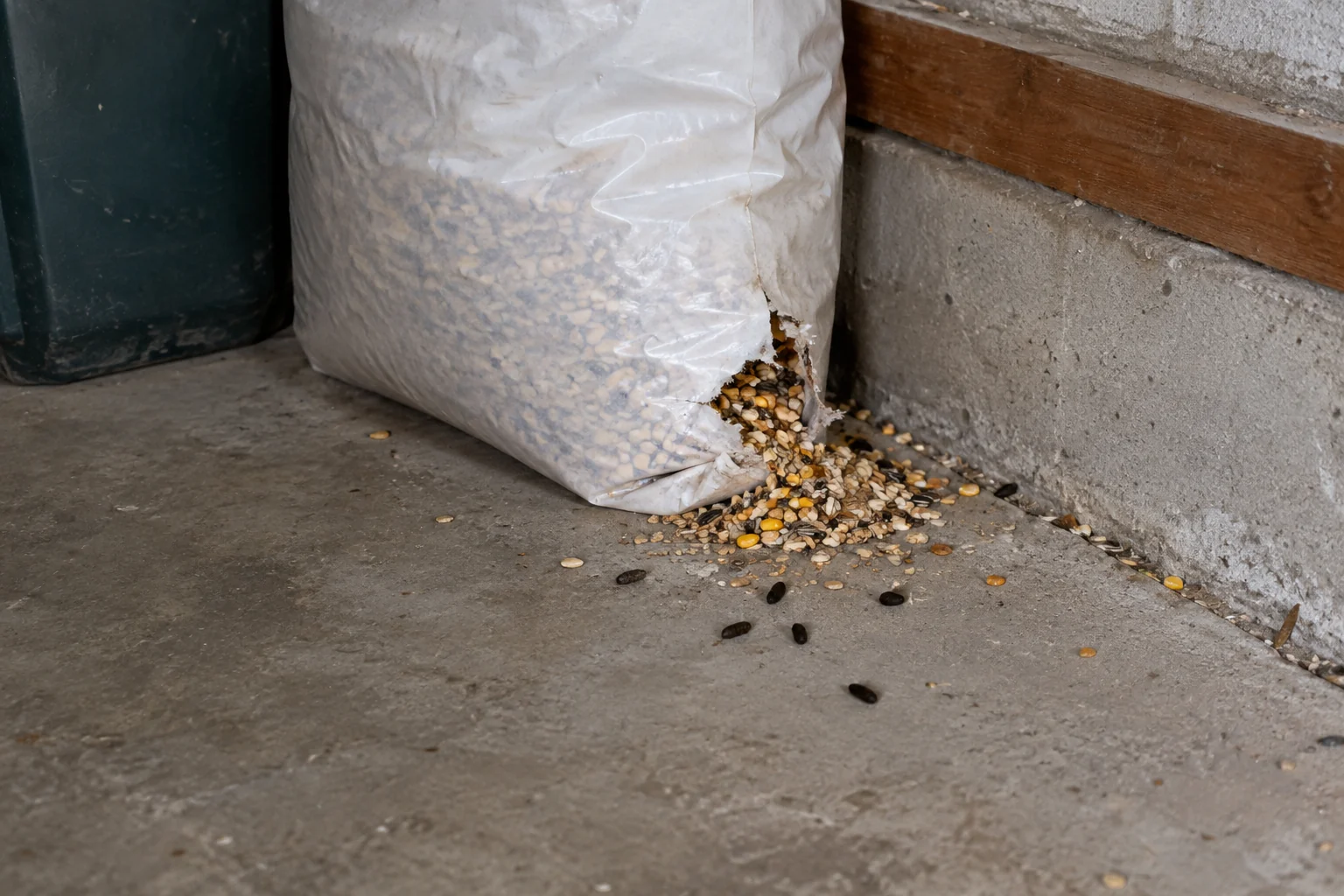
Pet food and bird seed are common garage attractants.
Inspect for:
- torn bags
- gnaw holes
- spilled material
- droppings
- tracks
Move vulnerable food into sturdy containers with secure lids.
Clean spilled material from the floor.
Rats Near Garbage
Garbage can support rat activity if containers are:
- open
- damaged
- overfilled
- easy to tip
Use containers that close securely.
Clean food residue around the storage area.
Sanitation reduces attraction but does not replace exclusion.
What to Do Right After Seeing a Rat in the Garage
A practical response is:
- note where the rat was seen
- note where it disappeared
- inspect nearby wall edges
- check garage-door corners
- look for rat-sized droppings
- inspect food and seed storage
- look for gnaw marks, tracks, and rub marks
- check for nests or exterior burrows
- place rat-sized traps on confirmed routes
- inspect likely entry points
Do not chase or corner the rat.
Remove Accessible Food
Store vulnerable food in sturdy containers.
Pay special attention to:
- pet food
- bird seed
- feed
- dry goods
- trash
Clean spills promptly.
Do not leave open bags along garage walls.
Reduce Clutter Around Active Routes
You do not need an empty garage.
But reducing dense storage around activity zones can make:
- routes easier to see
- traps easier to place
- droppings easier to detect
- entry points easier to inspect
Move contaminated items cautiously.
Do not create airborne dust from droppings or nests.
How to Clean Rat Droppings in a Garage Safely
Use wet-cleanup methods.
A practical sequence is:
- keep children and pets away
- wear suitable gloves
- wet droppings and contaminated material with an appropriate disinfecting solution
- allow the product’s required contact time
- wipe or collect the waste
- bag waste appropriately
- clean the surrounding hard surface
- wash hands after removing gloves
Do not dry sweep or vacuum fresh rat droppings or nesting material before wet cleanup.
See the cleanup section and rodent safety section.
What About Contaminated Cardboard?
Cardboard is porous.
If a box has:
- droppings
- urine contamination
- heavy nesting contamination
discarding it may be more practical than trying to disinfect it.
Handle contaminated material cautiously.
Where Should You Put Rat Traps in a Garage?
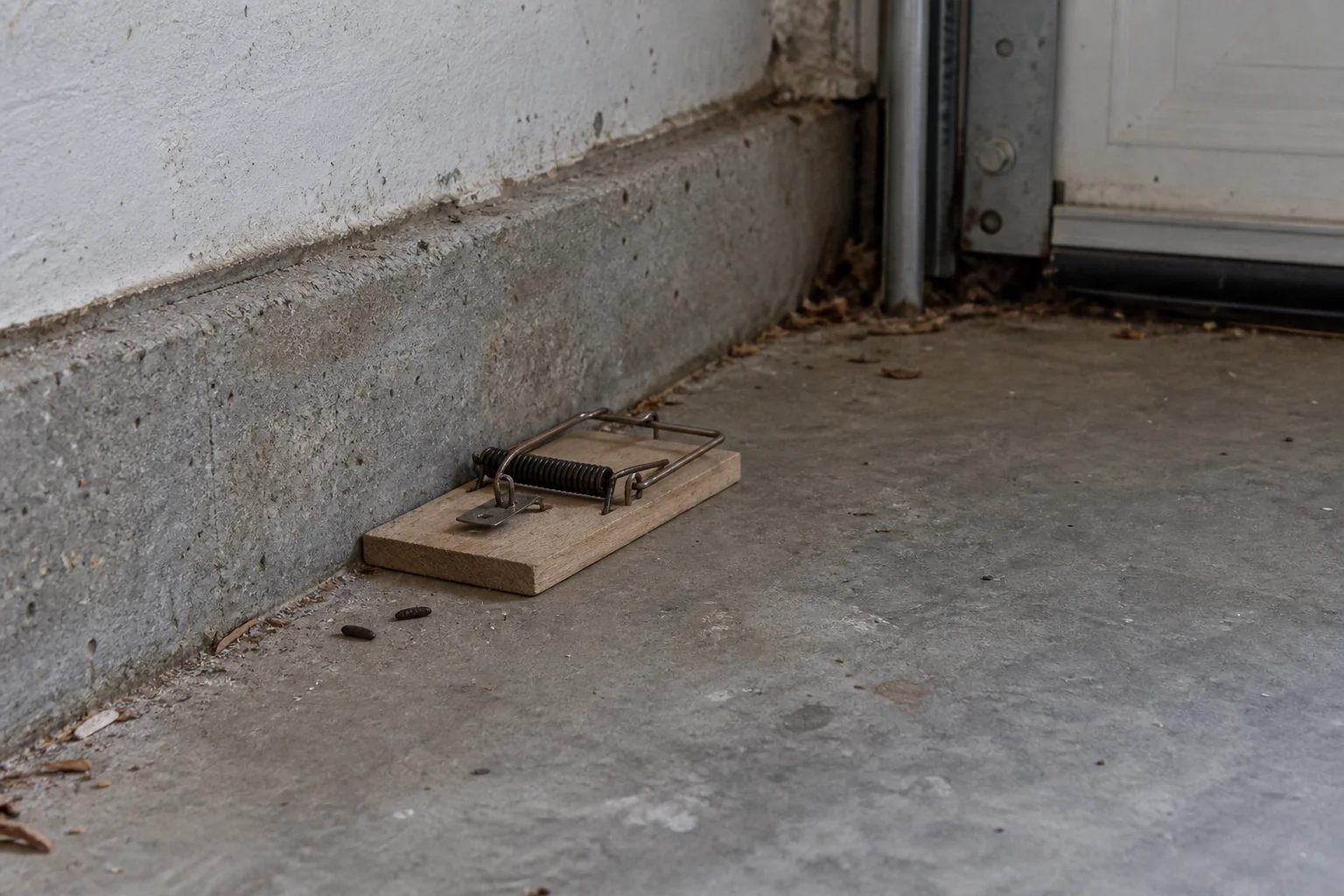
Place traps on confirmed rat travel routes.
Common locations include:
- along walls
- near garage-door corners
- beside shelving
- near storage edges
- near utility penetrations
Use traps designed for rats.
Rat traps are larger and more powerful than mouse traps.
Keep traps inaccessible to:
- children
- pets
- unintended animals
See Rat Traps: Types, Placement & How to Use Them and Best Rat Traps: Which Type Works Best & How to Choose.
Should Rat Traps Go in the Middle of the Garage?
Usually, no.
If evidence follows walls and edges, trap placement should follow those routes.
Rats often travel close to:
- walls
- shelving
- stored items
- structural edges
A random trap in open floor space may miss the active runway.
Follow the trap manufacturer’s instructions.
Should You Use Poison in the Garage?
Do not assume rodenticide is the easiest solution.
Rodenticides must be used according to:
- the product label
- applicable placement requirements
- child and pet safety requirements
Garages may be accessible to:
- children
- pets
- wildlife
A poisoned rat may also die in an inaccessible wall or void.
For localized indoor garage activity, monitored trapping plus exclusion is often easier to evaluate.
Find the Garage Entry Point
Inspect:
- door seals
- door corners
- side-door thresholds
- foundation openings
- utility penetrations
- wall joints
- attic or roofline connections
Look for rat evidence near the opening.
Do not assume every crack is active.
Check for Burrows Outside the Garage
Ground-level burrows are especially relevant to Norway rats.
Inspect near:
- foundations
- sheds
- decks
- retaining walls
- dense vegetation
Possible signs include:
- smooth burrow openings
- fresh soil
- worn runways
- droppings
Do not collapse or block a suspected active route without a control plan.
Should You Seal the Entry Point Immediately?
Not always.
If rats are still inside, sealing the only active route can trap them in the structure.
That can lead to:
- movement into the house
- new gnawing
- attempts to create another exit
- odor if a rat dies in an inaccessible void
Coordinate trapping and exclusion.
See Rodent Exclusion: How to Keep Rats & Mice Out.
How to Seal Rat Entry Points in a Garage
The correct repair depends on the construction.
Durable exclusion may involve:
- metal mesh
- flashing
- mortar
- rodent-resistant backing plus suitable sealant
- replacement weatherstripping
- replacement door seals
Do not block:
- drainage
- ventilation
- required exhaust
Garage-door repairs must not interfere with safe operation.
Check the Door From the Garage Into the House
For attached garages, inspect the interior connection.
Look at:
- door sweep
- threshold
- weatherstripping
- nearby utility penetrations
Do not compromise required fire or safety features of the garage-to-house door.
Check Whether Activity Has Reached the Kitchen
If the garage connects to:
- a kitchen
- pantry
- utility room
inspect the adjoining area.
See Rats in the Kitchen: Why They’re There & What to Do.
Check Whether Activity Has Reached the Attic
Elevated activity may indicate a route toward:
- attic framing
- upper walls
- roofline openings
See Rats in the Attic: Signs, Damage & Removal.
How to Know Whether the Garage Rat Problem Is Improving
Monitor for:
- fresh droppings
- trap activity
- new gnawing
- new tracks
- new rub marks
- additional sightings
- recurring odor
Improvement means fresh evidence declines and eventually stops.
Do not assume one quiet night means the garage is rat-free.
When to Call a Professional
Professional rat control may make sense when:
- rats are seen repeatedly
- fresh droppings keep returning
- active burrows are present
- several garage routes show activity
- rats are entering the house
- attic, wall, basement, or crawl-space routes are involved
- trapping does not reduce activity
- the entry point cannot be found
- garage-door or structural exclusion is complicated
See Rat Exterminator: What to Expect & When to Call One.
Rats in the Garage: The Bottom Line
Rats enter garages because garages can provide:
- shelter
- food
- water
- nesting material
- entry points
- access to the house
Common signs include:
- rat-sized droppings
- tracks
- heavy gnawing
- rub marks
- nests
- urine odor
- burrows
- sightings
If you find rats in the garage:
- remove accessible food
- reduce clutter around active routes
- wet-clean contamination safely
- place rat-sized traps on confirmed routes
- inspect garage-door, foundation, utility, and attic connections
- check whether activity extends into the house
- coordinate trapping with exclusion
- monitor for fresh signs
The long-term solution is not simply catching one rat.
It is reducing active rats while closing the routes that allowed them into the garage.
Continue with our signs of rats guide, rat droppings guide, rat tracks guide, rat gnaw marks guide, rat nest guide, rats in the kitchen guide, how to get rid of rats, how rats get into a house, or rodent exclusion guide.
For the broader overview, return to [Rats & Mice in the Home](/).