Snap Traps for Mice: How to Use Them Correctly
Snap traps are one of the most direct tools for controlling mice indoors. They work best when the trap is the right size, placed on an active mouse route, and checked consistently.
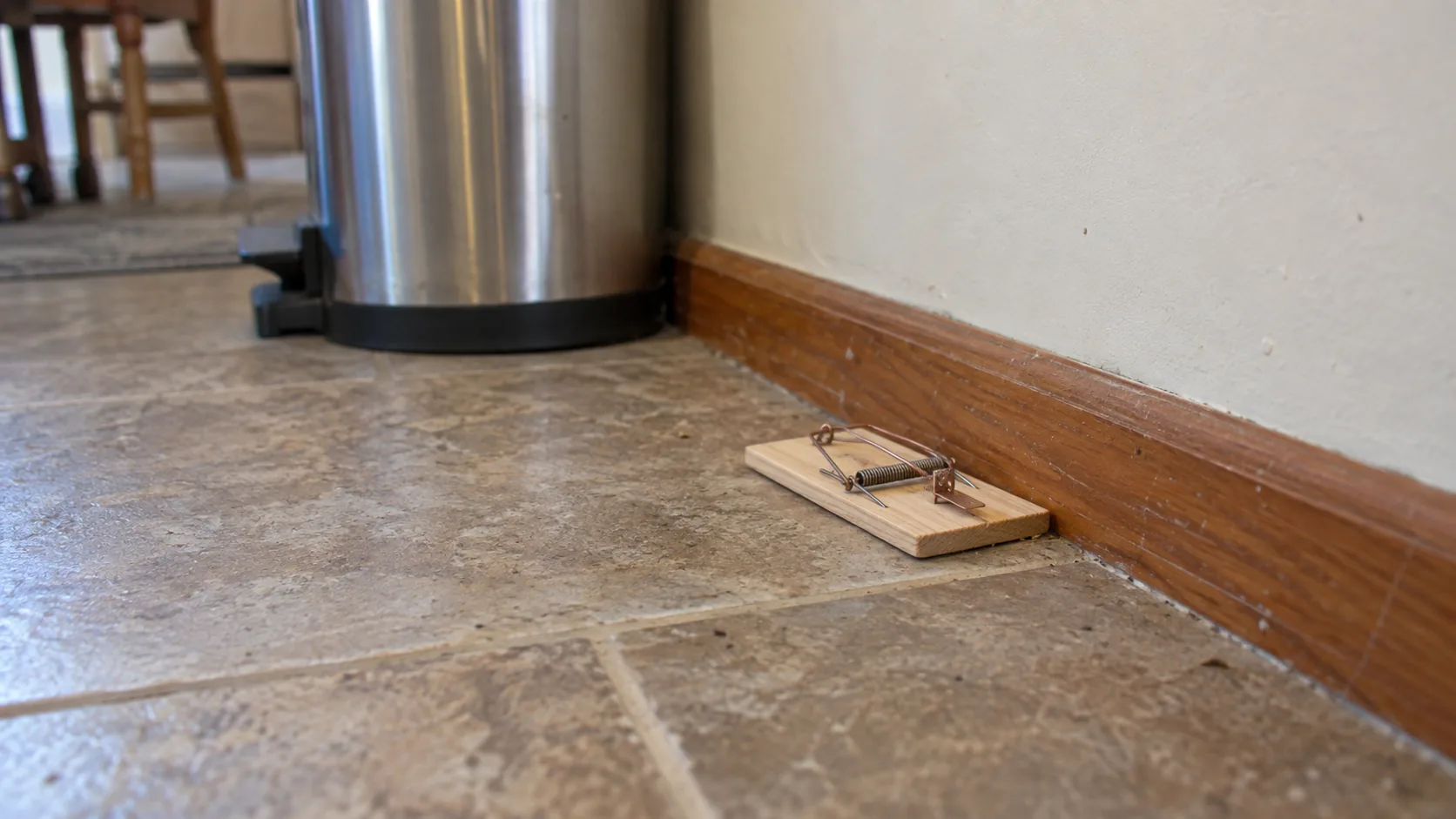
Snap traps are one of the most direct tools for controlling mice indoors.
They work best when three things are correct:
- the trap is the right size
- it is placed on an active mouse route
- it is checked and maintained consistently
Most snap-trap failures are not caused by the trap itself.
They are usually caused by:
- poor placement
- too few traps
- too much bait
- traps placed in open areas instead of along mouse routes
- traps that are difficult to inspect
- active entry points that keep bringing new mice inside
The goal is not to scatter traps around a room.
The goal is to put mouse-sized traps where mice are already traveling.
Are Snap Traps Good for Mice?
Yes.
Snap traps can be effective for indoor mouse control when they are:
- correctly sized for mice
- placed where fresh signs occur
- kept accessible for checking
- protected from children and pets
- used alongside sanitation and exclusion
They are especially useful because they let you monitor whether mouse activity is continuing.
A trap catch confirms that a mouse used that route.
But trap catches do not tell you the total number of mice in a house.
What Is a Mouse Snap Trap?
A snap trap is a mechanical trap that uses a spring-loaded striking or closing mechanism.
Common designs include:
- traditional wooden-base traps
- plastic jaw-style traps
- covered snap traps
- reusable enclosed designs
This page focuses on snap traps specifically.
For the broader trap overview, see Mouse Traps: Types, Placement & How to Use Them.
For choosing among trap categories, see Best Mouse Traps: Which Type Works Best & How to Choose.
Use a Mouse-Sized Trap
Use a trap designed for mice.
A rat snap trap is:
- larger
- more powerful
- harder to place safely in many indoor mouse routes
A mouse trap is better matched to:
- house-mouse body size
- cabinet edges
- baseboards
- appliance routes
- small wall-side travel paths
Do not assume a larger trap is automatically better.
Where Should You Put Snap Traps for Mice?
Place traps where fresh mouse evidence is strongest.
High-value locations can include:
- along baseboards
- beside cabinet edges
- under sinks
- behind accessible appliances
- along garage walls
- basement wall edges
- attic travel routes
- near confirmed utility gaps
Look for:
- fresh droppings
- small tracks
- gnawing
- repeated sightings
- nesting material
See Signs of Mice: How to Tell If You Have Mice.
Do Not Put Snap Traps in the Middle of the Room
Mice usually prefer protected edges.
A trap in the center of an open room may be far from the route the mouse actually uses.
Better locations are usually:
- wall edges
- cabinet edges
- behind objects
- beside a confirmed entry gap
Think about where the mouse travels, not where the trap is easiest to see.
Which Way Should a Mouse Snap Trap Face?
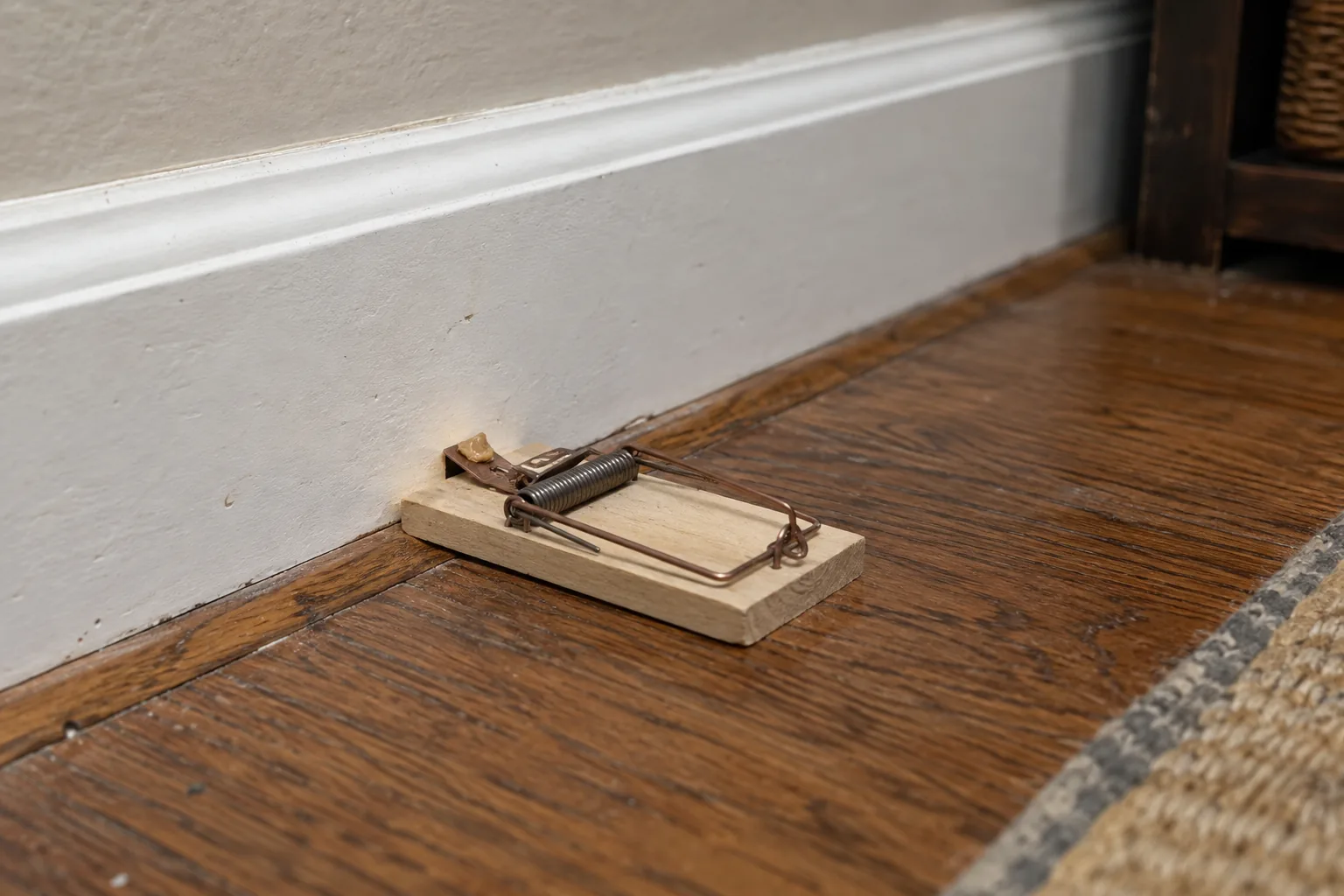
For a traditional snap trap, a common starting placement is:
- trap perpendicular to the wall
- trigger or bait end facing the wall
This places the trigger directly on the edge route.
Depending on trap design and the shape of the travel path, a trap can also be placed:
- parallel to the wall
- inside a protective tunnel or enclosure
- at an angle where the mouse naturally approaches
The important point is to position the trigger where the mouse is likely to encounter it.
Follow the trap manufacturer’s setup instructions.
Why Put the Trigger End Toward the Wall?
Mice often travel with their bodies close to:
- walls
- cabinets
- stored objects
When the trigger is close to the wall, the mouse is more likely to contact it while following that edge.
This does not mean every trap must be placed in exactly the same orientation.
Use the route and trap design to guide placement.
Put Traps Where Droppings Are Fresh
Fresh mouse droppings can help identify active travel areas.
Common locations include:
- cabinet corners
- behind appliances
- under sinks
- garage walls
- basement edges
Do not use dropping count to estimate mouse population.
See Mouse Droppings: What They Look Like & What They Mean.
Use Tracks and Gnawing to Refine Placement
Mouse tracks may show:
- direction of travel
- wall-following routes
- access around appliances
See Mouse Tracks: What They Look Like & Where to Find Them.
Fresh gnawing can also help identify areas where mice are:
- feeding
- entering
- moving repeatedly
See Mouse Gnaw Marks: How to Identify Rodent Damage.
How Many Snap Traps Should You Use?
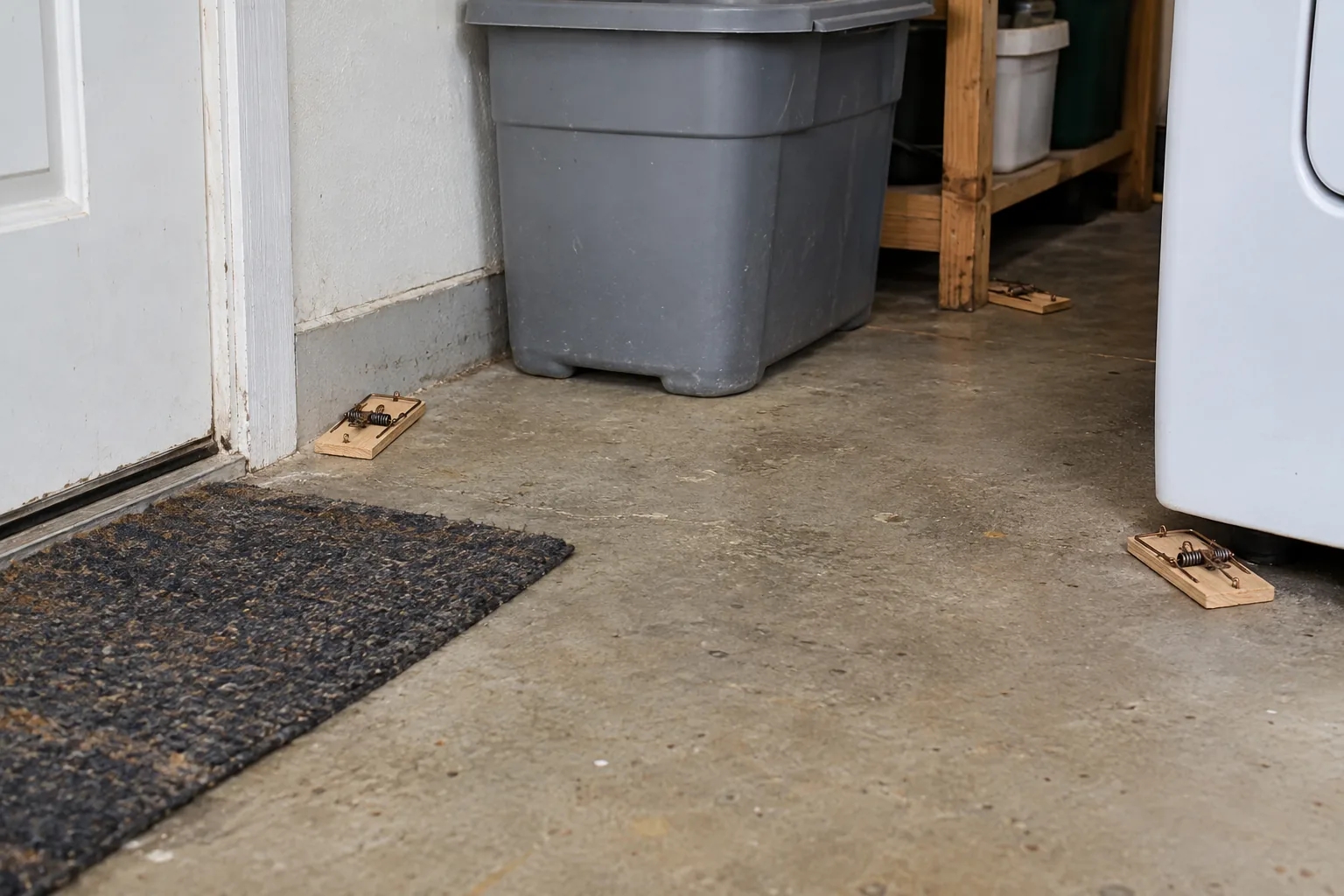
There is no single correct number for every home.
Use enough traps to cover the active routes.
A small kitchen problem may need only a few well-placed traps.
Activity across:
- kitchen
- garage
- basement
- attic
may require more traps because there are more travel routes.
Do not use the number of traps as an estimate of mouse population.
The better question is:
Have you covered the places where fresh evidence appears?
Should You Put Several Traps Close Together?
Sometimes.
Multiple traps can make sense when:
- one wall shows heavy fresh activity
- several routes converge
- bait is repeatedly taken
- mice pass a high-traffic cabinet or appliance edge
Do not arrange traps in a perfect decorative row.
Place them where the route actually occurs.
How Far Apart Should Mouse Snap Traps Be?
There is no universal spacing number that fits every room.
Spacing depends on:
- room size
- number of active routes
- amount of evidence
- obstacles
- trap design
It is usually better to cover several confirmed routes than to space traps evenly around a room.
What Is the Best Bait for a Mouse Snap Trap?
No bait works best in every house.
Common choices include a very small amount of:
- peanut butter
- nut spread
- soft food already being eaten by the mice
- oats mixed into a sticky bait
- nesting material in some situations
Use a small amount.
The purpose is to make the mouse interact with the trigger.
Can You Use Peanut Butter on a Mouse Trap?
Yes.
A small smear can work well because it:
- has odor
- sticks to the trigger
- requires the mouse to interact with it
Do not cover the entire trap with bait.
Too much bait can let a mouse feed without putting enough pressure on the trigger.
How Much Bait Should You Use?
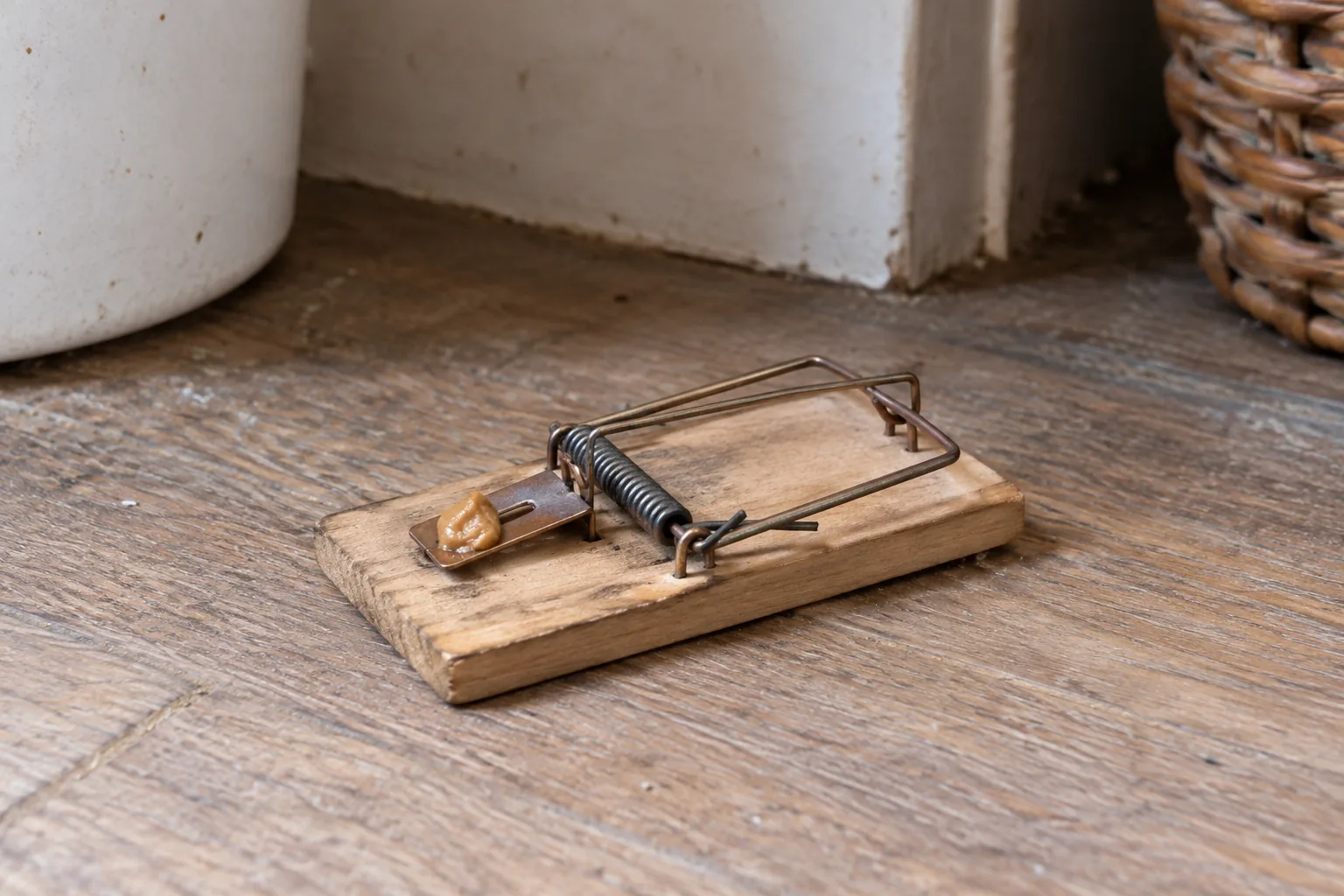
Use a small amount.
A thin smear or small dab on the trigger is usually enough.
More bait is not automatically better.
Too much can:
- reduce trigger contact
- make a mess
- attract insects
- be stolen from the edge
The trap should do the work.
The bait is only an attractant.
Can You Use Food the Mouse Is Already Eating?
Yes.
If mice are clearly feeding on one stored food, a small amount of that food may be useful.
Examples can include:
- cereal
- oats
- seed
- nut-based food
Use only enough to encourage trigger contact.
Do not leave extra food around the trap.
Do Mice Sometimes Ignore Baited Snap Traps?
Yes.
A mouse may ignore a trap because:
- the trap is not on its route
- food elsewhere is easier to reach
- the trap is new or unfamiliar
- bait is not attractive in that location
- the trap is positioned poorly
Before changing bait repeatedly, check placement.
Placement is often more important than bait.
What Is Prebaiting?
Prebaiting means placing bait on an unset trap for a short period before activating it.
This may be useful when mice seem cautious around new objects.
The goal is to let the trap become part of the environment before it is set.
Prebaiting is not always necessary.
If fresh activity is heavy and mice readily approach the trap, normal setup may be sufficient.
Can a Mouse Steal Bait Without Setting the Trap?
Yes.
Possible reasons include:
- too much bait
- bait placed beside the trigger instead of on it
- trap sensitivity
- bait that can be pulled away easily
Try:
- less bait
- a stickier bait
- placing bait directly on the trigger area
- checking that the trap is set correctly
Follow the trap manufacturer’s instructions.
Why Does the Trap Keep Going Off With No Mouse?
An empty triggered trap can happen because of:
- poor placement
- trap instability
- a mouse touching the trap from the side
- vibration
- incorrect setting
- another animal contacting it
Check that the trap sits flat and stable.
Do not place it on:
- moving appliance parts
- flexible ductwork
- unstable stored items
Keep Snap Traps Stable
The trap should sit on a stable surface.
Good surfaces can include:
- floor
- shelf edge where safely accessible
- cabinet floor
- attic walkway or stable structural surface
Avoid:
- soft insulation where the trap rocks
- dangling shelves
- moving machinery
- unstable boxes
The trap should not slide when a mouse approaches.
Snap Traps in the Kitchen
In kitchens, high-value routes include:
- under the sink
- behind accessible appliances
- lower cabinet edges
- pantry walls
Do not place traps:
- on food-preparation surfaces
- inside appliance machinery
- where children can reach them
- where pets can reach them
See Mice in the Kitchen: Why They’re There & What to Do.
Snap Traps Behind the Refrigerator
The refrigerator area can be active because it may provide:
- cover
- warmth
- food debris
- utility gaps
Place traps only in accessible areas outside the machinery.
Do not put a trap:
- inside the compressor compartment
- beside moving fan parts
- where the power cord or water line can contact it
Do not pull a heavy refrigerator out alone if it cannot be moved safely.
See Mice Behind the Refrigerator: Why They Hide There.
Snap Traps Under the Sink
Under-sink cabinets can be useful trap locations when they show fresh evidence.
Keep the trap:
- away from plumbing leaks
- clear of shutoff valves
- away from electrical components
- accessible for checking
If the cabinet is accessible to children or pets, use a protected setup.
Snap Traps in the Garage
Garage wall edges can be strong routes.
Place traps near:
- droppings
- wall edges
- stored-food routes
- door-corner activity
Do not place traps where:
- vehicles can crush them
- children play
- pets can reach them
- they become buried under storage
See Mice in the Garage: Entry Points, Nests & Control.
Snap Traps in the Basement
Basement traps should follow:
- wall edges
- utility routes
- storage edges
Keep them:
- dry
- stable
- visible
- retrievable
Do not place traps near:
- standing water
- energized electrical equipment
- unsafe utility components
See Mice in the Basement: Why They’re There & What to Do.
Snap Traps in the Attic
Attic placement can work when:
- activity is confirmed
- the trap sits on a stable surface
- the location can be checked safely
Do not bury traps in insulation where they cannot be found.
Do not place them where they can contact:
- exposed wiring
- moving equipment
- unsafe roof openings
See Mice in the Attic: Signs, Damage & Removal.
Can You Use Snap Traps in an Apartment?
Yes, when the trap can be used safely inside the unit.
Focus on:
- accessible wall routes
- cabinet edges
- appliance edges
Keep traps away from children and pets.
Apartment mouse problems may also involve:
- shared walls
- plumbing chases
- neighboring structural spaces
So trapping one unit may not solve the building route.
See Mice in an Apartment: What Renters Should Do.
How to Use Snap Traps Around Children
An exposed snap trap can injure fingers.
If children are present:
- keep traps out of reach
- use protected or enclosed setups where appropriate
- do not place traps in play areas
- do not place traps under furniture a child can easily reach
If you cannot create a safe placement, use professional help or another protected control setup.
How to Use Snap Traps Around Pets
Pets may:
- investigate bait
- step on a trap
- move the trap
- interfere with a captured mouse
Use:
- protected placement
- enclosed trap housings where appropriate
- inaccessible routes
Do not assume a trap behind furniture is automatically pet-safe.
Should You Put a Snap Trap Inside a Box or Tunnel?
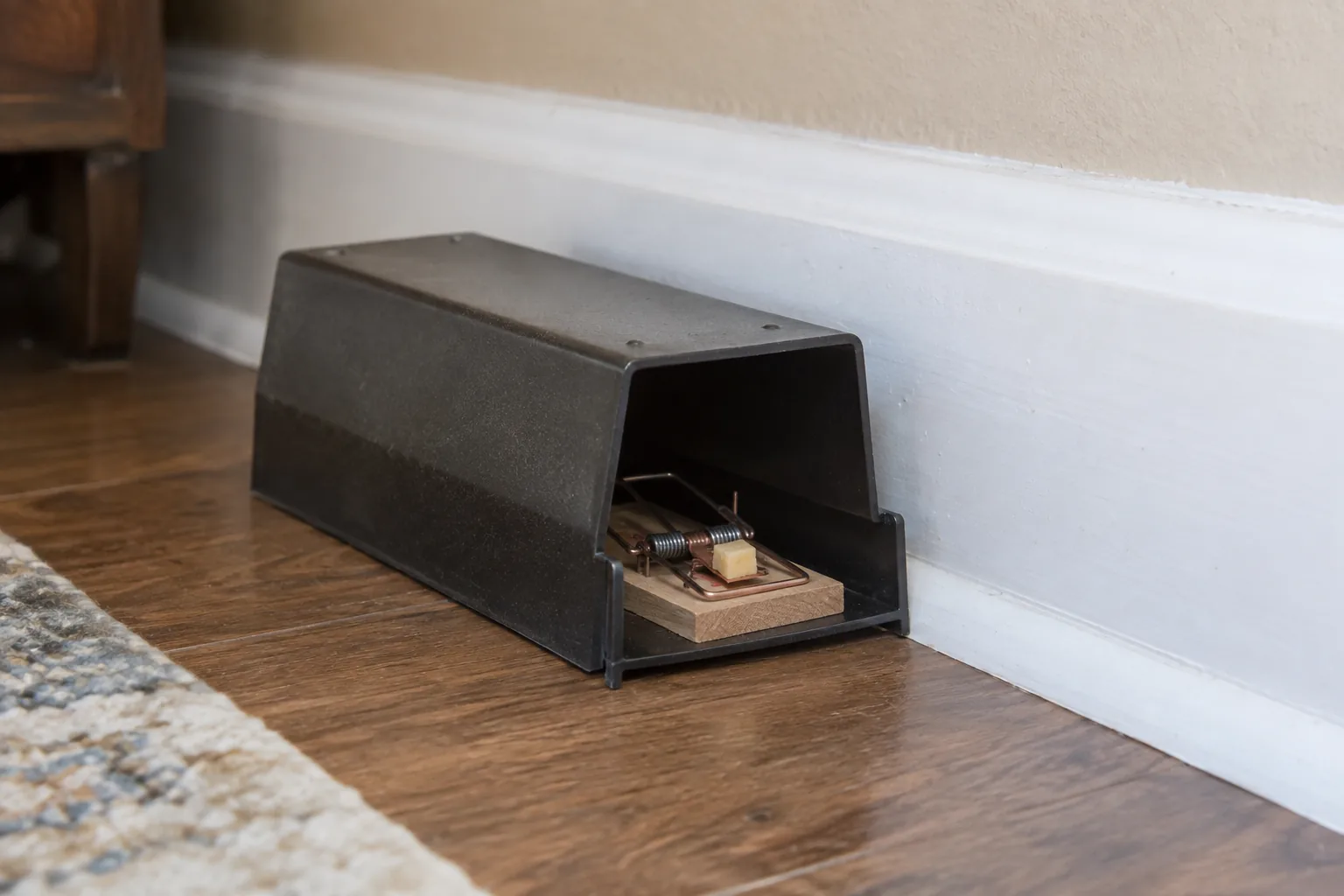
A protective tunnel or enclosure can be useful when it:
- keeps the trap stable
- guides the mouse along the route
- reduces accidental contact
The enclosure must still allow:
- mouse access
- trap operation
- inspection
- retrieval
Do not permanently hide a trap inside a wall or inaccessible cavity.
How Often Should You Check Snap Traps?
Check active traps regularly.
A practical routine is at least daily when traps are set indoors.
More frequent checks may be appropriate in:
- kitchens
- occupied living spaces
- homes with children or pets
Regular checks let you:
- remove catches promptly
- reset sprung traps
- replace stolen bait
- adjust poor placements
What Should You Do After a Trap Catches a Mouse?
Keep children and pets away from the area.
Use suitable gloves and avoid direct contact.
Follow local disposal requirements and the trap manufacturer’s instructions.
If the surrounding area has fresh droppings or urine contamination:
- avoid dry sweeping or vacuuming
- wet-clean contaminated hard surfaces appropriately
See the cleanup section and rodent safety section.
Can You Reuse a Mouse Snap Trap?
Many snap traps are reusable.
Reuse depends on:
- trap design
- damage
- contamination
- whether the mechanism still works properly
Inspect the trap before resetting.
Replace it if:
- the trigger is damaged
- the spring or mechanism is unreliable
- it cannot be cleaned appropriately
- the base is warped or broken
Follow the manufacturer’s cleaning and reuse instructions.
Do You Need to Wash a Trap After a Catch?
Cleaning can be appropriate when a reusable trap is contaminated.
Use suitable gloves.
Follow:
- manufacturer instructions
- the material limitations of the trap
- safe wet-cleaning principles
Do not soak electrical traps or components unless the manufacturer specifically allows it.
For mechanical snap traps, make sure the trap is completely functional before reuse.
Do Human Smells Make Mice Avoid Snap Traps?
Human scent is often blamed for trap avoidance, but placement, food competition, and unfamiliar objects are usually more practical factors to check first.
You do not need elaborate scent-masking rituals.
Focus on:
- correct placement
- stable traps
- small bait amounts
- active routes
Use gloves when needed for hygiene and safety.
Why Are Snap Traps Not Catching Mice?
Common reasons include:
- traps are not on active routes
- too few active routes are covered
- bait is competing with exposed food
- trap orientation is poor
- the trap is unstable
- mice are entering somewhere else
- activity has moved
Start by looking for fresh evidence again.
Do not keep adding traps randomly without reassessing the route.
What If Mice Avoid New Snap Traps?
Try:
- moving traps directly onto fresh routes
- using less bait
- prebaiting
- placing traps closer to walls
- using a covered or enclosed snap-trap design
Also remove competing food.
A mouse is less likely to investigate bait if easier food is nearby.
What If Bait Keeps Disappearing?
Reduce the amount of bait.
Use a sticky bait that requires more interaction with the trigger.
Check whether:
- insects
- pets
- other animals
could be taking the bait.
Do not place traps where non-target animals can reach them.
What If You Keep Catching Mice?
Repeated catches suggest activity is continuing.
That may mean:
- several mice were already inside
- one route remains active
- food remains available
- new mice are entering
Do not estimate the total population from catches.
Continue monitoring while inspecting entry points.
See Mouse Entry Points: Where to Inspect Your Home.
Snap Traps Do Not Replace Exclusion
Trapping removes individual mice.
It does not close:
- foundation gaps
- garage-door openings
- utility penetrations
- vent defects
- siding gaps
If entry points remain open, trapping may become an ongoing cycle.
See How to Keep Mice Out of Your House and Mouse-Proofing a House: Complete Checklist.
When Should You Seal Entry Points?
If mice are actively indoors, avoid blindly sealing the only route before you know whether mice remain inside.
A better sequence is:
- identify active routes
- place and monitor traps
- reduce food
- confirm activity is declining
- complete durable exclusion
- keep monitoring
This reduces the chance of trapping mice in inaccessible spaces.
Should You Use Snap Traps With Rodenticide?
Do not scatter loose rodenticide as a substitute for trap placement and exclusion.
Rodenticides must be used according to the product label and applicable safety requirements.
For many indoor mouse situations, snap traps offer the advantage of:
- known placement
- visible monitoring
- retrievable catches
Keep the treatment plan simple and controlled.
Snap Traps vs Glue Traps
This page focuses on snap traps.
Glue traps work differently and have different handling and welfare considerations.
If your goal is fast mechanical trapping on known indoor mouse routes, a correctly placed snap trap is generally the more direct tool.
For the broader trap-type comparison, see Mouse Traps: Types, Placement & How to Use Them.
Snap Traps vs Electronic Mouse Traps
Electronic traps are another trap category.
They may offer:
- enclosed operation
- different disposal handling
- higher purchase cost
Traditional snap traps remain useful because they are:
- simple
- widely available
- easy to place in multiple locations
Use the design that can be operated safely and consistently in your home.
Common Snap-Trap Mistakes
Using rat traps for mice
Use mouse-sized traps.
Placing traps in open floor space
Follow walls and active edges.
Using too much bait
Use a small amount on the trigger.
Placing only one trap
Cover the active routes.
Ignoring food competition
Secure accessible food.
Hiding traps where they cannot be checked
Every trap should be retrievable.
Leaving traps exposed to children or pets
Use protected placement.
Trapping without exclusion
Close the building route after active mice are addressed.
When to Call a Professional
Professional help may make sense when:
- mice continue despite careful trap placement
- fresh droppings keep returning
- several rooms show activity
- the active entry route cannot be found
- mice are inside inaccessible walls or ceilings
- safe trap placement is difficult because of children or pets
- electrical wiring is damaged
- contamination is extensive
A pest-control professional can help combine:
- inspection
- trap placement
- monitoring
- exclusion
See Mouse Exterminator: What to Expect & When to Call One.
Snap Traps for Mice: The Bottom Line
Snap traps work best when they are placed strategically rather than randomly.
For better results:
- use mouse-sized traps
- place them on fresh mouse routes
- keep the trigger where the mouse is likely to contact it
- use only a small amount of bait
- use enough traps to cover active areas
- keep traps stable and retrievable
- protect children and pets
- check traps regularly
- remove competing food
- combine trapping with exclusion
If traps are not working, reassess placement before assuming the trap design is the problem.
The most important question is not:
“How many traps do I have?”
It is:
“Are the traps sitting where the mice actually travel?”
Continue with our mouse traps guide, best mouse traps guide, signs of mice guide, mouse entry points guide, how to keep mice out guide, or how to get rid of mice.
For the broader overview, return to [Rats & Mice in the Home](/).