Rats in the Kitchen: Why They’re There & What to Do
Finding a rat in the kitchen is a serious sign because kitchens can provide food, water, shelter, and protected travel routes.
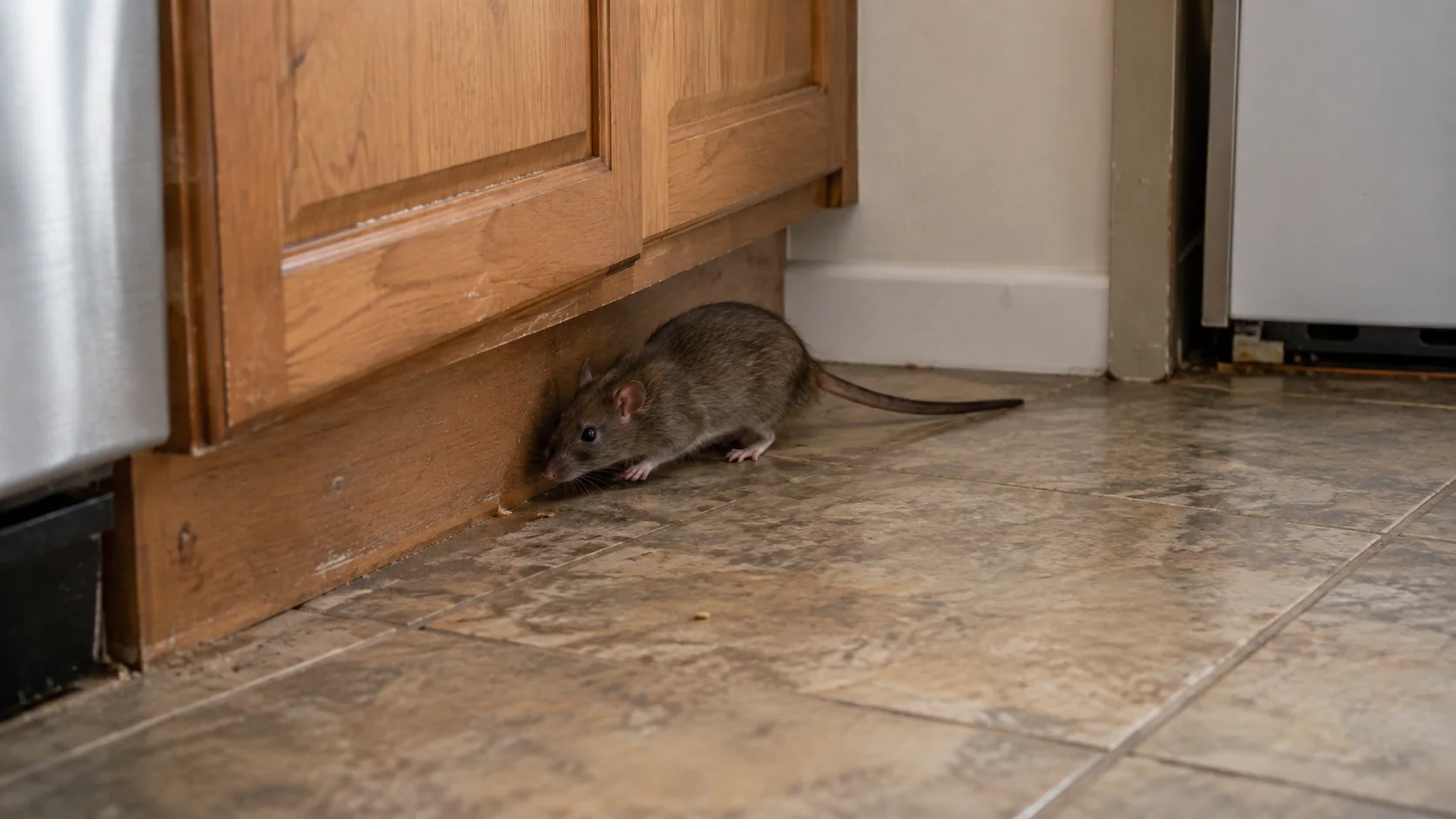
Finding a rat in the kitchen is a serious sign because kitchens can provide exactly what rats are looking for:
- food
- water
- shelter
- protected travel routes
A rat may enter a kitchen through:
- a gap around plumbing
- a wall opening
- a cabinet void
- a garage or basement connection
- a crawl-space route
- an attic or upper-wall route
- a damaged exterior opening
Once inside, rats may travel along walls, cabinet bases, appliance edges, and utility lines while searching for food and water.
Common kitchen signs include:
- rat-sized droppings
- heavy gnaw marks
- grease or rub marks
- tracks
- scratching or heavier movement sounds
- urine odor
- damaged food packaging
- a rat sighting
Seeing one rat in the kitchen does not tell you exactly how many rats are present.
It also does not prove the nest is inside the kitchen.
The practical goal is to determine:
- where the rat is traveling
- what food or water is attracting it
- whether the route is ground-level or elevated
- where the rat is entering the structure
- whether activity extends beyond the kitchen
- how to remove rats already inside before completing exclusion
This guide explains where kitchen rats commonly travel, how to inspect the room, how to clean contamination safely, and what to do to prevent the problem from returning.
Why Are Rats in the Kitchen?
Kitchens can provide concentrated food and water.
Possible food sources include:
- crumbs
- cereal
- grains
- pantry food
- pet food
- garbage
- fruit
- food residue behind appliances
Water may come from:
- sinks
- leaking plumbing
- condensation
- pet bowls
- dishwasher connections
- small plumbing leaks
A kitchen also contains protected routes.
Rats often move close to:
- walls
- cabinets
- appliances
- pipes
- structural edges
A kitchen therefore can become both a feeding area and a travel corridor.
Does a Rat in the Kitchen Mean There Are More?
Not automatically.
One rat may enter a kitchen while moving through the structure.
Additional rats become more plausible when you also find:
- droppings in several locations
- repeated sightings
- multiple active routes
- fresh gnawing
- a nest
- an active burrow
- continuing trap activity
Do not estimate population size from one sighting.
Use the full evidence pattern.
Where Do Rats Hide in a Kitchen?
Rats prefer protected spaces.
Possible hiding or travel areas include:
- under the sink
- behind the refrigerator
- behind the stove
- behind or beneath cabinets
- inside cabinet voids
- pantry edges
- wall cavities
- utility penetrations
- nearby garage or basement routes
A rat seen crossing the kitchen floor may simply be moving between protected areas.
The sighting location is not always the nesting location.
Rats Under the Kitchen Sink
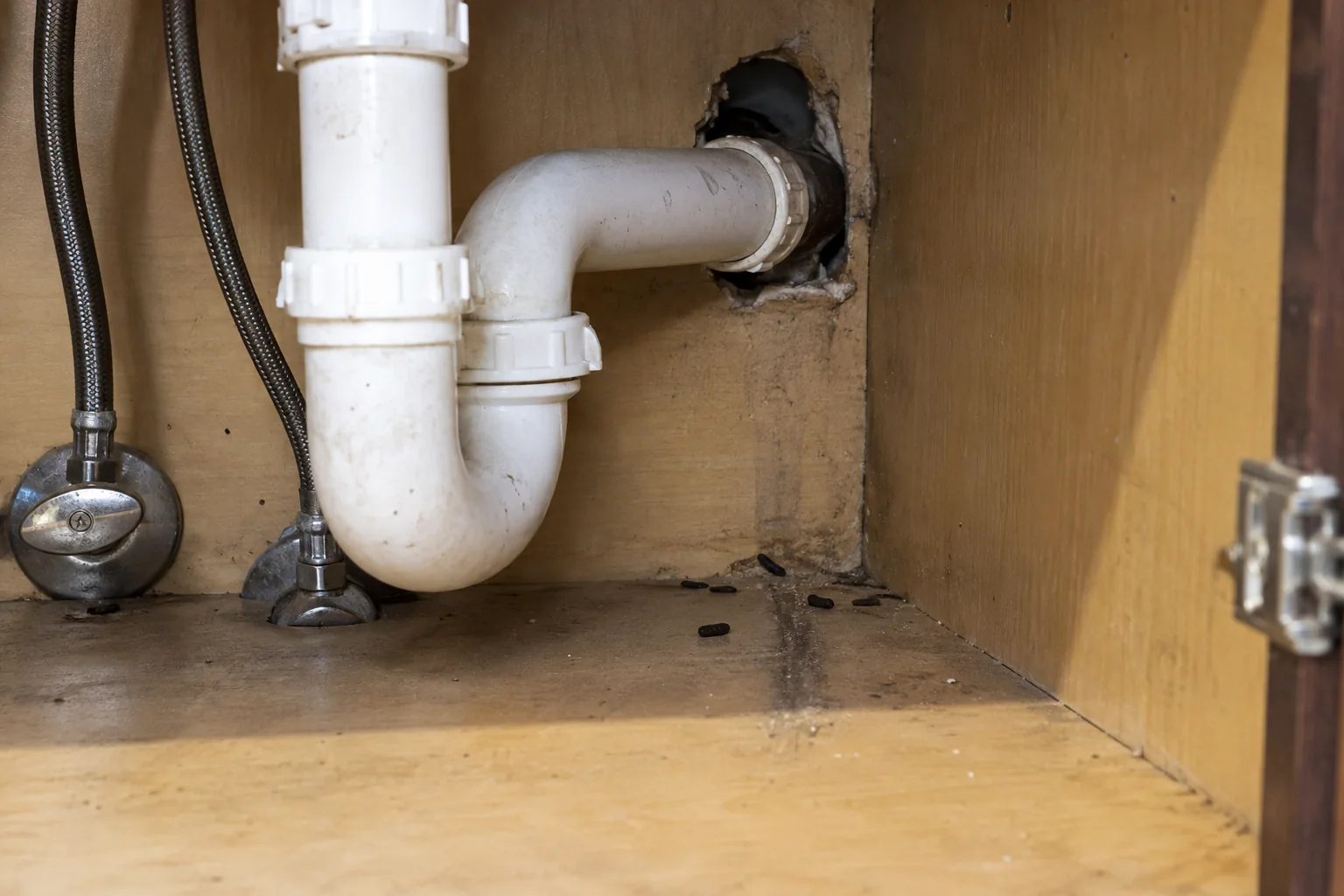
Sink cabinets are important inspection areas because pipes often pass through the cabinet wall or floor.
Inspect around:
- water lines
- drain pipes
- dishwasher hoses
- utility penetrations
Look for:
- large droppings
- gnaw marks
- rub marks
- urine staining
- disturbed material
Do not reach blindly into hidden openings.
A plumbing gap can connect directly to:
- a wall void
- a basement
- a crawl space
- another cabinet void
Rats Behind the Refrigerator
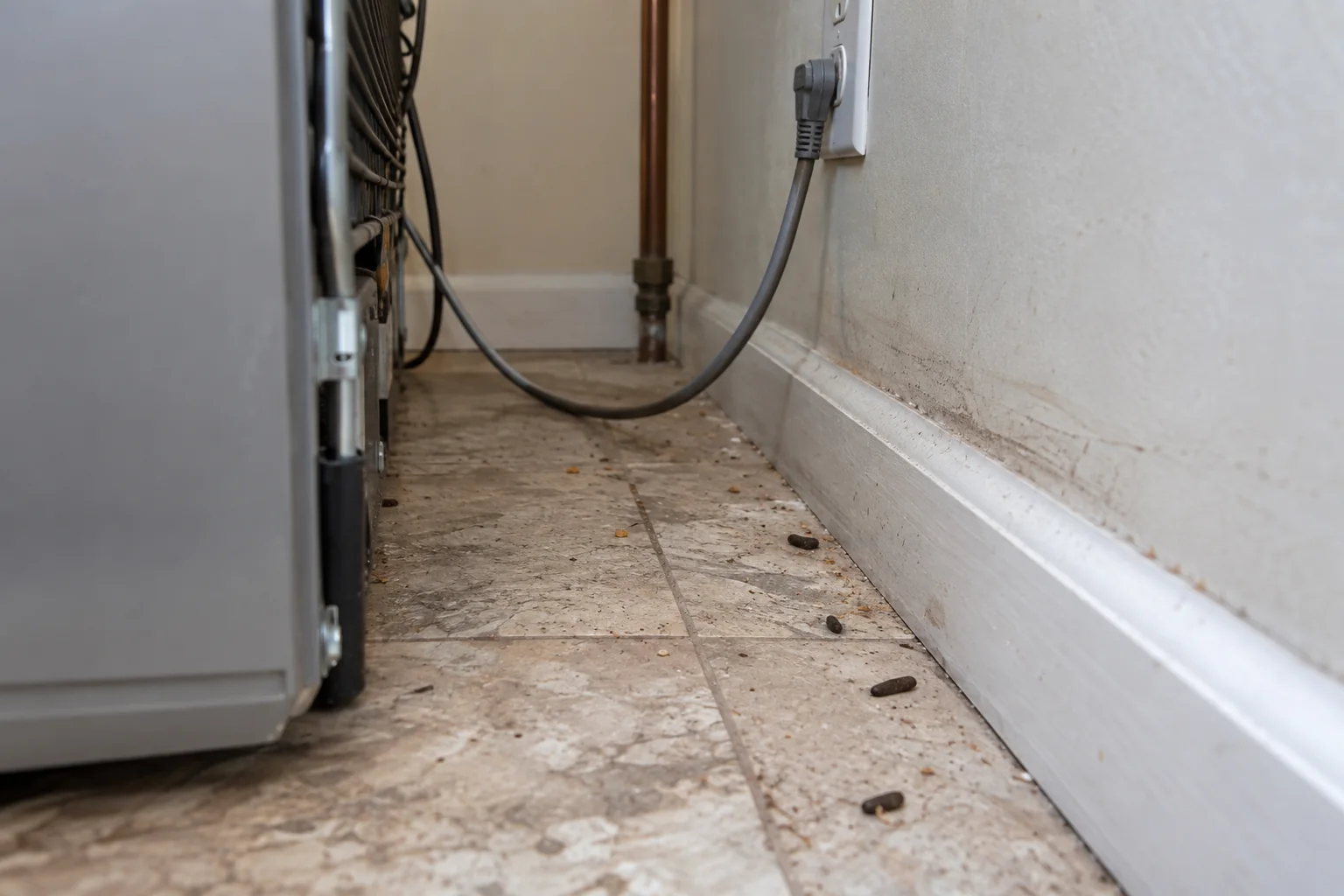
The refrigerator area may provide:
- warmth
- food debris
- wall-edge cover
- utility openings
- occasional water or condensation
Inspect accessible edges for:
- rat-sized droppings
- gnawing
- grease marks
- tracks
- a larger utility gap
Do not move a heavy refrigerator unsafely.
If the appliance must be moved, protect water and electrical connections.
Rats Behind the Stove
The stove area may collect:
- grease
- crumbs
- food particles
Rats may travel behind the appliance along:
- wall edges
- cabinet voids
- utility routes
Look for:
- droppings
- heavy gnawing
- rub marks
- openings
Do not disturb gas or electrical connections.
If moving the appliance could affect utilities, use appropriate professional help.
Rats Near the Dishwasher
The dishwasher area can contain:
- plumbing openings
- electrical penetrations
- warm cabinet voids
A rat may use the space around the appliance as part of a structural route.
Do not assume the rat lives inside the dishwasher itself.
Inspect accessible cabinet and plumbing areas first.
Do not open electrical components unless qualified.
Rats in Kitchen Cabinets
Rats can enter cabinet systems through:
- wall gaps
- floor gaps
- plumbing openings
- missing cabinet backs
- lower voids
Inspect:
- back corners
- lower shelves
- cabinet-to-wall gaps
- pipe openings
Look for:
- large droppings
- gnawed packages
- grease marks
- urine odor
A large rat requires more space than a mouse, so inspect for larger route openings.
Rats in the Pantry
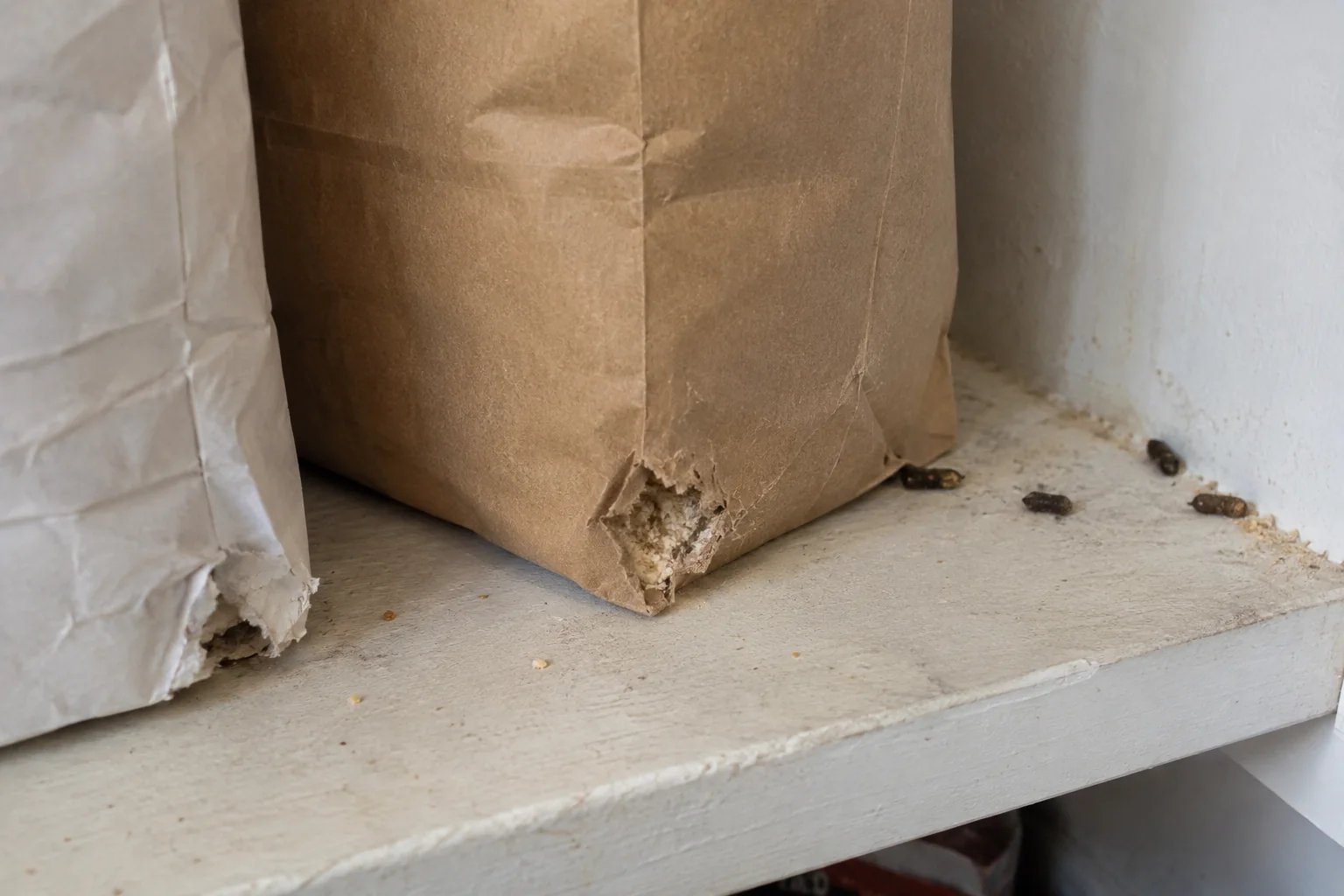
Pantries are attractive because food is concentrated.
Rats may damage:
- cardboard boxes
- grain bags
- pet-food bags
- paper sacks
- plastic packaging
Look for:
- heavy gnawing
- large droppings
- torn packaging
- rub marks
Discard food with direct rodent damage or contamination.
Do not simply wipe off a gnawed package and assume the food inside is safe.
Rats Under Kitchen Cabinets
Base cabinets can contain hidden voids.
Rats may move behind:
- toe-kicks
- cabinet bases
- utility panels
Look for evidence at:
- cabinet ends
- floor gaps
- pipe openings
- wall connections
A visible gap may connect to a larger hidden structural space.
Can Rats Live Inside Kitchen Walls?
Yes.
Rats can use wall voids as:
- travel routes
- shelter
- access between floors
Kitchen walls often contain:
- plumbing
- wiring
- cabinet penetrations
Ground-level walls may connect to basements or crawl spaces.
Upper walls may connect to attics.
If you hear heavier nighttime movement and find rat-sized droppings nearby, hidden wall activity becomes more plausible.
See Rats in Walls: Signs, Entry Points & What to Do.
Do Rats Nest in Kitchens?
They can, but a kitchen sighting does not prove the nest is in the kitchen.
A rat nest may be located in:
- a wall void
- a basement
- a crawl space
- an attic
- a garage
- protected storage
- an exterior burrow
Possible nesting material includes:
- shredded paper
- cardboard
- fabric
- insulation
See Rat Nests: What They Look Like & Where to Find Them.
Norway Rats vs Roof Rats in a Kitchen
Both may enter kitchen areas.
The broader activity pattern is more useful than the room itself.
Norway Rat Pattern
More strongly associated with:
- ground-level routes
- basements
- crawl spaces
- foundations
- exterior burrows
- lower utility penetrations
Roof Rat Pattern
More strongly associated with:
- attics
- rafters
- upper walls
- roofline entry
- elevated storage
These are tendencies, not absolute rules.
A kitchen sighting alone cannot identify the species.
See Roof Rat vs Norway Rat: How to Tell Them Apart.
Rat Droppings in the Kitchen
Rat droppings are substantially larger than typical mouse droppings.
Common kitchen locations include:
- cabinet corners
- pantry areas
- under the sink
- behind appliances
- wall edges
Droppings can help confirm a larger rodent is active.
Do not identify the exact rat species from droppings alone.
See Rat Droppings: What They Look Like & What They Mean.
Rat Droppings in a Kitchen Drawer
Droppings in a drawer indicate that a rodent accessed the cabinet or drawer system.
Remove:
- contaminated food
- contaminated disposable materials
Inspect:
- cabinet cavities
- back panels
- nearby openings
Do not dry sweep or vacuum fresh droppings.
Use appropriate wet-cleanup methods.
Rat Urine Smell in the Kitchen
Repeated rat activity can create a strong musky or urine-like odor.
The smell may become noticeable:
- in closed cabinets
- behind appliances
- near nests
- in porous materials
Odor alone cannot prove rats.
Compare it with:
- droppings
- gnawing
- tracks
- sightings
See Rat Urine Smell: What It Smells Like & What It Means.
Rat Gnaw Marks in the Kitchen
Rats may gnaw:
- heavy food packaging
- cardboard
- plastic
- wood edges
- door seals
- utility openings
- wire insulation
Rat damage is generally larger and heavier than mouse gnawing.
See Rat Gnaw Marks: How to Identify Rodent Damage.
Rat Tracks in the Kitchen
Rat tracks may appear in:
- dusty cabinet voids
- pantry edges
- behind appliances
- low-disturbance wall routes
They are generally larger than mouse tracks.
One rat can create many tracks.
See Rat Tracks: What They Look Like & Where to Find Them.
Rub Marks Around Kitchen Routes
Rats repeatedly moving along the same edge can leave dark greasy-looking marks.
Possible locations include:
- wall corners
- cabinet edges
- pipes
- entry gaps
Do not identify rats from a dark smudge alone.
Ordinary dirt and grease can look similar.
Rub marks become more meaningful when combined with rat droppings or tracks.
Scratching or Thumping Behind Kitchen Walls
Rat movement can produce:
- scratching
- heavier scurrying
- gnawing
- occasional thumps
But sound alone is not diagnostic.
Mice, squirrels, plumbing, and other sources can create wall noises.
See Scratching in Walls at Night: Could It Be Mice or Rats?.
Could Kitchen Droppings Be From Mice?
Yes.
Mouse droppings are much smaller than rat droppings.
If the evidence is small and delicate, compare it carefully.
See Mouse vs Rat Droppings: How to Tell the Difference and Rat vs Mouse: How to Tell the Difference.
Are Rats in the Kitchen Dangerous?
The main practical concern is contamination and damage.
Rat activity can affect:
- food
- cabinets
- counters
- drawers
- stored materials
- wiring
- packaging
Do not directly handle:
- droppings
- urine
- nesting material
- contaminated food
Treat food and food-contact areas cautiously.
What Food Should You Throw Away?
Discard food with obvious rodent contamination or direct package damage.
This may include packaging that is:
- gnawed
- punctured
- soiled
- contaminated by droppings or urine
Do not consume food from a package that has been penetrated by rodents.
For intact washable containers, clean the exterior appropriately if contamination occurred nearby.
How to Clean Rat Droppings in the Kitchen Safely
Use wet-cleanup methods.
A practical sequence is:
- keep children and pets away
- wear suitable gloves
- wet droppings and contaminated surfaces with an appropriate disinfecting solution
- allow the product’s required contact time
- wipe or collect the waste
- bag waste appropriately
- clean the surrounding hard surface
- wash hands after removing gloves
Do not dry sweep or vacuum fresh rat droppings or nesting material before wet cleanup.
See the cleanup section and rodent safety section.
How to Clean a Kitchen Cabinet After Rat Activity
Remove:
- contaminated food
- contaminated disposable liners
- heavily soiled disposable material
Then:
- wet-clean hard surfaces
- follow disinfectant label instructions
- clean corners and shelf edges
- allow surfaces to dry
Porous cabinet material that is heavily contaminated may be difficult to clean completely.
Do not mix cleaning chemicals unless product labels specifically allow it.
How to Clean Behind Appliances
If an appliance can be moved safely:
- follow manufacturer and safety requirements
- protect electrical, gas, and water connections
- wet-clean contamination
- inspect the wall and floor route
If moving the appliance could disturb utilities, use appropriate professional help.
What to Do Right After Seeing a Rat in the Kitchen
A practical response is:
- note where the rat appeared
- note where it disappeared
- inspect nearby walls and cabinet edges
- check for rat-sized droppings
- inspect food packages
- look for gnaw marks and rub marks
- inspect plumbing and utility gaps
- place rat-sized traps on confirmed routes
- remove accessible food
- inspect connected basement, garage, crawl-space, attic, or exterior routes
Do not rely only on the sighting.
Remove Accessible Food
Store food in sturdy containers with secure lids.
Pay particular attention to:
- grains
- cereals
- pet food
- bird seed
- snacks
- bulk dry food
Clean:
- crumbs
- grease
- spilled food
Sanitation reduces attraction, but it does not replace exclusion.
Remove Easy Water Sources
Correct avoidable water sources where practical.
Examples include:
- leaking sink plumbing
- drips
- standing water
- persistent appliance leaks
Do not attempt plumbing work beyond your skill level.
Where Should You Put Rat Traps in a Kitchen?
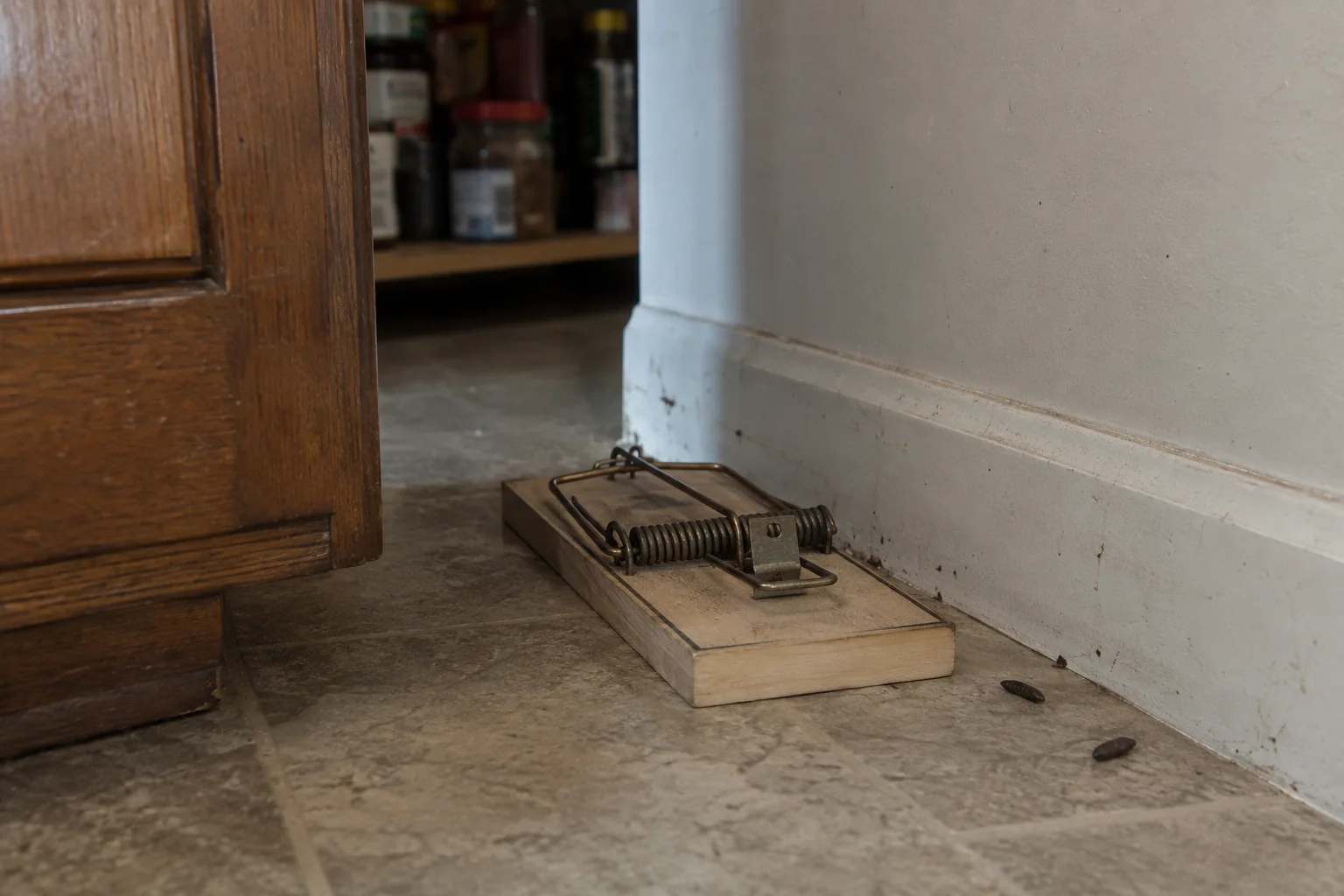
Place traps on confirmed rat travel routes.
Potential locations include:
- along wall edges
- behind accessible appliances
- near pantry routes
- near lower cabinet routes
- near an active utility gap
Use traps designed for rats.
Rat traps are larger and more powerful than mouse traps.
Keep them inaccessible to children and pets.
See Rat Traps: Types, Placement & How to Use Them and Best Rat Traps: Which Type Works Best & How to Choose.
How Should a Rat Trap Be Positioned?
Trap placement should match the confirmed route.
Rats often travel along:
- walls
- cabinet edges
- protected structural lines
Avoid placing a rat trap randomly in open floor space if evidence is concentrated along a wall.
Follow the trap manufacturer’s instructions.
Should You Put Poison in the Kitchen?
Do not casually place rodenticide around food-preparation areas.
Rodenticides must be used according to:
- the product label
- applicable placement requirements
- child and pet safety requirements
A poisoned rat may also die in an inaccessible wall or void.
For indoor kitchen activity, monitored trapping plus exclusion is often easier to evaluate.
Find the Entry Point
Once the active route is known, inspect where it connects to the structure.
Ground-Level Routes
Inspect:
- foundation gaps
- garage-door gaps
- crawl-space openings
- lower utility penetrations
- basement connections
Elevated Routes
Inspect:
- upper walls
- attic connections
- soffits
- roofline openings
See How Rats Get Into Your House.
Should You Seal the Kitchen Gap Immediately?
Not always.
If rats remain inside and the opening is the only active route, immediate sealing may trap them.
That can lead to:
- movement into another cabinet or room
- heavier gnawing
- attempts to create another exit
- odor if a rat dies in an inaccessible void
Coordinate trapping and exclusion.
See Rodent Exclusion: How to Keep Rats & Mice Out.
How to Seal Rat Entry Points Around a Kitchen
The correct repair depends on the construction.
Durable exclusion may involve:
- metal mesh
- flashing
- mortar
- rodent-resistant backing plus suitable sealant
- replacement trim
- replacement door seals
Do not block required:
- drainage
- ventilation
- appliance exhaust
Do not place materials around hot, electrical, or gas components unless they are suitable for that application.
Check Beyond the Kitchen
A kitchen may be only one part of the route.
Inspect connected areas such as:
- garage
- basement
- crawl space
- attic
- pantry
- utility room
- exterior foundation
These areas may reveal the actual entry point or nest.
How to Know Whether the Kitchen Rat Problem Is Improving
Monitor for:
- new droppings
- trap activity
- new gnawing
- rub marks
- additional sightings
- recurring odor
Improvement means fresh evidence declines and eventually stops.
Do not use one quiet night as proof that all rats are gone.
When to Call a Professional
Professional rat control may make sense when:
- rats are seen repeatedly
- droppings return after cleanup
- several kitchen areas show activity
- rats are inside walls
- active burrows are near the building
- attic or crawl-space routes are involved
- appliances or utilities block inspection
- trapping does not reduce activity
- the entry point cannot be found
- exclusion work is difficult
See Rat Exterminator: What to Expect & When to Call One.
Rats in the Kitchen: The Bottom Line
Rats enter kitchens because kitchens can provide:
- food
- water
- shelter
- protected routes
Useful evidence includes:
- rat-sized droppings
- heavy gnaw marks
- grease or rub marks
- tracks
- nesting material
- urine odor
- scratching or heavier movement
- sightings
If you find rats in the kitchen:
- discard contaminated food
- wet-clean rodent waste safely
- remove accessible food and water
- identify the travel route
- place rat-sized traps on that route
- inspect ground-level and elevated entry paths
- coordinate trapping with exclusion
- monitor for fresh signs
The long-term solution is not simply cleaning the kitchen.
It is removing active rats and closing the route that allowed them into the structure.
Continue with our signs of rats guide, rat droppings guide, rat gnaw marks guide, rat tracks guide, rat nest guide, Norway rat guide, roof rat guide, how to get rid of rats, how rats get into a house, or rodent exclusion guide.
For the broader overview, return to [Rats & Mice in the Home](/).