How Small a Hole Can a Mouse Fit Through?
A mouse can fit through a surprisingly small opening. For home inspection and exclusion, a practical rule is to treat gaps around 1/4 inch — about 6 millimeters — and larger as potentially accessible to a house mouse.
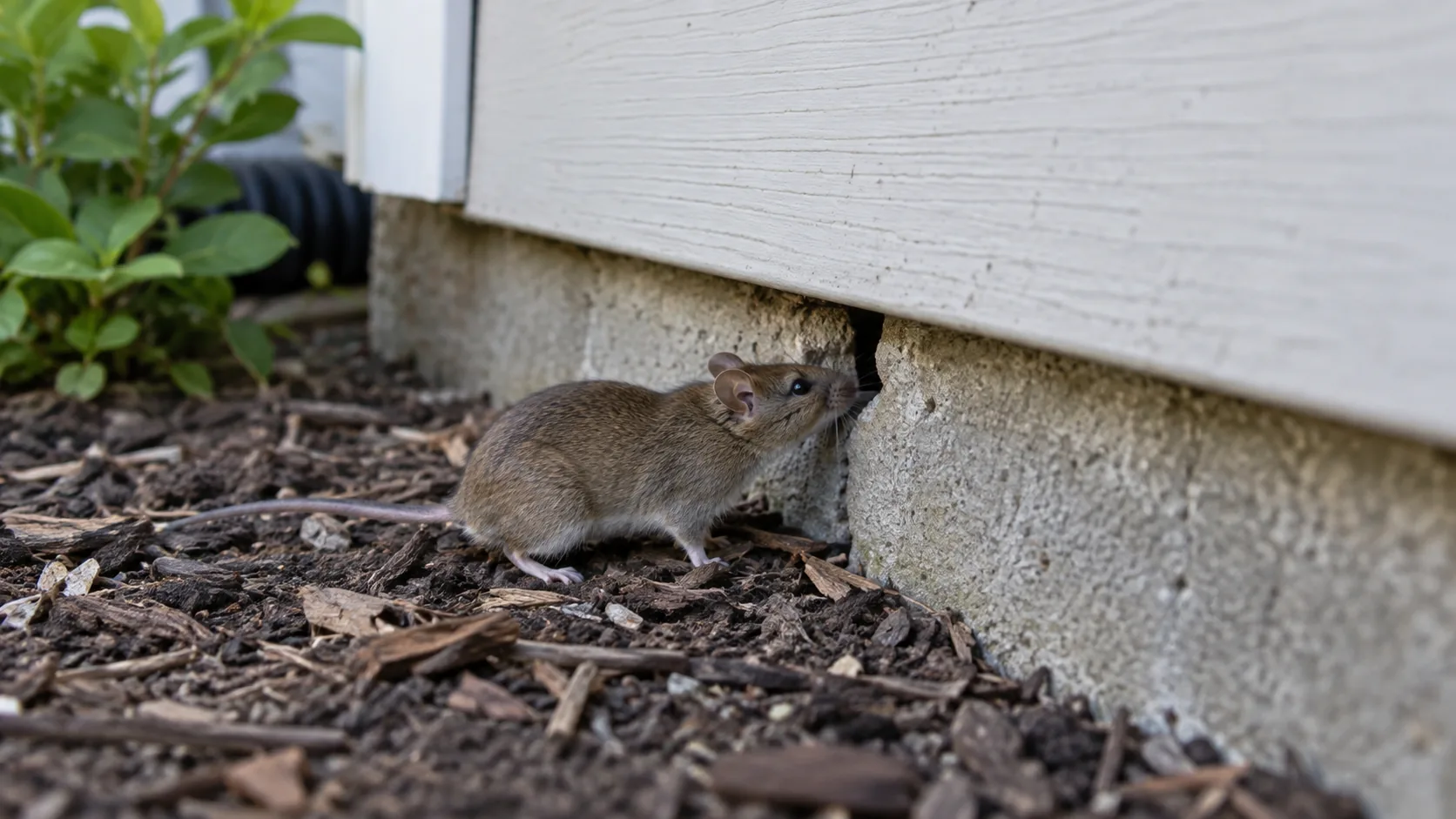
A mouse can fit through a surprisingly small opening.
For home inspection and exclusion, a practical rule is to treat gaps around 1/4 inch — about 6 millimeters — and larger as potentially accessible to a house mouse.
That does not mean every mouse can pass through every 1/4-inch opening.
Whether a mouse can squeeze through depends on:
- the mouse’s size
- the shape of the opening
- the narrowest dimension
- whether the edges flex
- whether the opening continues into usable space
- whether the mouse can gnaw the edge larger
The important homeowner takeaway is simple:
If you are inspecting a house for mouse entry points, do not ignore a gap just because it looks too small.
A pencil-width opening can be worth checking, especially when fresh mouse evidence appears nearby.
Can a Mouse Really Fit Through a 1/4-Inch Hole?
Yes, openings around 1/4 inch are commonly used as the practical inspection threshold for house mice.
Think of 1/4 inch as a prevention rule rather than a precise biological limit.
Some openings that measure roughly 1/4 inch may be:
- too shallow
- too irregular
- blocked behind the surface
- difficult for a particular mouse to use
Other openings may become easier to use because:
- one edge flexes
- the opening widens farther inside
- the mouse can gnaw a soft edge
- the gap is slightly larger than it first appears
That is why exclusion work should consider both measurement and surrounding evidence.
How Big Is 1/4 Inch?
One-quarter inch is about:
- 0.25 inch
- 6.35 millimeters
For a quick visual reference, it is roughly the diameter of many ordinary pencils.
A ruler or tape measure is more reliable than estimating by eye.
Do not force tools into:
- electrical equipment
- gas components
- moving door hardware
- HVAC equipment
just to measure a gap.
Why Can Mice Fit Through Such Small Openings?
Mice have:
- small bodies
- flexible joints
- compact skeletal structure
- strong climbing ability
- strong motivation to reach shelter and food
They can orient their bodies to pass through narrow spaces.
But the common statement that a mouse can “flatten itself completely” is misleading.
A mouse still needs enough room for its head, chest, and body to pass through the opening.
The gap’s shape and the mouse’s size matter.
Is the Skull the Limiting Factor?
The head is an important limiting part of the body, but a simple “if the skull fits, the whole mouse fits” rule is an oversimplification.
The animal still needs:
- enough body clearance
- usable space beyond the opening
- traction to move through
- no rigid obstruction blocking the chest or hips
For homeowners, measuring the opening and checking for mouse evidence is more useful than trying to predict anatomy from the outside.
Can Young Mice Fit Through Smaller Gaps?
Smaller or younger mice may be able to use openings that larger adults cannot use as easily.
That is one reason exclusion should not be based only on the size of the largest mouse you have seen.
If a gap is around the practical 1/4-inch threshold, treat it as worth inspecting.
Does the Shape of the Hole Matter?
Yes.
A round hole, vertical crack, horizontal gap, and irregular construction opening behave differently.
The most important dimension is often the narrowest usable dimension.
A long slot that is only 1/8 inch high is not the same as a slot that is 1/4 inch high.
Likewise, a circular opening that looks small from an angle may be wider than expected.
Can a Mouse Fit Through a Narrow Horizontal Gap?
Possibly, if the vertical clearance is large enough.
Common horizontal gaps include:
- under doors
- under garage-door seals
- beneath siding transitions
- under cabinet toe kicks
- at wall-floor junctions
The length of the gap does not matter as much as the actual clearance through it.
Can a Mouse Fit Through a Vertical Crack?
A vertical crack can also become a mouse route if it provides enough usable width.
Examples include gaps:
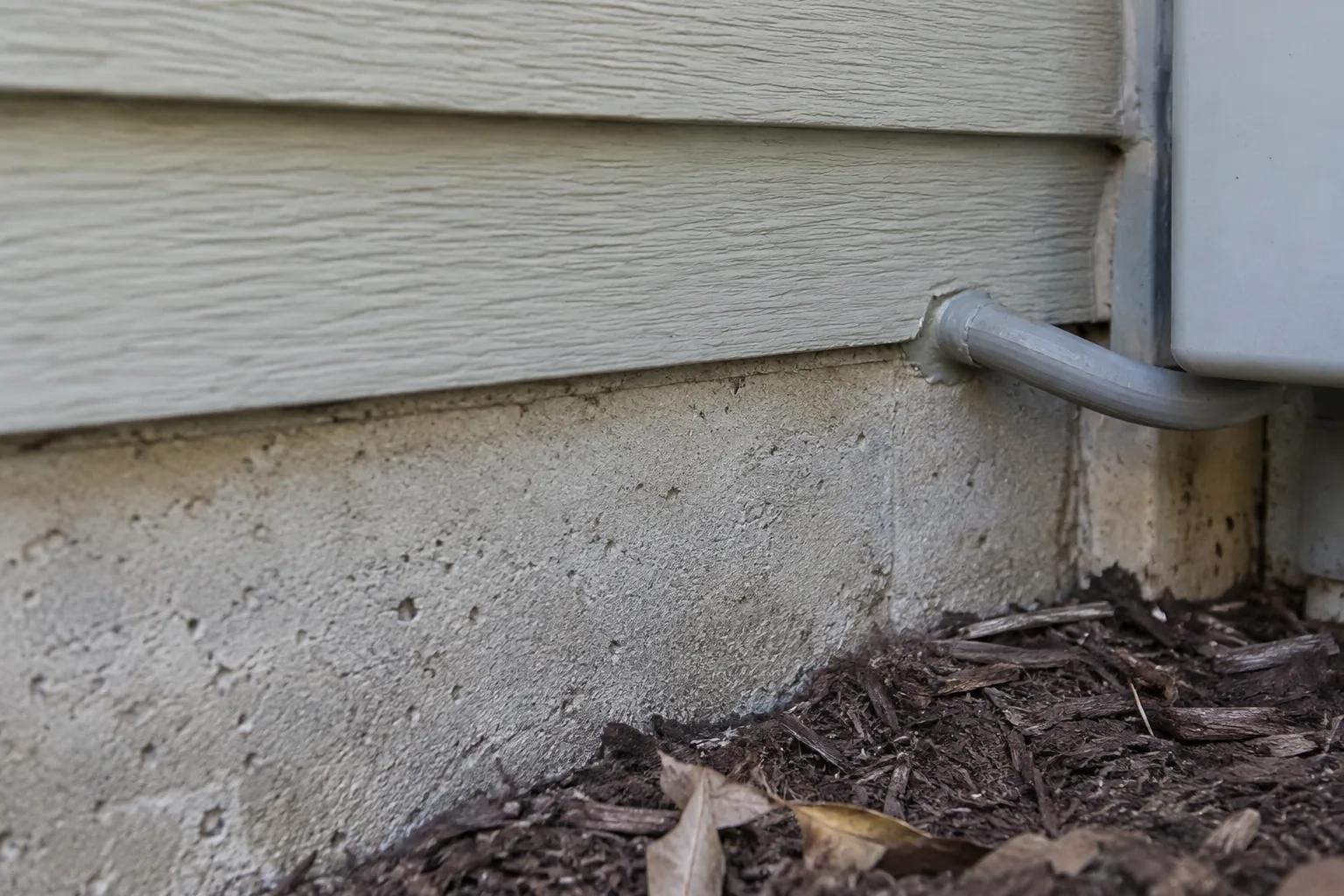
- beside door frames
- at siding corners
- beside utility penetrations
- between trim and masonry
Again, the narrowest usable dimension matters.
Can a Mouse Fit Under a Door?
Yes, if the gap below the door is large enough.
Pay special attention to:
- worn door sweeps
- damaged weatherstripping
- uneven thresholds
- lower door corners
A gap may be larger at one corner than across the center.
That corner can become the actual entry point.
Can Mice Get Under Garage Doors?
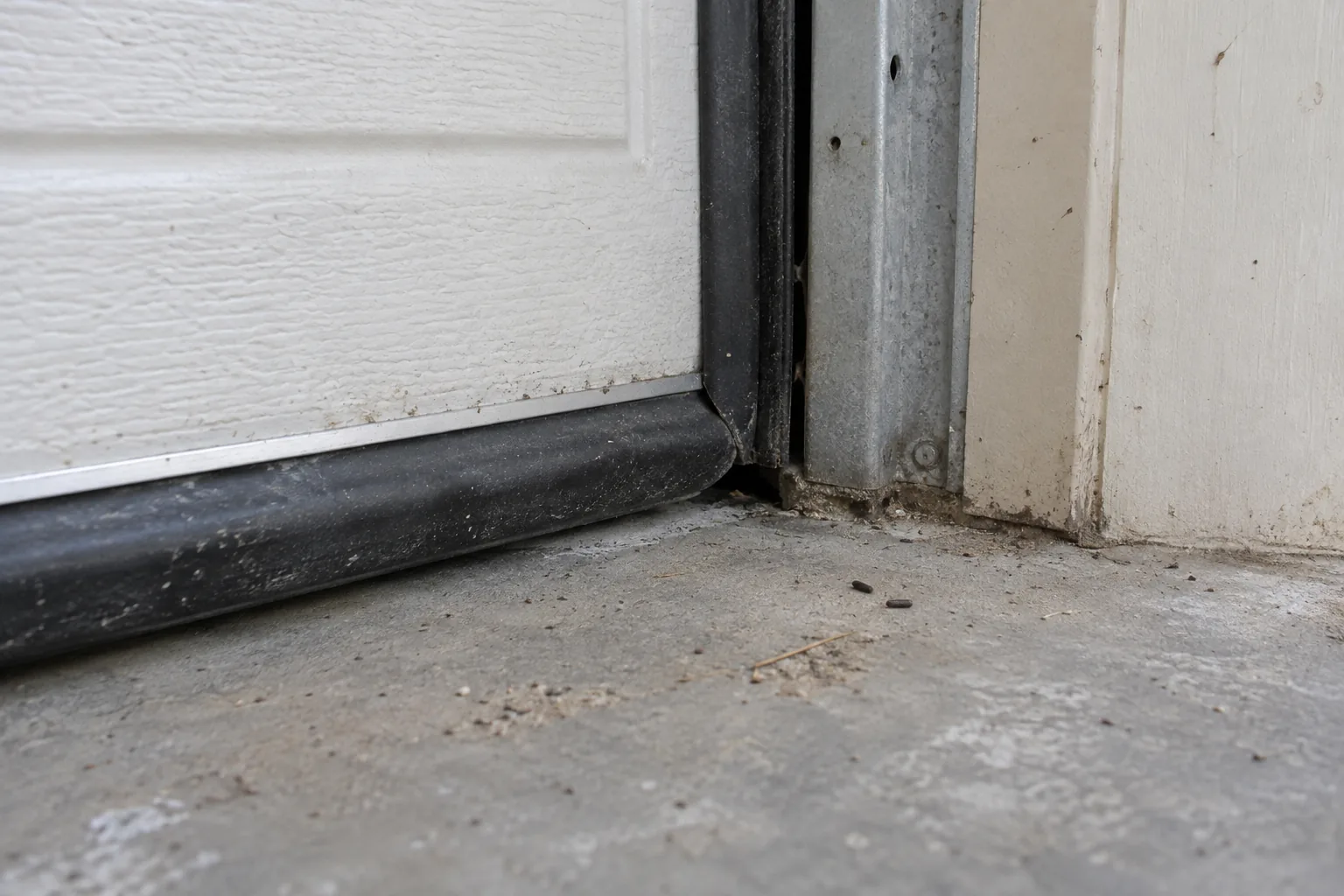
Yes.
Garage-door lower corners are common weak points because several materials meet there:
- bottom seal
- side seal
- jamb
- concrete slab
- door track area
A mouse-sized opening may develop even when the center of the bottom seal looks tight.
See Mice in the Garage: Entry Points, Nests & Control.
Can Mice Fit Around Pipes?
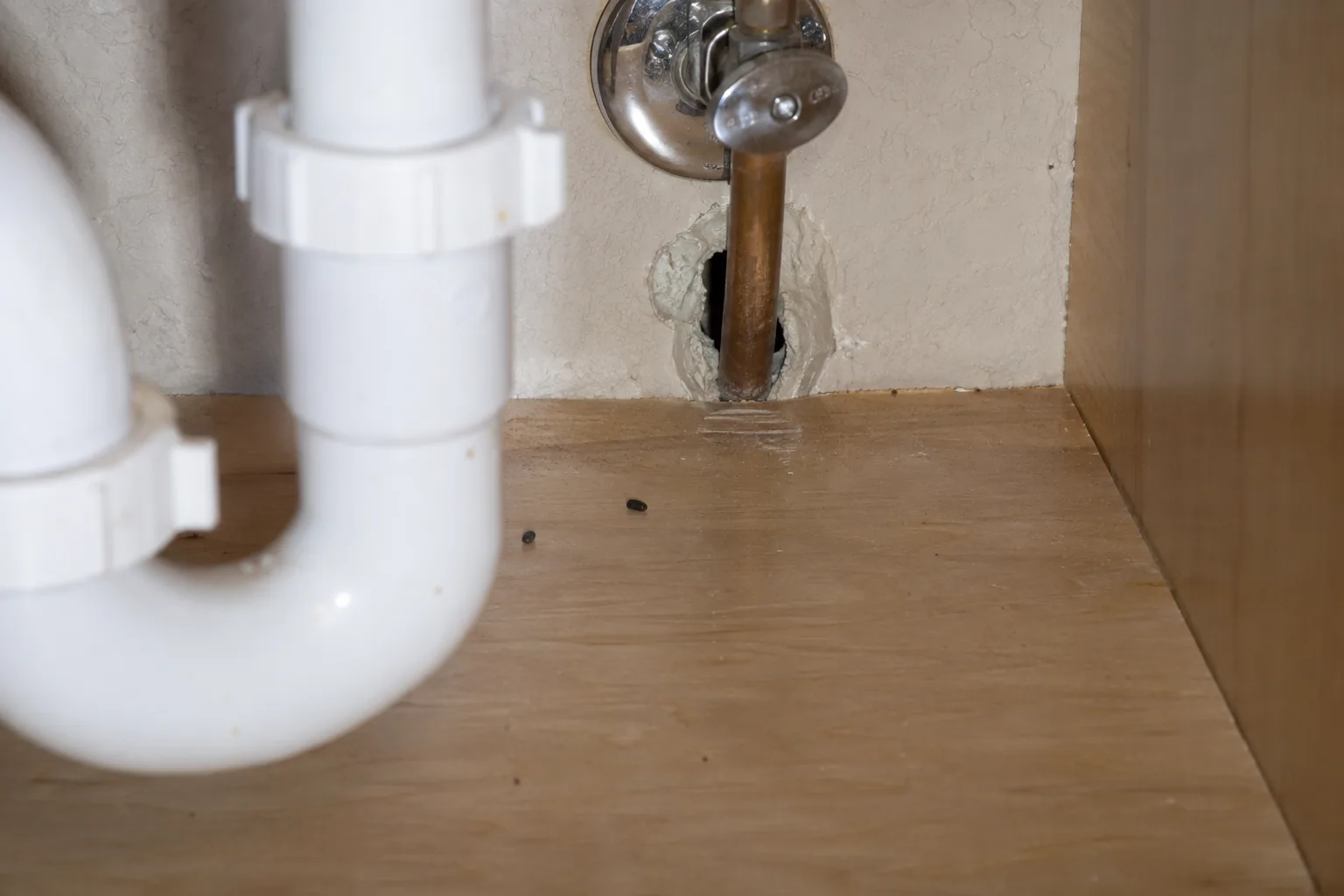
Yes, if the structural gap around the pipe is large enough.
Common examples include openings around:
- water lines
- drain pipes
- dishwasher lines
- refrigerator water lines
- condensate tubing
The pipe itself may be small, but the installer may have drilled a much larger opening through the wall or floor.
Can Mice Fit Around Electrical or Cable Penetrations?
They can use construction gaps around:
- conduit
- cable
- internet lines
- low-voltage wiring
Do not work inside electrical boxes or around exposed energized wiring unless qualified.
The repair target is usually the building gap around the penetration, not the electrical equipment.
Can Mice Fit Through Crawl-Space Vent Gaps?
Yes.
A crawl-space vent may allow entry when:
- screen mesh is torn
- the frame is loose
- a corner has separated
- a gap exists around the perimeter
Do not block the entire vent if it is required for ventilation.
Repair the damaged protective barrier while preserving airflow.
See Mice in the Crawl Space: Signs & Removal.
Can Mice Fit Through Siding Gaps?
Sometimes.
Siding systems contain many edges that look open from the outside.
Not all of them lead into the house.
A siding gap matters more when it connects to:
- damaged sheathing
- framing
- a wall cavity
- an unsealed utility penetration
See Mouse Entry Points: Where to Inspect Your Home for the full inspection route.
Can Mice Fit Through Roofline and Soffit Gaps?
Yes.
Mice can reach upper-level openings by climbing:
- rough walls
- pipes
- utility routes
- vegetation
- connected structures
Small gaps at:
- soffits
- fascia
- roof-to-wall transitions
- attic vents
can lead into attic cavities.
See Mice in the Attic: Signs, Damage & Removal.
Can Mice Make a Small Hole Bigger?
Yes.
Mice can gnaw many softer materials.
They may enlarge an opening in:
- wood
- plastic
- soft sealant
- foam
- damaged trim
- cabinet material
This means a gap slightly smaller than the practical threshold may still become usable if the edge can be gnawed.
See Mouse Gnaw Marks: How to Identify Rodent Damage.
Can Mice Chew Through Metal?
Thin or weak metal may be damaged under some conditions, but intact durable metal barriers are much more resistant than:
- foam
- soft plastic
- rubber
- wood
- soft sealant
The goal of exclusion is not simply to fill space.
It is to use a repair appropriate for the building surface and the opening.
Can Mice Chew Through Concrete?
Mice do not normally create a new route through sound structural concrete.
They are more likely to exploit:
- cracks
- damaged edges
- construction joints
- gaps around pipes
- deteriorated mortar
A defect in concrete or masonry may require a proper building repair rather than a soft filler.
Can Mice Fit Through a Hole Smaller Than 1/4 Inch?
A rigid opening clearly smaller than 1/4 inch is generally less concerning for an adult house mouse.
But do not rely on a single rough measurement if:
- the edge flexes
- the opening widens behind the surface
- the material can be gnawed
- the gap is irregular
The practical exclusion approach is to inspect and repair openings around the threshold rather than trying to find the exact minimum size for one individual mouse.
Is a 1/4-Inch Gap Always an Active Mouse Entry Point?
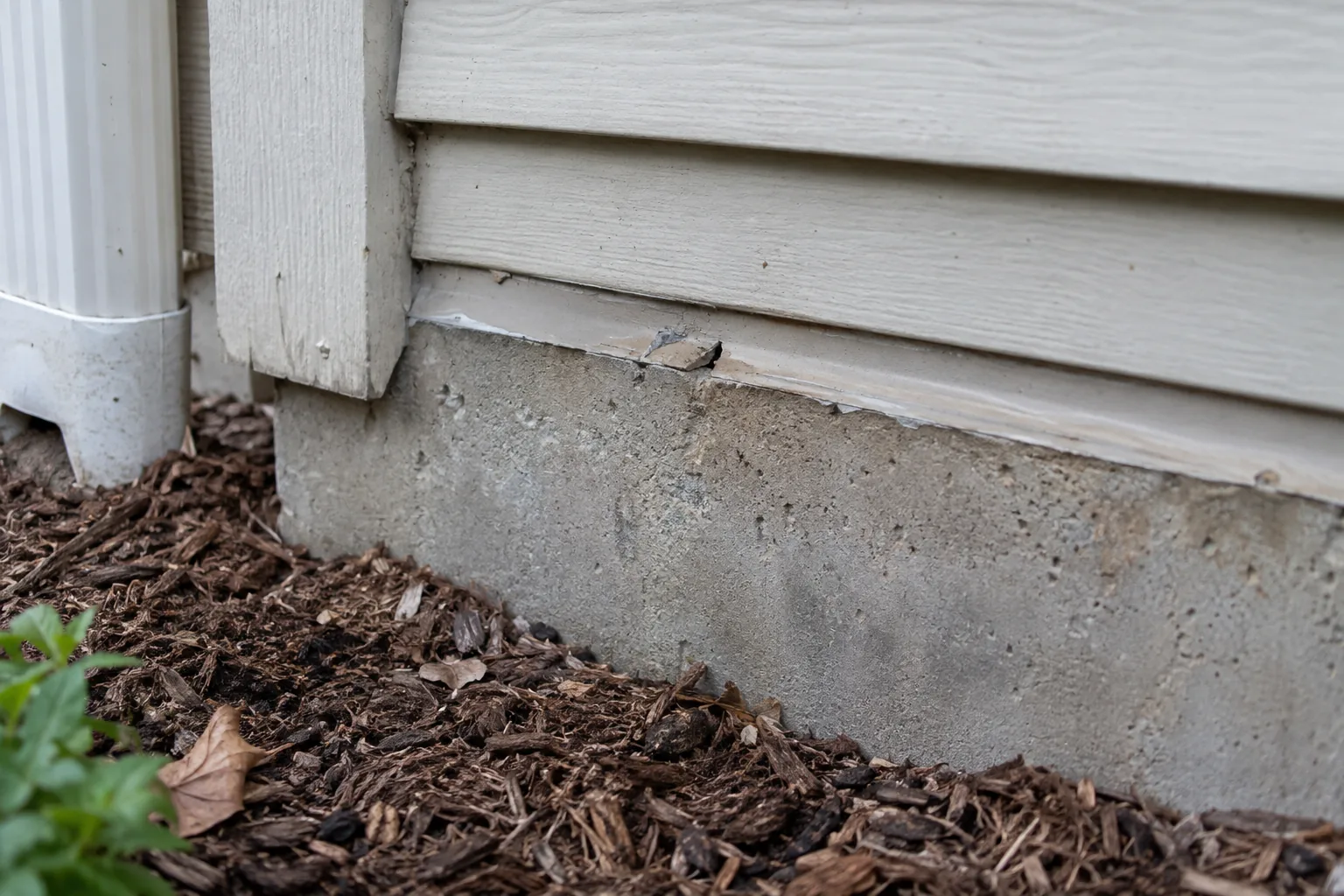
No.
A gap may be:
- unused
- blocked farther inside
- unrelated to the current mouse route
- too exposed for the mouse to prefer
The best way to prioritize gaps is to look for fresh evidence nearby.
What Signs Show a Small Gap May Be Active?
Look for:
- mouse droppings
- fine gnaw marks
- small tracks
- dirt or rub marks
- disturbed insulation
- repeated sightings
A gap with several of these signs deserves more attention than a clean cosmetic crack.
Mouse Droppings Near a Gap
Mouse droppings may appear along:
- foundation edges
- garage walls
- cabinets
- utility penetrations
- wall-floor junctions
Do not use the number of droppings to estimate how many mice are present.
See Mouse Droppings: What They Look Like & What They Mean.
Mouse Tracks Near a Gap
Tracks can appear in:
- dust
- soft soil
- garage debris
- basement surfaces
- crawl-space surfaces
A track pattern that leads toward a visible gap can help confirm the route.
See Mouse Tracks: What They Look Like & Where to Find Them.
Gnawing Around a Gap
Fine tooth marks around:
- wood
- plastic
- sealant
- foam
may show that mice are maintaining or enlarging the opening.
Fresh gnawing can help distinguish an active route from an old construction defect.
How to Measure a Mouse-Sized Gap
Use a ruler or tape measure when the area is safely accessible.
Measure the narrowest usable dimension.
For a slot, measure the height or width that actually limits passage.
For an irregular opening, check whether part of the gap becomes wider behind the visible edge.
Do not:
- remove electrical covers
- disconnect plumbing
- open HVAC equipment
- climb onto an unsafe roof
- enter a dangerous crawl space
just to get a measurement.
Should You Use a Pencil as a Quick Reference?
A pencil can provide a rough visual comparison because many pencils are close to 1/4 inch in diameter.
But pencils vary.
Use an actual measuring tool when deciding whether a repair is needed.
The point of the comparison is simply to show how small a potentially usable mouse opening can look.
Where Are the Most Important Small Gaps to Check?
High-value inspection areas include:
- foundation-to-sill transitions
- utility penetrations
- exterior door corners
- garage-door corners
- crawl-space vents
- basement windows
- siding transitions
- cabinet pipe openings
- roofline and soffit gaps
For a room-by-room and exterior inspection sequence, see Mouse Entry Points: Where to Inspect Your Home.
Should You Seal a 1/4-Inch Gap Immediately?
If there is no evidence of active mice inside, repairing an unnecessary building gap can be reasonable.
But if mice are currently active indoors, do not automatically seal the only route they may be using.
A mouse trapped inside may:
- move to another room
- gnaw a new opening
- die in an inaccessible void
Coordinate trapping, monitoring, and exclusion.
See Rodent Exclusion: How to Keep Rats & Mice Out.
What Materials Work for Small Mouse Entry Gaps?
The repair depends on the building surface.
Durable approaches may involve:
- metal mesh
- flashing
- mortar
- rodent-resistant backing
- suitable sealant
- repaired weatherstripping
- repaired vent screening
Soft foam alone should not be treated as universally mouse-proof.
The repair should be physically durable and compatible with the surrounding construction.
What Should You Never Seal Shut?
Do not block:
- dryer exhaust
- HVAC supply or return airflow
- combustion air
- attic ventilation
- crawl-space ventilation that the building requires
- intentional drainage or weep openings
- plumbing drainage
- electrical service access
- moving door hardware
A mouse-proofing repair should preserve the building system’s intended function.
What About Weep Holes?
Some masonry wall systems intentionally use small openings for drainage or ventilation.
Do not permanently fill a designed weep hole just because it appears mouse-sized.
If pest resistance is needed, the solution must preserve drainage and the wall system’s intended function.
What About Dryer Vents?
Do not reduce or obstruct the dryer exhaust opening.
Lint accumulation creates a fire hazard.
Inspect for gaps around the exterior vent housing rather than placing improvised material inside the exhaust path.
What About HVAC Vents?
Do not put:
- mesh
- foam
- traps
- poison
- loose material
inside active supply or return airflow paths.
If mouse activity appears around a vent, inspect the structural gap around the duct boot or nearby wall cavity.
See Mice in Air Vents: How They Get There & What to Do.
How to Know Whether Sealing Worked
After repairs, monitor for:
- no new droppings
- no new tracks
- no fresh gnawing
- no trap activity
- no repeated sightings
One quiet night does not prove the route is closed.
Look for the absence of fresh evidence over time.
When to Call a Professional
Professional inspection or repair may make sense when:
- you cannot find the active gap
- mouse activity continues after obvious openings are repaired
- the gap involves roofing
- wiring is damaged
- plumbing is leaking
- HVAC equipment is involved
- masonry or structural repair is needed
- crawl-space access is unsafe
- several possible routes exist
A pest-control professional may help identify active mouse routes.
A qualified trade may be needed for the actual repair.
See Mouse Exterminator: What to Expect & When to Call One.
How Small a Hole Can a Mouse Fit Through? The Bottom Line
For practical home inspection, treat openings around 1/4 inch — about 6 millimeters — and larger as potentially mouse-accessible.
Remember:
- 1/4 inch is a practical rule of thumb, not an absolute biological limit
- gap shape matters
- the narrowest usable dimension matters
- young or smaller mice may use tighter openings
- flexible or gnawable edges can make a gap easier to use
- not every small opening is an active entry point
Prioritize gaps that also show:
- droppings
- tracks
- gnawing
- rub marks
- repeated mouse activity
Then coordinate trapping or removal with durable exclusion.
Continue with our mouse entry points guide, how mice get into a house guide, rodent exclusion guide, mouse droppings guide, mouse tracks guide, mouse gnaw marks guide, or how to get rid of mice.
For the broader overview, return to [Rats & Mice in the Home](/).