Rat Entry Points: Where to Inspect Your Home
Rats usually enter homes through existing building openings rather than chewing a brand-new hole through a solid wall. A useful inspection connects possible rat entry points with fresh evidence such as rat-sized droppings, larger tracks, greasy rub marks, heavier gnawing, worn travel routes, repeated sightings, or fresh soil around a suspected burrow.
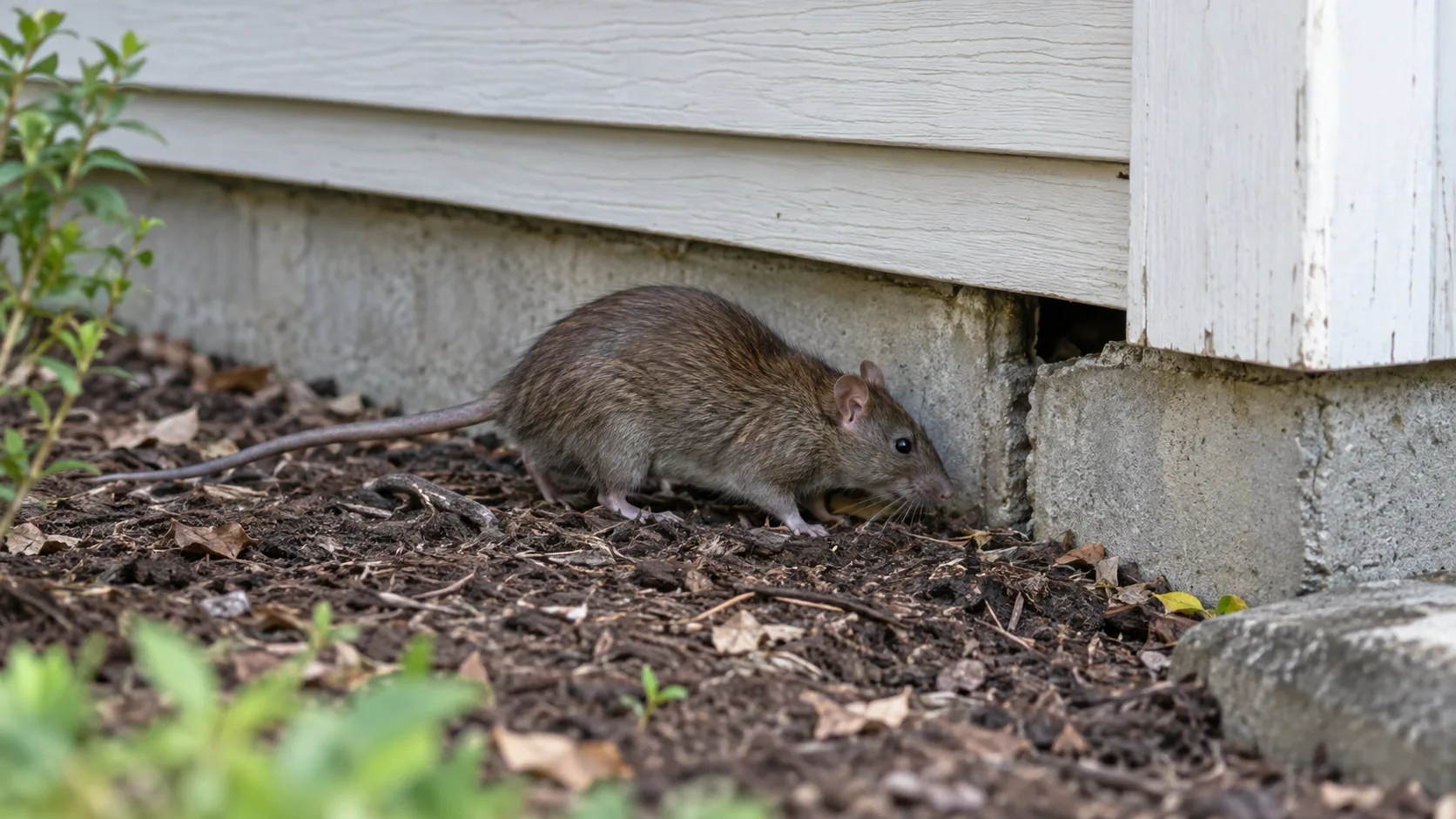
Rats usually enter homes through existing building openings rather than chewing a brand-new hole through a solid wall.
Common entry routes include:
- foundation gaps
- crawl-space openings
- damaged garage-door seals
- exterior door gaps
- utility penetrations
- basement openings
- damaged siding or trim
- soffit and roofline gaps
- openings around vents or service lines
A house may have several openings large enough for a rat.
That does not mean every opening is active.
The most useful inspection connects a possible entry point with fresh rat evidence such as:
- rat-sized droppings
- larger tracks
- greasy rub marks
- heavier gnawing
- worn travel routes
- repeated sightings
- fresh soil around a suspected burrow
The goal is to identify which openings deserve priority, which can be repaired safely, and which should be coordinated with trapping or professional control before final sealing.
This guide walks through the main rat entry points from the foundation to the roofline.
How Small an Opening Can a Rat Use?
Rats need a larger opening than mice.
As a practical inspection rule, pay close attention to gaps around roughly 1/2 inch and larger, especially when the opening:
- leads into a wall or floor cavity
- follows a pipe or utility line
- sits along a foundation or garage edge
- shows fresh rat evidence nearby
Do not treat that size as a guarantee that an opening is active.
Body size, shape of the gap, surrounding construction, and the individual rat all matter.
The inspection priority should come from both the opening and the evidence around it.
Where Should You Start Looking for Rat Entry Points?
Start outside.
Walk the building perimeter slowly from ground level upward.
A practical order is:
- foundation and slab edges
- sill and lower-wall transitions
- utility penetrations
- exterior doors
- garage
- crawl-space or basement openings
- decks and porches
- siding and masonry transitions
- vents and exterior service openings
- soffits, fascia, attic vents, and roofline
Then compare those areas with where rat signs appear indoors.
See How Rats Get Into Your House for the broader route overview.
Rat Entry Points at the Foundation
Foundation areas deserve careful inspection because many rat routes begin close to ground level.
Look for:
- gaps where concrete meets wood framing
- openings where additions meet the original structure
- damaged masonry
- utility penetrations
- openings beside steps or porches
- crawl-space vent defects
- gaps hidden behind skirting
A surface crack is not automatically an entry route.
The opening must actually connect to a cavity the rat can use.
Foundation-to-Sill and Rim Gaps
The transition between foundation and framing may contain:
- missing material
- deteriorated trim
- irregular masonry
- gaps at corners
- damaged sill or rim-area coverings
These routes can lead into:
- crawl spaces
- basements
- wall cavities
- floor systems
Rat droppings, rub marks, or gnawing near the gap make the route more important.
Rat Burrows Beside the Foundation
Norway rats are strongly associated with ground-level burrowing.
A suspected rat burrow may appear near:
- foundation walls
- steps
- decks
- sheds
- retaining walls
- dense vegetation
Possible signs of active use include:
- smooth entry edges
- fresh soil
- a worn runway
- rat droppings
- repeated sightings
Not every hole is a rat burrow.
Do not flood, smoke, burn, gas, chemically treat, or blindly collapse a suspected burrow.
See Rats Under the House: Causes, Entry Points & Removal.
Can Rats Enter Beneath a Slab?
Rats generally do not move through solid concrete.
They may instead use:
- soil beside slab edges
- openings where utilities penetrate
- damaged transitions
- gaps where additions meet the slab
A burrow near a slab does not automatically mean the rat is beneath the entire foundation.
If soil movement appears to affect structural support or drainage, professional evaluation may be appropriate.
Gaps Around Exterior Plumbing
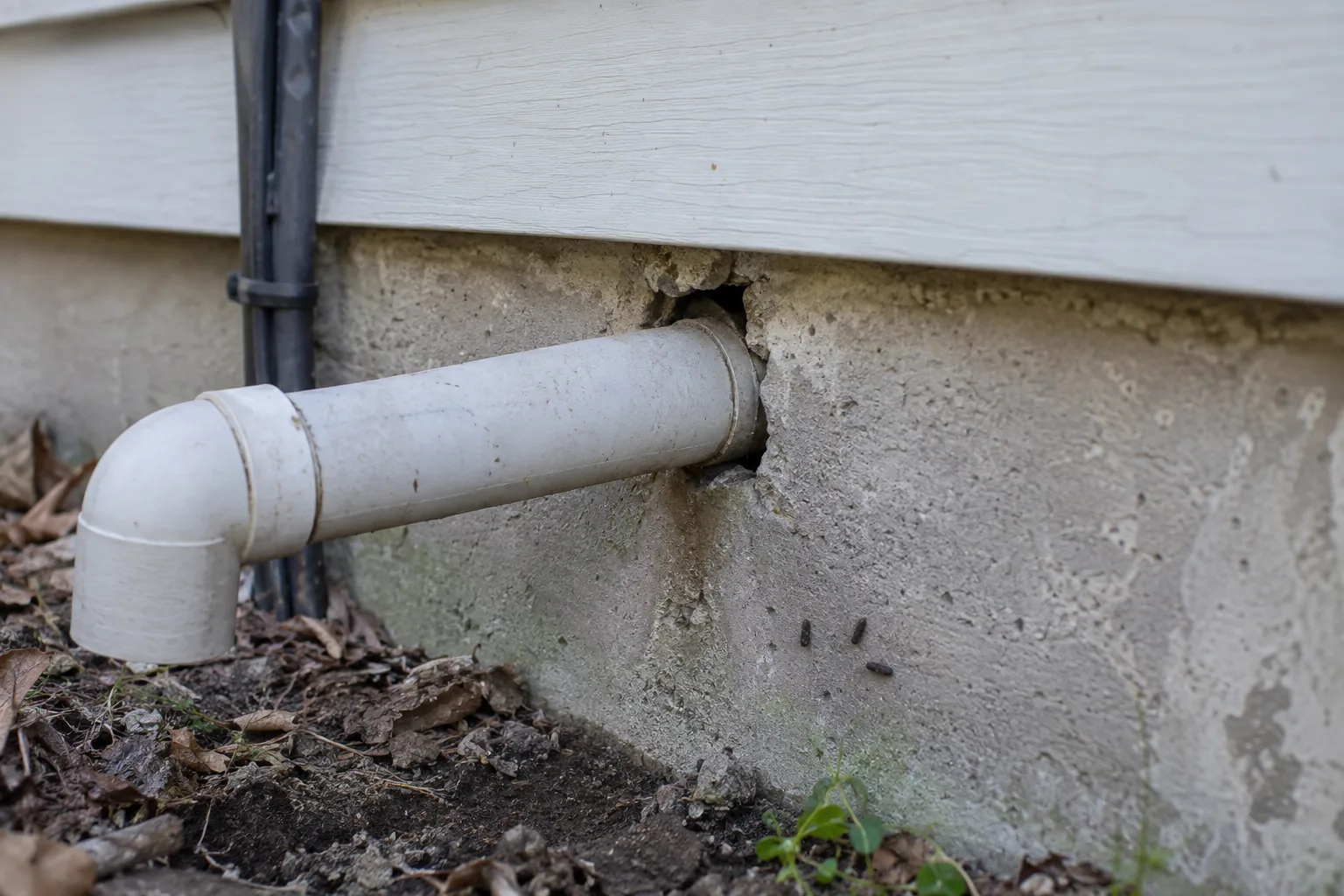
Pipes often pass through exterior walls and foundations.
Inspect around:
- water lines
- drain lines
- hose bibs
- condensate lines
- other plumbing penetrations
A pipe may be much smaller than the hole around it.
Do not:
- bend or strain the pipe
- cover shutoff access
- interfere with drainage
- hide a leaking connection
The repair should close the structural gap without compromising the plumbing system.
Gaps Around Electrical Conduit
Electrical penetrations can leave openings around:
- conduit
- service cables
- exterior boxes
- low-voltage wiring
Do not work inside electrical equipment or around exposed energized conductors unless qualified.
The rat route is often the construction gap around the electrical penetration.
If wiring appears gnawed or damaged, the electrical issue needs appropriate repair.
Cable and Communication Line Penetrations
Cable, fiber, telephone, and similar lines may enter through oversized wall openings.
Inspect whether the gap leads into:
- a wall cavity
- basement
- crawl space
- utility room
Small service lines should not require a large unsealed structural opening.
HVAC Line-Set Openings
Air-conditioning and heat-pump lines may pass through an exterior wall.
Inspect around:
- refrigerant lines
- condensate tubing
- control wiring
Do not:
- kink tubing
- crush insulation
- cover service fittings
- block condensate drainage
Close only the excess building gap while preserving HVAC operation and service access.
Dryer Vent Openings
Inspect the wall around the dryer vent hood.
Look for:
- a gap around the duct
- loose trim
- deteriorated mounting
- an opening beside the vent housing
Do not block the dryer exhaust.
Do not add improvised material inside the airflow path where lint can collect.
The focus is the structural perimeter around the vent, not the exhaust opening itself.
Exterior Exhaust and Intake Openings
Bathroom, kitchen, mechanical, or combustion-related openings may have gaps around their housings.
Do not block:
- required exhaust
- combustion air
- required intake
- HVAC airflow
If the structural perimeter has an opening, repair the building gap while preserving the system’s intended function.
Rat Entry Points Around Exterior Doors
Exterior doors may develop usable gaps around:
- lower corners
- thresholds
- frames
- damaged weatherstripping
- deteriorated trim
Rats are larger than mice, so a substantial door gap is usually more relevant than a hairline opening.
Inspect with the door fully closed.
How to Check a Door Sweep or Threshold
Look for:
- visible daylight
- torn sweep material
- missing weatherstripping
- an uneven threshold
- damaged lower corners
Repairs should reduce unnecessary openings without preventing:
- safe door operation
- egress
- fire-rated door function where applicable
Garage-Door Rat Entry Points
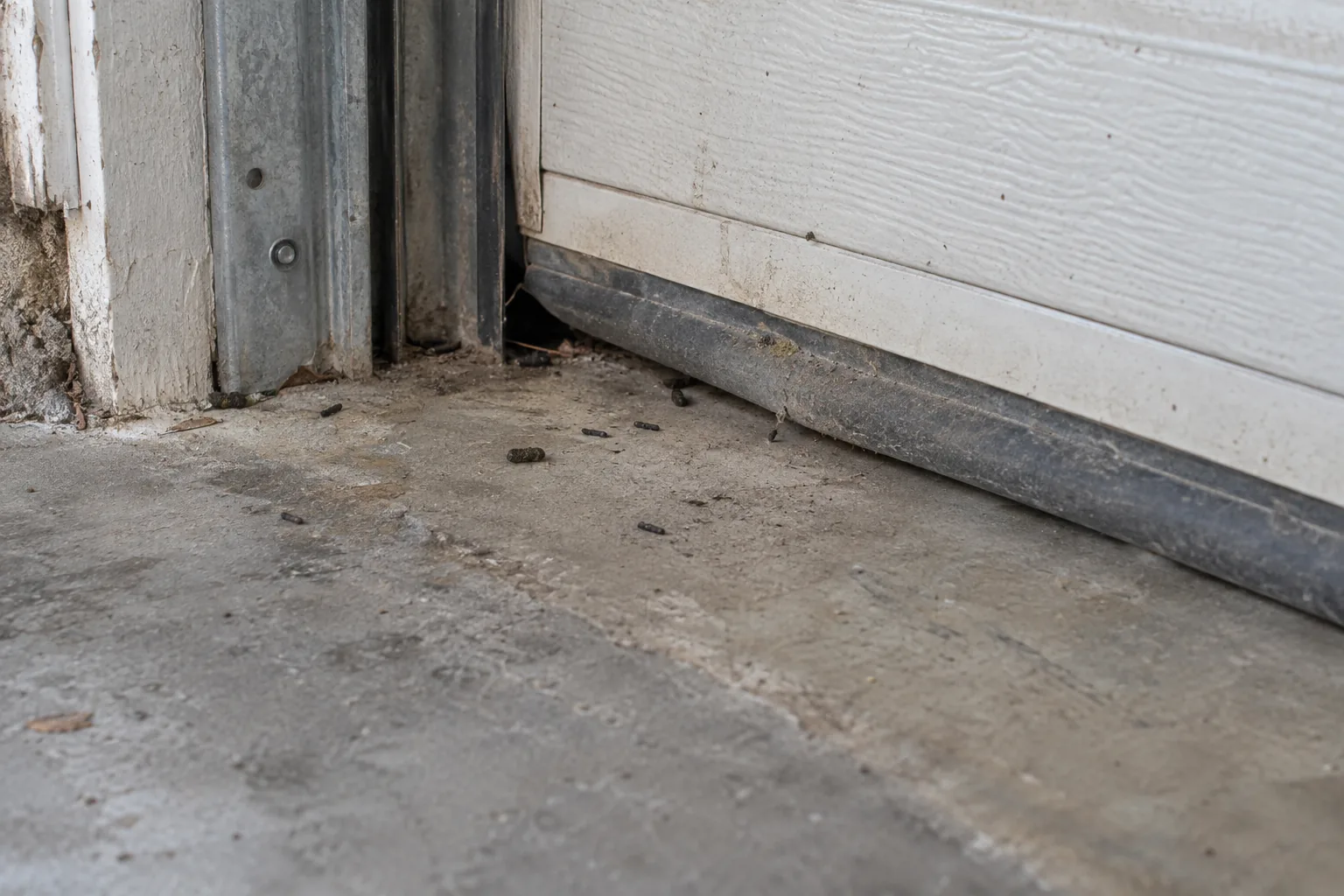
Garage doors are common weak points.
Inspect:
- bottom seals
- lower side seals
- door corners
- jamb transitions
- slab-to-frame edges
- damaged weatherstripping
Look for supporting evidence such as:
- rat droppings
- rub marks
- larger tracks
- gnawing
See Rats in the Garage: Entry Points, Nests & Control.
Attached Garage to House Routes
A rat may enter the garage first, then continue toward the house.
Inspect the shared wall for:
- utility penetrations
- plumbing gaps
- cable holes
- damaged trim
- floor-wall openings
Do not alter fire-rated garage-to-house assemblies without preserving their required function.
Permanent repairs may require appropriate materials and building knowledge.
Crawl-Space Vents
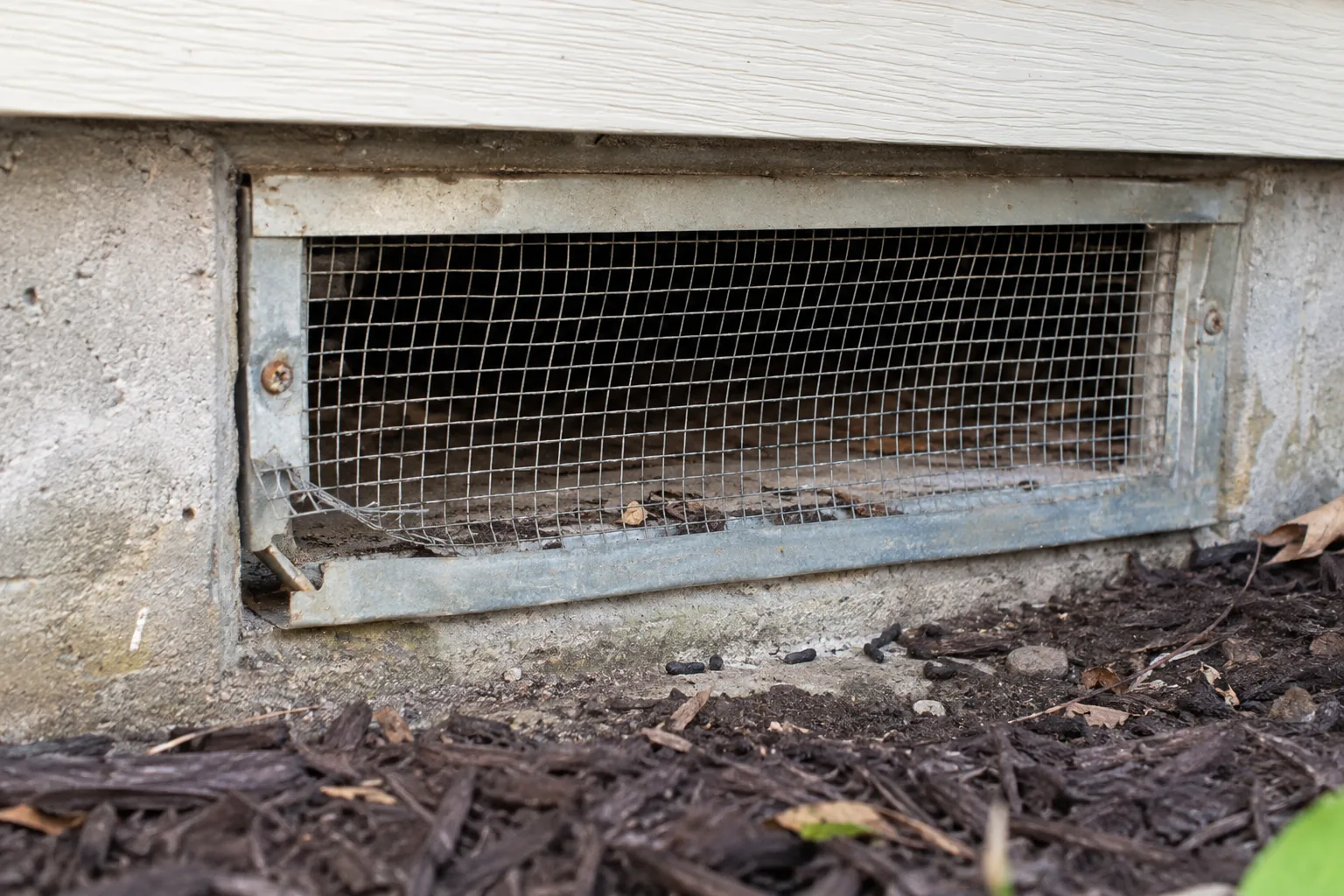
Crawl-space vents can become rat entry points when:
- protective screening is missing
- mesh is torn
- the frame is loose
- the perimeter has a larger gap
Do not simply block the whole vent.
Ventilation requirements depend on the building design and moisture-control strategy.
Repair the protective barrier or perimeter defect without defeating intended airflow.
See Rats in the Crawl Space: Signs & Removal.
Crawl-Space Access Doors
Inspect access doors for:
- damaged lower edges
- loose frames
- failed latches
- large bottom gaps
- gnawing
An access-door defect may give rats direct access to the under-floor area.
The door should remain functional for future inspection.
Basement Window Entry Points
Ground-level or below-grade windows can develop openings around:
- frames
- window wells
- damaged trim
- deteriorated sealant
- nearby utilities
Look for rat evidence in the same area.
See Rats in the Basement: Why They’re There & What to Do.
Basement Doors and Bulkhead Openings
Basement exterior doors may have:
- lower corner gaps
- worn thresholds
- damaged frames
- deteriorated weatherstripping
Bulkhead-style entries also deserve inspection around:
- door edges
- wall transitions
- nearby foundation gaps
Do not assume every damp or dirty lower-level opening is a rat route.
Look for physical rat evidence.
Gaps Around Siding and Trim
Siding may hide openings where:
- panels meet trim
- lower edges meet foundations
- corners are damaged
- utilities penetrate the wall
A visible siding gap is more important when it opens into:
- sheathing damage
- framing
- a wall cavity
Do not seal intentional drainage paths blindly.
Brick and Masonry Openings
Masonry buildings can have rat entry points around:
- utility penetrations
- damaged mortar
- transitions to wood framing
- additions
- basement openings
A masonry repair should preserve:
- drainage
- flashing
- structural function
Professional repair may be appropriate for larger defects.
Weep Holes and Drainage Openings
Some wall systems include intentional openings for moisture drainage or ventilation.
Do not permanently plug a designed weep or drainage opening simply because it appears large enough for a pest.
Any pest-resistant solution must preserve the opening’s original function.
Decks and Porches Can Hide Rat Entry Points
Decks and porches may conceal:
- foundation gaps
- burrows
- utility penetrations
- damaged lower-wall trim
- crawl-space openings
Inspect from safe perimeter positions when possible.
Do not crawl into a low, unstable, wet, contaminated, or electrically hazardous space.
See Rats Under a Deck: Signs, Burrows & What to Do.
Rat Entry Points Near the Roofline
Not all rat entry points are at ground level.
Roof rats are strongly associated with:
- trees
- fences
- upper walls
- soffits
- roof edges
- attic routes
Norway rats can also move upward through structures.
An upper-level opening does not identify species by itself.
See Roof Rat vs Norway Rat: How to Tell Them Apart.
Soffit Gaps
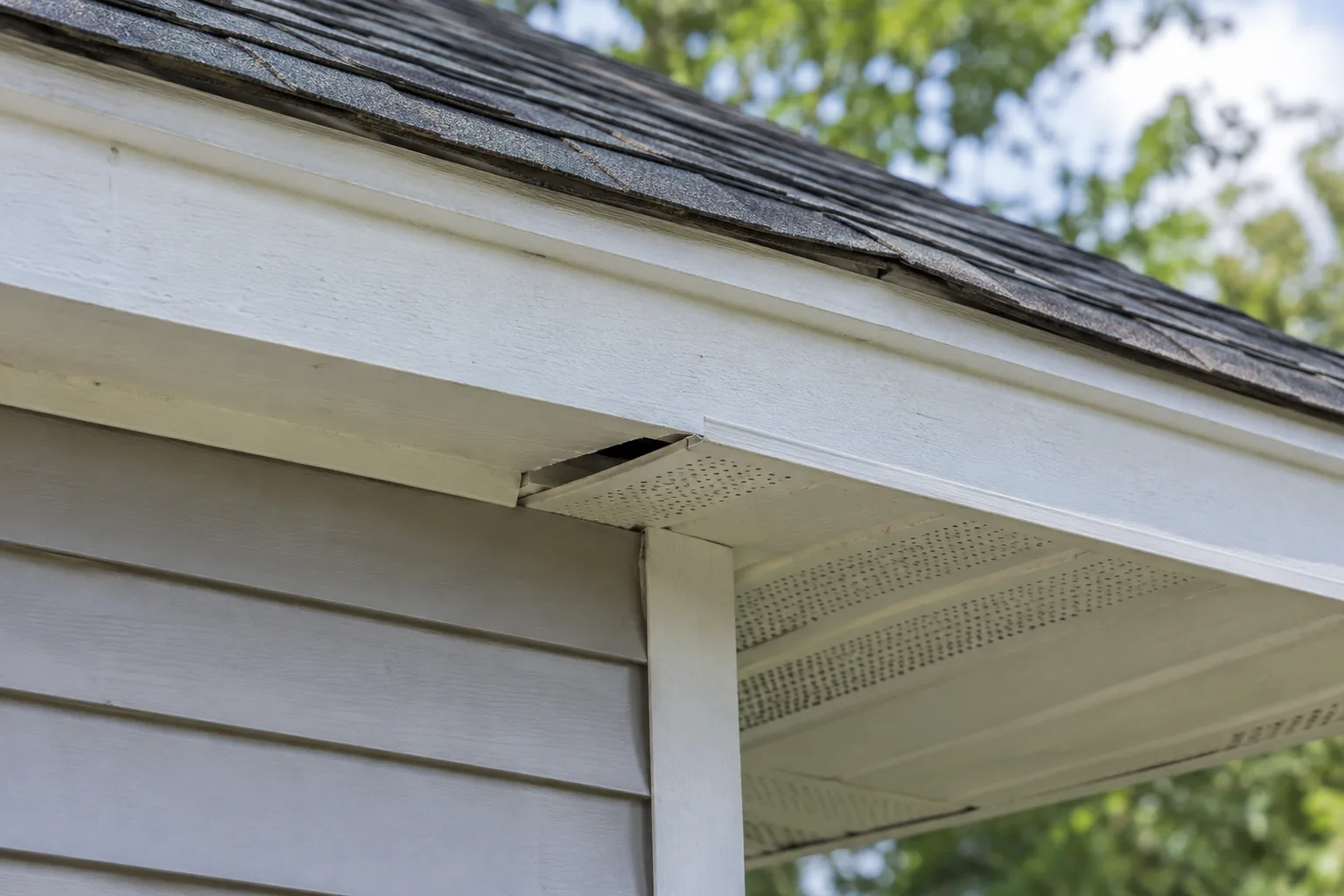
Inspect soffits for:
- loose panels
- damaged vent edges
- deteriorated trim
- gaps at transitions
A soffit gap becomes especially relevant when attic rat evidence appears nearby.
Do not work from an unstable ladder or unsafe roof position.
Use a safe ground-level view or professional help when needed.
Fascia and Roof-Edge Gaps
Look for:
- separated trim
- damaged fascia
- gaps at roof-to-wall transitions
- openings near eaves
Do not treat every shadow line as a hole.
A useful entry point should connect to a cavity.
Gable and Attic Vents
Attic vents should allow airflow while preventing animal entry.
Inspect for:
- missing screening
- torn screening
- loose frames
- damaged perimeter trim
Do not block required attic ventilation.
Repair the protective barrier while keeping the vent functional.
See Rats in the Attic: Signs, Damage & Removal.
Tree and Fence Routes Near the Roof
Trees, fences, and connected structures can help climbing rats reach upper building areas.
Inspect whether:
- branches contact or closely overhang the roof
- fence lines lead directly toward the building
- upper openings exist near those routes
The tree or fence itself is not the entry point.
The building opening is the entry point.
Can Rats Enter Through Air Vents?
Sometimes rat activity appears near an air register or duct route.
The actual structural route may be around:
- a duct boot
- a wall cavity
- a utility chase
- a damaged connection
Do not block supply or return airflow.
See Rats in Air Vents: How They Get There & What to Do.
Interior Rat Entry Points Under Sinks
Interior inspection can help connect an exterior route to the room where evidence appears.
Under-sink cabinets may reveal oversized openings around:
- drain pipes
- water lines
- dishwasher lines
Do not disconnect plumbing simply to investigate.
If the gap belongs to a shared building system, permanent repair may require management or a qualified trade.
Rat Entry Points Behind Appliances
Large appliances may hide:
- wall-floor gaps
- utility penetrations
- cabinet voids
- baseboard defects
Do not move a heavy appliance alone if it cannot be moved safely.
Do not remove electrical or mechanical appliance panels unless qualified.
How to Tell Whether a Rat Entry Point Is Active
A possible opening becomes more convincing when fresh rat signs appear nearby.
Look for:
- rat-sized droppings
- larger tracks
- greasy rub marks
- heavier gnawing
- fresh soil
- repeated sightings
- a worn runway
The strongest evidence is usually a combination of signs.
A clean opening with no activity may still deserve repair, but it may not be the route currently in use.
Rat Droppings Near an Entry Point
Droppings can help prioritize inspection.
Common places include:
- garage corners
- foundation edges
- utility penetrations
- crawl-space openings
- basement routes
Do not use dropping count to estimate rat population.
See Rat Droppings: What They Look Like & What They Mean.
Rat Tracks Near an Entry Point
Tracks may appear in:
- dust
- soft soil
- mud
- garage debris
- crawl-space surfaces
Tracks are most useful when they align with a plausible opening.
See Rat Tracks: What They Look Like & Where to Find Them.
Rat Rub Marks Near an Entry Point
Repeated rat travel may leave dark greasy-looking marks.
Look along:
- walls
- pipes
- door edges
- foundation openings
- utility routes
Do not identify rats from a dark mark alone.
Dirt, moisture, and ordinary wear can look similar.
Rat Gnawing Around Entry Points
Rats may gnaw:
- wood
- plastic
- soft sealant
- trim
- screening
Heavier gnawing near a gap can indicate repeated use.
See Rat Gnaw Marks: How to Identify Rodent Damage.
Should You Seal Every Rat-Sized Gap?
Many unnecessary openings should eventually be repaired.
But do not blindly seal every possible route during active indoor rat activity.
If rats are already inside and you close the only active exit, they may:
- move deeper into the structure
- enter another room
- gnaw another opening
- die in an inaccessible void
Coordinate removal, trapping, monitoring, and exclusion.
See Rodent Exclusion: How to Keep Rats & Mice Out.
Which Rat Entry Points Should Be Prioritized First?
Start with openings that have both:
- a plausible structural route
- fresh rat evidence nearby
Examples include:
- a garage-door corner with rat droppings
- a foundation gap with a worn runway
- a damaged crawl-space vent near tracks
- a utility opening with rub marks
- a soffit gap near attic evidence
This is more useful than repairing random cosmetic cracks first.
What Materials Are Used to Repair Rat Entry Points?
The correct material depends on the opening and building surface.
Durable approaches may involve:
- metal mesh
- flashing
- mortar
- rodent-resistant backing
- suitable exterior sealant
- repaired weatherstripping
- repaired vent screening
Do not assume soft foam alone is rat-proof.
The full repair strategy belongs in the rodent exclusion guide.
What Should You Not Seal?
Do not block or interfere with:
- dryer exhaust
- HVAC supply or return airflow
- combustion air
- attic or crawl-space ventilation
- designed drainage or weep openings
- plumbing drainage
- electrical equipment
- service access
- moving door hardware
A good rat exclusion repair preserves the building system’s intended function.
Should You Use Rat Traps Before Final Sealing?
When fresh indoor rat activity is present, monitored trapping can help determine whether rats remain inside.
Use rat-sized traps on safe accessible routes.
See Rat Traps: Types, Placement & How to Use Them.
Do not place traps:
- inside active HVAC airflow
- inside electrical equipment
- where they cannot be checked
- where children or pets can reach them
How to Inspect Without Missing Rat Entry Points
Use a repeatable method.
Exterior Perimeter
Walk every wall.
Foundation and Ground Level
Check burrows, slab edges, sill transitions, and lower openings.
Utilities
Inspect every pipe, cable, conduit, line set, and service penetration.
Doors and Garage
Check lower corners, thresholds, weatherstripping, and shared walls.
Lower-Level Openings
Inspect crawl-space vents, access doors, basement windows, and bulkheads.
Hidden Lower Walls
Check behind safe-access deck and porch edges.
Upper Building
Inspect soffits, fascia, attic vents, and roof-to-wall transitions.
Take notes or photos so each suspect route can be compared with fresh evidence.
Should You Inspect at Night?
Daylight is usually better for seeing building defects.
You do not need to watch rats enter at night to find the route.
Fresh droppings, tracks, rub marks, gnawing, and trap monitoring are often more useful.
When to Call a Professional
Professional inspection or repair may make sense when:
- the active entry point cannot be found
- rat activity continues after obvious gaps are addressed
- active burrows are close to structural supports
- roof or high-wall access is required
- electrical wiring is damaged
- plumbing is leaking
- HVAC components are involved
- masonry or structural repair is needed
- crawl-space access is unsafe
- several routes appear active
A pest-control professional may help identify active rat routes.
A qualified trade may be needed for the building repair.
See Rat Exterminator: What to Expect & When to Call One.
Rat Entry Points: The Bottom Line
Rat entry points can occur from the foundation to the roofline.
The most important places to inspect are:
- foundation edges
- burrow areas
- sill transitions
- utility penetrations
- exterior doors
- garage corners
- crawl-space vents
- basement openings
- decks and porches
- siding and masonry transitions
- soffits and attic vents
Do not treat every opening as equally important.
Prioritize openings that connect to fresh rat evidence.
If rats are already active indoors:
- document likely routes
- use monitored trapping where appropriate
- avoid sealing rats inside
- repair entry points with durable materials
- preserve ventilation, drainage, utilities, and service access
- monitor for fresh signs after repairs
The best inspection connects the exterior building opening with the rat evidence inside or around the home.
Continue with our how rats get into a house guide, rodent exclusion guide, signs of rats guide, rat droppings guide, rat tracks guide, rats in the garage guide, rats in the crawl space guide, rats under the house guide, rats in the attic guide, or how to get rid of rats.
For the broader overview, return to [Rats & Mice in the Home](/).