Rats in Insulation: Signs, Damage & Cleanup
Insulation can give rats several things they need inside a building: shelter, warmth, protected travel routes, nesting material, and access between structural cavities.
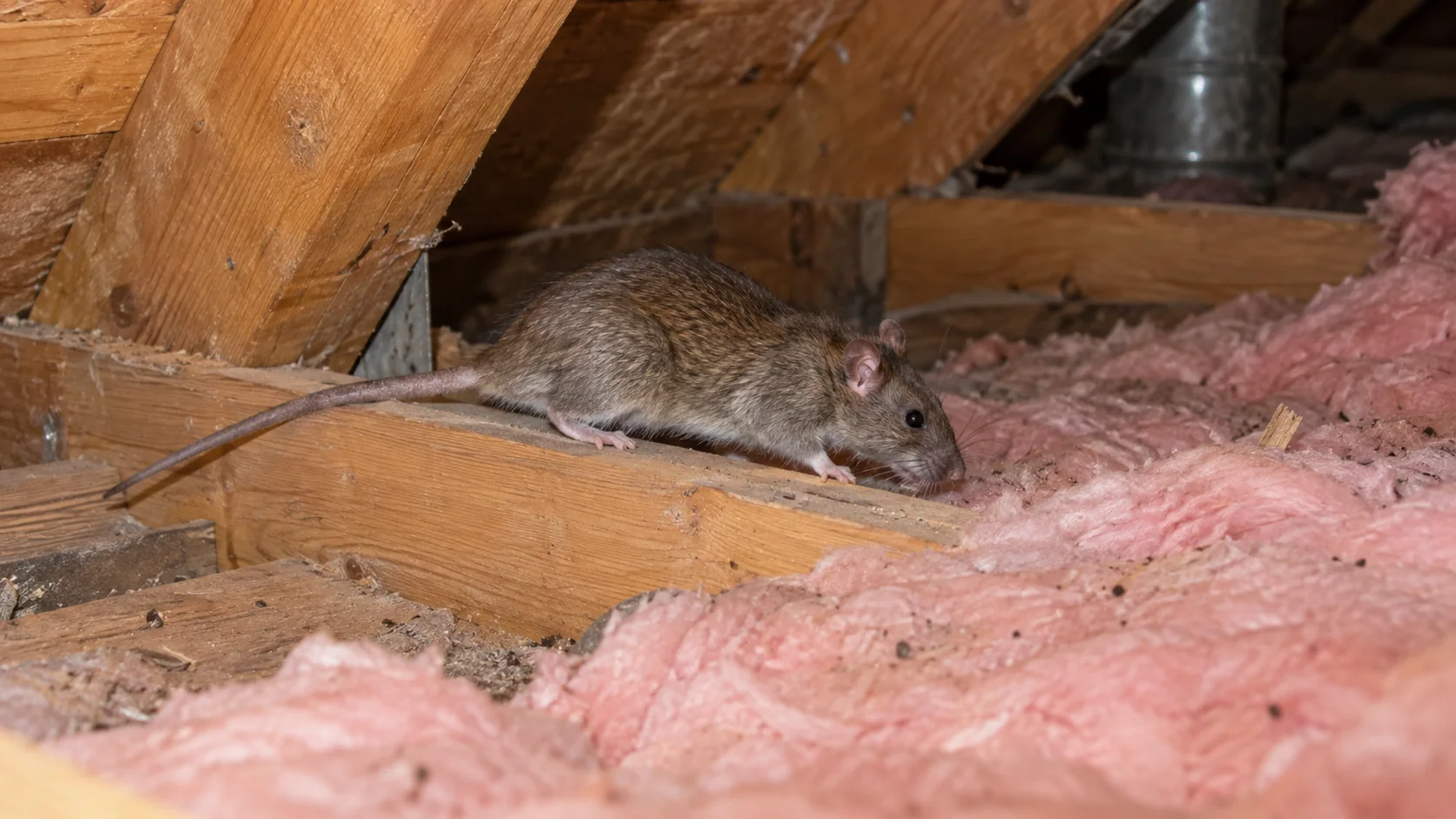
Insulation can give rats several things they need inside a building:
- shelter
- warmth
- protected travel routes
- nesting material
- access between structural cavities
Rats may use insulation in:
- attics
- wall cavities
- crawl spaces
- basements
- floor systems
- ceiling voids
- utility areas
They may:
- compress insulation
- move through loose-fill material
- pull fibers into nests
- contaminate insulation with droppings and urine
- gnaw nearby paper, plastic, wood, or wiring
But disturbed insulation alone does not prove rats.
Insulation can also be changed by:
- maintenance work
- airflow
- moisture
- mice
- squirrels
- normal settling
The practical goal is to determine whether rat activity is current, identify which insulation is actually affected, trace how the rats entered, remove active rats, and decide whether cleanup or insulation removal is necessary.
This guide explains what rat activity in insulation looks like, what damage matters, how cleanup should be approached, and when professional help may make sense.
Do Rats Live in Insulation?
They can.
Insulation may provide:
- cover
- warmth
- nesting material
- protected movement along framing
Rats may spend time:
- beneath fiberglass batts
- along loose-fill insulation
- behind insulated walls
- around insulated pipes or ducts
- between floor joists
- near attic or crawl-space framing
But insulation is often only one part of a larger route.
A rat may move between insulation and:
- a basement
- a crawl space
- a garage
- a kitchen
- an attic
- a wall cavity
Do Rats Eat Insulation?
Insulation is not a normal food source for rats.
They may still damage it by:
- shredding it
- compressing it
- moving through it
- pulling fibers into nests
- gnawing paper or plastic facing
The important issue is not whether rats eat the insulation.
It is whether they are using, damaging, or contaminating it.
Why Do Rats Use Insulation?
Insulation can create a protected environment.
It may provide:
- warmth
- darkness
- cover
- nesting material
- low-disturbance travel routes
Insulation is especially useful when it sits close to:
- wall voids
- top plates
- sill plates
- utility penetrations
- attic edges
- crawl-space framing
- roofline routes
The insulation may hide a structural path the rat is using.
What Types of Insulation Can Rats Get Into?
Rats can use spaces around many common residential insulation types.
Examples include:
- fiberglass batts
- blown-in fiberglass
- cellulose
- foam board
- spray foam around gaps
- duct insulation
- pipe insulation
The material itself does not have to be soft for a rat to use the surrounding cavity.
The main questions are:
- can the rat reach the area?
- is there a protected route?
- is there access to food or water elsewhere?
Rats in Fiberglass Insulation
Fiberglass batts can provide:
- shelter
- nesting fibers
- protected movement along framing
Possible signs include:
- compressed sections
- larger disturbed routes
- rat-sized droppings
- rub marks
- gnawing on paper facing
- a more substantial nest
Do not assume every displaced batt was disturbed by rats.
Installation, maintenance, gravity, or other animals can also alter the material.
Rats in Blown-In Insulation
Loose-fill insulation can hide rat activity.
Possible signs include:
- disturbed paths
- larger depressions
- droppings on top of the material
- rub marks along framing
- nesting material near structural edges
- tracks in exposed dusty areas
A rat route may be broader and more obvious than a mouse route, but the material can also settle naturally.
Look for supporting rat evidence.
Rats in Cellulose Insulation
Cellulose is loose and can be moved by rats.
Rats may:
- create travel routes
- compress sections
- use surrounding paper-like material in nests
Cellulose may also settle over time without rodents.
Confirm rat activity with additional signs.
Rats in Wall Insulation
Wall cavities can connect multiple levels of a house.
Rats may move through:
- plumbing chases
- utility penetrations
- framing gaps
- wall-to-ceiling transitions
Possible signs include:
- scratching or heavier movement
- rat droppings near openings
- rub marks
- gnawing
- odor
- activity at top or bottom plates
Do not open a finished wall simply because rats are suspected.
Use accessible evidence first.
See Rats in Walls: Signs, Entry Points & What to Do.
Rats in Attic Insulation
Attics are common places to find rats using insulation.
Look for:
- rat-sized droppings
- larger tracks
- rub marks along framing
- disturbed insulation
- heavy gnawing
- nesting material
Roof rats are strongly associated with elevated attic and roofline routes.
However, attic insulation alone does not prove the rat is a roof rat.
See Rats in the Attic: Signs, Damage & Removal and Roof Rat vs Norway Rat: How to Tell Them Apart.
Rats in Crawl-Space Insulation
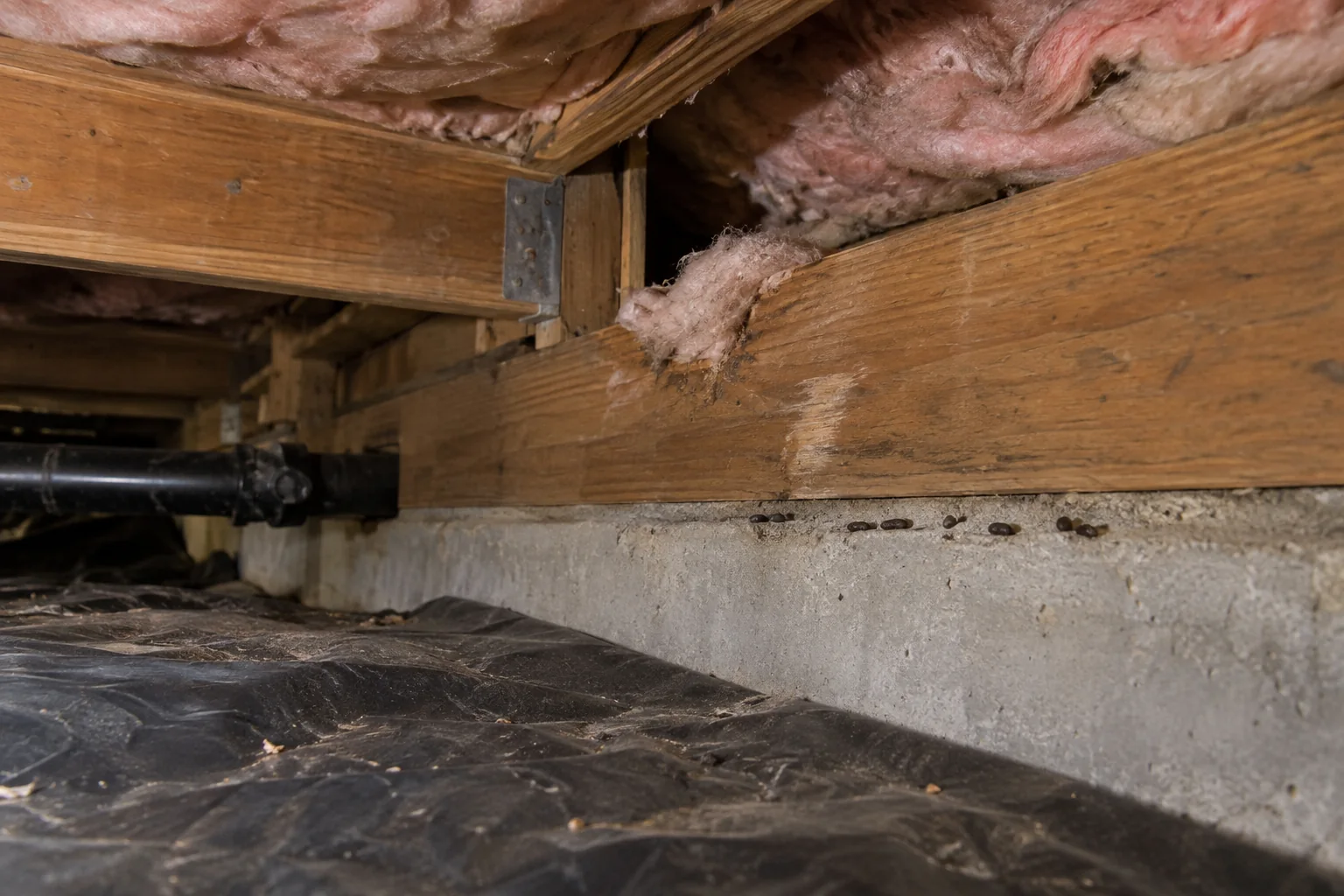
Crawl spaces may contain insulation:
- between floor joists
- around pipes
- near foundation walls
- around utility penetrations
Rats may travel along:
- foundation edges
- joists
- sill areas
- utility routes
Possible evidence includes:
- droppings
- rub marks
- disturbed insulation
- nests
- heavier gnawing
See Rats in the Crawl Space: Signs & Removal.
Rats in Basement Insulation
Basements may contain exposed insulation around:
- rim joists
- unfinished walls
- pipes
- utility areas
Rats can use these locations for:
- shelter
- nesting
- structural travel
Ground-level basement activity often fits Norway-rat behavior, but location alone does not identify species.
See Rats in the Basement: Why They’re There & What to Do.
Rats Above Ceiling Insulation
If a ceiling is directly below an attic or floor cavity, rats may travel through insulation above the drywall.
Possible clues include:
- scratching
- heavier scurrying
- rat droppings
- rub marks
- disturbed insulation
- nesting material
See Rats in the Ceiling: Signs, Sounds & Removal.
What Are the Main Signs of Rats in Insulation?
The strongest identification uses more than one sign.
Look for:
- rat-sized droppings
- larger tracks
- rub marks
- heavy gnawing
- a substantial irregular nest
- disturbed insulation
- urine odor
- direct sightings
One sign alone may not be conclusive.
Rat Droppings in Insulation
Rat droppings may appear:
- on top of attic insulation
- beside joists
- near wall plates
- around crawl-space framing
- near utility penetrations
They are substantially larger than mouse droppings.
Do not use dropping count to estimate rat population.
See Rat Droppings: What They Look Like & What They Mean.
Rat Nests in Insulation
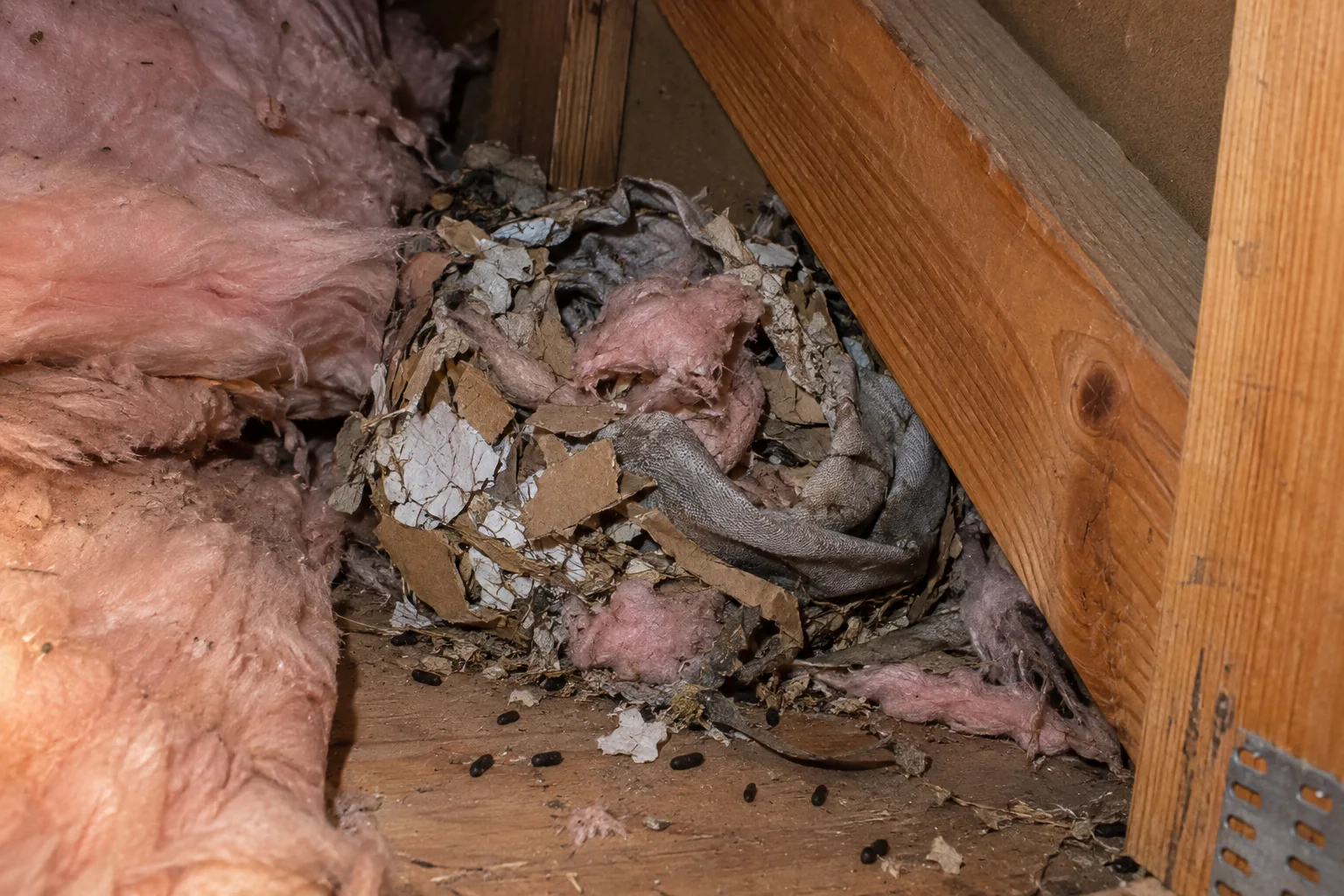
A rat nest may be tucked:
- under a batt
- beside a joist
- within loose-fill insulation
- near a wall cavity
- behind stored material
A rat nest may contain:
- shredded paper
- cardboard
- fabric
- insulation
- soft debris
It is usually larger and more substantial than a mouse nest.
It should still look irregular and hidden, not like a neat bird nest.
See Rat Nests: What They Look Like & Where to Find Them.
Rat Tracks Around Insulation
Tracks are easier to see on:
- dusty framing
- plywood
- unfinished floors
- vapor barriers
than deep inside loose insulation.
Rat tracks are larger than mouse tracks and may include:
- smaller front prints
- longer hind prints
- occasional tail drag marks
See Rat Tracks: What They Look Like & Where to Find Them.
Rat Rub Marks Near Insulation
Repeated rat travel may leave dark greasy-looking rub marks.
Look along:
- joists
- wall edges
- pipes
- utility routes
- structural openings
Do not identify rats from a dark mark alone.
Dust, moisture, and ordinary grime can look similar.
Rub marks are more useful with other rat evidence.
Rat Gnaw Marks Near Insulation
Rats may gnaw materials around insulated cavities.
Common targets include:
- paper facing
- plastic
- wood edges
- utility-opening material
- wire insulation
Rat gnawing is generally broader and heavier than mouse gnawing.
See Rat Gnaw Marks: How to Identify Rodent Damage.
Rat Urine Smell in Insulation
Repeated activity can create a strong musky or urine-like odor.
Porous insulation can retain odor.
But odor alone does not prove rats.
Other possible causes include:
- moisture
- mold
- dead animals
- other pests
See Rat Urine Smell: What It Smells Like & What It Means.
Is Disturbed Insulation Enough to Confirm Rats?
No.
Insulation can be disturbed by:
- people
- HVAC work
- electricians
- plumbers
- mice
- squirrels
- airflow
- moisture
- normal settling
Rat activity becomes more likely when disturbed insulation appears with:
- rat-sized droppings
- larger tracks
- rub marks
- heavy gnawing
- a substantial nest
- direct sightings
Could the Insulation Damage Be From Mice?
Yes.
Mouse evidence is generally smaller.
Compare:
- dropping size
- track size
- gnaw marks
- nest size
- disturbed route size
See Mouse vs Rat Droppings: How to Tell the Difference, Rat vs Mouse: How to Tell the Difference, and Mice in Insulation: Signs, Damage & Cleanup.
Does Insulation Location Identify Norway Rats or Roof Rats?
No.
Location can provide context.
Roof rats are more strongly associated with:
- attics
- rooflines
- elevated routes
Norway rats are more strongly associated with:
- basements
- crawl spaces
- foundations
- ground-level routes
But either species can move through connected structural cavities.
Use multiple identification clues.
See Norway Rat: Identification, Signs & Behavior and Roof Rat: Identification, Signs & Behavior.
How Much Damage Can Rats Do to Insulation?
Damage can range from localized to extensive.
Possible effects include:
- compressed insulation
- pulled fibers
- nesting pockets
- contaminated material
- damaged facing
- altered coverage
A few disturbed areas do not mean all insulation has failed.
The amount of repair depends on:
- insulation type
- contamination level
- moisture
- physical damage
- accessibility
Can Rat Travel Routes Reduce Insulation Performance?
Heavy repeated disturbance can reduce insulation performance in localized areas by:
- compressing material
- moving loose fill
- creating gaps
- damaging facing
Minor disturbance does not automatically mean a whole attic or wall system must be replaced.
Evaluate the actual affected area.
Can Rat Droppings and Urine Contaminate Insulation?
Yes.
Droppings and urine can contaminate porous insulation.
The practical question is how extensive the contamination is.
A few droppings on accessible framing beside insulation are different from:
- widespread droppings throughout loose fill
- several nests
- urine-soaked material
- extensive contamination across a large area
Does All Rat-Contaminated Insulation Need to Be Removed?
No.
Not every rat sign requires total insulation replacement.
Localized cleanup may be possible when:
- contamination is limited
- the area is accessible
- insulation is not heavily soiled
- nesting is minimal
Removal may be more appropriate when insulation is:
- heavily contaminated
- saturated
- extensively nested in
- badly compressed
- damaged by moisture
- difficult to clean safely
Do not make a whole-attic replacement decision based on one dropping area or one small nest.
Should You Vacuum Rat Droppings Out of Insulation?
Do not use a normal household vacuum on fresh rodent droppings or nesting material.
Dry vacuuming can disturb contaminated dust.
Do not dry sweep fresh rodent waste either.
See the rodent cleanup guide and rodent safety guide.
Should You Spray Disinfectant Over the Entire Insulation Area?
Do not blindly soak large insulation areas.
Large-scale spraying can:
- add moisture
- damage materials
- complicate cleanup
- create issues around wiring or other building components
For small accessible contaminated areas, use safe wet-cleanup principles where appropriate.
For widespread contaminated insulation, professional cleanup may be more practical.
How to Clean Small Accessible Rat Contamination Safely
For a small accessible area:
- keep unnecessary people and pets away
- wear suitable gloves
- avoid stirring up dust
- wet accessible droppings or nesting material with an appropriate disinfecting solution
- allow the product’s required contact time
- collect the waste carefully
- bag it appropriately
- clean nearby hard surfaces
- wash hands after removing gloves
Do not dry sweep or vacuum fresh rat droppings or nesting material before wet cleanup.
What About a Rat Nest Inside Insulation?
If a small accessible nest is found:
- do not handle it bare-handed
- wet contaminated nesting material appropriately before disturbance
- remove it carefully
- inspect nearby insulation
- look for droppings, urine contamination, gnawing, and rub marks
- monitor for fresh activity
The presence of one nest does not prove all insulation nearby requires removal.
When Insulation Removal May Make Sense
Removal may be reasonable when:
- contamination is widespread
- several nests are present
- urine contamination is extensive
- insulation is heavily compressed
- material is wet or mold-damaged
- rat activity has persisted for a long time
- safe cleaning is not practical
The decision should follow inspection.
Should You Replace Insulation Before Removing the Rats?
No.
Replacing insulation while rats are still active can lead to the new material being contaminated again.
A better sequence is usually:
- confirm rat activity
- identify accessible routes
- remove active rats
- identify exterior entry points
- coordinate exclusion
- clean or remove contaminated insulation as needed
- restore insulation after fresh activity has stopped
How Do Rats Get Into Insulated Areas?
Rats usually enter the building through a structural opening first.
Common routes include:
- foundation openings
- utility penetrations
- garage-door gaps
- crawl-space openings
- soffit defects
- roofline gaps
- damaged vents
Once inside, they can move into insulation through connected framing.
See How Rats Get Into Your House.
Where Should You Look for the Entry Point?
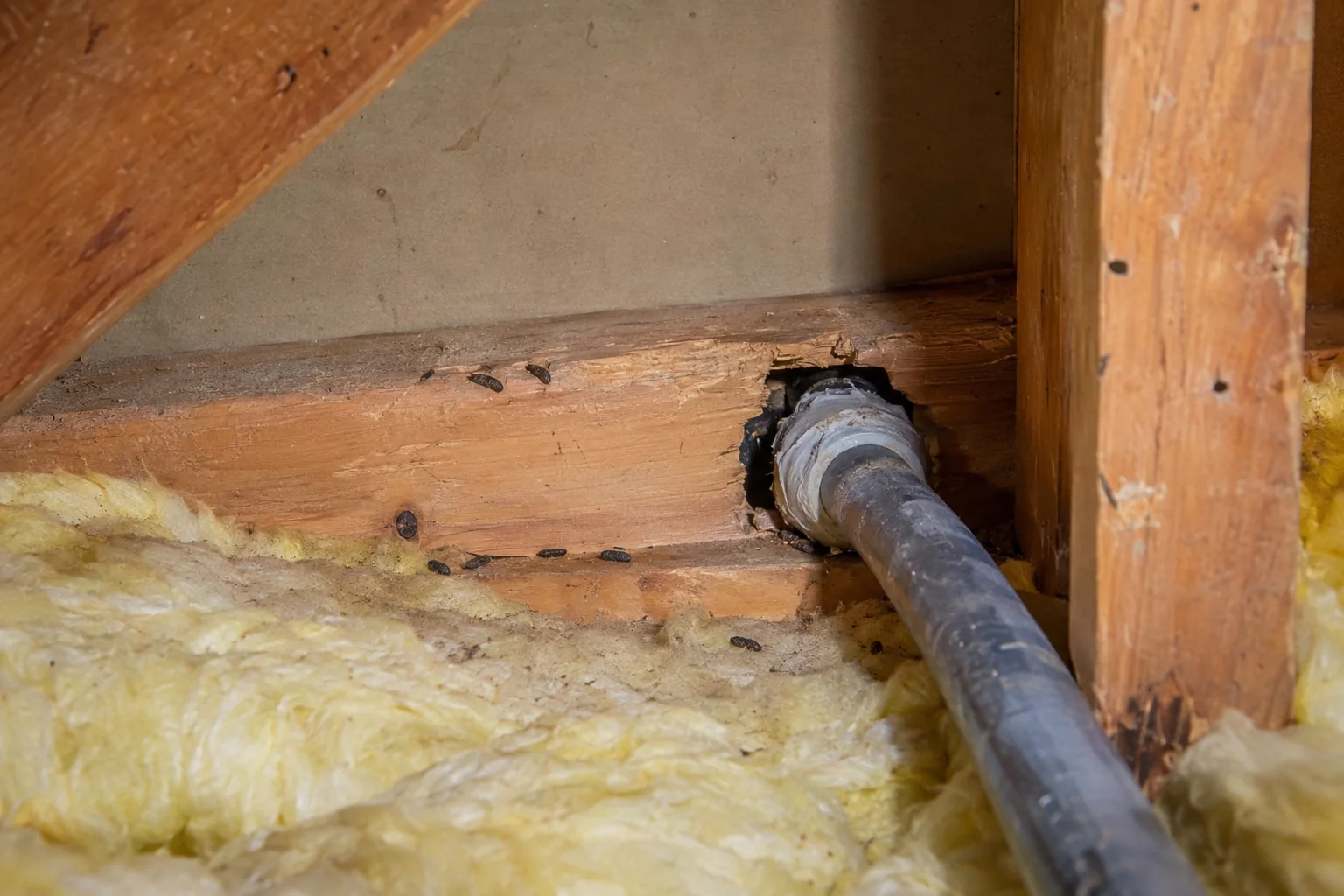
Inspect the structural route that connects to the affected insulation.
Attic Insulation
Check:
- roofline gaps
- soffits
- vents
- top plates
- garage connections
Wall Insulation
Check:
- utility penetrations
- foundation transitions
- siding or trim gaps
- wall-top and wall-bottom connections
Crawl-Space Insulation
Check:
- foundation openings
- sill areas
- vents
- access doors
- utility penetrations
Basement Insulation
Check:
- rim joists
- foundation openings
- utility routes
- window or door transitions
The entry point may be far from the most damaged insulation.
Should You Seal the Entry Point Immediately?
Not always.
If rats are still inside and you seal the only active route, they may:
- move deeper into the structure
- enter another room
- gnaw another opening
- die in an inaccessible void
Coordinate removal and exclusion.
See Rodent Exclusion: How to Keep Rats & Mice Out.
Can Spray Foam Alone Stop Rats?
Do not assume ordinary foam by itself is rat-proof.
Rats can gnaw many soft materials.
Durable exclusion may require:
- metal mesh
- flashing
- mortar
- rodent-resistant backing
- suitable sealant
The correct repair depends on the opening and construction material.
Where Should You Put Rat Traps Near Insulation?
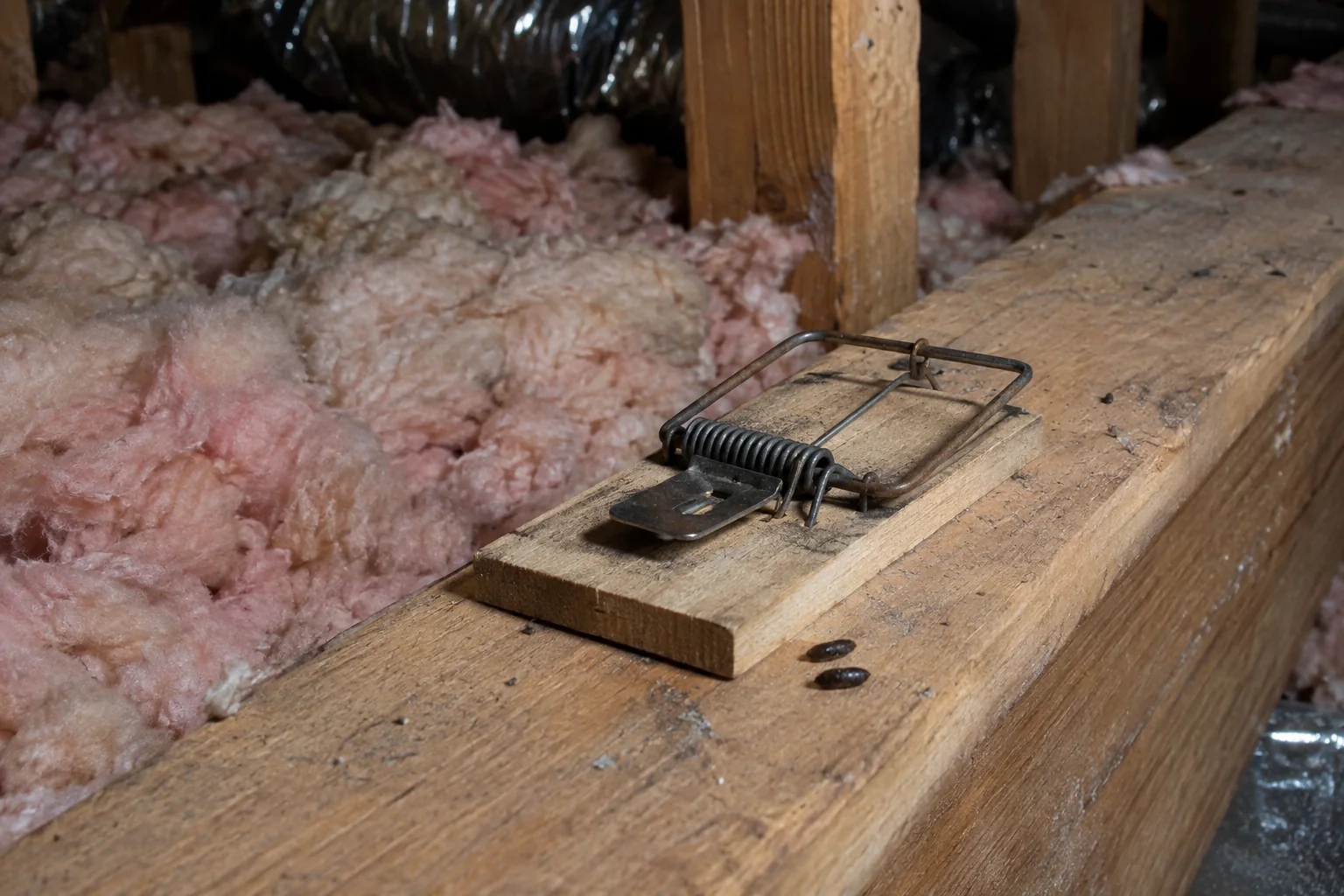
Place rat-sized traps on stable accessible routes.
Possible locations include:
- attic framing
- wall edges
- crawl-space foundation edges
- basement perimeter routes
- utility penetrations
Keep traps:
- stable
- accessible for checking
- away from children and pets
- out of loose insulation where they could become buried or difficult to retrieve
See Rat Traps: Types, Placement & How to Use Them and Best Rat Traps: Which Type Works Best & How to Choose.
Should You Put Rat Traps Inside Loose Insulation?
Not if the trap cannot remain:
- stable
- visible
- accessible
- retrievable
A trap buried in insulation is difficult to monitor and may not function correctly.
Place it on a nearby solid structural route.
Should You Put Poison in Insulation?
Do not scatter loose rodenticide through insulation.
Rodenticides must be used according to:
- the product label
- placement requirements
- child and pet safety requirements
A poisoned rat may die in an inaccessible wall, ceiling, or insulation cavity and create a significant odor problem.
For indoor structural activity, monitored trapping plus exclusion is often easier to evaluate.
Can Rats Damage Wiring Hidden in Insulation?
Yes.
Rats can gnaw wire insulation.
If accessible wiring appears damaged:
- do not touch exposed conductors
- keep people away from unsafe wiring
- have electrical damage evaluated appropriately
Do not dig blindly through insulation around energized wiring.
What If the Insulation Is Wet?
Wet insulation can indicate:
- roof leaks
- plumbing leaks
- condensation
- drainage problems
Water damage should be addressed before insulation restoration.
Wet insulation combined with rodent contamination may require more extensive removal.
How to Know Whether the Rat Problem Is Improving
Monitor for:
- no new droppings
- no new nests
- no new rub marks
- no trap activity
- no new gnawing
- no new tracks
- no repeated sightings
- no new scratching or thumping
One quiet day is not proof the problem is solved.
Look for the absence of fresh evidence over time.
When to Call a Professional
Professional rat control or cleanup may make sense when:
- contamination is widespread
- several nests are present
- insulation removal is extensive
- attic or crawl-space access is difficult
- wiring may be damaged
- moisture or mold is also present
- the entry route cannot be found
- trapping does not reduce activity
- insulation needs large-scale removal and replacement
A pest-control professional may address the rat route.
An insulation or cleanup contractor may be needed for heavily contaminated material.
See Rat Exterminator: What to Expect & When to Call One.
Rats in Insulation: The Bottom Line
Rats can use insulation for:
- shelter
- travel
- nesting material
- access between structural areas
Useful signs include:
- rat-sized droppings
- larger tracks
- rub marks
- heavy gnawing
- substantial irregular nests
- disturbed insulation
- urine odor
- direct sightings
If you find rat activity in insulation:
- confirm it with physical evidence
- identify whether the affected area is attic, wall, crawl-space, basement, or ceiling insulation
- avoid dry sweeping or vacuuming fresh rodent waste
- remove active rats before replacing insulation
- place rat-sized traps on stable accessible routes
- inspect exterior entry points
- coordinate trapping with exclusion
- clean or remove only the insulation that actually needs it
- restore damaged insulation after activity has stopped
The long-term solution is not simply replacing insulation.
It is stopping the rat activity, correcting the entry route, and then restoring contaminated or damaged material as needed.
Continue with our rat droppings guide, rat nest guide, rat gnaw marks guide, rat tracks guide, rats in the attic guide, rats in walls guide, rats in the crawl space guide, rats in the basement guide, how to get rid of rats, how rats get into a house, or rodent exclusion guide.
For the broader overview, return to [Rats & Mice in the Home](/).