Rats in Air Vents: How They Get There & What to Do
Hearing heavier scratching near an air vent, finding large droppings beside a floor register, or seeing a rat disappear near a grille can make it seem like rats are living inside the HVAC system.
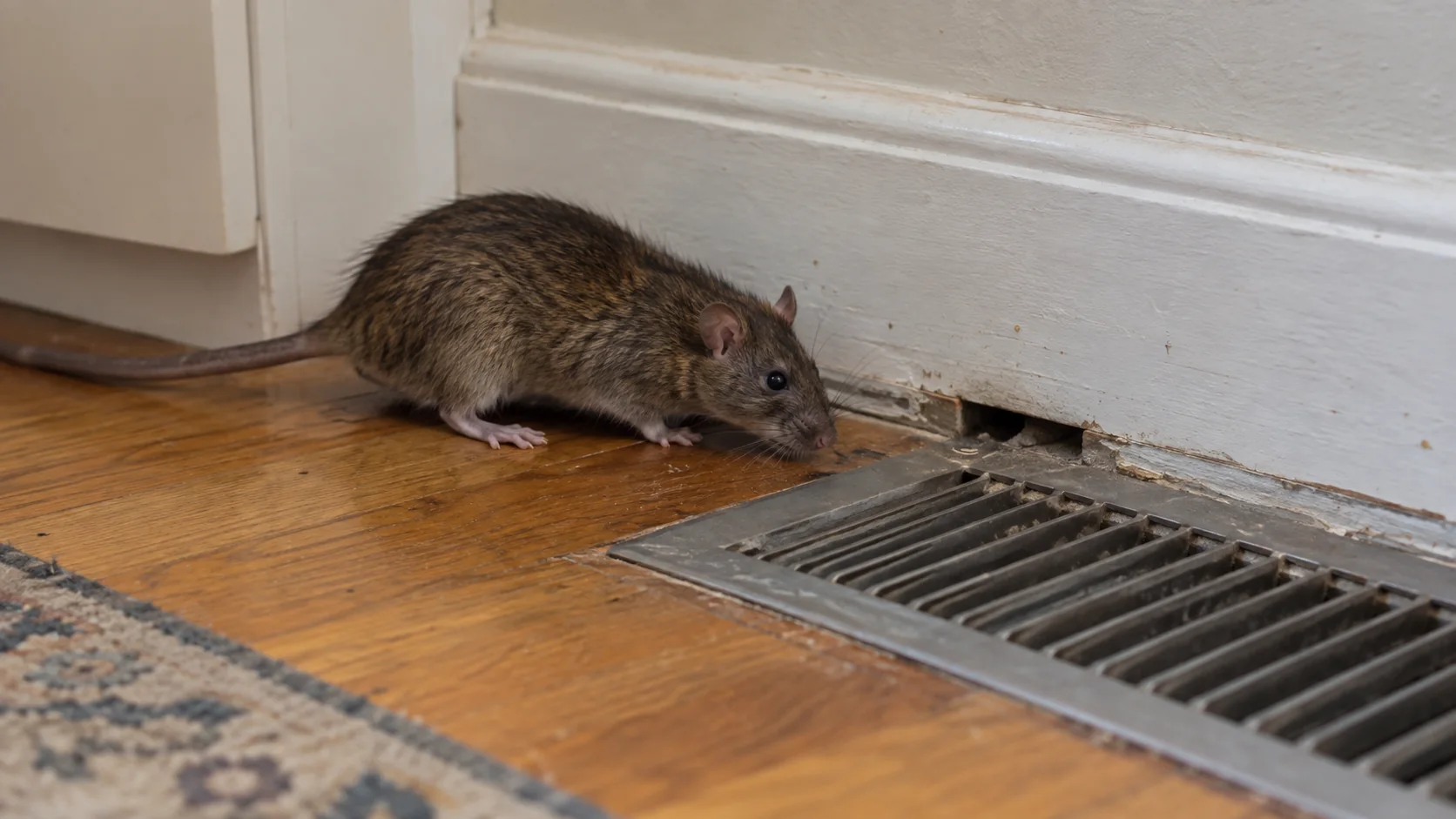
Hearing heavier scratching near an air vent, finding large droppings beside a floor register, or seeing a rat disappear near a grille can make it seem like rats are living inside the HVAC system.
Sometimes a rat can enter part of the duct system.
But many “rats in the vents” problems actually involve rats moving through:
- a wall cavity around the duct
- a floor or ceiling void
- a gap around the duct boot
- an attic or basement utility chase
- framing beside the register
- insulation around ductwork
That distinction matters.
The practical goal is to determine whether the rat activity is:
- inside accessible ductwork
- around the vent opening
- inside a connected wall or ceiling cavity
- coming from an attic, basement, crawl space, or garage
- entering through a structural gap near the HVAC system
Common signs include:
- rat-sized droppings near registers
- heavier gnawing around a duct opening or boot
- grease or rub marks
- scratching or heavier movement near a vent
- larger tracks in dusty utility areas
- nesting material near duct routes
- strong musky or urine-like odor
- direct rat sightings
- fresh rat evidence in nearby walls, attic, basement, or crawl space
Sound or odor alone does not prove a rat is inside the duct.
This guide explains how rats reach vent areas, which signs are more reliable, how to inspect accessible parts safely, and what to do to prevent the problem from returning.
Can Rats Get Into Air Vents?
Yes.
Rats can enter some HVAC-related spaces if they find an opening large enough.
Possible routes include:
- gaps around duct boots
- damaged duct connections
- open utility chases
- unfinished wall or floor cavities
- attic duct routes
- basement or crawl-space duct penetrations
- missing or damaged registers
But a rat near a vent may never enter the duct itself.
It may travel around the outside of the duct through the building structure.
What Does “Rats in the Vents” Usually Mean?
Homeowners may use that phrase for several different situations.
Rat Inside a Duct
The rat is physically inside ductwork.
Rat Around a Register
The rat is moving through a structural gap around the register or duct boot.
Rat in the Wall Beside a Vent
The duct opening carries sound from a nearby wall cavity, making the movement seem as if it is inside the vent.
Rat Above or Below a Vent
The rat may actually be in:
- an attic
- a ceiling cavity
- a basement
- a crawl space
near the duct route.
Inspection should identify which situation is actually occurring.
Can Rats Travel Through HVAC Ducts?
They can in some systems, especially when there is:
- a damaged connection
- an open return cavity
- a missing register
- damaged flexible duct
- an accessible duct opening
However, a sound heard through a vent does not prove the rat is physically inside the duct.
Metal ducts and open grilles can transmit noise from other parts of the structure.
Supply Vents vs Return Vents
Supply and return systems have different functions.
Supply Vent
A supply register delivers conditioned air into a room.
Return Vent
A return grille pulls room air back toward the HVAC system.
Do not block either type unless the HVAC design specifically permits it.
A rat problem should be solved by addressing the rodent route, not by covering required airflow openings.
Rats Near Floor Registers
Floor registers may sit above:
- basements
- crawl spaces
- floor cavities
A rat may approach the register through a gap around the duct boot without entering the duct itself.
Inspect the perimeter for:
- rat-sized droppings
- rub marks
- heavier gnawing
- loose trim
- visible gaps
Do not place a rat trap inside the register.
Rats Near Wall Vents
Wall registers can connect to:
- wall cavities
- utility chases
- duct boots
If heavier scratching is heard beside the vent, inspect nearby wall evidence.
The vent opening may transmit sound even when the rat remains outside the duct.
See Rats in Walls: Signs, Entry Points & What to Do.
Rats Near Ceiling Vents
Ceiling vents may connect to:
- attic ducts
- ceiling voids
- floor cavities above
If rat evidence is also present in the attic or ceiling, the route may be structural rather than inside the duct.
See Rats in the Ceiling: Signs, Sounds & Removal and Rats in the Attic: Signs, Damage & Removal.
Does a Rat Near a Ceiling Vent Mean It Is a Roof Rat?
Not automatically.
Roof rats are strongly associated with:
- attics
- rooflines
- rafters
- elevated routes
So activity around an upper vent can fit roof-rat behavior.
However, Norway rats can also move upward through:
- wall cavities
- utility chases
- pipe routes
- floor cavities
Vent location alone does not identify species.
See Roof Rat: Identification, Signs & Behavior, Norway Rat: Identification, Signs & Behavior, and Roof Rat vs Norway Rat: How to Tell Them Apart.
How Do Rats Get Near Air Vents?
Rats usually reach vent areas through the same structural routes they use elsewhere.
Common pathways include:
- foundation openings
- utility penetrations
- crawl-space openings
- basement framing
- wall cavities
- attic routes
- garage connections
- roofline or soffit defects
Once inside the structure, rats may follow:
- ducts
- pipes
- wires
- framing
- wall edges
See How Rats Get Into Your House.
Rats Coming From the Basement
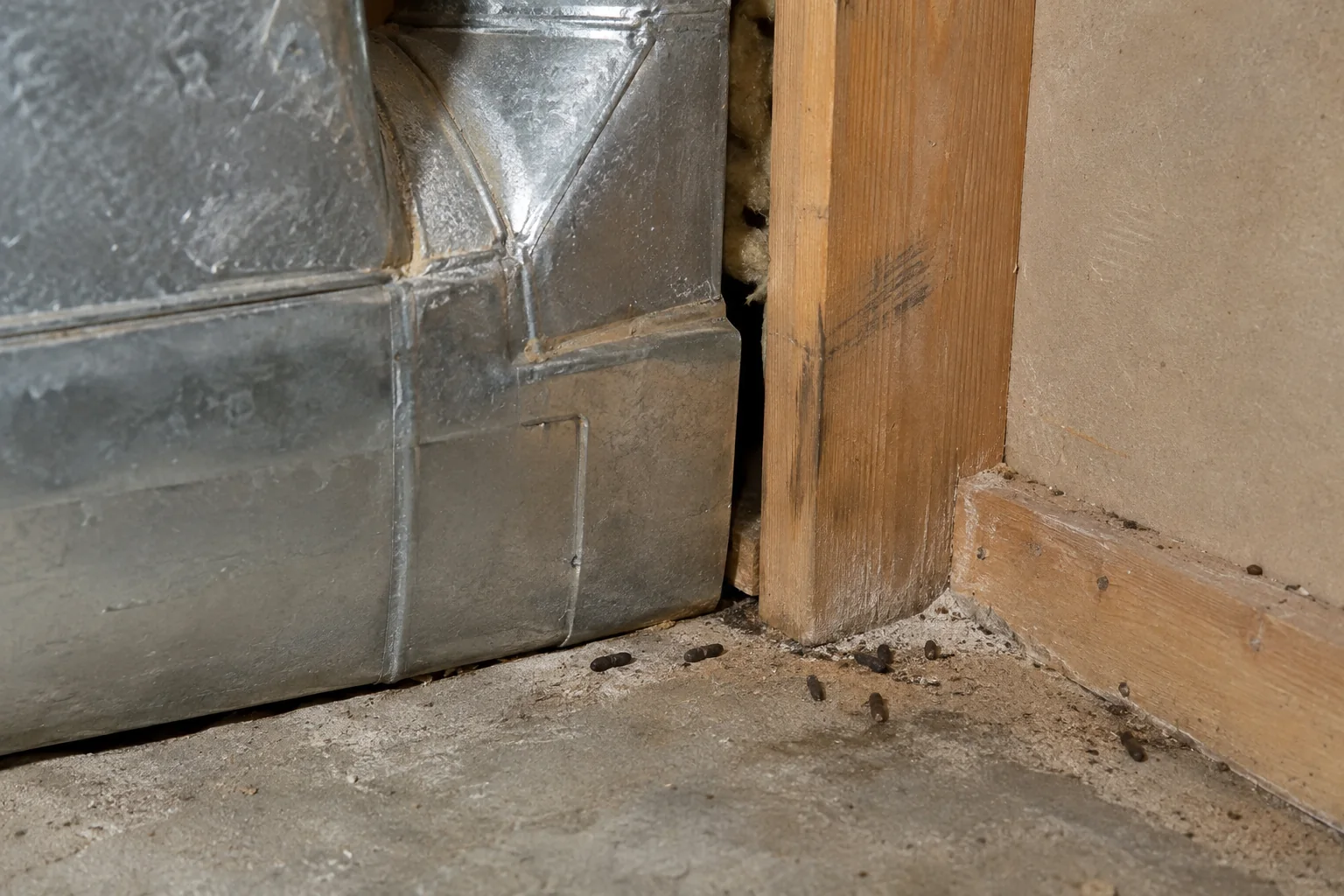
Basements often contain:
- exposed ductwork
- utility penetrations
- floor openings
- wall connections
A rat may travel beside ductwork and appear near a floor register above.
This is particularly consistent with Norway-rat behavior, but it does not prove species.
See Rats in the Basement: Why They’re There & What to Do.
Rats Coming From the Crawl Space
Crawl spaces may contain ducts running beneath the house.
Rats can travel along:
- foundation edges
- utility routes
- floor penetrations
- the outside of ducts
If evidence appears near both crawl-space ducts and indoor registers, the routes may be connected.
See Rats in the Crawl Space: Signs & Removal.
Rats Coming From the Attic
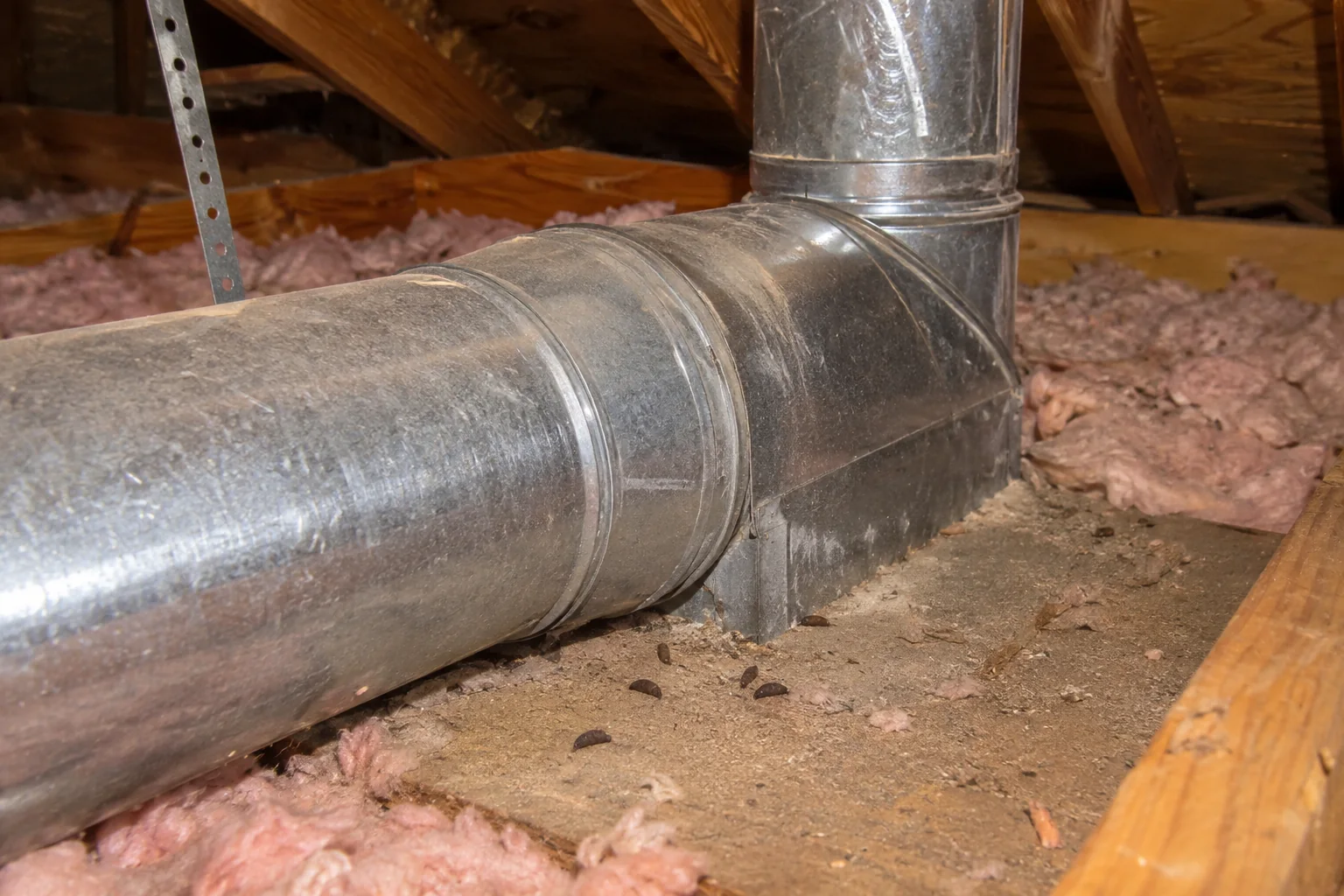
Attics commonly contain:
- flexible ducts
- rigid ducts
- ceiling boots
- insulation
- wall-top openings
A rat in the attic may reach a ceiling vent area without entering the duct.
Inspect for:
- rat-sized droppings
- larger tracks
- rub marks
- gnawing
- disturbed insulation
See Rats in the Attic: Signs, Damage & Removal.
Rats Coming From the Garage
Attached garages may connect to HVAC routes through:
- walls
- ceilings
- utility penetrations
- attic spaces
A rat can enter through the garage and later appear near a register elsewhere in the house.
See Rats in the Garage: Entry Points, Nests & Control.
What Do Rats in or Around Vents Sound Like?
Possible sounds include:
- heavier scratching
- rustling
- scurrying
- gnawing
- occasional thumps
Metal registers and ductwork can amplify or transmit noise.
A sound may seem to come directly from the grille even when the rat is:
- in the wall
- above the ceiling
- below the floor
- beside the duct
Sound alone is not enough to confirm the route.
Is Scratching in a Vent Always Rats?
No.
Possible sources include:
- mice
- insects
- duct expansion
- loose duct components
- debris movement
- normal HVAC operation
Look for physical rat evidence before deciding the cause.
See Scratching in Walls at Night: Could It Be Mice or Rats?.
Rat Droppings Near a Vent
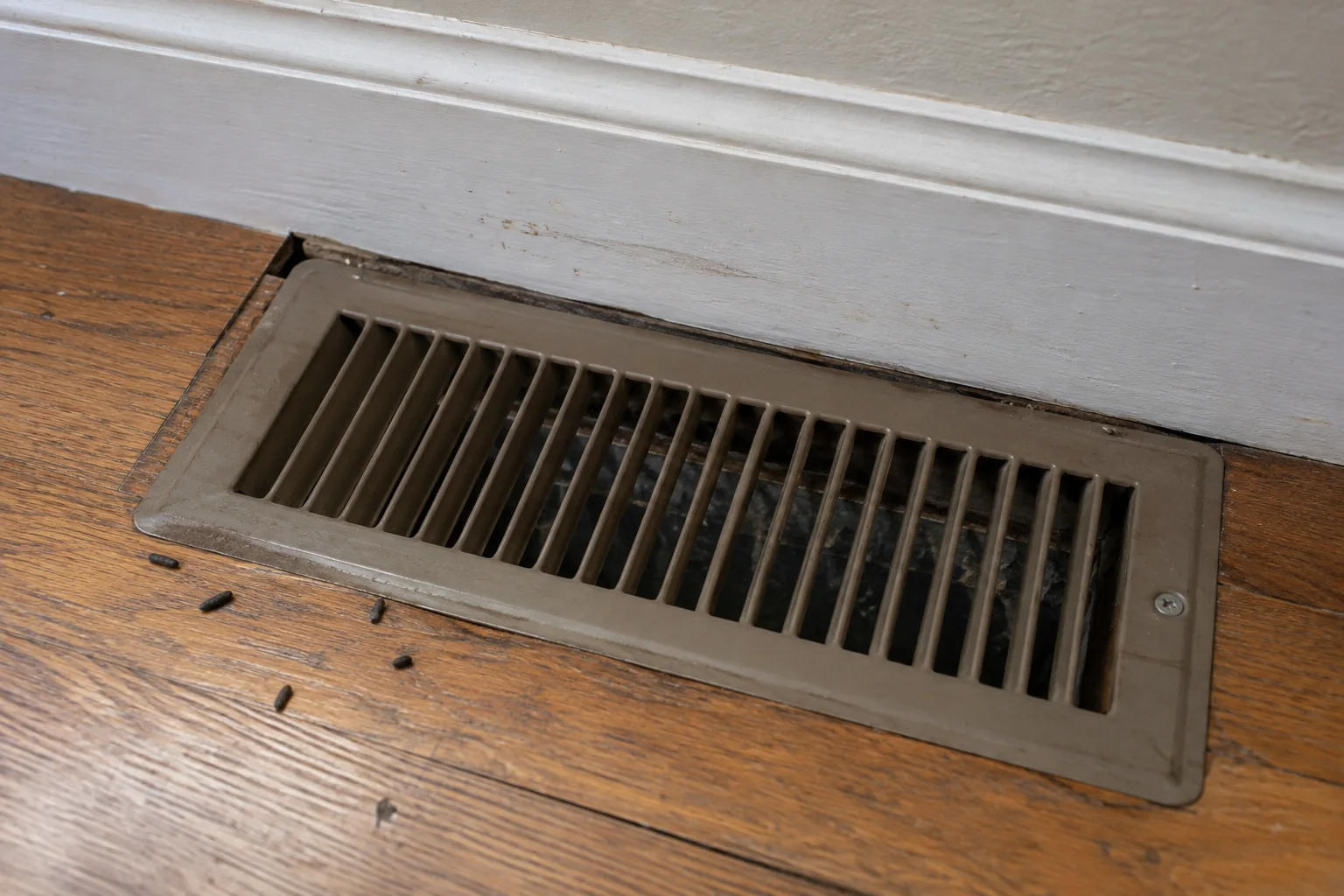
Rat droppings near a register are useful evidence that a rat traveled nearby.
But they do not prove the rat was inside the duct.
Look at where the droppings appear:
- beside the grille
- along the wall edge
- behind register trim
- near a floor gap
- on framing near the duct boot
Do not use dropping count to estimate population size.
See Rat Droppings: What They Look Like & What They Mean.
Rat Droppings Inside an Accessible Register
If rat droppings are visible just inside a removable register or accessible boot, that suggests a rat reached that area.
Do not:
- reach blindly into the duct
- use a household vacuum on fresh droppings
- spray chemicals into the duct
If contamination extends deeper into the system, professional assessment may be more appropriate.
Rat Rub Marks Around a Vent
Repeated rat travel can leave dark greasy-looking marks.
Possible locations include:
- wall edges
- duct boots
- framing
- register edges
- utility penetrations
Do not identify rats from a dark mark alone.
Dust, ordinary grime, or moisture staining can look similar.
Rub marks are more useful when combined with droppings, tracks, or gnawing.
Rat Gnaw Marks Around a Vent
Rats may gnaw:
- wood trim
- plastic
- insulation
- sealant
- wall material around openings
Rat gnawing is generally broader and heavier than mouse gnawing.
See Rat Gnaw Marks: How to Identify Rodent Damage.
Rat Tracks Near Ductwork
Dusty basement, attic, or crawl-space surfaces may preserve rat tracks.
Look beside:
- ducts
- wall edges
- utility chases
- framing
Rat tracks are larger than mouse tracks.
One rat can create many tracks.
See Rat Tracks: What They Look Like & Where to Find Them.
Rat Nesting Material Near HVAC Routes
Rats may use:
- paper
- cardboard
- fabric
- insulation
- soft debris
for nesting.
A nest near ductwork does not automatically mean the nest is inside the duct.
See Rat Nests: What They Look Like & Where to Find Them.
Rat Urine Smell From a Vent
A strong musky or urine-like odor may seem more noticeable when air moves through a grille.
Possible sources include:
- contamination near the register
- a nearby wall cavity
- insulation around the duct
- contamination inside accessible ductwork
- a nesting area nearby
Odor alone does not prove rats.
See Rat Urine Smell: What It Smells Like & What It Means.
Could the Odor Come From Something Else?
Yes.
Vent odors can also come from:
- moisture
- dust
- mold
- drains
- HVAC equipment
- other animals
Do not assume rat urine without supporting physical evidence.
Could the Rodent Be a Mouse?
Yes.
Mouse evidence is generally smaller.
Compare:
- droppings
- tracks
- gnawing
- opening size
- direct sightings
See Rat vs Mouse: How to Tell the Difference and Mice in Air Vents: How They Get There & What to Do.
How to Inspect a Floor Register Safely
If the register is designed to be removable and accessible:
- stop nearby airflow if appropriate for a simple visual check
- remove the register only if it can be done safely
- inspect the immediate boot and surrounding structural gap
- look for droppings, rub marks, gnawing, nesting material, or damage
- replace the register securely
Do not:
- dismantle HVAC equipment
- open sealed duct joints
- reach deep into ductwork
- disturb electrical components
How to Inspect a Wall or Ceiling Register
Inspect the visible perimeter.
Look for:
- loose trim
- gaps around the boot
- rat droppings
- rub marks
- gnawing
- damaged drywall
If the register is fixed or connected to equipment, do not force it open.
The structural gap around the duct boot may be more relevant than the duct itself.
Should You Remove the Vent Cover?
Only if it is a normal removable register and can be removed without damaging the system.
Do not remove:
- fixed HVAC panels
- air-handler covers
- electrical panels
- sealed access components
unless qualified.
Should You Look Inside the Duct?
A limited visual inspection of an accessible register opening may be reasonable.
Do not:
- crawl into ductwork
- insert hands into hidden areas
- push tools deep into the system
- damage duct lining
- disconnect duct sections casually
Professional HVAC or pest inspection may be more appropriate when the suspected route is inaccessible.
Can Rats Damage Flexible Ducts?
Yes.
Rats can damage soft materials around flexible ductwork.
Possible signs include:
- gnawed outer jacket
- torn insulation
- disturbed material
- nesting debris nearby
Damaged ductwork may require HVAC repair in addition to rodent control.
Can Rats Damage Duct Insulation?
Yes.
They may:
- compress insulation
- pull material into nests
- contaminate insulation
- create travel paths around ducts
Heavily contaminated porous insulation may be difficult to clean effectively.
Can Rats Damage HVAC Wiring?
Yes.
Rats can gnaw wire insulation.
If wiring appears damaged:
- do not touch exposed conductors
- keep people away from unsafe equipment
- have electrical or HVAC damage evaluated appropriately
Rodent control does not replace electrical repair.
Should You Block the Vent to Keep Rats Out?
Do not block required supply or return airflow.
Blocking a vent may affect:
- airflow balance
- comfort
- equipment operation
The better approach is to identify and repair the structural rat route around the vent or elsewhere in the building.
Should You Put Mesh Behind a Vent?
Do not add improvised mesh or other material to an HVAC airflow path unless the system design specifically allows it.
Improvised screening can:
- reduce airflow
- collect dust
- create maintenance problems
If a structural gap exists around the duct boot, repair the building gap without obstructing the duct opening.
Should You Put a Rat Trap Inside the Vent?
No.
Do not place rat traps inside active supply or return ductwork.
A trap inside a duct may be:
- difficult to inspect
- difficult to retrieve
- exposed to airflow
- a source of contamination
Place rat-sized traps on accessible structural routes outside the airflow path.
See Rat Traps: Types, Placement & How to Use Them and Best Rat Traps: Which Type Works Best & How to Choose.
Where Should You Put Rat Traps for Vent Activity?
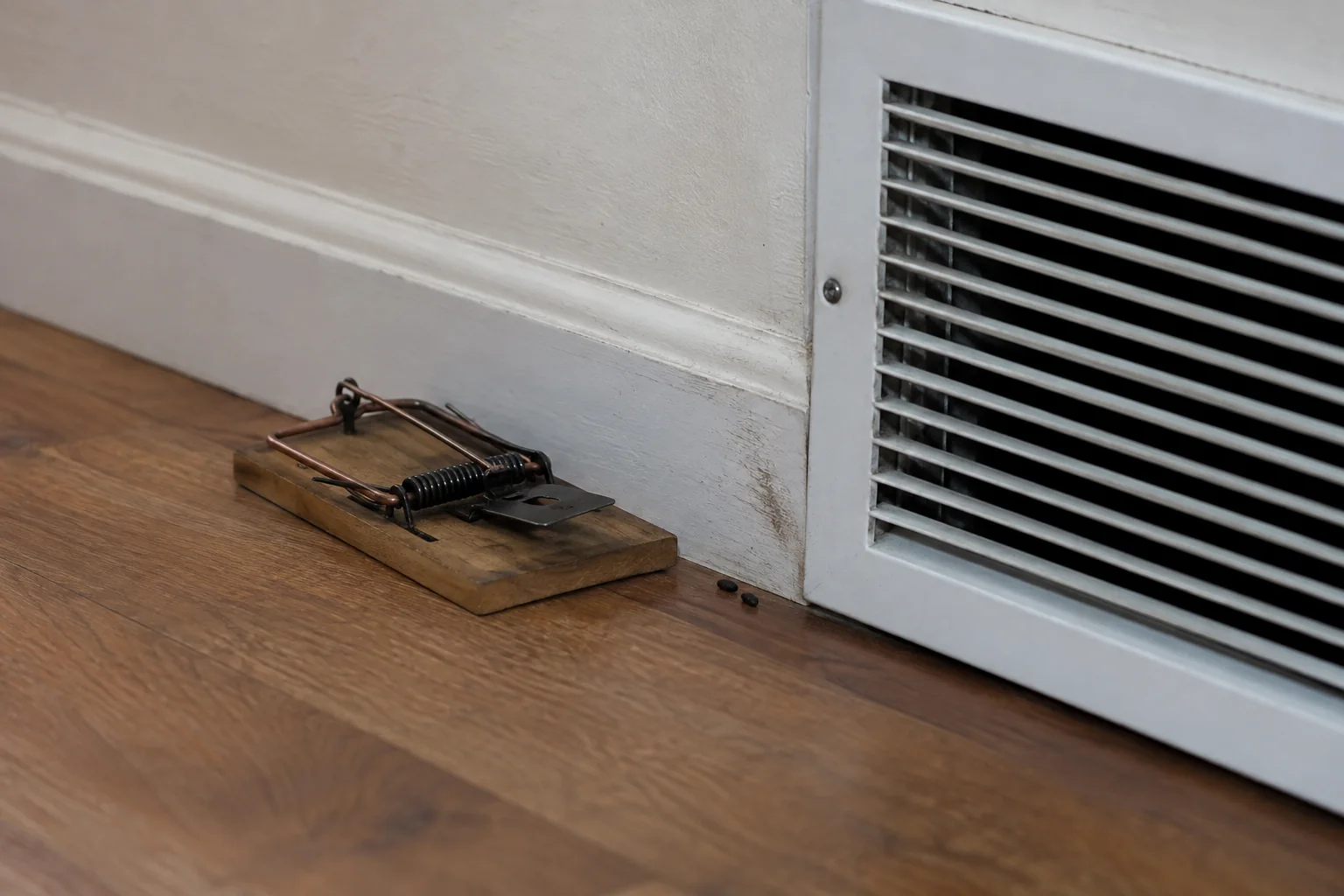
Use confirmed accessible routes such as:
- wall edges near the register
- attic framing near the duct route
- basement foundation routes
- crawl-space edges
- garage routes
- utility penetrations
Keep traps:
- stable
- accessible
- away from children and pets
- outside active HVAC airflow
The trap should be sized for rats, not mice.
Should You Put Poison in Air Vents?
No.
Do not place loose rodenticide inside supply or return ducts.
Rodenticides must be used according to:
- the product label
- placement requirements
- child and pet safety requirements
A poisoned rat may die in an inaccessible duct, wall, or ceiling void and create a significant odor problem.
For indoor structural activity, monitored trapping plus exclusion is often easier to evaluate.
Should You Spray Disinfectant Into a Vent?
Do not spray chemicals blindly into ductwork or HVAC equipment.
If rat droppings are on an accessible hard surface near a register, wet-clean that accessible surface using appropriate methods.
If contamination extends deeper into the HVAC system, professional assessment may be more appropriate.
How to Clean Rat Droppings Near a Vent Safely
For a small accessible contaminated area:
- keep children and pets away
- wear suitable gloves
- wet droppings and the nearby hard surface with an appropriate disinfecting solution
- allow the required contact time
- wipe or collect the waste
- bag waste appropriately
- clean the surrounding surface
- wash hands after removing gloves
Do not dry sweep or vacuum fresh rat droppings or nesting material before wet cleanup.
See the cleanup section and rodent safety section.
What If Rat Droppings Are Deep Inside the Duct?
Do not reach into an inaccessible duct or attempt to vacuum contaminated material with a normal household vacuum.
Professional HVAC cleaning or inspection may be appropriate if:
- contamination extends deep into ductwork
- nesting material is present
- the duct is damaged
- the route cannot be accessed safely
Rodent removal and entry-point correction should be coordinated with any cleanup plan.
What If There Is a Dead Rat Smell From the Vent?
Odor near a vent may come from:
- a duct
- a wall cavity
- a ceiling void
- insulation around the duct
If a carcass is accessible and can be removed safely, use appropriate cleanup precautions.
If it is inaccessible, the exact location may require professional inspection.
Do not dismantle HVAC equipment or finished structure blindly to chase odor.
How to Find the Entry Point
Inspect likely routes such as:
- foundation openings
- utility penetrations
- crawl-space vents
- garage-door gaps
- attic or roofline defects
- wall penetrations
- gaps around duct boots
The vent where you notice the problem may be far from the original exterior entry point.
Should You Seal the Gap Around a Vent Immediately?
Only after considering whether rats are still using the route.
If rats remain inside and you seal the only active route, they may:
- move deeper into the structure
- enter another room
- gnaw another opening
- die in an inaccessible void
Coordinate trapping and exclusion.
See Rodent Exclusion: How to Keep Rats & Mice Out.
How to Seal Rat Entry Routes Around HVAC Openings
The repair depends on the construction.
Possible exclusion materials may include:
- metal mesh
- flashing
- mortar
- rodent-resistant backing plus suitable sealant
- trim repair
Do not place materials:
- inside required airflow paths
- against hot components unless appropriate
- around electrical equipment improperly
- where they block service access
The goal is to repair the building gap, not obstruct the HVAC system.
How to Know Whether the Problem Is Improving
Monitor for:
- no new droppings
- no new tracks
- no new rub marks
- no new gnawing
- no scratching or thumping
- no trap activity
- no sightings
- no recurring odor
One quiet day is not proof that rats are gone.
Look for the absence of fresh evidence over time.
When to Call a Professional
Professional help may make sense when:
- scratching continues near vents
- rat droppings reappear
- rats are active in several structural areas
- ductwork is damaged
- contamination extends inside inaccessible ducts
- electrical wiring is damaged
- the entry route cannot be found
- rat traps do not reduce activity
- attic, crawl-space, or ceiling access is difficult
- HVAC equipment would need to be opened or repaired
A pest-control professional may address the rat route.
An HVAC professional may be needed for damaged or contaminated ductwork.
See Rat Exterminator: What to Expect & When to Call One.
Rats in Air Vents: The Bottom Line
Rats can sometimes enter ductwork, but many “rats in the vents” problems actually involve rats moving:
- around the duct boot
- inside a wall cavity
- above a ceiling
- below the floor
- through an attic, basement, crawl space, or garage
Useful evidence includes:
- rat-sized droppings
- larger tracks
- rub marks
- heavy gnawing
- nesting material
- odor
- direct sightings
If you suspect rats near air vents:
- confirm activity with physical evidence
- inspect accessible registers and surrounding structural gaps
- check connected attic, basement, crawl-space, wall, and garage routes
- place rat-sized traps on accessible routes outside the airflow path
- wet-clean accessible contamination safely
- do not spray chemicals or place poison inside ducts
- preserve required HVAC airflow
- coordinate trapping with exclusion
- repair the structural entry route
The long-term solution is not blocking the vent.
It is identifying where rats are moving, removing active rats, and closing the building openings that let them reach the HVAC route.
Continue with our signs of rats guide, rat droppings guide, rat tracks guide, rat gnaw marks guide, rat nest guide, rats in walls guide, rats in the ceiling guide, rats in the attic guide, rats in the basement guide, rats in the crawl space guide, how to get rid of rats, how rats get into a house, or rodent exclusion guide.
For the broader overview, return to [Rats & Mice in the Home](/).