Where to Place Mouse Traps for Best Results
Mouse traps work best when they are placed where mice already travel. Trap placement is one of the most common reasons a mouse-control attempt fails.
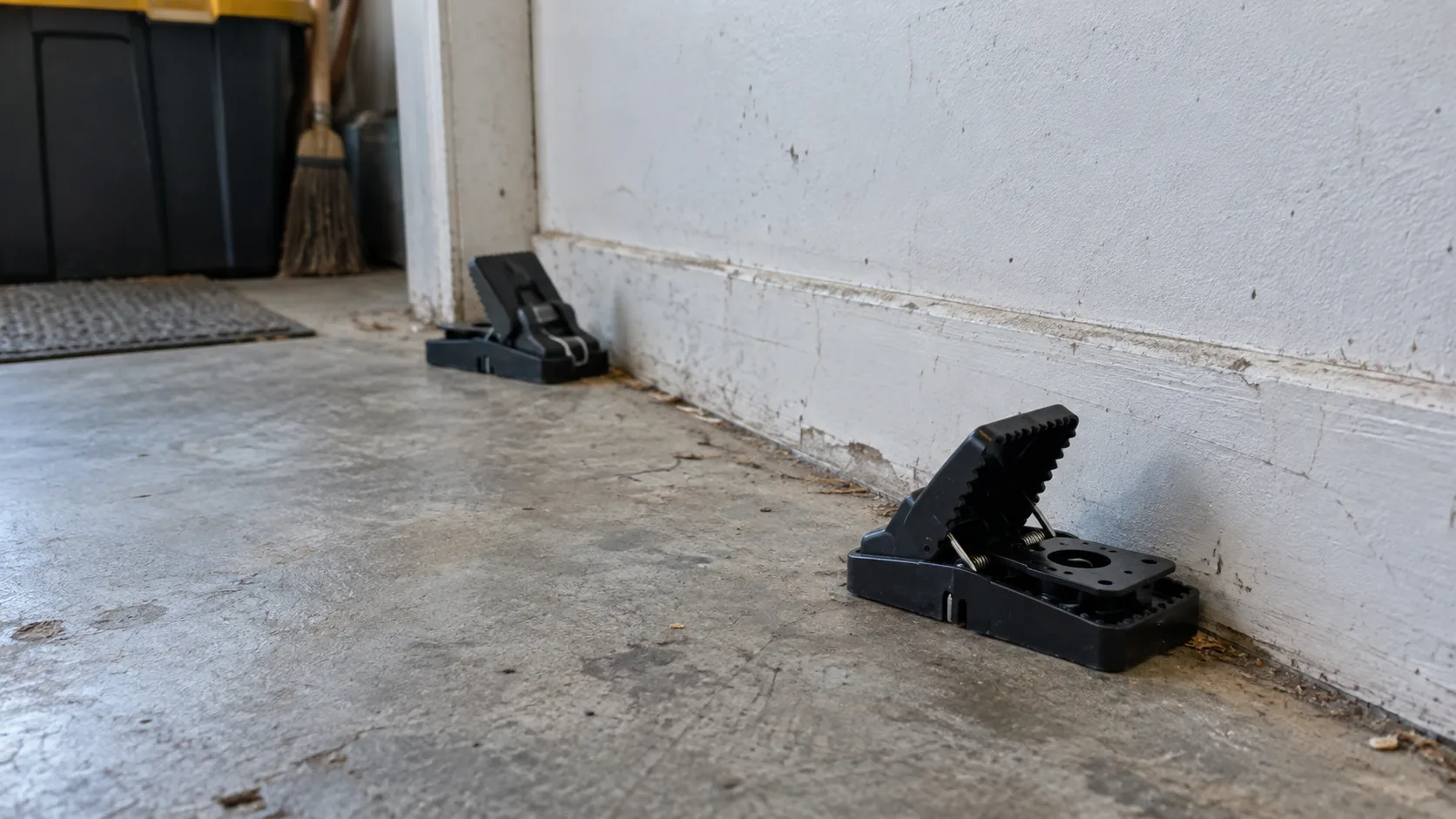
Mouse traps work best when they are placed where mice already travel.
That sounds simple, but trap placement is one of the most common reasons a mouse-control attempt fails.
A trap can be:
- correctly sized
- properly baited
- mechanically sound
and still catch nothing if it is sitting in the wrong place.
The most useful rule is:
Place traps on active mouse routes, not randomly around the room.
That usually means focusing on:
- wall edges
- baseboards
- cabinet edges
- appliance edges
- corners
- utility routes
- garage walls
- basement perimeter routes
- accessible attic travel paths
Fresh mouse evidence should guide the final position.
Where Should You Put Mouse Traps First?
Start where fresh signs are strongest.
Look for:
- fresh droppings
- tracks
- gnawing
- repeated sightings
- nesting material
- food damage
A trap placed close to fresh evidence is usually more useful than a trap placed in a clean open area.
See Signs of Mice: How to Tell If You Have Mice.
Put Mouse Traps Along Walls
Mice commonly travel along protected edges.
That can include:
- baseboards
- cabinet sides
- walls
- storage edges
- appliance edges
A mouse moving along a wall is more likely to encounter a trap placed directly on that route.
Do not place all your traps in the middle of open floor space.
Why Do Mice Prefer Wall Edges?
Wall edges provide:
- cover
- orientation
- predictable travel paths
Open floor space can feel more exposed.
That does not mean mice never cross a room.
It means wall and edge routes are usually better first targets for trap placement.
Which Way Should a Mouse Snap Trap Face?
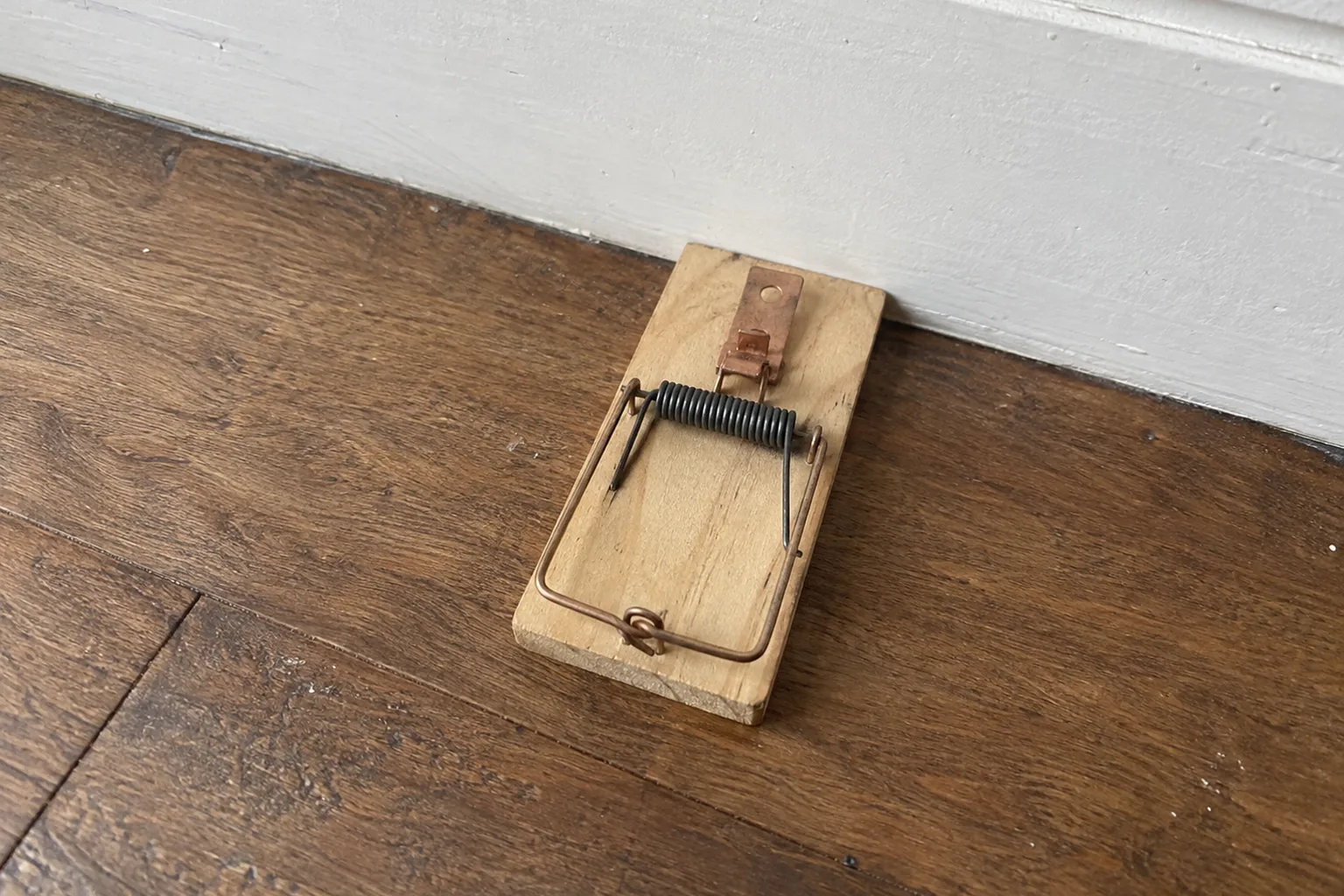
For a traditional mouse snap trap, a common starting position is:
- trap perpendicular to the wall
- trigger or bait end facing the baseboard
This places the trigger directly where the mouse is likely to pass.
Depending on:
- trap design
- wall geometry
- route shape
a trap may also work when placed parallel to the wall.
The goal is not to follow one decorative layout.
The goal is to put the trigger where the mouse is most likely to contact it.
See Snap Traps for Mice: How to Use Them Correctly.
Should the Trap Touch the Wall?
For many traditional snap-trap placements, the trigger end can be positioned very close to the wall.
Do not force the trap into:
- trim
- wiring
- pipes
- moving hardware
The trap should remain:
- flat
- stable
- unobstructed
A rocking or crooked trap is harder for the mouse to approach correctly.
Can You Put Mouse Traps Parallel to a Wall?
Yes.
Parallel placement may work well when:
- the trap design is intended for it
- a narrow route runs directly along the wall
- the entry path into an enclosed trap aligns with the wall
- perpendicular placement is blocked by furniture or cabinet geometry
Do not focus on orientation alone.
A perfectly oriented trap on an inactive wall is less useful than a slightly different placement on a confirmed route.
Use Fresh Droppings to Guide Placement
Mouse droppings can help identify active areas.
Common locations include:
- under sinks
- behind appliances
- cabinet corners
- pantry edges
- garage walls
- basement perimeter routes
Do not assume a dropping cluster identifies the exact nest.
Do not estimate mouse population from dropping count.
Use the evidence to narrow the travel route.
See Mouse Droppings: What They Look Like & What They Mean.
Use Mouse Tracks to Refine Placement
Tracks can help show:
- direction of travel
- repeated wall routes
- movement around appliances
- garage or basement paths
If tracks repeatedly cross one corner or wall edge, that is a better trap location than a nearby clean surface.
See Mouse Tracks: What They Look Like & Where to Find Them.
Use Fresh Gnawing as Another Clue
Fresh gnawing can appear near:
- food
- packaging
- structural openings
- cabinet edges
- utility penetrations
That can indicate repeated mouse activity.
See Mouse Gnaw Marks: How to Identify Rodent Damage.
How Many Mouse Traps Should Be in One Area?
There is no universal number.
Use enough traps to cover the active routes.
One room may have:
- one dominant route
- several wall routes
- an appliance route
- a utility route
If fresh evidence appears in several places, a single trap may not cover enough of the activity.
Do not estimate the number of mice from the number of traps.
How Far Apart Should Mouse Traps Be?
There is no one spacing number that fits every house.
Spacing depends on:
- room size
- route layout
- fresh evidence
- obstacles
- trap type
It is usually better to place traps directly on several confirmed routes than to space them evenly around the perimeter.
Should You Put Two Traps Near the Same Route?
Sometimes.
Two or more traps can make sense where:
- activity is concentrated
- several paths converge
- one trap is repeatedly approached but not triggered
- bait is being disturbed
- a corner is heavily used
Avoid arranging traps in a perfect row simply for symmetry.
Use the actual travel pattern.
Where to Place Mouse Traps in the Kitchen
Good kitchen locations can include:
- lower cabinet edges
- under the sink
- behind accessible appliances
- pantry wall edges
- wall-floor transitions with fresh signs
Avoid:
- countertops
- food-preparation surfaces
- open-food shelves
- areas where children or pets can reach the trap
See Mice in the Kitchen: Why They’re There & What to Do.
Where to Put Mouse Traps Under the Sink
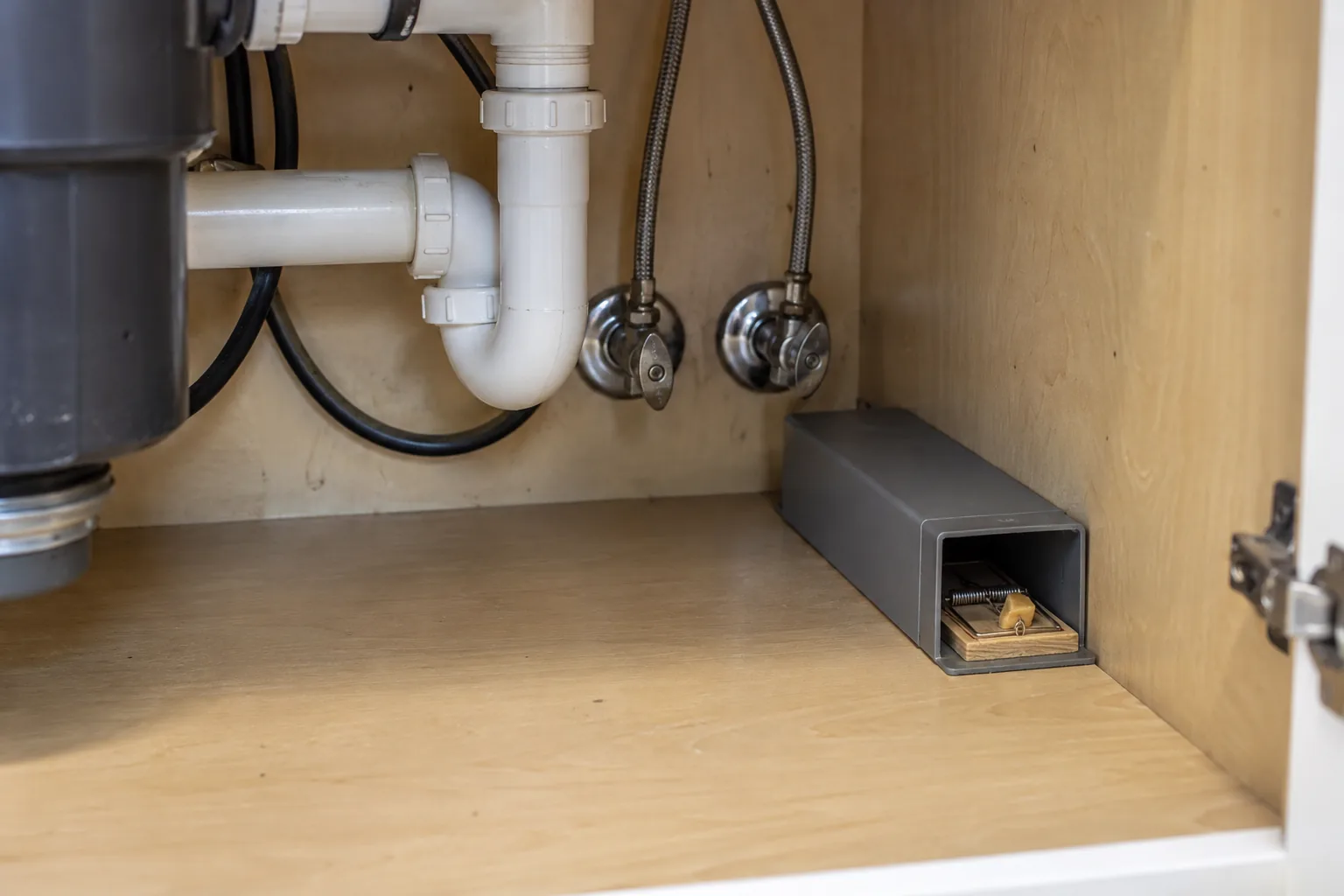
Under-sink cabinets can be active because they may contain:
- pipe penetrations
- wall void access
- dark protected edges
Place traps:
- along cabinet walls
- near confirmed pipe-route activity
- away from leaks
- away from shutoff valves
- away from electrical components
If children or pets can access the cabinet, use protected placement.
Where to Place Mouse Traps in a Pantry
Focus on:
- wall edges
- shelf-support edges near floor level
- damaged food packages
- corners with fresh droppings
Secure food so the trap bait is not competing with easy pantry food.
Keep traps away from open food.
Where to Put Mouse Traps Behind the Refrigerator
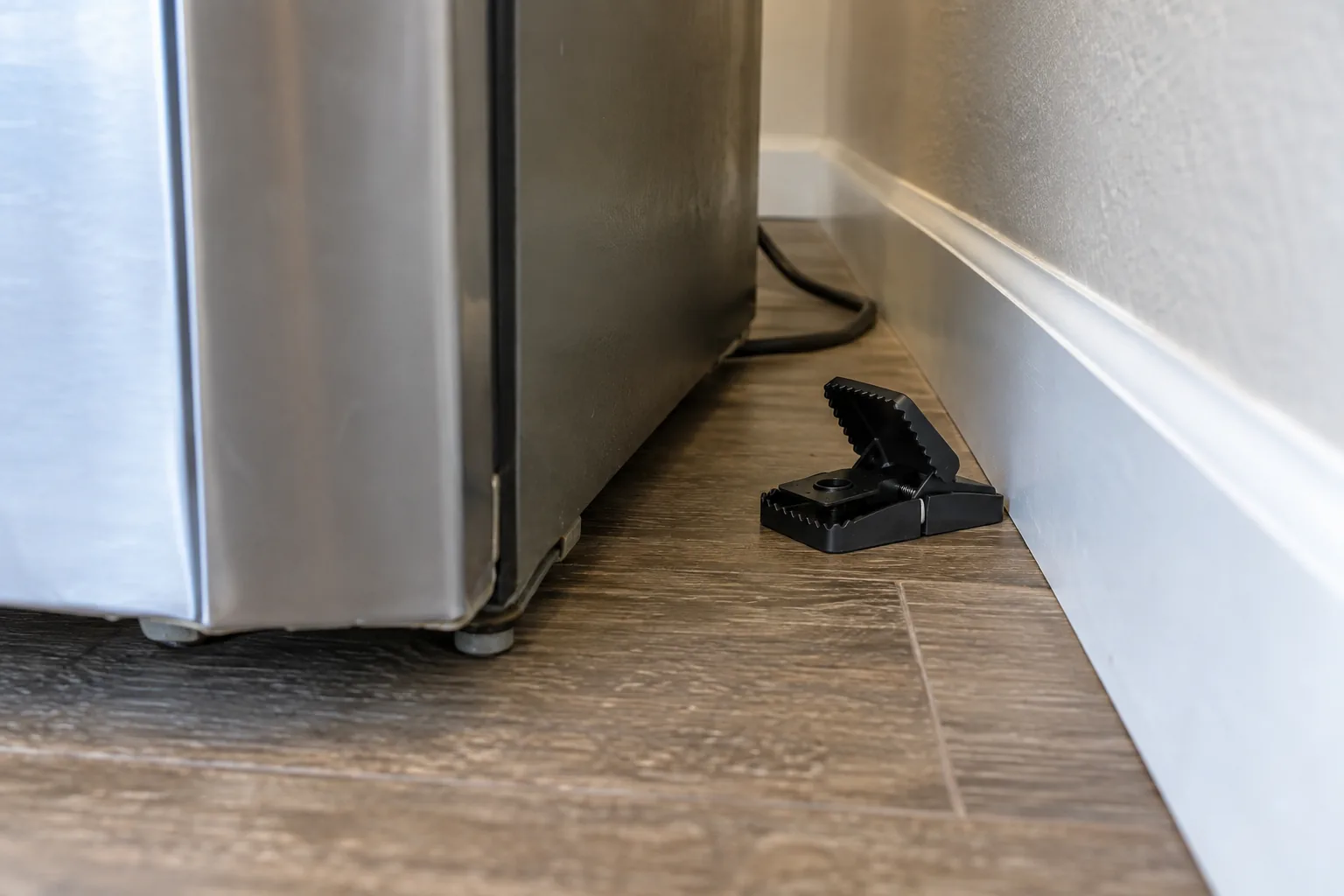
Behind or beside a refrigerator can be a strong route because the area may provide:
- cover
- warmth
- crumbs
- a water-line penetration
- wall-floor gaps
Place traps only in accessible areas outside the machinery.
Do not place traps:
- inside the compressor compartment
- beside moving fan parts
- against electrical connections
- where the power cord or water line can contact the mechanism
Do not move a heavy refrigerator alone if it cannot be moved safely.
See Mice Behind the Refrigerator: Why They Hide There.
Where to Put Mouse Traps Near a Stove or Dishwasher
Use accessible wall or cabinet routes.
Do not put traps:
- inside appliance machinery
- under powered moving components
- where heat or water can interfere
- where a trap cannot be retrieved
If the route disappears behind fixed equipment, use the nearest accessible wall edge instead.
Where to Place Mouse Traps in the Garage
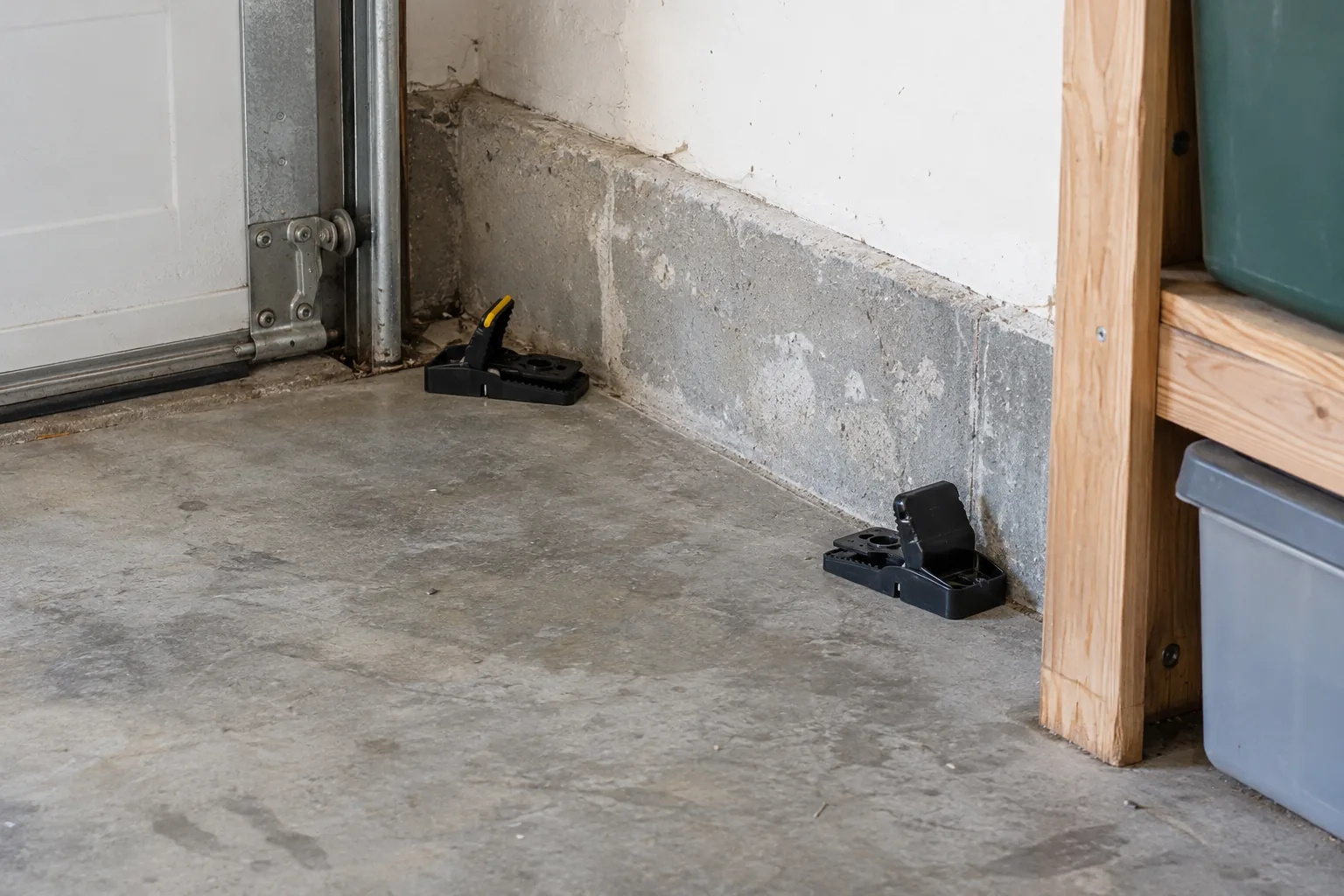
Garages often provide clear wall routes.
Focus on:
- lower wall edges
- garage-door corners
- storage edges
- utility penetrations
- shared walls with the house
Keep traps:
- outside vehicle tire paths
- away from garage-door moving hardware
- accessible for checking
- protected from children and pets
See Mice in the Garage: Entry Points, Nests & Control.
Where to Place Mouse Traps in the Basement
Basement wall edges and utility routes can be effective locations.
Good candidates include:
- foundation-wall edges
- storage edges
- pipe routes
- sill-area routes that are safely accessible
Keep traps:
- dry
- stable
- visible
- retrievable
Do not place them near:
- standing water
- energized electrical equipment
- gas equipment
- unsafe utility components
See Mice in the Basement: Why They’re There & What to Do.
Where to Put Mouse Traps in the Attic
Attic trapping can work when the activity is confirmed and the location is safe to reach.
Place traps on:
- stable structural surfaces
- accessible travel routes
- known wall or framing edges
Do not:
- bury traps in insulation
- balance traps on joists where they can fall
- place them near exposed wiring
- place them where they cannot be retrieved
- cross unsafe framing or unstable areas to check them
See Mice in the Attic: Signs, Damage & Removal.
Where to Put Mouse Traps in a Crawl Space
Only use traps where the crawl space can be accessed safely.
Do not enter a crawl space that is:
- wet
- unstable
- electrically hazardous
- heavily contaminated
- too tight for safe movement
Keep traps:
- on stable surfaces
- near confirmed routes
- accessible for checking
- away from standing water
See Mice in the Crawl Space: Signs & Removal.
Where to Put Mouse Traps Near a Ceiling Problem
If you hear or see evidence associated with a ceiling, do not put traps blindly inside an inaccessible ceiling void.
Instead, look for accessible connected routes such as:
- attic edges
- upper cabinets
- accessible wall-top routes
- utility paths
Do not cut drywall blindly just to place a trap.
See Mice in the Ceiling: Signs, Sounds & What to Do.
Where to Put Mouse Traps Near Air Vents
Do not put traps:
- inside active supply ducts
- inside return-air paths
- inside HVAC equipment
If mouse evidence appears near a vent, inspect:
- the wall edge
- duct perimeter
- nearby utility route
- accessible structural path
Place traps outside the airflow path.
See Mice in Air Vents: How They Get There & What to Do.
Where to Place Mouse Traps in an Apartment
Inside an apartment, focus on accessible routes such as:
- kitchen cabinet edges
- under sinks
- appliance edges
- baseboards
- utility penetrations
Keep traps safe around:
- children
- pets
- roommates
Apartment mouse activity may also involve:
- shared walls
- plumbing chases
- neighboring units
So trapping one unit may not fix the structural route.
See Mice in an Apartment: What Renters Should Do.
Where Not to Put Mouse Traps
Avoid placing traps:
- in the middle of open rooms without evidence
- inside HVAC ducts
- inside active appliance machinery
- inside electrical panels
- in drains
- in moving door hardware
- in inaccessible wall voids
- in ceiling voids you cannot reach
- under standing water
- on unstable insulation
- where children or pets can reach them
- where a trap cannot be retrieved
Every trap should be serviceable.
Keep Mouse Traps Stable
A mouse trap should sit flat.
Avoid surfaces that:
- rock
- flex
- vibrate
- tilt
- move with machinery
An unstable trap may:
- fire early
- shift away from the route
- allow bait theft
- become difficult to trigger correctly
Keep Mouse Traps Retrievable
Do not push a trap into a gap where you cannot get it back.
A trap should be placed where you can:
- inspect it
- reset it
- remove a catch
- clean around it
- reposition it
If the only route is inaccessible, professional inspection may be more appropriate.
How to Place Mouse Traps Around Children
Do not leave an exposed snap trap where a child can reach it.
Use:
- inaccessible cabinet locations
- locked or restricted areas
- protective enclosures where appropriate
Do not assume a trap under furniture is safe.
If you cannot create a safe placement, use another protected control method or professional help.
How to Place Mouse Traps Around Pets
Pets may:
- smell bait
- paw at the trap
- move it
- trigger it
Use:
- inaccessible routes
- protective tunnel/enclosure setups
- controlled rooms
Do not place exposed snap traps along normal pet travel paths.
Do Bait Choices Change Trap Placement?
Not much.
Bait can help encourage interaction, but the trap still needs to be on the route.
A trap with excellent bait in the wrong place will often perform worse than a lightly baited trap directly on an active wall edge.
See Mouse Bait: What Works & How to Use It Safely.
What If the Mouse Trap Is Being Ignored?
Reassess:
- route
- orientation
- food competition
- trap stability
- fresh evidence
Try moving the trap closer to:
- fresh droppings
- tracks
- gnawing
- wall edges
Do not keep adding random traps to clean areas.
What If Bait Is Stolen?
Possible reasons include:
- too much bait
- poor trigger placement
- poor orientation
- unstable trap
- mouse approaching from the wrong angle
Use:
- a smaller amount of bait
- a sticky bait
- better wall alignment
- a protected trap enclosure if needed
See Snap Traps for Mice: How to Use Them Correctly.
What If the Trap Keeps Firing Empty?
Check:
- stability
- trigger setup
- placement
- vibration
- contact with nearby objects
Move the trap if:
- a door hits it
- an appliance vibrates it
- stored items bump it
Do not place traps on unstable machinery or flexible surfaces.
How Often Should You Check Mouse Traps?
Check active traps regularly.
A practical routine is at least daily for indoor traps.
More frequent checks may make sense in:
- kitchens
- occupied living areas
- homes with children or pets
Regular checking helps you:
- remove catches promptly
- reset traps
- replace stolen bait
- adjust placement
Should You Move Traps That Catch Nothing?
Yes, if fresh evidence suggests the route is somewhere else.
Do not move a trap just because it was quiet for one night.
Instead, compare:
- fresh droppings
- tracks
- sightings
- food damage
- gnawing
If the evidence shifts, move the trap with it.
Should You Leave Successful Trap Locations in Place?
If a trap catches a mouse on a confirmed route, keeping a trap on that route can make sense while activity continues.
But do not use one catch to estimate how many mice remain.
Keep monitoring the broader area.
See How Many Mice Are in Your House?.
Do Mouse Traps Need to Be Near Entry Points?
Sometimes, but not always.
A trap near a confirmed entry route can be useful.
However, the best indoor trap location may be where:
- mice emerge from a wall
- they move toward food
- several routes converge
Do not place a trap inside a utility opening or inaccessible cavity.
See Mouse Entry Points: Where to Inspect Your Home.
Trapping Does Not Replace Exclusion
Even perfect trap placement will not stop new mice from entering through:
- foundation gaps
- garage-door openings
- utility penetrations
- vent defects
Once active mice are being controlled, complete durable exclusion.
See How to Keep Mice Out of Your House and Mouse-Proofing a House: Complete Checklist.
Remove Competing Food
Trap placement works better when easy food is controlled.
Secure:
- cereal
- flour
- rice
- pasta
- pet food
- bird seed
Clean:
- crumbs
- grease
- spills
- damaged food packages
Sanitation supports trapping.
It does not replace exclusion.
Clean Fresh Mouse Waste Safely
If traps are placed near droppings:
- wear suitable gloves
- avoid dry sweeping or vacuuming fresh waste
- wet contaminated hard surfaces with an appropriate disinfecting solution
- allow the product’s required contact time
- collect waste carefully
- wash hands after removing gloves
See the cleanup section and rodent safety section.
When to Call a Professional
Professional help may make sense when:
- you cannot identify the active route
- traps remain untouched despite fresh signs
- mice are active in inaccessible walls or ceilings
- safe trap placement is difficult around children or pets
- attic or crawl-space access is unsafe
- several rooms show fresh activity
- electrical wiring is damaged
- contamination is extensive
A pest-control professional can help combine:
- inspection
- placement
- trapping
- monitoring
- exclusion
See Mouse Exterminator: What to Expect & When to Call One.
Where to Place Mouse Traps: The Bottom Line
For the best results, put mouse traps where mice already travel.
Prioritize:
- wall edges
- baseboards
- cabinet edges
- appliance edges
- corners
- utility routes
- garage walls
- basement perimeter routes
- safe attic or crawl-space routes
Use fresh:
- droppings
- tracks
- gnawing
- sightings
to refine placement.
For traditional snap traps, a common starting position is perpendicular to the wall with the trigger or bait end close to the wall.
But route coverage matters more than one universal orientation or spacing rule.
Keep every trap:
- stable
- retrievable
- accessible for checking
- protected from children and pets
If traps are not catching mice, reassess placement before buying more traps or changing bait repeatedly.
Continue with our mouse traps guide, snap traps for mice guide, mouse bait guide, signs of mice guide, mouse entry points guide, or how to get rid of mice.
For the broader overview, return to [Rats & Mice in the Home](/).